November 21, 2025


The Australian Dollar (AUD) advances against the US Dollar (USD) on Friday after two days of losses. The AUD/USD pair gains ground following the preliminary reading of Australia’s S&P Global Purchasing Managers Index (PMI).
S&P Global Manufacturing PMI came in at 51.6 in November versus 49.7 prior. Meanwhile, Services PMI rose to 52.7 in November from the previous reading of 52.5, while the Composite PMI increased to 52.6 in November versus 52.1 prior.
The AUD finds support as expectations grow for a cautious stance from the Reserve Bank of Australia (RBA). Minutes from the RBA’s November meeting indicated the central bank may keep rates unchanged for an extended period if economic data continues to outperform.
RBA Assistant Governor Sarah Hunter said on Thursday that “sustained above-trend growth could fuel inflationary pressures.” Hunter noted that monthly inflation data can be volatile and that the central bank won’t react to a single month of figures.
ASX 30-Day Interbank Cash Rate Futures show that as of November 18, the December 2025 contract traded at 96.41, implying an 8% probability of a rate cut to 3.35% from 3.60% at the upcoming RBA Board meeting.
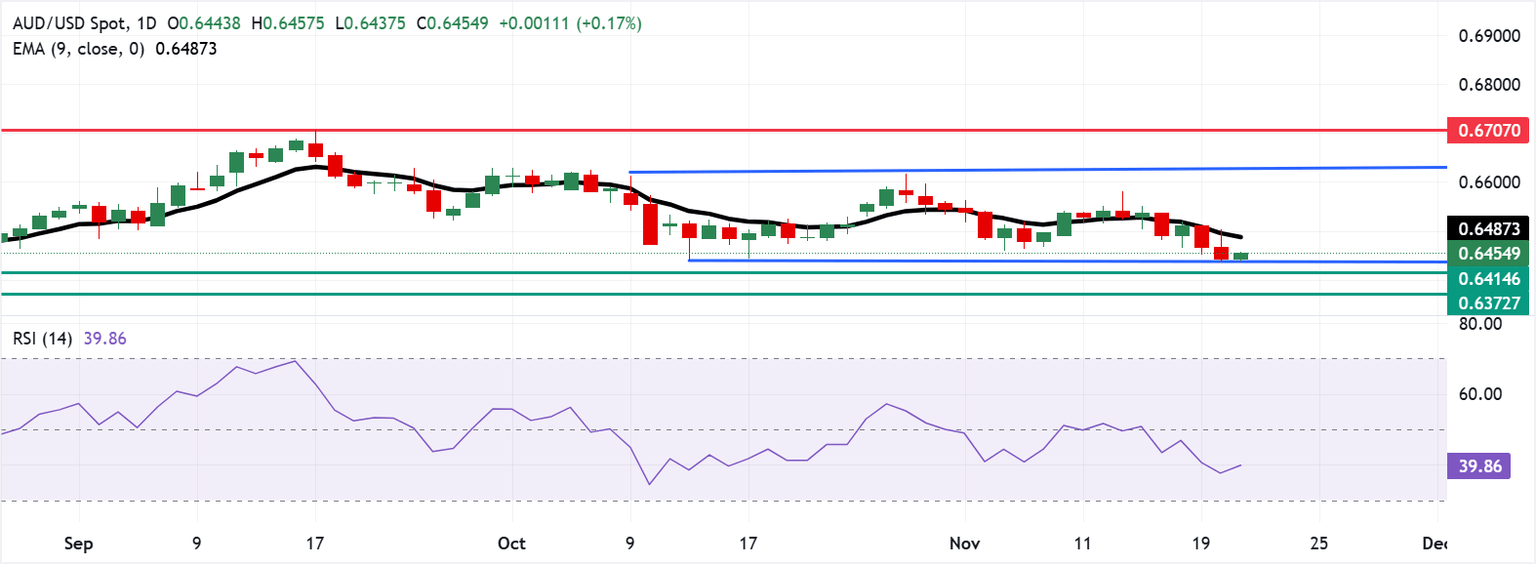
The AUD/USD pair is trading around 0.6450 on Thursday. The daily chart analysis indicates that the pair is moving sideways within a rectangular range, signalling a period of price consolidation. Meanwhile, the price remains below the nine-day Exponential Moving Average (EMA), highlighting that the short-term price momentum is weaker.
On the downside, the AUD/USD pair finds immediate support at the lower boundary of the rectangle around 0.6440, followed by the five-month low of 0.6414, which was recorded on August 21.
The initial barrier lies at the nine-day EMA of 0.6487, followed by the psychological level of 0.6500. A break above this confluence resistance zone would improve the short-term price momentum and lead the pair to reach the rectangle’s upper boundary near 0.6630.
The table below shows the percentage change of Australian Dollar (AUD) against listed major currencies today. Australian Dollar was the strongest against the US Dollar.
| USD | EUR | GBP | JPY | CAD | AUD | NZD | CHF | |
|---|---|---|---|---|---|---|---|---|
| USD | -0.09% | -0.09% | -0.11% | -0.07% | -0.07% | -0.07% | -0.18% | |
| EUR | 0.09% | -0.00% | -0.04% | 0.02% | 0.01% | 0.01% | -0.09% | |
| GBP | 0.09% | 0.00% | -0.04% | 0.02% | 0.02% | 0.02% | -0.09% | |
| JPY | 0.11% | 0.04% | 0.04% | 0.07% | 0.06% | 0.05% | -0.05% | |
| CAD | 0.07% | -0.02% | -0.02% | -0.07% | -0.01% | -0.02% | -0.12% | |
| AUD | 0.07% | -0.01% | -0.02% | -0.06% | 0.01% | -0.00% | -0.11% | |
| NZD | 0.07% | -0.01% | -0.02% | -0.05% | 0.02% | 0.00% | -0.11% | |
| CHF | 0.18% | 0.09% | 0.09% | 0.05% | 0.12% | 0.11% | 0.11% |
The heat map shows percentage changes of major currencies against each other. The base currency is picked from the left column, while the quote currency is picked from the top row. For example, if you pick the Australian Dollar from the left column and move along the horizontal line to the US Dollar, the percentage change displayed in the box will represent AUD (base)/USD (quote).

Leave A Comment