January 12, 2026


The Australian Dollar (AUD) rises against the US Dollar (USD) on Monday, following three days of losses. The AUD/USD pair advances as the Greenback weakens, potentially amid concerns surrounding the Federal Reserve.
Federal prosecutors have opened a criminal investigation into Fed Chair Jerome Powell regarding the central bank’s renovation of its Washington headquarters and whether Powell lied to Congress about the project’s scope, the New York Times reported on Sunday.
ANZ Job Advertisements declined 0.5% in December, following an upwardly revised 1.5% drop in the prior month. Meanwhile, household spending increased 1.0% month-on-month in November 2025, easing from a revised 1.4% rise in October, as consumers remained cautious amid elevated interest rates and persistent inflation.
Australia’s mixed November Consumer Price Index (CPI) left the Reserve Bank of Australia’s (RBA) policy outlook uncertain. However, RBA Deputy Governor Andrew Hauser said that the November inflation data was largely as expected. Hauser added that interest rate cuts are unlikely anytime soon. Focus now shifts to the quarterly CPI report due later this month for clearer guidance on the RBA’s next policy move.
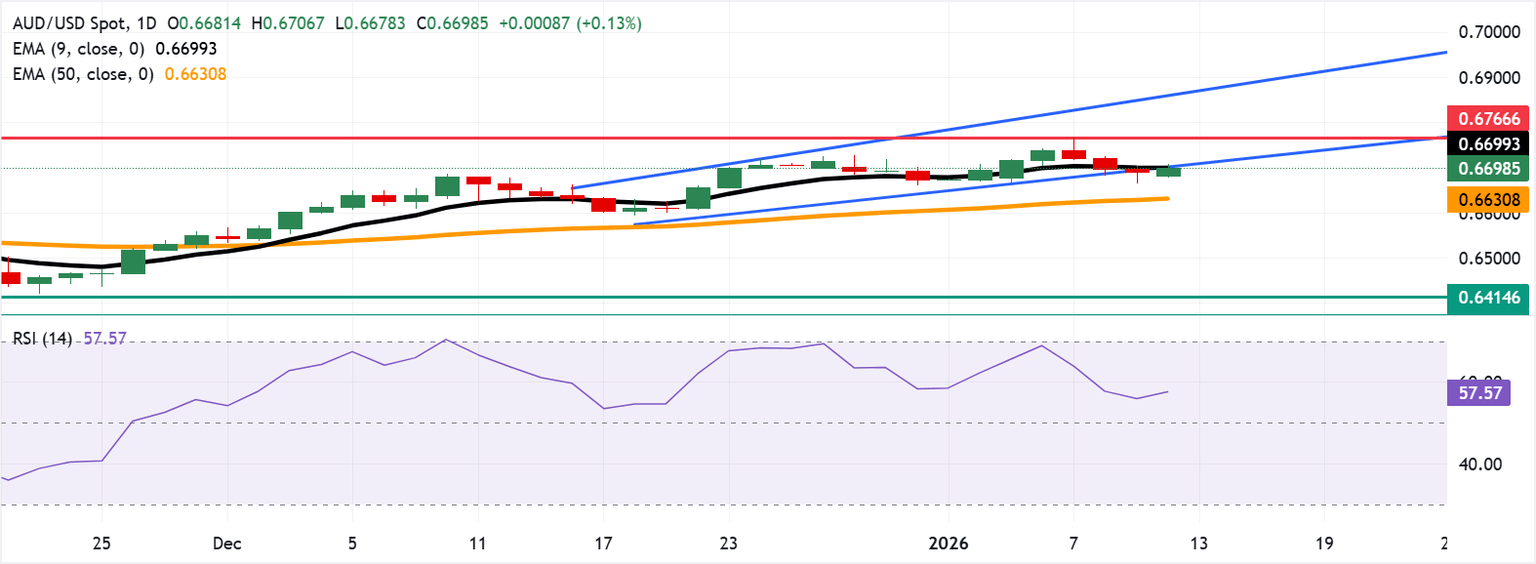
AUD/USD is trading around 0.6700 on Monday. Daily chart analysis shows the pair attempting a rebound toward an ascending channel, signaling a renewed bullish bias. The 14-day Relative Strength Index (RSI) at 58.33 remains above the midpoint, supporting upside momentum.
A sustained move back inside the channel would strengthen the bullish bias and support AUD/USD toward 0.6766, its highest level since October 2024. Further gains could see the pair test the upper boundary of the ascending channel near 0.6860.
The immediate support lies at the nine-day Exponential Moving Average (EMA) of 0.6700, followed by the 50-day EMA at 0.6631. Further losses would open the downside toward 0.6414, the lowest since June 2025.
The table below shows the percentage change of Australian Dollar (AUD) against listed major currencies today. Australian Dollar was the strongest against the Japanese Yen.
| USD | EUR | GBP | JPY | CAD | AUD | NZD | CHF | |
|---|---|---|---|---|---|---|---|---|
| USD | -0.29% | -0.21% | 0.09% | -0.15% | -0.10% | -0.24% | -0.35% | |
| EUR | 0.29% | 0.09% | 0.37% | 0.13% | 0.19% | 0.06% | -0.05% | |
| GBP | 0.21% | -0.09% | 0.30% | 0.04% | 0.11% | -0.03% | -0.14% | |
| JPY | -0.09% | -0.37% | -0.30% | -0.25% | -0.20% | -0.33% | -0.44% | |
| CAD | 0.15% | -0.13% | -0.04% | 0.25% | 0.05% | -0.08% | -0.19% | |
| AUD | 0.10% | -0.19% | -0.11% | 0.20% | -0.05% | -0.14% | -0.25% | |
| NZD | 0.24% | -0.06% | 0.03% | 0.33% | 0.08% | 0.14% | -0.11% | |
| CHF | 0.35% | 0.05% | 0.14% | 0.44% | 0.19% | 0.25% | 0.11% |
The heat map shows percentage changes of major currencies against each other. The base currency is picked from the left column, while the quote currency is picked from the top row. For example, if you pick the Australian Dollar from the left column and move along the horizontal line to the US Dollar, the percentage change displayed in the box will represent AUD (base)/USD (quote).

Leave A Comment