February 2, 2026


The Indian Rupee (INR) gains against the US Dollar (USD) in the opening session on Monday, following the fiscal budget Financial Year (FY) 2026-27 announcement by the Indian government on Sunday. The USD/INR pair declines to near 91.85 as the Reserve Bank of India (RBI) has intervened in the spot and Non-Deliverable Forward (NDF) markets to provide a cushion to the Indian Rupee near its lifetime lows against the US Dollar.
According to a report from Reuters, traders say that the Indian central bank likely intervened before the local spot market opened on Monday to help the currency stave off a fall to near record low levels.
Meanwhile, Indian stock markets trade slightly higher after a subdued opening on Monday, striving to regain ground after crashing the previous day. Indian bourses fell like a house of cards on Sunday after the annual budget announcement in which the government surprisingly raised Securities Transaction Tax (STT) on trading in the Futures and Options (F&O) segment in the derivative market to extend its grip on curbing speculative activities.
Other major highlights of the fiscal budget were 22% increase in the defence budget to modernize defence equipment, 9% rise in capital expenditure to ₹12.2 lakh crore, tax holidays for global companies to produce data centers in India till 2047, an increase in outlay of Rs. 40,000 Crore to boost the manufacturing of electronic components, and the launch of the Semiconductor Mission 2.0.
Going forward, the major trigger for the Indian Rupee will be the monetary policy announcement by the RBI on Friday. In the December policy meeting, the Indian central bank slashed the Repo Rate by 25 basis points (bps) to 5.25%, and announced a fresh liquidity infusion of ₹1.5 lakh crore to boost credit flow.
The table below shows the percentage change of Indian Rupee (INR) against listed major currencies today. Indian Rupee was the strongest against the Australian Dollar.
| USD | EUR | GBP | JPY | CAD | AUD | INR | CHF | |
|---|---|---|---|---|---|---|---|---|
| USD | -0.05% | 0.00% | -0.06% | 0.27% | 0.47% | -0.20% | -0.07% | |
| EUR | 0.05% | 0.06% | -0.02% | 0.33% | 0.52% | -0.12% | -0.02% | |
| GBP | -0.01% | -0.06% | -0.06% | 0.27% | 0.46% | -0.21% | -0.07% | |
| JPY | 0.06% | 0.02% | 0.06% | 0.34% | 0.53% | -0.10% | -0.01% | |
| CAD | -0.27% | -0.33% | -0.27% | -0.34% | 0.19% | -0.47% | -0.35% | |
| AUD | -0.47% | -0.52% | -0.46% | -0.53% | -0.19% | -0.66% | -0.54% | |
| INR | 0.20% | 0.12% | 0.21% | 0.10% | 0.47% | 0.66% | 0.10% | |
| CHF | 0.07% | 0.02% | 0.07% | 0.00% | 0.35% | 0.54% | -0.10% |
The heat map shows percentage changes of major currencies against each other. The base currency is picked from the left column, while the quote currency is picked from the top row. For example, if you pick the Indian Rupee from the left column and move along the horizontal line to the US Dollar, the percentage change displayed in the box will represent INR (base)/USD (quote).
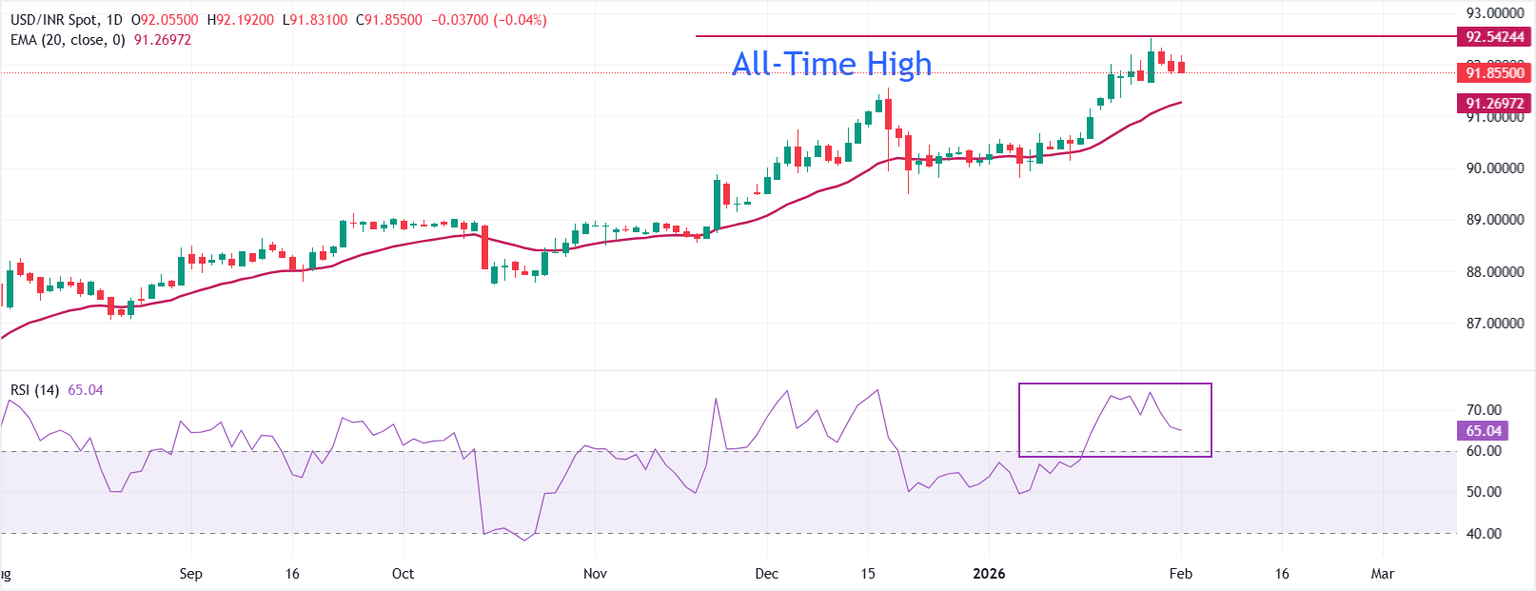
USD/INR trades lower at around 91.8550 at the time of writing. The pair holds firm above the rising 20-day EMA at 91.2697, keeping the short-term uptrend intact. The average continues to ascend, pointing to sustained buying pressure and favoring dips to be bought.
RSI at 65 (positive) has cooled from recent overbought readings, yet remains above the midline to validate bullish momentum. Continuation could see the advance extend, while pullbacks would find initial support at the rising average. A daily close beneath it would open room for a deeper correction.

Leave A Comment