January 9, 2026


The Australian Dollar (AUD) declines against the US Dollar (USD) on Friday, remaining subdued for the third successive session. The AUD/USD pair remains subdued following the release of key economic data from China, a key trading partner of Australia.
China’s Consumer Price Index (CPI) rose 0.8% year-over-year (YoY) in December, up from 0.7% in November but below the 0.9% forecast. On a monthly basis, CPI increased 0.2%, reversing November’s -0.1% reading. Meanwhile, China’s Producer Price Index (PPI) fell 1.9% YoY in December, improving from a 2.2% decline previously and slightly beating expectations of a -2.0% print.
The Australian Bureau of Statistics (ABS) reported on Thursday that Australia’s Trade Surplus narrowed to 2,936M MoM in November, versus 4,353M (revised from 4,385M) in the previous reading. Exports fell by 2.9% MoM in November from a rise of 2.8% (revised from 3.4%) seen a month earlier. Meanwhile, Imports grew by 0.2% MoM in November, compared to a rise of 2.4% (revised from 2.0%) seen in October.
Australia’s mixed November Consumer Price Index (CPI) left the Reserve Bank of Australia’s (RBA) policy outlook uncertain. Focus now shifts to the quarterly CPI report due later this month for clearer guidance on the RBA’s next policy move. However, RBA Deputy Governor Andrew Hauser said on Thursday that the November inflation data was largely as expected. Hauser added that interest rate cuts are unlikely anytime soon.
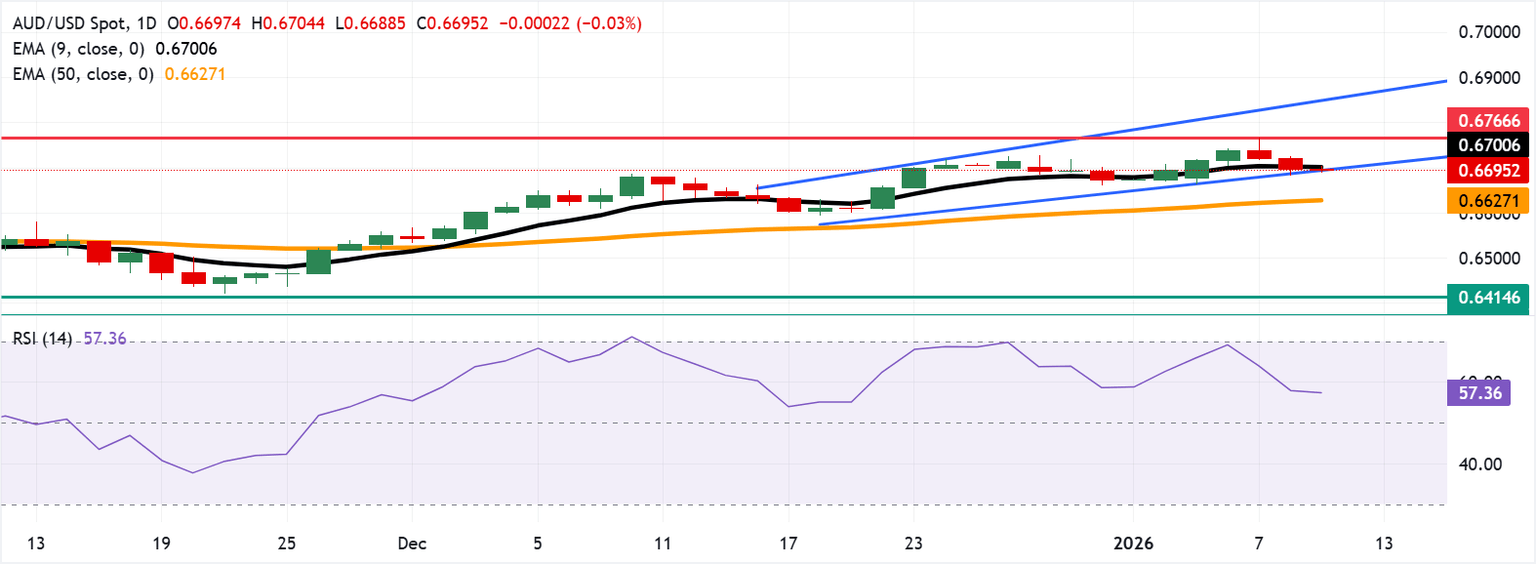
AUD/USD is trading around 0.6690 on Friday. Technical analysis of the daily chart indicates that the pair is testing the lower boundary of the ascending channel pattern, suggesting a potential for a weakening of a bullish bias. The 14-day Relative Strength Index (RSI) at 56.8 stays above the midline but has eased from recent peaks, indicating slower bullish impetus.
The immediate resistance lies at the nine-day Exponential Moving Average (EMA) of 0.6700. A break above the short-term average would reinforce the bullish momentum, and the AUD/USD pair may rebound toward the target 0.6766, the highest level since October 2024, followed by the upper boundary of the ascending channel near 0.6850.
On the downside, the break below the lower ascending channel boundary would lead the AUD/USD pair to test the 50-day EMA at 0.6628. Further losses would open the downside toward 0.6414, the lowest since June 2025.
The table below shows the percentage change of Australian Dollar (AUD) against listed major currencies today. Australian Dollar was the weakest against the US Dollar.
| USD | EUR | GBP | JPY | CAD | AUD | NZD | CHF | |
|---|---|---|---|---|---|---|---|---|
| USD | 0.02% | 0.05% | 0.28% | 0.05% | 0.07% | 0.17% | 0.03% | |
| EUR | -0.02% | 0.03% | 0.28% | 0.03% | 0.05% | 0.15% | 0.00% | |
| GBP | -0.05% | -0.03% | 0.23% | 0.00% | 0.02% | 0.12% | -0.03% | |
| JPY | -0.28% | -0.28% | -0.23% | -0.22% | -0.21% | -0.12% | -0.26% | |
| CAD | -0.05% | -0.03% | -0.00% | 0.22% | 0.01% | 0.10% | -0.03% | |
| AUD | -0.07% | -0.05% | -0.02% | 0.21% | -0.01% | 0.10% | -0.04% | |
| NZD | -0.17% | -0.15% | -0.12% | 0.12% | -0.10% | -0.10% | -0.14% | |
| CHF | -0.03% | -0.01% | 0.03% | 0.26% | 0.03% | 0.04% | 0.14% |
The heat map shows percentage changes of major currencies against each other. The base currency is picked from the left column, while the quote currency is picked from the top row. For example, if you pick the Australian Dollar from the left column and move along the horizontal line to the US Dollar, the percentage change displayed in the box will represent AUD (base)/USD (quote).

Leave A Comment