December 18, 2025


The Australian Dollar (AUD) loses ground against the US Dollar (USD) on Thursday for the sixth successive day. The AUD/USD pair may gain ground as the Aussie Dollar could receive support from investors’ caution following the release of Australia’s Consumer Inflation Expectations, which rose to 4.7% in December from November’s three-month low of 4.5%, supporting the Reserve Bank of Australia’s (RBA) hawkish stance.
The AUD could find support as markets grow increasingly expectant of an RBA rate hike as early as February. Commonwealth Bank of Australia and National Australia Bank now expect the RBA to start tightening sooner than previously projected, pointing to stubborn inflation in a capacity-constrained economy. Their forecasts followed the central bank’s hawkish hold on rates at its final 2025 meeting last week. Swaps price in a 28% chance of a February hike, nearly 41% in March, with August almost fully priced.
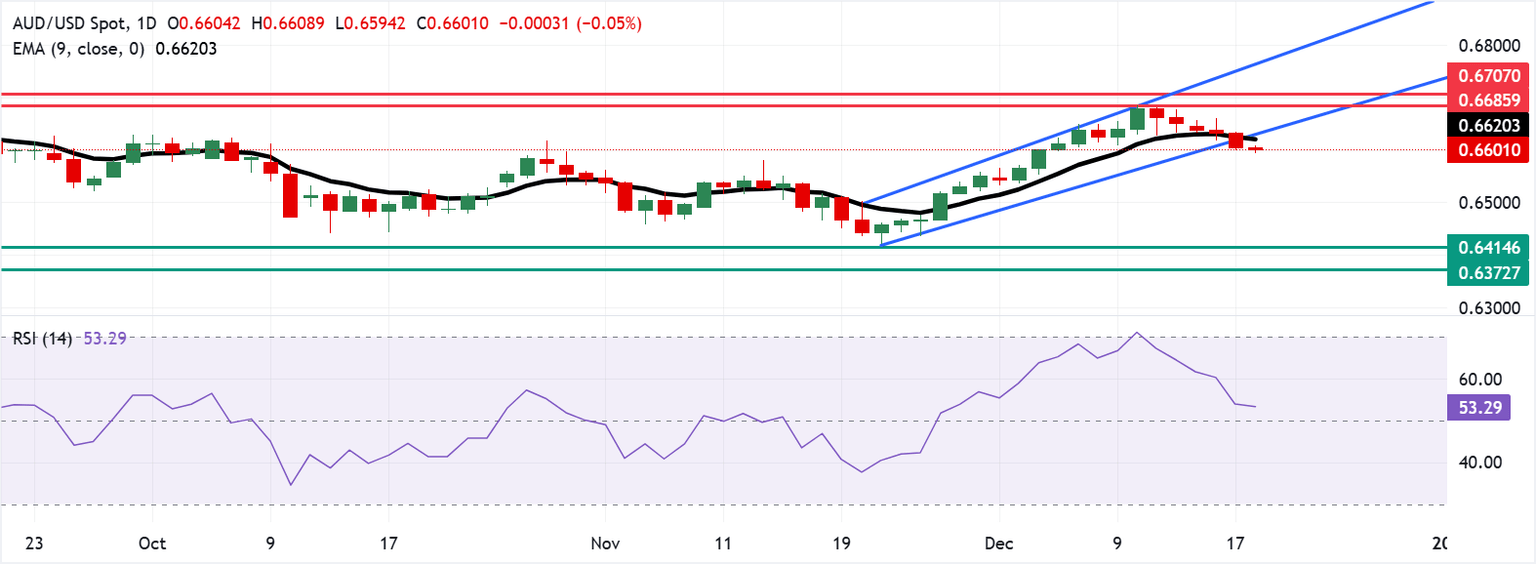
The AUD/USD pair is trading below 0.6600 on Thursday. The technical analysis of the daily chart shows the pair is positioned below the ascending channel trend, reflecting a weakening of a bullish bias. Additionally, the pair is trading below the nine-day Exponential Moving Average (EMA), indicating a weaker short-term price momentum.
The AUD/USD pair could fall toward the psychological level of 0.6500, followed by the six-month low of 0.6414, recorded on August 21.
On the upside, the AUD/USD pair may test the nine-day EMA at 0.6619. A rebound toward the ascending channel would revive the bullish bias and support the pair to test the three-month high of 0.6685, followed by 0.6707, the highest since October 2024. Further advances would support the pair to test the upper ascending channel boundary around 0.6760.
The table below shows the percentage change of Australian Dollar (AUD) against listed major currencies today. Australian Dollar was the weakest against the Swiss Franc.
| USD | EUR | GBP | JPY | CAD | AUD | NZD | CHF | |
|---|---|---|---|---|---|---|---|---|
| USD | -0.04% | 0.06% | 0.03% | -0.03% | -0.00% | 0.21% | -0.06% | |
| EUR | 0.04% | 0.08% | 0.05% | 0.00% | 0.03% | 0.25% | -0.02% | |
| GBP | -0.06% | -0.08% | -0.02% | -0.09% | -0.06% | 0.16% | -0.12% | |
| JPY | -0.03% | -0.05% | 0.02% | -0.05% | -0.03% | 0.16% | -0.09% | |
| CAD | 0.03% | -0.00% | 0.09% | 0.05% | 0.04% | 0.23% | -0.03% | |
| AUD | 0.00% | -0.03% | 0.06% | 0.03% | -0.04% | 0.22% | -0.06% | |
| NZD | -0.21% | -0.25% | -0.16% | -0.16% | -0.23% | -0.22% | -0.28% | |
| CHF | 0.06% | 0.02% | 0.12% | 0.09% | 0.03% | 0.06% | 0.28% |
The heat map shows percentage changes of major currencies against each other. The base currency is picked from the left column, while the quote currency is picked from the top row. For example, if you pick the Australian Dollar from the left column and move along the horizontal line to the US Dollar, the percentage change displayed in the box will represent AUD (base)/USD (quote).

Leave A Comment