January 21, 2026


The Australian Dollar struggles against the US Dollar (USD) on Wednesday despite rising United States (US)–Greenland concerns.
The Westpac–Melbourne Institute Leading Economic Index for Australia rose 0.1% month-on-month (MoM) in December 2025, after remaining unchanged in the prior month. At the same time, the six-month annualized growth rate increased to 0.42% from 0.20% in November, indicating that the economic recovery through 2025 is extending into early 2026.
The AUD also finds support as emerging upward price pressures strengthen expectations of tighter monetary policy from the Reserve Bank of Australia (RBA). The International Monetary Fund (IMF) has urged the RBA to remain cautious, highlighting that inflation has stayed above the Bank’s 2%–3% target band for a prolonged period, even though headline CPI eased more quickly than anticipated in November.
The People’s Bank of China (PBOC), China’s central bank, announced on Tuesday that it would leave its Loan Prime Rates (LPRs) unchanged. The one-year and five-year LPRs were at 3.00% and 3.50%, respectively. It is essential to note that any changes in the Chinese economy could impact the Australian Dollar, as both countries are close trading partners.
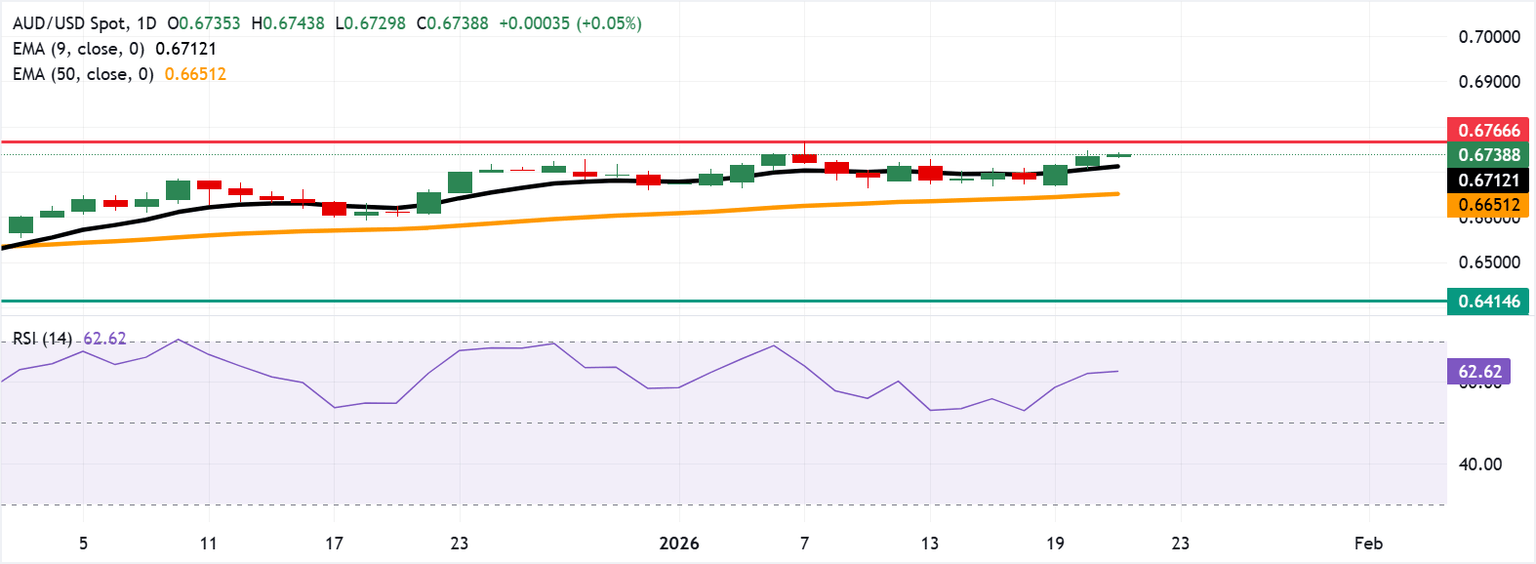
The AUD/USD pair is trading around 0.6740 on Wednesday. Daily chart analysis indicates that the pair is rising above the nine-day Exponential Moving Average (EMA), pointing to a bullish bias for the short term. Meanwhile, the 14-day Relative Strength Index (RSI), at 62.90, is reinforcing underlying upside momentum.
On the upside, the AUD/USD pair could target the 15-month high of 0.6766. The immediate support lies at the nine-day EMA of 0.6712. A daily close below the short-term average may bring the 50-day EMA at 0.6651 into focus as initial support. Deeper losses could then extend toward 0.6414, the lowest level since June 2025.
The table below shows the percentage change of Australian Dollar (AUD) against listed major currencies today. Australian Dollar was the weakest against the New Zealand Dollar.
| USD | EUR | GBP | JPY | CAD | AUD | NZD | CHF | |
|---|---|---|---|---|---|---|---|---|
| USD | -0.00% | -0.03% | -0.03% | 0.03% | 0.00% | -0.09% | 0.06% | |
| EUR | 0.00% | -0.03% | -0.02% | 0.02% | 0.00% | -0.09% | 0.06% | |
| GBP | 0.03% | 0.03% | 0.00% | 0.05% | 0.01% | -0.07% | 0.08% | |
| JPY | 0.03% | 0.02% | 0.00% | 0.03% | 0.02% | -0.09% | 0.07% | |
| CAD | -0.03% | -0.02% | -0.05% | -0.03% | -0.01% | -0.12% | 0.04% | |
| AUD | -0.01% | -0.01% | -0.01% | -0.02% | 0.01% | -0.10% | 0.05% | |
| NZD | 0.09% | 0.09% | 0.07% | 0.09% | 0.12% | 0.10% | 0.15% | |
| CHF | -0.06% | -0.06% | -0.08% | -0.07% | -0.04% | -0.05% | -0.15% |
The heat map shows percentage changes of major currencies against each other. The base currency is picked from the left column, while the quote currency is picked from the top row. For example, if you pick the Australian Dollar from the left column and move along the horizontal line to the US Dollar, the percentage change displayed in the box will represent AUD (base)/USD (quote).

Leave A Comment