December 23, 2025


The Australian Dollar (AUD) gains ground against the US Dollar (USD) on Tuesday, following the release of the Reserve Bank of Australia (RBA) Minutes of its December monetary policy meeting. Additionally, the AUD/USD pair appreciated as the US Dollar (USD) faced challenges amid growing expectations that the Federal Reserve will continue easing policy, reinforced by President Donald Trump’s calls for lower borrowing costs.
The RBA Meeting Minutes showed that board members signalled growing less confident that monetary policy remains restrictive, as evidence mounts that inflation pressures may prove more persistent than previously expected.
Policymakers also indicated that they would assess policy at future meetings, noting that G4 inflation data had been released ahead of the February meeting. They discussed whether a rate increase might be needed at some point in 2026 and felt that it would take a little longer to assess the persistence of inflation.
The ASX 30-Day Interbank Cash Rate Futures February 2026 contract was trading at 96.34 as of December 18, implying a 27% probability of a rate increase to 3.85% at the next RBA Board meeting.
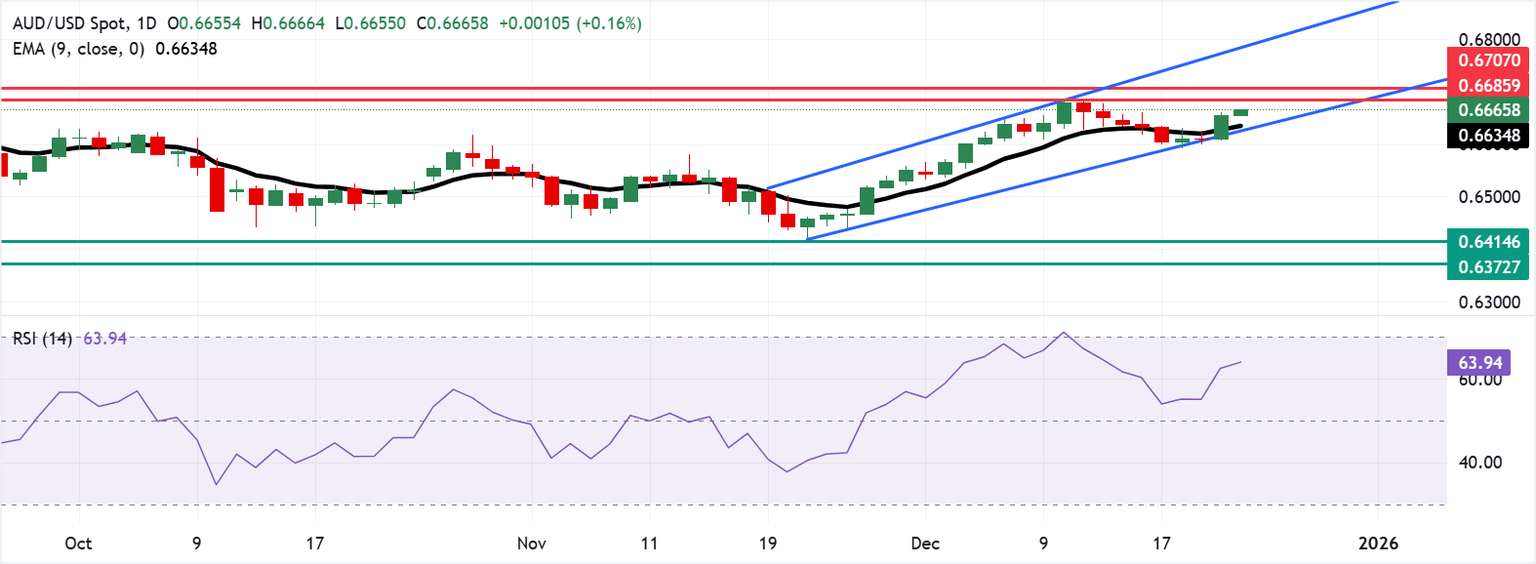
The AUD/USD pair is trading below 0.6660 on Tuesday. The technical analysis of the daily chart shows the pair is rising above the lower ascending channel boundary, indicating the strengthening of a bullish bias. The 14-day Relative Strength Index (RSI) stands at 63.34, reflecting bullish conditions and building momentum.
A successful break above the nine-day Exponential Moving Average (EMA) has improved the short-term price momentum and led the AUD/USD pair to target the three-month high at 0.6685 and then 0.6707, the highest since October 2024.
On the downside, the immediate support lies at 0.6633, aligned with the lower ascending channel boundary around 0.6630. A break below the channel would expose the six-month low near 0.6414, marked on August 21.
The table below shows the percentage change of Australian Dollar (AUD) against listed major currencies today. Australian Dollar was the strongest against the US Dollar.
| USD | EUR | GBP | JPY | CAD | AUD | NZD | CHF | |
|---|---|---|---|---|---|---|---|---|
| USD | -0.19% | -0.23% | -0.58% | -0.14% | -0.21% | -0.37% | -0.33% | |
| EUR | 0.19% | -0.04% | -0.39% | 0.06% | -0.03% | -0.18% | -0.14% | |
| GBP | 0.23% | 0.04% | -0.36% | 0.09% | 0.01% | -0.14% | -0.10% | |
| JPY | 0.58% | 0.39% | 0.36% | 0.44% | 0.39% | 0.19% | 0.27% | |
| CAD | 0.14% | -0.06% | -0.09% | -0.44% | -0.06% | -0.24% | -0.17% | |
| AUD | 0.21% | 0.03% | -0.01% | -0.39% | 0.06% | -0.15% | -0.11% | |
| NZD | 0.37% | 0.18% | 0.14% | -0.19% | 0.24% | 0.15% | 0.04% | |
| CHF | 0.33% | 0.14% | 0.10% | -0.27% | 0.17% | 0.11% | -0.04% |
The heat map shows percentage changes of major currencies against each other. The base currency is picked from the left column, while the quote currency is picked from the top row. For example, if you pick the Australian Dollar from the left column and move along the horizontal line to the US Dollar, the percentage change displayed in the box will represent AUD (base)/USD (quote).

Leave A Comment