November 27, 2025


The Australian Dollar (AUD) gains against the US Dollar (USD) on Thursday, extending its gains for the fifth successive session. The AUD/USD pair gains ground as the US Dollar (USD) struggles amid rising odds of Federal Reserve (Fed) rate cut bets in December.
The Australian Bureau of Statistics (ABS) released Private Capital Expenditure on Thursday, which rose by 6.4% quarter-over-quarter in the third quarter, accelerating from a 0.2% gain in Q2 and surpassing the 0.5% expected. On Wednesday, ABS reported the first “complete” monthly Consumer Price Index (CPI), which climbed by 3.8% year-over-year (YoY) in October. The reading surpassed the market consensus of a 3.6% rise and a 3.5% increase prior.
The AUD gained ground after the first monthly CPI boosted the cautious sentiment surrounding the Reserve Bank of Australia (RBA) policy outlook. The RBA is expected to maintain the Official Cash Rate (OCR) at 3.6% in December as inflation remains above RBA’s 2–3% target range. RBA officials noted that the unemployment rate has risen slightly, but the job market remains healthy and is expected to continue doing so.
The ASX 30-Day Interbank Cash Rate Futures showed, as of November 26, the December 2025 contract trading at 96.41, implying a 6% chance that the RBA will cut the cash rate to 3.35% from 3.60% at its upcoming Board meeting.
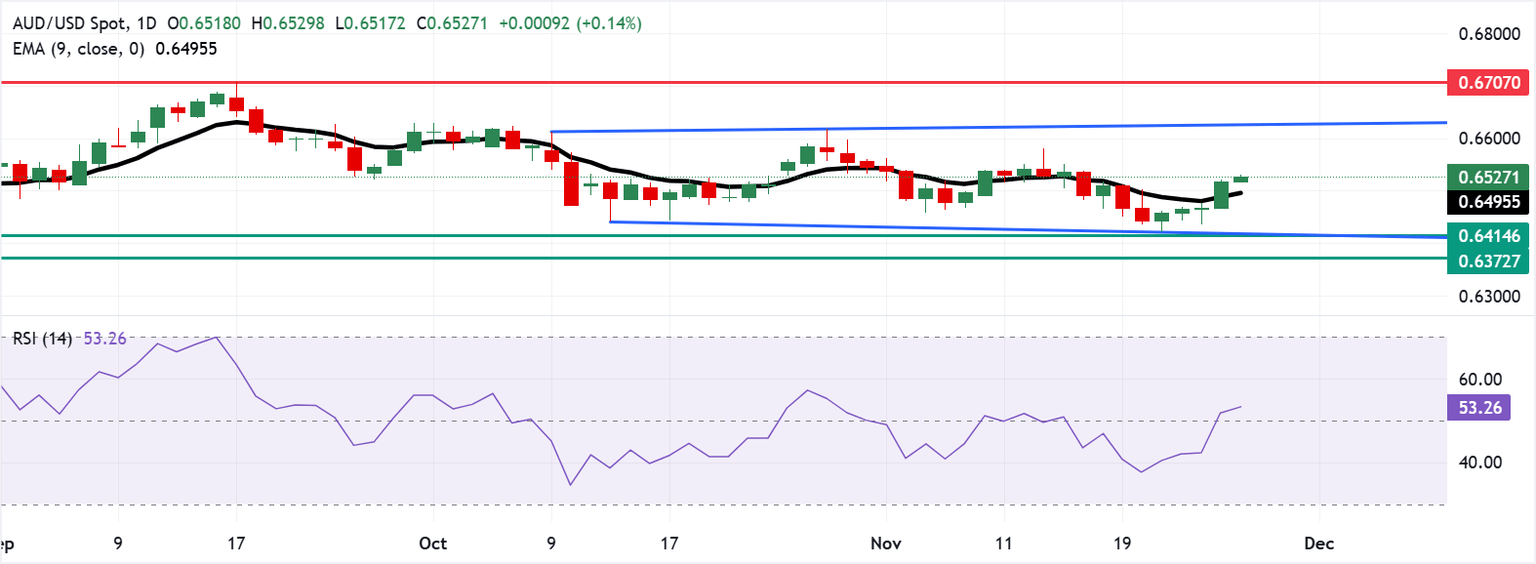
The AUD/USD pair is trading around 0.6530 on Thursday. The daily chart analysis shows the pair holding within a rectangular consolidation zone, signaling a neutral bias. The pair has moved above the nine-day Exponential Moving Average (EMA), highlighting that short-term upward momentum has turned stronger.
The AUD/USD pair may explore the region around the rectangle’s upper boundary near 0.6630.
On the downside, the AUD/USD pair could retreat toward the psychological level of 0.6500, aligned with the nine-day EMA at 0.6495. A break below this confluence support area could prompt the AUD/USD pair to test the lower boundary of the rectangle around 0.6420, followed by the five-month low of 0.6414, recorded on August 21.
The table below shows the percentage change of Australian Dollar (AUD) against listed major currencies today. Australian Dollar was the strongest against the US Dollar.
| USD | EUR | GBP | JPY | CAD | AUD | NZD | CHF | |
|---|---|---|---|---|---|---|---|---|
| USD | -0.08% | -0.18% | -0.31% | -0.07% | -0.24% | -0.55% | -0.12% | |
| EUR | 0.08% | -0.11% | -0.24% | 0.01% | -0.17% | -0.48% | -0.04% | |
| GBP | 0.18% | 0.11% | -0.12% | 0.12% | -0.06% | -0.38% | 0.06% | |
| JPY | 0.31% | 0.24% | 0.12% | 0.22% | 0.07% | -0.27% | 0.20% | |
| CAD | 0.07% | -0.01% | -0.12% | -0.22% | -0.16% | -0.47% | -0.06% | |
| AUD | 0.24% | 0.17% | 0.06% | -0.07% | 0.16% | -0.31% | 0.12% | |
| NZD | 0.55% | 0.48% | 0.38% | 0.27% | 0.47% | 0.31% | 0.44% | |
| CHF | 0.12% | 0.04% | -0.06% | -0.20% | 0.06% | -0.12% | -0.44% |
The heat map shows percentage changes of major currencies against each other. The base currency is picked from the left column, while the quote currency is picked from the top row. For example, if you pick the Australian Dollar from the left column and move along the horizontal line to the US Dollar, the percentage change displayed in the box will represent AUD (base)/USD (quote).

Leave A Comment