


USDJPY remains under strong pressure, trading in the 159.50–159.80 range, close to the psychological barrier of 160.00. Current price movements are driven by a combination of dollar strength, concerns over potential Japanese government intervention, and macroeconomic and geopolitical factors.
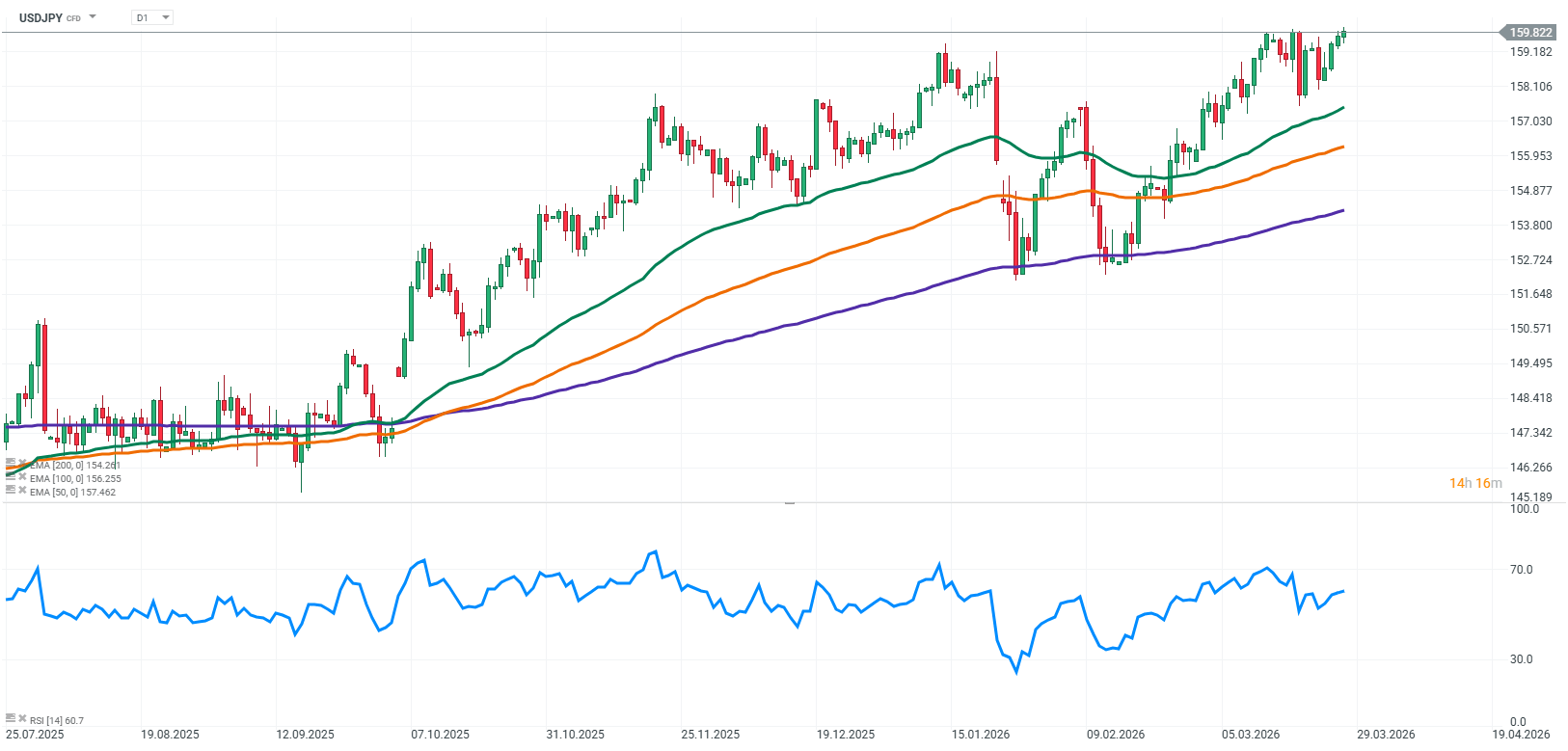
Source: xStation5
What shapes USDJPY movements?
Dollar strength and global tensions
USDJPY is supported by the overall strength of the US dollar. Investors view the dollar as a safe-haven amid rising geopolitical tensions in the Middle East and uncertainty in commodity markets. Strong demand for the USD limits the potential for yen appreciation, especially in an environment of global unrest and increased risk aversion.
Risk of intervention by Japanese authorities
Japanese authorities have increasingly signaled their readiness to intervene if USDJPY exceeds the 160.00 level. The purpose of potential intervention is to protect Japanese exports and stabilize the economy. A strong dollar raises import costs and may increase inflationary pressure in Japan. Interventions serve as a tool for authorities to manage excessive currency fluctuations that could negatively impact the trade balance and financial market stability.
Monetary policy
The Bank of Japan continues its ultra-loose policy, maintaining low interest rates over the long term. At the same time, US rates remain elevated, widening the yield differential between the USD and JPY and supporting further dollar strength against the yen. This divergence in monetary policy makes the dollar more attractive to investors in the short and medium term, maintaining upward pressure on USDJPY.
Energy prices and Japan’s trade balance
Japan is heavily reliant on imported oil and gas. Rising energy prices increase import costs, weaken the trade balance, and limit growth potential. Higher commodity prices also add to inflationary pressure, increasing the risk of currency instability. In this context, a strong dollar combined with high commodity prices can further weaken the yen, keeping USD/JPY near record levels.
Conclusion
USDJPY remains sensitive to a combination of dollar strength, intervention signals from Japanese authorities, and external factors such as energy prices and geopolitical tensions. Strong dollar momentum and potential actions by the Japanese government limit the scope for stable gains above 160.00.
The material on this page does not constitute financial advice and does not take into account your level of understanding, investment objectives, financial situation or any other specific needs. All information provided, including opinions, market research, mathematical results and technical analyzes published on the Website or transmitted To you by other means, it is provided for information purposes only and should in no way be construed as an offer or solicitation for a transaction in any financial instrument, nor should the information provided be construed as advice of a legal or financial nature on which any investment decisions you make should be based exclusively To your level of understanding, investment objectives, financial situation, or other specific needs, any decision to act on the information published on the Website or sent to you by other means is entirely at your own risk if you In doubt or unsure about your understanding of a particular product, instrument, service or transaction, you should seek professional or legal advice before trading. Investing in CFDs carries a high level of risk, as they are leveraged products and have small movements Often the market can result in much larger movements in the value of your investment, and this can work against you or in your favor. Please ensure you fully understand the risks involved, taking into account investments objectives and level of experience, before trading and, if necessary, seek independent advice.