EUR/JPY could find the initial barrier at the upper boundary of the ascending channel around 187.00.
The 14-day Relative Strength Index at 60.85 signals solid bullish momentum.
The primary support lies at the nine-day EMA of 184.79.
EUR/JPY remains stronger for the second successive day, trading around 186.00 during the Asian hours on Friday. The technical analysis of a daily chart indicates that the spot is moving higher within the ascending channel pattern, signaling a persistent bullish bias.
The EUR/JPY cross is retaining a bullish near-term bias as it holds above both the nine-period and 50-period Exponential Moving Averages (EMAs). The 14-day Relative Strength Index (RSI) around 60.85 suggests constructive upside momentum rather than overbought conditions.
The primary resistance lies at the upper boundary of the ascending channel around 187.00. A break above the channel would strengthen the bullish bias and support the currency cross to explore the region around its all-time high of 187.95 set on April 17.
On the downside, the EUR/JPY cross may find the primary support around the nine-day EMA of 184.79, followed by the 50-day EMA at 184.64 and the lower boundary of the ascending channel around 184.70. A break below this confluence support zone would revive the bearish bias, potentially pressing the currency cross down toward its nine-month low of 179.37, recorded on August 3.
US Treasury move doubles buybacks and flattens the long end
Commerzbank’s FX Research team highlights the impact of the latest US Treasury announcement on the rates complex, noting that, effective 9 September, “the US Treasury will double the size of liquidity support buyback operations to at least USD4bn.” They add that the decision immediately rippled through the long end of the curve, as “the 30Y yield fell 10bp following the announcement, and the curve flattened,” reinforcing the bull-flattening move that has underpinned recent Dollar weakness and Yen strength.
USD/JPY trades flat at around 159.00 as both currencies underperform their peers.
The US aims to double the pace of its bond-buying operations to curb rising borrowing costs.
Japan’s National CPI ex. Fresh Food arrives higher at 1.8% YoY, as expected.
The Japanese Yen (JPY) trades in a limited range at around 159.00 against the US Dollar (USD) during the Asian trading session on Friday. The pair consolidates, while both the JPY and the USD are underperforming against their other currency peers.
US Dollar Price Today
The table below shows the percentage change of US Dollar (USD) against listed major currencies today. US Dollar was the weakest against the New Zealand Dollar.
USD
EUR
GBP
JPY
CAD
AUD
NZD
CHF
USD
-0.14%
-0.11%
-0.06%
-0.19%
-0.41%
-0.45%
-0.12%
EUR
0.14%
0.03%
0.07%
-0.08%
-0.27%
-0.29%
0.03%
GBP
0.11%
-0.03%
0.04%
-0.10%
-0.28%
-0.33%
-0.00%
JPY
0.06%
-0.07%
-0.04%
-0.12%
-0.34%
-0.39%
-0.05%
CAD
0.19%
0.08%
0.10%
0.12%
-0.22%
-0.25%
0.07%
AUD
0.41%
0.27%
0.28%
0.34%
0.22%
-0.05%
0.29%
NZD
0.45%
0.29%
0.33%
0.39%
0.25%
0.05%
0.34%
CHF
0.12%
-0.03%
0.00%
0.05%
-0.07%
-0.29%
-0.34%
The heat map shows percentage changes of major currencies against each other. The base currency is picked from the left column, while the quote currency is picked from the top row. For example, if you pick the US Dollar from the left column and move along the horizontal line to the Japanese Yen, the percentage change displayed in the box will represent USD (base)/JPY (quote).
However, financial market experts are of the view that the Japanese currency could outperform the US Dollar as the Bank of Japan (BoJ) is expected to remain on a tight monetary policy path. Also, the United States (US) Treasury Department’s plans to double down on its debt-repayment plans, in an effort to curb higher borrowing costs, would keep the US Dollar under pressure.
Dollar pullback eases pressure on USD/JPY as BoJ rate path eyed
Rabobank’s FX team notes that the recent move lower in the Dollar, following news of Treasury Secretary Bessent’s buyback plans, has helped relieve some of the immediate strain on the pair, with “USD/JPY … steered a little further away from the psychologically important 160 level.”
Looking ahead, the bank anchors its outlook on the expectation that the BoJ will quicken the pace of tightening, stating that “on the assumption that the BoJ will accelerate the pace of rate hikes, we maintain a 3-month USD/JPY forecast of 158,” while cautioning that they “cannot rule out the possibility of further attempts at the upside in the near-term.”
Meanwhile, higher-than-expected Japan’s National Consumer Price Index (CPI) data for July has reinforced BoJ interest rate hike expectations.
Earlier in the day, the Statistics Bureau of Japan reported that the CPI ex. Fresh Food grew at a faster pace of 1.8% Year-on-Year (YoY), as expected, faster than 1.6% in June.
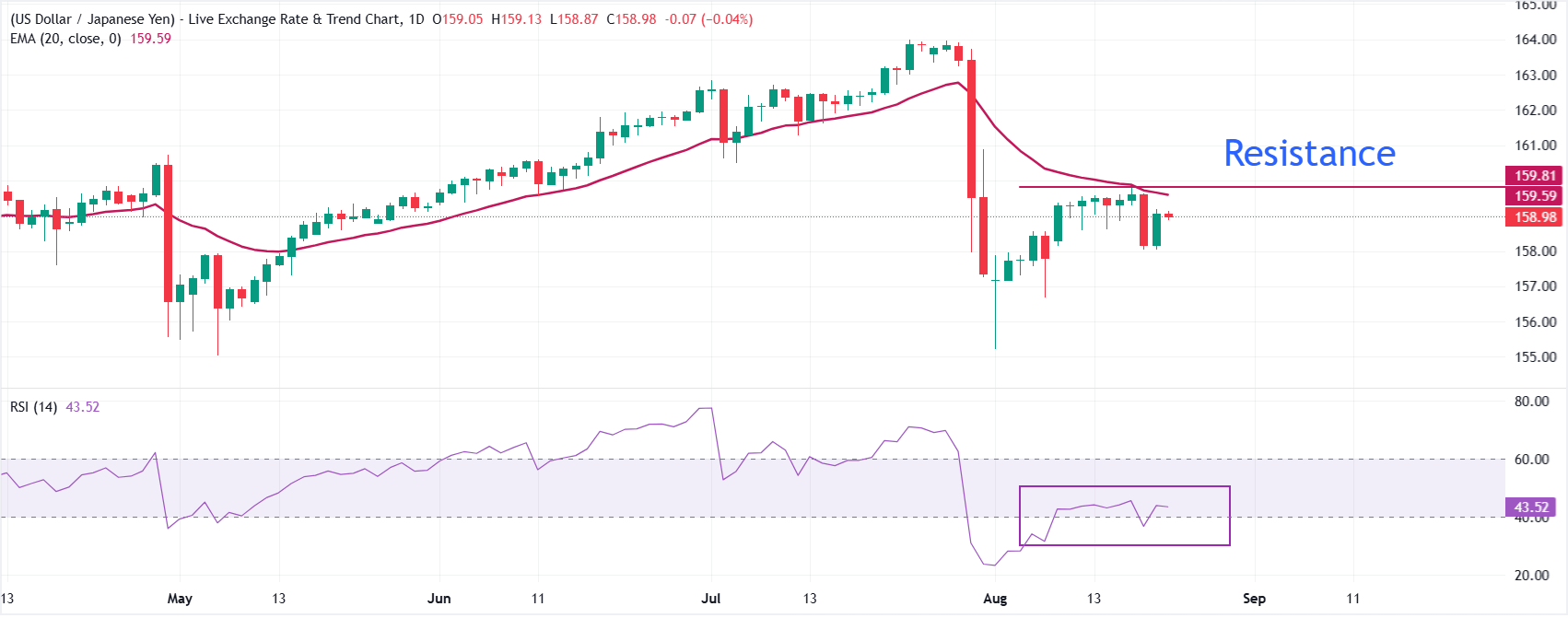
USD/JPY Technical Analysis
In the daily chart, USD/JPY trades at 158.98, maintaining a bearish near-term tone as it holds beneath the 20-day exponential moving average (EMA) at 159.59. Price action remains capped by this dynamic resistance, suggesting upside attempts are likely to struggle while the pair trades below the short-term trend metric.
The Relative Strength Index (RSI) at 43.50 stays in neutral territory, hinting at modest bearish pressure rather than oversold conditions.
On the topside, immediate resistance is located at the 20-day EMA at 159.59, and a sustained break above this level would be needed to ease the current downside bias and allow for a stronger recovery phase. Looking down, the August 20 low near 158.00 is the key supply level, followed by the August 7 low at 156.68.
Strong Eurozone inflation and rising gas prices reinforce expectations for further ECB interest rate hikes.
Resurgent US Treasury yields may cap EUR/USD gains despite the Treasury’s bond buyback efforts.
Fed’s Musalem notes accommodative financial conditions while warning that underlying inflation at 2.5%–3% remains too high.
EUR/USD remains stronger for the third consecutive day, trading around 1.1680 during the Asian hours on Friday. The Euro (EUR) gains ground against the US Dollar (USD), bolstered by strong economic fundamentals across the region. Markets are closely watching the upcoming HCOB Purchasing Managers’ Index (PMI) data from Germany and the broader Eurozone for further directional cues.
Adding to this strength, soaring European natural gas prices, driven by supply shortages in the Middle East, are keeping inflationary risks elevated. These ongoing price pressures will likely compel the European Central Bank to continue raising interest rates throughout the year.
The central bank’s hawkish stance is further supported by robust German economic figures, highlighted by July producer prices rising 3.0% year-on-year. Exceeding market expectations of 2.7%, this marked the fastest annual increase since April 2023. Coupled with a sharp 1.1% monthly rebound, the data underscores persistent inflationary momentum across the Eurozone.
However, upside potential for the EUR/USD pair may remain capped as the Greenback finds renewed strength. Despite attempts by the US Treasury to restrain elevated yields through a long-end bond buyback program, US Treasury yields have resumed their upward trajectory, offering underlying support to the Dollar.
Fed’s Musalem delivers a speech broadly in line with the established baseline, with the FXS Speechtracker score at 7/10 matching the historical average but masking a notably hawkish tilt on inflation risks. Musalem underscores that monetary policy is “neutral or accommodative” and financial conditions are “pretty accommodative,” yet stresses that underlying inflation at 2.5%-3% is “too high,” warns that a Super El Niño could be the next supply shock, and argues that hiking rates now could avert more aggressive action later, a combination that leans hawkish for the Dollar and front-end yields. The emphasis on Fed credibility, policy independence from fiscal authorities, and the need to get inflation back to 2% reinforces a bias toward tighter policy if inflation fails to decelerate, even as Musalem refuses to prejudge the September FOMC outcome.
The FXS Fed Sentiment Index slipped by 0.34 points to 132.42, indicating a modest pullback in perceived hawkishness relative to recent communications while remaining firmly above the 100 neutral line. This configuration signals that, despite the slight softening captured by the FXS Fed Sentiment Index, the overall stance is still clearly hawkish in aggregate, consistent with the 7/10 FXS Speechtracker score and supportive of Dollar resilience on persistent inflation concerns.
NZD/USD retains its positive bias for the third straight day amid a combination of supporting factors.
Receding Fed-hike bets weigh on the USD, while bets for another RBNZ rate hike support the NZD.
Geopolitical risks could limit losses for the safe-haven USD and cap the pair ahead of flash US PMIs.
The NZD/USD pair attracts buyers for the third straight day and climbs to a fresh high since early June, around the 0.5965-0.5970 region during the Asian session on Friday. Spot prices remain on track to register strong weekly gains amid a supportive fundamental backdrop.
The US Dollar (USD) struggles to capitalize on the previous day’s bounce from a three-month low amid receding bets for an immediate interest rate hike by the US Federal Reserve (Fed). The New Zealand Dollar (NZD), on the other hand, draws some support from expectations of another interest rate hike by the Reserve Bank of New Zealand (RBNZ). These turn out to be key factors lending support to the NZD/USD pair.
Meanwhile, investors remain worried about inflation risks stemming from higher oil prices due to the Middle East crisis. Adding to this, hawkish FOMC Minutes released on Wednesday keep the door open for some policy tightening by the US central bank. Furthermore, traders continue to price in the geopolitical risk premium amid the US-Iran stalemate over the Strait of Hormuz, which should limit losses for the safe-haven buck.
In the latest developments, President Donald Trump said that the US will launch the most crushing economic operation against Iran and threatened severe penalties on any nation that helps Tehran evade sanctions or does business with Iran. Moreover, Vice President JD Vance said that economic pressure is the most effective tool against Iran. This warrants some caution for USD bears and positioning for further NZD/USD appreciation.
On the economic data front, New Zealand recorded a monthly trade deficit of NZ$1.95 billion in July. This, however, does little to provide any meaningful impetus as spot prices remain at the mercy of USD price dynamics. Traders now look forward to the release of flash US PMIs, which, along with the incoming geopolitical headlines, will drive the buck and produce short-term trading opportunities around the NZD/USD pair.
NZD/USD 4-hour chart
Technical Analysis
The NZD/USD pair is extending its gains above the 200-period Exponential Moving Average (EMA) at 0.5851, which now underpins a bullish near-term bias. Any corrective pullback could find demand near the said pivotal support before the broader bullish structure is questioned.
Canadian Dollar receives support amid higher oil prices driven by US-Iran tensions over the Strait of Hormuz.
Washington plans maximum economic pressure on Iran to avoid large-scale military conflict and force negotiations.
The US Dollar may find underlying support as Treasury yields resume their upward trend despite bond buyback plans.
USD/CAD extends its losses for the third successive day, trading around 1.3770 during the Asian hours on Friday. The currency pair loses ground as the commodity-linked Canadian Dollar (CAD) receives support from rising crude oil prices.
Oil prices have surged due to escalating tensions between the United States (US) and Iran, which remain locked in a standoff over control of the crucial Strait of Hormuz. In response, Washington is moving to severely restrict Iran’s economy in an initiative President Donald Trump labeled an “economic D-day,” with formal details expected on Monday.
The US proposed measures aim to sever Tehran’s access to global commercial and financial networks, targeting banks, businesses, shipping registries, cash transfers, and smuggling operations, in an effort to force the regime into negotiations regarding its nuclear program, regional conflicts, and the passage through Hormuz.
According to a CNBC report, US Treasury Secretary Scott Bessent noted that the administration’s campaign to dismantle Iran’s economic lifelines will likely eliminate the need for significant military intervention. Bessent stated that applying maximum economic pressure makes a large-scale kinetic escalation far less probable.
CAD outperforms as broad Dollar softness and US-Canada trade progress support
Strategists at Scotiabank note that the Canadian Dollar is benefiting from a combination of “broad dollar weakness and signs of progress on US/Canada trade” that are “combining to drive the CAD higher.” They point out that intraday gains remain relatively contained, but emphasize that the currency’s “0.3% rise is second only to the NZD among the major currencies,” underscoring the Loonie’s firm tone in the current session.
Despite these downward pressures on USD/CAD, the pair’s losses could be limited by underlying strength in the US Dollar (USD). Although the US Treasury attempted to control elevated yields through a long-end bond buyback program, US Treasury yields have resumed their upward movement, providing a solid floor for the Greenback. This comes alongside Bessent’s comments indicating that accelerated debt buybacks could surpass the planned $4 billion per issue and that an upcoming fiscal plan is in development, with the US budget deficit expected to have peaked under President Trump.
Dollar slides to mid-June lows as Treasuries underperform
Strategists at Scotiabank highlight that the USD is “weakening further, sliding to its lowest since midJune,” with broader market price action mixed across asset classes. They note that “stocks are mixed, crude oil prices are stronger, and major bond markets are a little weaker,” while “Treasuries are underperforming and the curve is steepening again,” underscoring the pressure on the Dollar as US rates move higher at the long end.
GBP/USD strengthens to around 1.3645 in Friday’s early Asian session.
A disappointing US jobs report and softer inflation data dialed back bets of tighter Fed monetary policy.
BoE is expected to hold rates for the remainder of the year.
The GBP/USD pair gathers strength near 1.3645 during the early Asian trading hours on Friday. The US Dollar (USD) softens against the British Pound (GBP) amid fading Federal Reserve (Fed) rate hike expectations. Traders brace for the UK Retail Sales data for July, which will be published later on Friday.
Softer US economic data and uncertainty over Fed policy exert some selling pressure on the Greenback. Charu Chanana, chief investment strategist at Saxo, said that higher Treasury yields do not necessarily underpin the USD if investors believe the increase reflects fiscal risk, heavier government borrowing or persistent inflation, rather than stronger US growth or tighter monetary policy.
Markets are pricing in a 64% chance that the US central bank will keep rates unchanged in September and a 36% chance of a hike, according to the CME FedWatch Tool.
The Bank of England (BoE) is likely to leave interest rates unchanged at 3.75% for the rest of the year, according to a strong majority of economists polled by Reuters.
Traders await the UK July Retail Sales data for more cues about the UK interest rate outlook. Economists project the Retail Sales to decline by 0.5% MoM in July, compared to 1.0% in June. In case of a weaker-than-expected outcome, this could drag the Cable lower in the near term.
BoE rate expectations ease as UK data undercuts hawkish bets
Analysts at Danske Bank note that the latest inflation release, when viewed alongside “yesterday’s weak labour market data,” has helped cool expectations for further tightening. They highlight that the combination of softer price dynamics and labour market signals “has taken the top off BoE pricing for the remainder of the year.”
Fed’s Musalem flags inflation risks and hints at case for pre-emptive hikes
Fed’s Musalem delivered a speech broadly in line with the established baseline, with the FXS Speechtracker score at 7/10 matching the historical average and signaling a familiar mix of concern and caution. The emphasis on strong growth, accommodative financial conditions, underlying inflation stuck around 2.5%-3%, and the notion that “hiking rates now could save more aggressive action later” tilts the tone modestly hawkish, even as Musalem stresses Fed credibility and independence from fiscal policy. References to high input costs, the risk of a Super El Nino supply shock, and the view that current policy is neutral or accommodative underscore a bias toward tighter policy if inflation fails to converge to 2%, while avoiding explicit guidance ahead of the September FOMC.
The FXS Fed Sentiment Index slipped by 0.34 points to 132.42, indicating a slight pullback in hawkishness relative to the prior reading but remaining firmly above the 100 neutral line. This configuration suggests the Fed is still perceived as operating in hawkish territory despite the marginal softening, consistent with a speech that acknowledges accommodative conditions yet frames pre-emptive tightening as a live option, as captured by the FXS Speechtracker.
In the daily chart, GBP/USD maintains a bullish near‑term bias as spot holds above both the 100‑day simple moving average (SMA) and the Bollinger 20‑period middle band. Price is pressing toward the upper Bollinger band, highlighting a strong topside extension, while the Relative Strength Index (14) at about 71 shifts into overbought territory, suggesting that upside momentum is robust but increasingly vulnerable to a corrective pause.
On the topside, immediate resistance is located at the Bollinger upper band at 1.3665, and a sustained break above this level would open the path for further gains in the broader up‑move. On the downside, initial support emerges from the Bollinger middle band cluster around 1.3485, followed by the 100‑day SMA at 1.3432, with deeper demand seen near the lower Bollinger band at 1.3300; a pullback towards this layered support zone would likely be seen as a dip‑buying opportunity while price holds above the 100‑day average.
DXY struggles to capitalize on the previous day’s modest bounce from an over three-month trough.
Receding Fed-hike bets undermine the USD, though geopolitical risks help limit any further losses.
Inflation risks support US bond yields, warranting caution for USD bears amid the US-Iran standoff.
The US Dollar Index (DXY), which tracks the Greenback against a basket of currencies, attracts fresh sellers during the Asian session on Friday, stalling the previous day’s modest bounce from the vicinity of mid-98.00s, or the lowest since May 14. The index currently trades around the 98.80-98.75 region, down 0.10% for the day, and seems poised to register heavy weekly losses.
Traders pared their bets for an immediate interest rate hike by the Federal Reserve (Fed) following the release of soft US inflation figures last week, which is seen as acting as a headwind for the US Dollar (USD). Meanwhile, the immediate market reaction to the US Treasury Department’s announcement that it will double the size of some long-dated debt buyback operations fades rather quickly amid inflation risks stemming from higher energy prices.
In fact, crude oil prices touched a fresh three-week high on Thursday after President Donald Trump said that the US will launch the most crushing economic operation against Iran. Trump also threatened severe penalties on any nation that helps Iran evade sanctions or does business with Iran. This keeps geopolitical risk premium in play, which might hold back traders from placing aggressive bearish bets on the safe-haven Greenback.
Moreover, the CME Group’s FedWatch Tool indicates that investors are still pricing in around a 68% chance that the US central bank will raise borrowing costs at least once by the end of this year. The outlook, in turn, remains supportive of elevated US bond yields and should limit further losses for the DXY. Hence, it will be prudent to wait for some follow-through selling before positioning for any further USD-depreciating move.
DXY daily chart
Technical Analysis
The DXY keeps a bearish near-term tone beneath the 200-day Simple Moving Average (SMA) at 99.16 and key Fibonacci retracement levels overhead. The failed attempt to sustain above the 78.6% retracement at 98.52 earlier in the week leaves price exposed to further downside while rallies are likely to be capped by the dense cluster of resistance formed by the 200-day SMA and the 61.8% retracement at 99.22.
AUD/USD edges higher to around 0.7135 in Friday’s Asian session.
Traders are still worried about growing US debt, undermining the US Dollar.
RBA faces new pressure to pause rate hikes as unemployment rises again.
The AUD/USD pair gains traction to near 0.7135 during the Asian trading hours on Friday. The US Dollar (USD) weakens against the Australian Dollar (AUD) and is set for a weekly loss as traders viewed the US Treasury’s bond buyback gambit as merely a temporary fix.
The preliminary readings of the US Purchasing Managers Index (PMI) are due later on Friday. US Treasury Secretary Scott Bessent said on Thursday that the Treasury could increase bond buybacks beyond $4 billion, partly to signal that current yields do not reflect underlying economic fundamentals. He stressed that interest rates have nothing to do with the buyback decision.
This action came after the department announced it would double the size of buybacks on longer-dated securities over the next quarter in an attempt to stem a sharp rise in yields. The Greenback has declined following these headlines as markets grew wary of the deteriorating fiscal picture and worries about the credibility of US institutions resurfaced.
On the other hand, disappointing Australian labor data might cap the upside for the pair. The Australian Bureau of Statistics revealed on Thursday that employment unexpectedly fell by 15,800 jobs in July. This figure came in weaker than the market expectations of 15,000 gains, pushing the Unemployment Rate up to 4.5%.
“The rise in unemployment marginally strengthens the case for the RBA to hold, particularly given broader signs of weakness in the economy,” said Ray White chief economist Nerida Conisbee.
Australia labour data softens as unemployment edges higher
Analysts at BNY highlight a further cooling in Australia’s employment backdrop, noting that the July 2026 Labour Force Survey “showed a softer labor market with the unemployment rate edging up to 4.5% from 4.4%.” This modest deterioration in job conditions, alongside earlier evidence of weaker participation and hours worked, reinforces concerns that the labour market is losing momentum just as gross federal debt climbs above AU$1tn and interest costs are projected to rise steadily toward 2030.
Fed’s Musalem flags upside inflation risks, keeps Dollar bulls alert despite cautious tone
Fed’s Musalem delivered a speech that aligns with the established baseline, with a 7/10 FXS Speechtracker score matching the historical average and signaling a steady, moderately hawkish stance. Emphasis on strong growth, accommodative financial conditions, underlying inflation stuck around 2.5%-3%, and the notion that hiking rates now could avert more aggressive action later underscores upside inflation risks even as Musalem stresses Fed credibility and policy independence from fiscal pressures. The acknowledgement of potential new supply shocks such as a “super El Nino” and crowded-out credit in parts of the economy adds a risk-aware tone that tempers the hawkish bias but still leans toward pre-emptive tightening rather than complacency.
The FXS Fed Sentiment Index slipped by 0.34 points to 132.42, indicating a modest pullback in perceived hawkishness while remaining firmly above the neutral 100 mark. This configuration suggests that, despite a slight softening in tone, the Fed narrative remains in hawkish territory, with Musalem’s remarks reinforcing a bias toward further tightening if inflation fails to converge convincingly toward the 2% target.
Technical Analysis: AUD/USD
In the daily chart, AUD/USD maintains a bullish near-term bias as price holds above the 100-day simple moving average (SMA) and the Bollinger middle band. The pair is pressing towards the upper Bollinger band, signaling an upside extension of the recent advance, while the Relative Strength Index (14) at 65.95 hovers just below overbought territory, hinting that bullish momentum remains firm but increasingly stretched.
On the topside, initial resistance is located at the upper Bollinger band near 0.7150, where buyers may hesitate after the latest run-up. On the downside, immediate support is seen at the 100-day SMA around 0.7070, followed by the Bollinger middle band near 0.7055, with a deeper cushion at the lower Bollinger band around 0.6958 if a broader corrective phase unfolds.
To provide the best experiences, we use technologies like cookies to store and/or access device information. Consenting to these technologies will allow us to process data such as browsing behavior or unique IDs on this site. Not consenting or withdrawing consent, may adversely affect certain features and functions.
Functional
Always active
The technical storage or access is strictly necessary for the legitimate purpose of enabling the use of a specific service explicitly requested by the subscriber or user, or for the sole purpose of carrying out the transmission of a communication over an electronic communications network.
Preferences
The technical storage or access is necessary for the legitimate purpose of storing preferences that are not requested by the subscriber or user.
Statistics
The technical storage or access that is used exclusively for statistical purposes.The technical storage or access that is used exclusively for anonymous statistical purposes. Without a subpoena, voluntary compliance on the part of your Internet Service Provider, or additional records from a third party, information stored or retrieved for this purpose alone cannot usually be used to identify you.
Marketing
The technical storage or access is required to create user profiles to send advertising, or to track the user on a website or across several websites for similar marketing purposes.