

US stock index futures came under significant pressure after reports that the Trump administration is preparing a fresh round of tariffs targeting China, the European Union and 14 other economies. The prospect of renewed trade restrictions has revived concerns about a potential escalation in global trade tensions, with S&P 500 futures falling nearly 1.5% following the reports.
According to The Wall Street Journal, the proposed measures are intended to address what Washington describes as excess industrial production capacity outside the United States. The administration argues that foreign subsidies are allowing overseas manufacturers to produce goods at artificially competitive prices, putting American industries at a disadvantage.
US Trade Representative Jamieson Greer could publish the findings of a months-long investigation as early as this week, although the timing remains uncertain. No new tariffs have been formally introduced, and the final rates and scope of any measures have yet to be confirmed.
Market Snapshot
| Market indicator | Latest development |
|---|---|
| S&P 500 futures | Down nearly 1.5% |
| Trade policy | Potential new US tariff measures |
| Countries affected | China, EU, Japan, South Korea, India, Vietnam and 14 other economies |
| Investigation | Section 301 of the US Trade Act of 1974 |
| Potential tariff ceiling | Up to 15% for some existing US trade partners, according to the report |
| Main market concern | Inflation, corporate margins and global supply chains |
New US Tariff Investigation Raises Trade War Concerns
The proposed tariffs could cover a broad range of industrial goods imported from several major manufacturing economies, including China, the European Union, Japan, South Korea, India and Vietnam.
The investigation is being conducted under Section 301 of the US Trade Act of 1974, which allows Washington to investigate foreign trade practices it considers unfair. The administration’s argument centres on industrial subsidies and excess production capacity, which it believes enable overseas manufacturers to export goods at prices that undermine US competitors.
Certain products, including steel, aluminium and automobiles, could be exempt from the proposed measures because they are already subject to separate tariffs.
The exact tariff rates have not been officially determined. According to the reported proposals, countries with existing trade agreements with the United States, including the European Union, Japan and South Korea, could face tariffs capped at 15%. China, India and Vietnam may face more restrictive measures.
However, the final outcome will depend on the administration’s findings and subsequent policy decisions.
Global Supply Chains Face Renewed Pressure
The possibility of additional import duties could create further uncertainty for companies operating across international supply chains.
Tariffs imposed on top of existing duties would potentially increase the cost of imported components, raw materials and finished products. Manufacturers reliant on overseas suppliers could face higher operating expenses, while businesses may need to reconsider sourcing strategies and pricing structures.
Industrial manufacturers, electronics companies and retailers with significant international supply-chain exposure could be particularly vulnerable.
The uncertainty surrounding exemptions and tariff rates also makes it difficult for businesses to assess the potential financial impact before the administration announces its final position.
Could Tariffs Threaten Inflation and Wall Street?
The potential inflationary consequences represent one of the most significant concerns for financial markets.
Higher import duties could increase the cost of components and finished goods, potentially forcing companies to absorb additional expenses or pass them on to consumers. Either outcome could create pressure: corporate margins may weaken if businesses absorb the costs, while consumer prices could rise if companies transfer the additional expense.
For the Federal Reserve, renewed tariff-related inflation would complicate efforts to bring price pressures under control.
The risk is that the US economy could face a combination of slower growth and persistent inflation, creating an increasingly difficult environment for monetary policy.
Bullish Sentiment
- Tariffs remain unconfirmed: The reported measures have not yet been formally introduced, leaving room for negotiations, exemptions or a more limited final package.
- Potential exemptions: Steel, aluminium and automobiles could remain outside the proposed measures because they already face separate tariff arrangements.
- Existing trade agreements: The reported potential 15% ceiling for certain US trading partners could limit the scale of disruption for some economies.
- Policy flexibility: The final outcome will depend on the investigation’s findings and decisions by the administration, meaning the reported proposals may not represent the final policy.
Bearish Sentiment
- Renewed trade war fears: The prospect of tariffs against multiple major economies raises the risk of another escalation in global trade tensions.
- Higher import costs: Additional duties could increase expenses for US manufacturers, retailers and companies dependent on international suppliers.
- Inflationary pressure: Higher prices for imported goods and industrial components could complicate the Federal Reserve’s inflation outlook.
- Corporate margin risks: Businesses may struggle to absorb additional costs without affecting profitability or passing expenses to customers.
- Market uncertainty: The sharp decline in S&P 500 futures highlights how quickly trade-policy developments can influence investor sentiment.
Price Forecast: What Traders Are Watching
The immediate focus for equity markets will be the publication of the Section 301 investigation findings and any subsequent clarification from the Trump administration.
Traders will be watching for confirmation of the countries and product categories covered, the proposed tariff rates, and whether existing trade agreements will provide meaningful exemptions.
The nearly 1.5% decline in S&P 500 futures indicates that investors are already pricing in the possibility of a more disruptive trade environment. However, the direction of the next market move will depend heavily on whether the reported proposals translate into formal measures.
A narrower tariff package or meaningful exemptions could ease some of the pressure. Conversely, broad restrictions or the prospect of retaliatory action from affected economies could deepen concerns across global equity markets.
Market Outlook for the Coming Sessions
The return of tariff uncertainty has introduced another potential obstacle for Wall Street, with investors already concerned about inflation, economic growth and the outlook for interest rates.
The possibility of higher import costs could weigh on industrial and consumer-facing companies, while renewed trade tensions may encourage investors to reassess exposure to businesses dependent on global manufacturing and distribution networks.
For now, the proposed tariffs remain under consideration rather than formally implemented. Nevertheless, the market reaction demonstrates that investors are increasingly sensitive to the potential economic consequences of another major trade dispute.
The coming sessions will depend on the administration’s next steps, particularly the timing and findings of the investigation. Until greater clarity emerges, trade policy is likely to remain an important source of volatility for US equities and global financial markets.
US500 chart (1H and 1D timeframes)
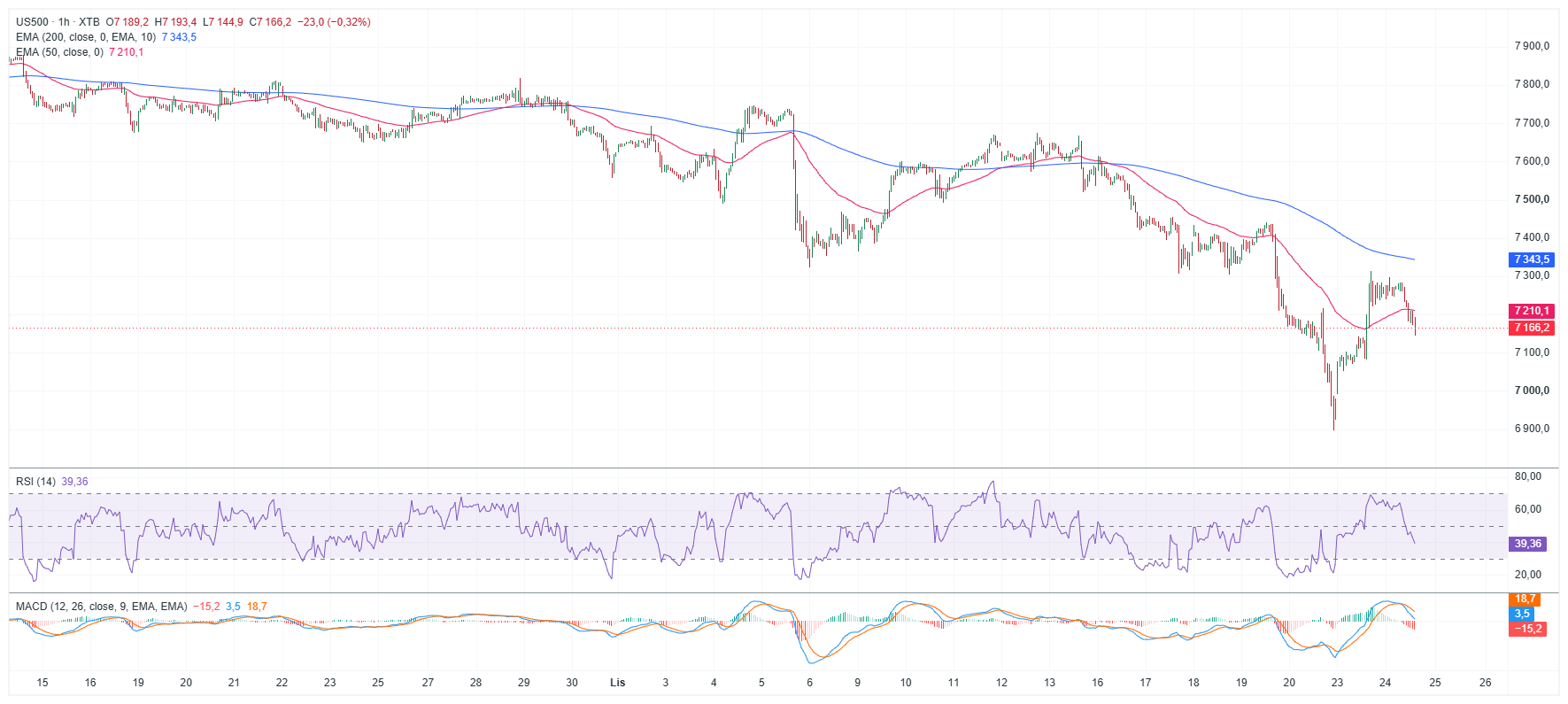
On the hourly chart, US500 has given back roughly one-third of yesterday’s strong rebound. The sharp negative reaction highlights persistent nervousness across financial markets, while reports of potentially higher tariffs, including measures targeting China, appear to have introduced another source of risk for investors.
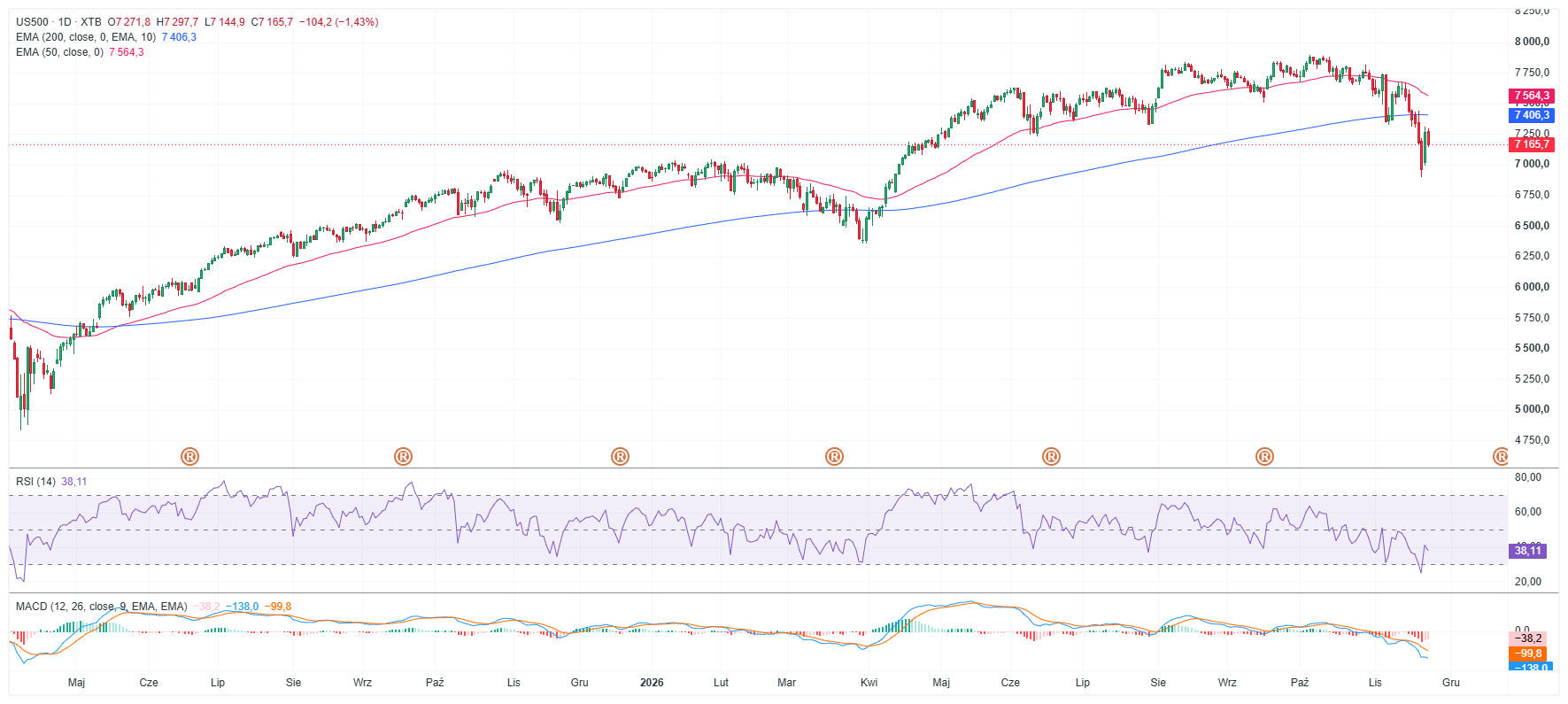
Source: XTB On the daily chart, a recovery above 7,400 points appears crucial for US500, as the 200-session exponential moving average (EMA200) is located near this level. For now, however, the index is struggling to generate sufficient buying momentum to initiate a sustained recovery. As long as it remains below this area, the risk of a continued downtrend persists. The key support zone lies between 6,900 and 7,000 points. A decisive breakdown below this range could expose the index to a deeper decline toward 6,300 points, corresponding to the lows recorded in spring 2026. Such a move would represent a correction of more than 20% from its all-time high.
Source: XTB
Currency Hedger – Global Market Perspective
Currency Hedger provides market insights and international currency services for businesses managing cross-border payments and foreign exchange exposure.
Visit Currency Hedger or open an account.
Disclaimer: This article is provided for informational and educational purposes only. It does not constitute investment advice, financial advice or a recommendation to buy or sell any financial instrument. Financial markets involve risk, and readers should conduct their own research before making investment decisions.

Leave A Comment