



The Japanese yen was handed catalysts for gains in the form of higher Tokyo inflation and falling Japanese unemployment, yet it is losing ground against all G10 currencies. USDJPY is dangerously close to its post-intervention peak (160.00; today: +0.12% to 159.500), and a potential impulse following Kevin Warsh’s speech at Jackson Hole could test the pain threshold for both Tokyo and Washington.
Technical Analysis: USDJPY (D1)
For a month, USDJPY has been attempting to rebuild its uptrend and sustainably return above the 200-day exponential moving average (EMA200; black line) following the recent currency intervention. Taking small steps, the exchange rate is approaching the psychological 160.00 level, widely perceived by market participants as the upper limit acceptable to Tokyo and Washington. Price action remains bounded by the 50.0% Fibonacci retracement level and two moving averages: EMA30 (light purple) and EMA100 (dark purple). Together with the EMA200, they form a narrow corridor (158.00–160.00) that could define a consolidation range for an extended period until either the Fed or the BOJ adopts a more aggressive rate-hiking path.
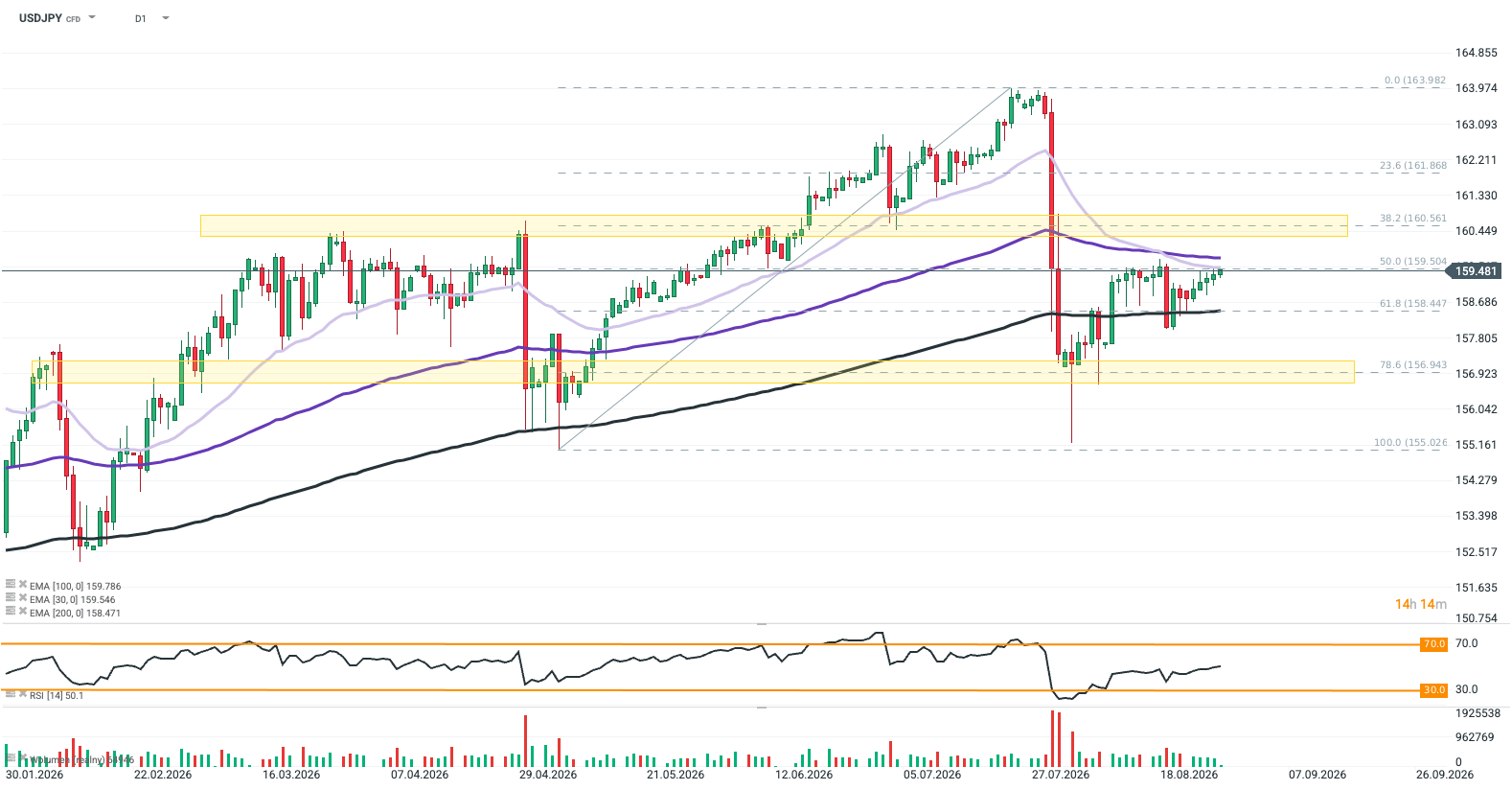
Source: xStation5
What is driving USDJPY today?
- Tokyo’s core CPI (excluding fresh food) accelerated to 1.8% YoY in August from 1.7% in July, rising for the third consecutive month and beating consensus expectations (1.7%). Meanwhile, the core-core CPI (excluding fresh food and energy), closely watched by the Bank of Japan, rose to 2.0% YoY compared to 1.8% in July.
- Price increases in Tokyo were driven by steady growth in food costs and the gradual pass-through of higher energy and commodity prices from businesses to consumers. Inflationary pressure is further exacerbated by the yen’s weakness in recent months (Japan imports 85%–90% of its energy) alongside robust demand in the AI sector.
- The data confirms that inflation is approaching the Bank of Japan’s 2% target, thereby boosting expectations for Japanese rate hikes. Markets are currently pricing in an ~84% probability of a hawkish move in September (the last rate hike occurred in May 2026, raising the policy rate from 0.75% to 1.00%).However, given the central bank’s history of falling “behind the curve,” the market may penalize the yen if inflation leaves the BOJ further behind—leaving the yen under pressure even if the BOJ hikes without signaling a clear tightening trajectory.
- USDJPY is breaking away from broader FX market trends today, where most G10 pairs are moving sideways with fluctuations below 0.1% ahead of Warsh’s speech at Jackson Hole. While the greenback has stabilized after recent US debt market turbulence, market demand for policy clarity remains high; a failure to deliver guidance could weaken the dollar and pull USDJPY back from the 160.00 pain threshold.

Leave A Comment