



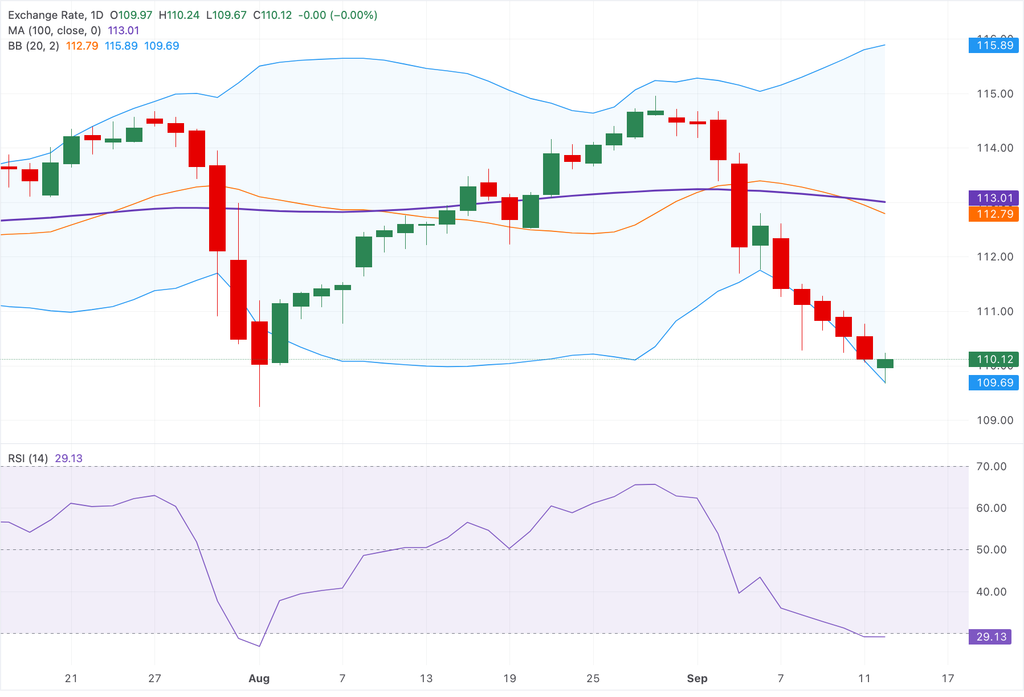
Currency Hedger Analysis: AUD/JPY is holding near 110.10 in early European trading, but the broader technical structure remains bearish as the cross trades below its 100-day moving average. Expectations of further Bank of Japan tightening are providing additional support for the Japanese yen, while an oversold RSI leaves room for a temporary AUD/JPY rebound.
The key question for traders is whether the current decline is simply approaching a short-term exhaustion point or whether the yen is beginning a more sustained recovery against the Australian dollar.
BoJ Tightening Expectations Support the Yen
The Japanese yen remains supported by expectations that the Bank of Japan (BoJ) will raise its policy rate to 1.25% at its September meeting.
Markets are already pricing the expected 25-basis-point increase heavily, meaning the decision itself may have limited impact unless Governor Kazuo Ueda signals that further tightening is likely.
This makes the accompanying policy guidance particularly important.
If the BoJ indicates that rates could continue rising at a relatively fast pace, the yen could gain further support as investors reassess the future interest-rate differential between Japan and Australia.
MUFG analysts have indicated that the expected hike is already almost fully priced, leaving the yen increasingly dependent on the BoJ’s forward guidance.
RBA Expectations Provide a Counterweight
The Australian dollar is not without fundamental support.
Markets are pricing approximately a 76% probability that the Reserve Bank of Australia will raise its cash rate to 4.60% at its next meeting.
That leaves a substantial interest-rate differential between Australia and Japan, which has historically supported AUD/JPY carry demand.
However, the cross is increasingly sensitive to changes in expectations rather than simply the absolute level of interest rates.
If the BoJ becomes more hawkish while the RBA approaches the end of its tightening cycle, the relative advantage of holding Australian dollars could gradually diminish.
That creates a potential structural headwind for AUD/JPY.
Japanese Policy Independence Supports Yen Sentiment
Japanese policy signals are also becoming increasingly important.
Scotiabank analysts have highlighted resistance from Japanese officials to external attempts to influence the country’s monetary and macroeconomic policy.
Japanese Finance Minister Katayama has reportedly described recent comments from US Treasury Secretary Scott Bessent as concerning.
For currency markets, the broader implication is that Japanese policymakers appear determined to retain control over the direction of domestic monetary policy.
That could reinforce expectations that the BoJ will continue normalising rates based on Japanese inflation and economic conditions rather than external political pressure.
AUD/JPY Remains Below Key Moving Averages
The technical picture remains bearish.
AUD/JPY is trading below both the 20-period Bollinger middle band and the 100-day moving average, indicating that sellers retain control of the broader trend.
However, the 14-day RSI is around 29, placing the pair close to oversold territory.
That does not necessarily signal a trend reversal, but it does increase the probability of a corrective rebound.
Key AUD/JPY Levels
| Level | Significance |
|---|---|
| 115.90 | Bollinger upper band |
| 113.00 | 100-day moving average |
| 112.80 | Bollinger middle band |
| 111.63 | Initial resistance |
| 110.10 | Current trading area |
| 109.70 | Initial downside target/support |
| 109.24 | August 3 low |
| 108.79 | March 31 low |
The immediate technical battleground is therefore between 109.70 and 111.63.
109.70 Is the First Downside Test
A sustained break below 109.70 would reinforce the bearish technical structure and expose the 109.24 August 3 low.
Below that level, attention would turn toward 108.79, the March 31 low.
The downside structure remains intact while AUD/JPY trades below the 100-day moving average around 113.00.
Oversold RSI Leaves Room for a Rebound
The main argument against an aggressive bearish view in the immediate term is momentum.
An RSI around 29 indicates that selling pressure has become stretched.
A recovery toward 111.63 would therefore not necessarily invalidate the bearish trend. Instead, it could represent a normal technical correction within the broader downtrend.
The more important test would come at 112.80, followed by the 113.00 100-day moving average.
A decisive move above 113.00 would materially weaken the current bearish technical structure and could open the way toward 115.90.
Until that happens, rallies remain vulnerable to renewed selling.
Currency Hedger View
AUD/JPY is increasingly becoming a contest between two monetary-policy forces.
Australia continues to offer a significant yield advantage over Japan, but the market is increasingly focused on the direction of travel. A more aggressive BoJ tightening cycle would gradually reduce the attractiveness of the yen-funded carry trade, particularly if Australian rates are approaching their peak.
At the same time, the oversold technical conditions mean traders should be cautious about chasing the cross lower after an extended decline.
“AUD/JPY remains technically bearish, but the market is approaching an important point where momentum and fundamentals could temporarily diverge. The RSI near 29 suggests selling pressure is becoming stretched, while expectations for further BoJ tightening are providing the yen with a stronger fundamental backdrop. The key levels are 109.70 on the downside and 113.00 on the upside. Until the 100-day moving average is reclaimed, rallies are more likely to be viewed as corrections within the broader downtrend.”
Louis Roche, Analyst at Currency Hedger
What Currency Traders Are Watching
The next major catalysts for AUD/JPY include:
- BoJ September interest-rate decision
- Kazuo Ueda’s forward guidance
- Future BoJ rate-hike expectations
- RBA interest-rate expectations
- Australian inflation and labour-market data
- Japanese inflation and economic activity
- AUD/JPY reaction around 109.70
- Whether buyers can reclaim 111.63 and ultimately 113.00
The interaction between the BoJ and RBA rate paths will remain particularly important because the pair is highly sensitive to changes in the interest-rate differential.
Bottom Line
AUD/JPY: ~110.10
Immediate resistance: 111.63
Major resistance: 112.80–113.00
Initial downside target: 109.70
Next support: 109.24
Major downside level: 108.79
RSI: ~29, near oversold territory
AUD/JPY remains bearish below 113.00, although the oversold RSI creates scope for a short-term recovery. A break below 109.70 would strengthen the bearish case and expose 109.24 and 108.79, while a sustained move above 113.00 would signal a more meaningful change in the technical structure.
Analysis by Louis Roche, Analyst, Currency Hedger.

Leave A Comment