


sustainability of the artificial intelligence boom.
The new week has brought a sharp deterioration in sentiment across technology markets, with the US100 falling around 1.7% at the opening.
The decline comes as investors increasingly question whether expectations surrounding artificial intelligence have moved too far ahead of reality.
For years, AI has been one of the dominant drivers of the technology market. Massive investment in data centres, semiconductors and increasingly powerful AI models has helped push technology stocks to record valuations.
Now, however, the market is beginning to ask a different question:
How much of the future AI boom is already priced into technology stocks?
AI enthusiasm meets reality
The debate surrounding the pace and safety of AI development has intensified, with technology leaders increasingly discussing the risks associated with increasingly powerful models.
Anthropic CEO Dario Amodei has been among the industry’s prominent voices warning about the potential risks of rapid AI development. The wider debate has also involved figures such as OpenAI CEO Sam Altman and Elon Musk.
For investors, however, the underlying issue is less about the technology debate itself and more about what it means for corporate investment and future earnings.
The technology industry is spending enormous amounts on AI infrastructure.
.
Data centres, advanced processors, energy infrastructure and AI research require substantial capital expenditure. The market has so far been willing to accept that spending because investors expect AI revenues and productivity gains to eventually justify it.
That assumption is now facing greater scrutiny.
If AI monetisation develops more slowly than expected, or companies are forced to spend substantially more before seeing meaningful returns, technology valuations could remain under pressure.
The AI race is also becoming geopolitical
The United States remains a global leader in artificial intelligence, but China is rapidly expanding its own AI capabilities.
Beijing is increasingly treating artificial intelligence as a strategic technology, with implications for economic growth, industrial competitiveness and national security.
That creates an additional challenge for US policymakers.
Restrictions designed to control the development or export of advanced AI technology may address certain security concerns, but they could also make it easier for Chinese competitors to close the technological gap.
The AI race has therefore become much larger than a competition between individual technology companies.
It is increasingly a competition between entire technological ecosystems.
Are technology valuations finally becoming more attractive?
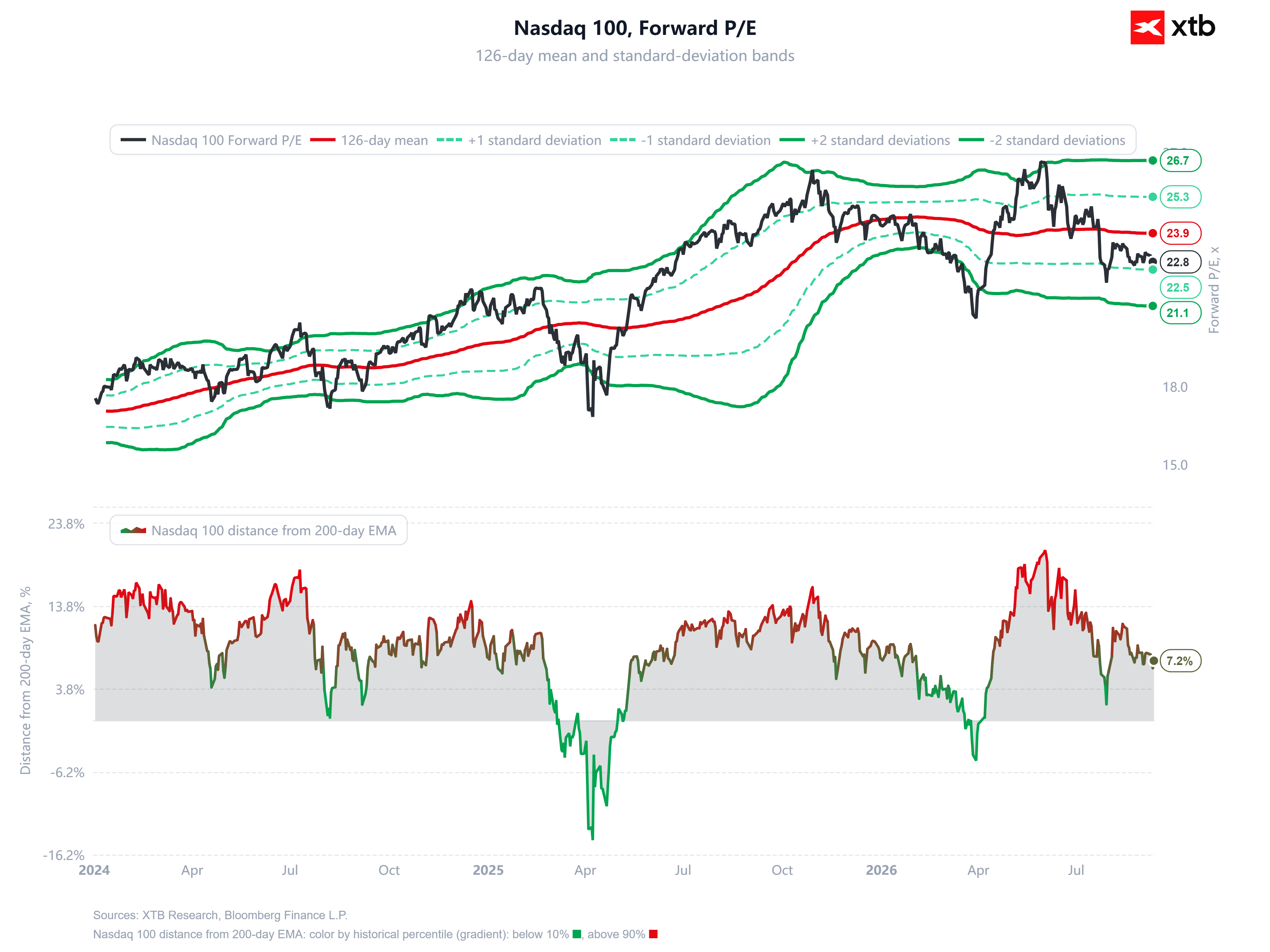
Despite the negative headlines, the valuation picture is not as extreme as it was during the strongest stages of the AI rally.
The forward price-to-earnings ratio of the Nasdaq 100 has fallen towards the low-20s, bringing valuations closer to the lower end of their recent historical range.
That is important.
A falling valuation does not necessarily mean that the technology market is entering a bear market. It can also mean that investors are already pricing in a significant amount of bad news.
If corporate earnings remain strong while valuations continue to decline, technology stocks could become increasingly attractive to longer-term investors.
The opposite is also true.
If lower valuations are accompanied by falling earnings expectations, the market could face a much deeper correction.
The technical picture matters
The latest decline is also testing an important area of the US100’s broader uptrend.
The volume profile highlighted in the underlying market analysis shows several areas where significant trading activity has taken place since the beginning of the year.
The latest consolidation is now being tested from the downside.
A sustained break below this area could encourage sellers to target the next major volume cluster, potentially around the lows created during the sharp market declines seen in early August.
For now, however, the longer-term uptrend has not necessarily been broken.
That distinction is important.
A 1.7% decline is significant, but it does not by itself signal the end of the technology bull market.
The next few sessions will be important in determining whether Monday’s move represents a normal correction or the beginning of a deeper reassessment of technology valuations.
What investors should watch
The most important indicators for the AI trade are increasingly becoming fundamental rather than simply technological.
Investors will be watching:
- AI-related revenue growth
- Technology company capital expenditure
- Data-centre investment
- Semiconductor demand
- AI adoption by businesses
- Productivity gains from AI
- Operating margins
- Free cash flow
- Forward earnings expectations
If these indicators remain strong, the current weakness could eventually be viewed as a valuation reset within a continuing AI expansion.
If spending continues to rise while returns disappoint, however, investors may begin questioning whether the enormous AI investment cycle can generate the earnings growth currently embedded in technology valuations.
Today Markets View
The latest US100 decline does not yet signal the end of the AI boom.
But it does highlight a change in investor psychology.
The market is moving away from simply asking how big AI can become and increasingly asking how much investors should pay for that future growth today.
That distinction could become increasingly important.
The AI story remains one of the most significant long-term technological developments in global markets. But after years of extraordinary optimism and massive capital investment, investors are likely to become more selective.
For the US100, the next major direction could therefore depend on whether strong AI earnings and productivity gains can continue to justify the enormous amount of capital being committed to the sector.
Currency Hedger Contributor View: The long-term AI trend remains powerful, but the market may be entering a more selective phase. Valuations, capital expenditure and actual AI monetisation are likely to matter increasingly more than headlines alone.
Market analysis for Today Markets, with contribution from Currency Hedger, an Octalas Group division specialising in foreign exchange, currency risk and hedging.

Leave A Comment