


Contributor: Currency Hedger | Market Analysis: Louis Roche, Today Markets
The US Dollar Index (DXY) enters the coming sessions consolidating below the 102.50 resistance area, as persistent Federal Reserve hawkishness competes with weakening consumer confidence and uncertainty over the timing of further monetary tightening. With US inflation data, producer prices and retail sales scheduled for release, the dollar faces a decisive test of whether expectations for another Federal Reserve rate increase can translate into fresh upside momentum.
The immediate technical bias remains cautious while the index trades below 102.50. However, stronger-than-expected inflation or spending data could revive expectations of an earlier rate increase and push the dollar towards 103.00. Conversely, softer figures may encourage traders to reduce near-term tightening expectations, leaving DXY vulnerable to a move towards 101.75 and 101.50.
Market Snapshot
| Indicator | Latest reported level or expectation |
|---|---|
| US Dollar Index (DXY) | Around 102.25 |
| Key resistance | 102.50 |
| Next upside reference | 103.00 |
| Initial support | 102.00 |
| Secondary support | 101.75 |
| Lower support | 101.50 |
| October Fed rate-hike probability | Around 20% |
| December Fed rate-hike probability | Around 70% |
| September headline CPI forecast | +0.6% month-on-month |
| September core CPI forecast | +0.2% month-on-month |
Figures reflect the supplied market report and forecasts; verify the latest readings and event schedule before publication.
Fundamental Outlook: The Fed’s Hawkish Message Faces a Market Test
Federal Reserve officials maintain pressure for higher rates
Federal Reserve officials have continued to argue that additional monetary tightening may be necessary to contain persistent inflation. Their comments support the prospect of another rate increase before the end of the year, although the timing remains uncertain.
Market pricing in the supplied report places the probability of an October increase at approximately 20%, compared with around 70% for December. This suggests investors are leaning towards a later move rather than expecting the Federal Reserve to tighten at its next meeting.
The dollar’s recent inability to establish fresh highs despite hawkish commentary is significant. It suggests that expectations for further rate increases may already be reflected in prices, leaving the index increasingly dependent on incoming economic data to generate another sustained advance.
Treasury yields will remain an important part of this assessment. A renewed rise in short-term yields could support the dollar by reinforcing expectations for higher policy rates. If yields continue to retreat despite hawkish Fed messaging, DXY may struggle to break above resistance.
Consumer confidence raises questions about economic momentum
The preliminary University of Michigan consumer sentiment reading cited in the report fell to 46.3, below the 47.6 forecast. The survey also indicated elevated household inflation expectations, with the one-year measure at 4.7% and the five-year measure at 3.5%.
This combination presents a challenge for policymakers. Persistent inflation expectations could strengthen the argument for keeping monetary policy restrictive, while deteriorating confidence raises concerns about household spending and future economic growth.
For the dollar, the outcome depends on which factor dominates. If inflation concerns outweigh evidence of weakening demand, the market may continue to favour a hawkish Federal Reserve. If softer sentiment is followed by weaker retail sales, expectations for further tightening could lose momentum.
CPI becomes the principal near-term catalyst
The September US Consumer Price Index is the key event in the coming sessions. The supplied report forecasts headline CPI rising by 0.6% month-on-month, with annual inflation reaching 3.6%. Core CPI, which excludes food and energy, is forecast to increase by 0.2% month-on-month, compared with 0.3% previously.
A core reading of 0.3% or higher could renew speculation about an October rate increase, particularly if headline inflation also remains firm. Such an outcome could lift Treasury yields and give the dollar the momentum required to challenge 102.50.
A core reading in line with the 0.2% forecast may leave investors focused on a possible December move rather than an immediate increase. A softer result, especially alongside weaker retail sales, could further undermine the case for near-term tightening.
The Federal Reserve’s Beige Book, followed by producer price inflation and retail sales, will provide additional evidence about underlying price pressures and the strength of US demand.
Technical Analysis: DXY Remains Capped Below 102.50
The Dollar Index has struggled to regain its recent high near 102.50, with successive lower highs indicating that buying momentum has weakened. The index has recovered above 102.00 after briefly falling below that level, but it has yet to establish a decisive breakout.
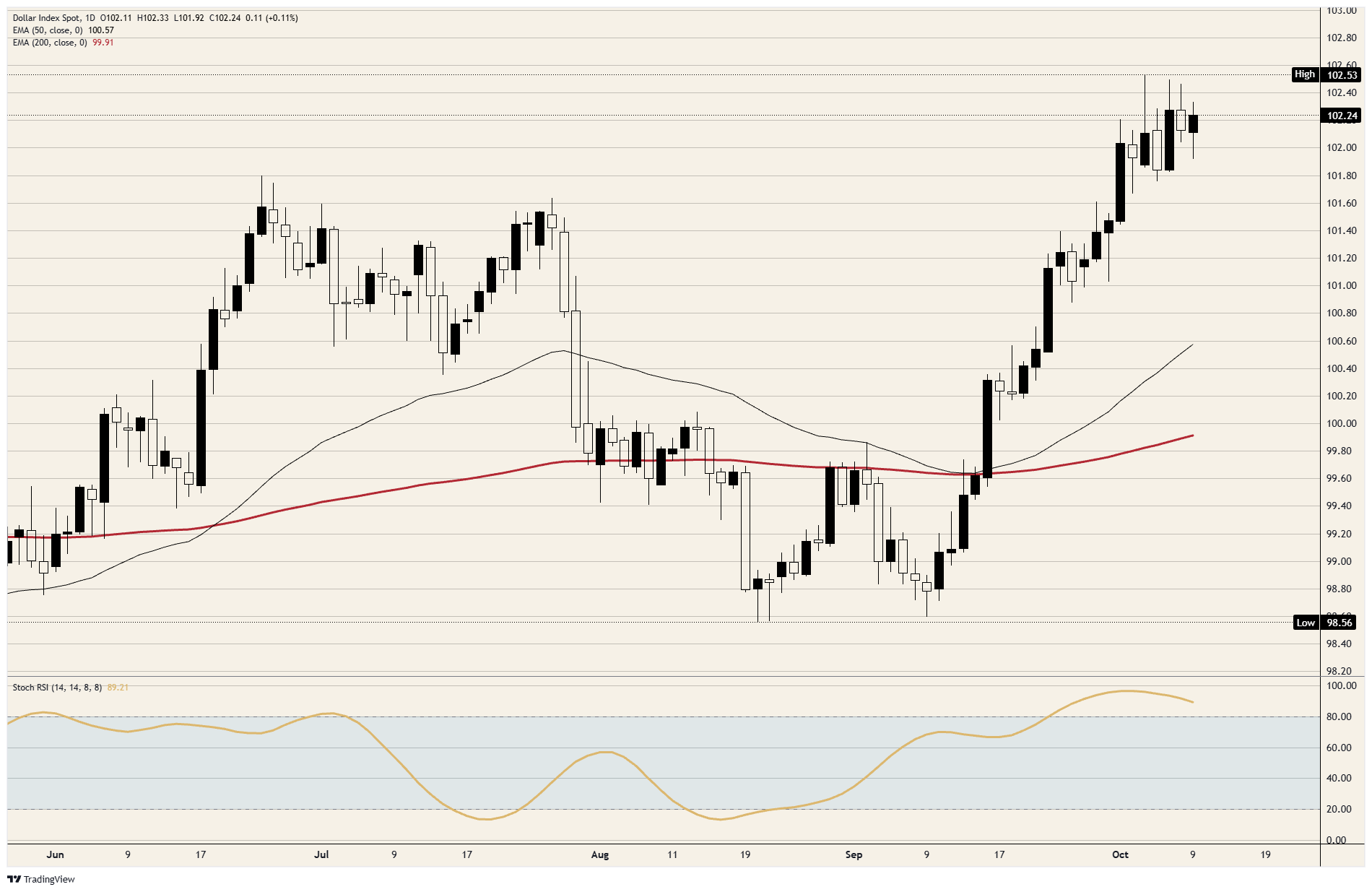
The daily Stochastic RSI is reported to be near 89 and turning lower from elevated territory. This suggests upside momentum may be losing strength, although the indicator alone does not confirm a reversal.
Key technical levels
| Level | Significance |
|---|---|
| 103.00 | Next upside reference following a confirmed breakout |
| 102.50 | Major resistance and short-term directional trigger |
| 102.30 | Recent intraday high area |
| 102.00 | Immediate support and psychological level |
| 101.75 | First downside objective and recent weekly low area |
| 101.50 | Secondary support and prior range reference |
These levels should be treated as reference areas rather than guaranteed turning points.
Bullish Scenario: Inflation Pushes DXY Above 102.50
A stronger-than-expected core CPI reading could revive expectations of an October rate increase and encourage fresh dollar buying. Confirmation from producer prices or retail sales would strengthen the case for a sustained move higher.
A daily close above 102.50 would weaken the current bearish technical bias and bring 103.00 into focus. A continued rise in Treasury yields would add confirmation to this scenario.
For the bullish outlook to remain credible, DXY would need to hold above the breakout area rather than briefly trade through resistance before retreating.
Bearish Scenario: Softer Data Opens the Way to 101.75
If core inflation meets or falls below expectations and retail sales disappoint, traders may become less confident that the Federal Reserve will raise rates in October. A decline in US Treasury yields could add further pressure to the dollar.
A sustained move below 102.00 would put the 101.75 area in focus, followed by 101.50. A break of these levels would suggest that the recent consolidation is developing into a deeper correction rather than a temporary pause.
The bearish scenario would be weakened by a strong inflation surprise or a decisive recovery above 102.50.
Neutral Scenario: DXY Remains Range-Bound Ahead of the Fed
If CPI broadly matches expectations, the index may remain trapped between 102.00 and 102.50 as traders maintain expectations for a later rate increase but avoid making aggressive new positions ahead of the Federal Reserve meeting.
Under this scenario, Treasury yields, retail sales and developments in the euro and Canadian dollar may influence short-term moves without generating a sustained breakout. The market may require a clear inflation surprise to establish a stronger directional trend.
US Dollar Index Forecast for the Coming Sessions
The near-term outlook for DXY is cautious to bearish below 102.50, with inflation data likely to determine whether the index can regain upward momentum.
A daily close above 102.50 would shift the technical outlook towards 103.00. Failure to overcome resistance, combined with a break below 102.00, would increase the risk of a move towards 101.75 and 101.50.
The key question is whether US inflation proves sufficiently persistent to reinforce expectations for further Federal Reserve tightening. Strong data could restore the dollar’s advance, while softer inflation and weaker spending would leave the index exposed to additional downside.
Traders should also account for the possibility of sharp moves around scheduled releases, particularly if the headline and core inflation measures send conflicting signals. The reaction in Treasury yields may be as important as the headline figures themselves.
Analysis — Louis Roche, Today Markets
The dollar’s inability to extend its advance despite repeated hawkish comments from Federal Reserve officials suggests that policy expectations alone may no longer be enough to drive the next leg higher. Investors now need evidence that inflation remains sufficiently persistent to justify another increase in interest rates.
This places the upcoming CPI report at the centre of the short-term outlook. A stronger core reading could give the Federal Reserve’s hawks renewed credibility and push DXY through resistance. However, elevated inflation expectations alongside weakening consumer confidence create a more complicated policy environment: persistent price pressures support restrictive policy, while deteriorating demand may limit how far rates can rise without damaging growth.
My near-term assessment is that the index remains vulnerable to a correction while 102.50 holds as resistance. A break below 102.00 would strengthen the case for a test of 101.75, although the broader direction will depend on inflation data and the subsequent reaction in bond yields. A sustained close above 102.50 would invalidate this immediate bearish bias and reopen the path towards 103.00.
The coming sessions are therefore likely to be driven less by the number of hawkish Fed statements and more by whether the economic evidence supports their message.
Currency Hedger View
The US dollar remains sensitive to the interaction between inflation, interest-rate expectations and global risk sentiment. Businesses with USD exposure should monitor the CPI release and the direction of Treasury yields, as either a breakout above resistance or a move towards support could influence near-term currency conversion decisions.
Currency Hedger monitors foreign exchange markets alongside broader commodity and macroeconomic conditions, helping businesses assess and manage their international currency exposure.
Open a Currency Hedger Account: https://currencyhedger.numito.com/onboarding?utm_source=chatgpt.com
Visit: https://currencyhedger.com/
Disclaimer
This material is provided for informational and market commentary purposes only and does not constitute investment advice, a recommendation, or an offer to buy or sell any financial instrument. Forecasts and technical levels are conditional scenarios, not guarantees of future performance. Foreign exchange and leveraged trading involve significant risk. Readers should conduct their own research and consider their financial circumstances before making decisions.

Leave A Comment