


Contributor: Currency Hedger | Market Analysis: Louis Roche, Today Markets
The British pound enters the week beginning 12 October 2026 holding near 1.3230 against the US dollar, but the broader technical picture remains under pressure. Sterling has struggled to build a sustained recovery as elevated US Treasury yields, persistent inflation concerns and expectations of further Federal Reserve tightening continue to support the dollar.
The latest US consumer sentiment figures add complexity to the outlook. Sentiment fell to 46.3 in October, below expectations, while household inflation expectations increased. The combination raises questions about the strength of the US economy while reinforcing concerns that inflation may remain difficult to contain.
For sterling, the coming week brings several important domestic events, including UK retail sales, gross domestic product data and comments from Bank of England officials. Investors will also assess the implications of elevated energy prices and the government’s forthcoming Autumn Budget.
The immediate outlook remains cautious. GBP/USD is trading below important technical resistance, leaving the pair vulnerable to further losses unless incoming data provides a catalyst for recovery.
Market Snapshot
| Indicator | Latest reported position |
|---|---|
| Currency pair | GBP/USD |
| Reference price | Around 1.3230–1.3231 |
| US Dollar Index | Approximately 102.27 |
| US consumer sentiment | 46.3, down from 48.1 |
| US one-year inflation expectations | 4.7%, up from 4.6% |
| US five-year inflation expectations | 3.5%, up from 3.4% |
| Initial resistance | 1.3360 |
| Major resistance | 1.3439 |
| Near-term bias | Bearish while resistance holds |
Figures are taken from the supplied market report and should be checked against live data before publication.
US Inflation and Treasury Yields Remain Key Drivers
The US dollar enters the new week supported by elevated Treasury yields and expectations that the Federal Reserve may need to maintain restrictive monetary policy.
The University of Michigan’s preliminary October Consumer Sentiment Index declined to 46.3 from 48.1 in September, missing expectations of 47.6. Meanwhile, one-year inflation expectations increased to 4.7%, and five-year expectations rose to 3.5%, according to the supplied report.
These figures present a difficult combination for policymakers. Weaker consumer confidence may indicate growing concerns about the economic outlook, but rising inflation expectations could discourage the Federal Reserve from easing financial conditions.
The next US consumer and producer inflation releases will therefore be important for GBP/USD. If inflation proves persistent, markets could increase expectations of further tightening, supporting US yields and the dollar. If price pressures moderate, Treasury yields could retreat and create room for sterling to recover.
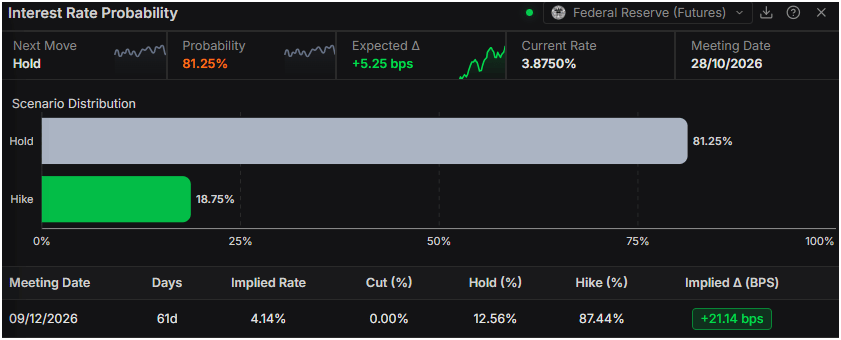
Fed interest rate probability – Source: Prime Terminal
Retail sales, employment data and further comments from Fed officials will also influence expectations ahead of the next policy meeting.
The key issue is whether the US economy remains resilient enough to sustain elevated interest rates or whether weakening activity begins to outweigh inflation concerns.
Federal Reserve Policy: A Potential Source of Dollar Strength
According to the supplied report, markets expect the Federal Reserve to leave interest rates unchanged at its October meeting, while continuing to price in the possibility of a December increase.
A pause in October would not necessarily be negative for the dollar. If investors believe that rates will remain elevated for longer or rise again before year-end, US yields could remain attractive relative to other major markets.
For GBP/USD, the relative policy outlook matters more than the decision of either central bank in isolation. If expectations for US interest rates rise faster than those for UK rates, the dollar could maintain its advantage.
Conversely, softer US inflation or weaker activity data could reduce expectations of further tightening. That would potentially narrow the relative yield advantage supporting the dollar and allow GBP/USD to recover.
The market reaction will depend on the combined signal from inflation, employment and consumer spending rather than any single release.
UK Economic Outlook: Retail Sales and GDP in Focus
Sterling’s domestic outlook will be tested by UK retail sales and GDP data, alongside comments from Bank of England Chief Economist Huw Pill.
The data should help investors assess whether the UK economy is maintaining sufficient momentum despite elevated energy prices and pressure on household purchasing power.
Stronger retail sales and resilient GDP growth could support sterling by reducing concerns about the economic outlook. If the data also reinforce expectations that inflation will remain persistent, markets may reassess the likely path of Bank of England policy.
However, weaker figures could increase concerns about slowing activity and leave sterling exposed, particularly if US data simultaneously supports higher Treasury yields.
The Bank of England faces a difficult balance between containing inflation and avoiding unnecessary damage to economic growth. Higher energy prices complicate that balance because they can raise household and business costs while reducing discretionary spending.
The next round of UK data will help determine whether sterling has sufficient domestic support to challenge the broader downward trend.
UK Autumn Budget Adds Fiscal Uncertainty
The forthcoming UK Autumn Budget is another factor for currency markets to monitor. Investors will assess the government’s approach to taxation, spending, borrowing and fiscal discipline, alongside any implications for the country’s growth outlook.
A credible fiscal framework could help limit uncertainty around government borrowing and support confidence in UK assets. Conversely, concerns about higher borrowing requirements, weaker growth or difficult policy trade-offs could place additional pressure on sterling.
The impact will depend on the details of the budget and the market’s expectations ahead of its release. Currency markets can react sharply when fiscal announcements differ from what investors have already priced in.
For GBP/USD, the budget’s significance will also depend on developments in the US. Even if UK fiscal news supports sterling, a simultaneous rise in US yields could limit the pair’s recovery.
GBP/USD Technical Outlook: Sellers Retain Control Below 1.3360
GBP/USD is trading around 1.3230 and remains below its longer-term moving-average cluster near 1.3439. The pair has also fallen beneath former rising trend-line support, with those broken levels now acting as potential resistance.
The daily Relative Strength Index is reported near 38.5, indicating weak momentum without reaching deeply oversold territory. This suggests that selling pressure remains present, while leaving room for additional downside if support fails to develop.
The first important recovery hurdle is around 1.3360, where a former upward trend line is now acting as resistance. A move above this area would offer an initial indication that bearish momentum is easing.
The next major barrier sits near 1.3439, around the 50-, 100- and 200-day simple moving averages. A sustained break above this cluster would improve the technical picture, although additional resistance remains higher up.
On the downside, the supplied chart analysis does not identify a confirmed nearby support level below the current price. This makes it important to monitor live price action for the development of a new base rather than assume that a particular lower level will hold.
Key GBP/USD levels to monitor
- 1.3230: Reference trading area at the end of the previous week.
- 1.3360: Initial resistance at the former rising trend line.
- 1.3439: Major resistance around the longer-term moving-average cluster.
- 1.3508: Higher resistance associated with a former descending trend line.
- 1.3544: Additional overhead trend-line resistance.
- 1.3606: Higher resistance associated with former support that has been broken.
These are reference levels from the supplied technical analysis, not guaranteed support or resistance points. They should be checked against the current chart before publication.
Fed interest rate probability – Source: Prime Terminal
Bullish and Bearish Scenarios
Bullish scenario
GBP/USD begins to recover if US inflation moderates, Treasury yields retreat and the dollar loses momentum. Stronger UK retail sales or GDP data could provide additional support, particularly if the figures reduce concerns about the domestic economy.
A sustained move above 1.3360 would provide an initial technical improvement. A subsequent break above 1.3439 would strengthen the recovery case and bring higher resistance areas into focus.
Bearish scenario
US inflation remains persistent, reinforcing expectations of further Federal Reserve tightening and keeping Treasury yields elevated. At the same time, weaker UK data or concerns about the Autumn Budget undermine confidence in sterling.
Under these conditions, GBP/USD could remain below 1.3360 and extend its decline. A failure to establish a new support base would leave the pair vulnerable to further losses.
Neutral scenario
US inflation and UK economic data produce mixed signals, leaving neither currency with a decisive fundamental advantage. GBP/USD could consolidate near current levels as traders wait for clearer guidance from the Fed, Bank of England and UK fiscal announcements.
GBP/USD Forecast for the Week Ahead
The outlook for GBP/USD remains cautious as the pair enters the week below its key technical resistance levels. The direction of US Treasury yields and the latest inflation data will be particularly important in determining whether dollar strength continues.
Early in the week, investors will assess US inflation and producer-price data for evidence that price pressures are easing or remaining persistent. Retail sales, employment indicators and Fed commentary may then influence expectations for the remainder of the year.
In the UK, retail sales, GDP and Bank of England commentary will help determine whether domestic conditions can provide sterling with a stronger foundation. The forthcoming Autumn Budget could also influence sentiment if it changes expectations for borrowing, growth or fiscal policy.
If US inflation remains firm and UK data disappoints, GBP/USD could remain under pressure below 1.3360. If US price pressures ease while UK activity proves resilient, the pair could attempt a recovery towards 1.3439.
Overall outlook: Sterling faces continued downside risk while GBP/USD remains below 1.3360 and the longer-term moving-average cluster near 1.3439. A sustained recovery will require a combination of less supportive US dollar conditions and stronger evidence that the UK economy can withstand elevated energy costs.
Analysis — Louis Roche, Today Markets
GBP/USD enters the coming week with a clear conflict between weaker US consumer confidence and persistent inflation concerns. The decline in sentiment could point to increasing pressure on the US economy, but rising inflation expectations may prevent the Federal Reserve from adopting a more accommodative stance.
Sterling also faces its own challenges. UK growth data, retail sales and fiscal developments will influence confidence in the domestic outlook, while elevated energy prices could weigh on both household spending and business costs.
From a technical perspective, the inability to regain 1.3360 leaves the pair vulnerable to further selling. The moving-average cluster near 1.3439 remains a more substantial barrier, and a move towards it would need support from the underlying fundamentals.
The most important development next week will be whether the economic data changes the relative interest-rate outlook. Softer US inflation could give sterling room to recover, but persistent price pressure and higher Treasury yields would keep the dollar supported. Until price action improves, rallies should be assessed cautiously rather than treated as confirmation of a trend reversal.
Currency Hedger View
GBP/USD volatility can influence UK businesses paying US dollar suppliers, American companies receiving sterling revenue and international firms managing cash flows across both currencies.
Changes in inflation expectations and central-bank policy can alter exchange rates quickly, while UK fiscal announcements may create additional uncertainty for businesses with sterling exposure.
Companies with upcoming dollar payments or sterling receipts should consider how different exchange-rate scenarios could affect their budgets, operating margins and cash flow. Reviewing exposure ahead of major economic releases can help businesses make more informed currency-management decisions.
Currency Hedger monitors foreign exchange markets alongside broader commodity and macroeconomic conditions, helping businesses assess and manage their international currency exposure.
Open a Currency Hedger Account: https://currencyhedger.numito.com/onboarding?utm_source=chatgpt.com
Explore Currency Hedger at https://currencyhedger.com/
Disclaimer
This article is for informational and educational purposes only and does not constitute investment advice, a recommendation or an offer to buy or sell any financial instrument. Currency markets are volatile, and the scenarios described are conditional rather than guaranteed outcomes. Readers should conduct their own research and consider their financial circumstances before making trading or hedging decisions.

Leave A Comment