

Today Markets IQ – Brazilian Real Market Analysis
The Brazilian real strengthened sharply against the US dollar after President Luiz Inácio Lula da Silva confirmed the appointment of former Bradesco executive Luiz Carlos Trabuco as the country’s next finance minister. The announcement was interpreted by financial markets as a potential signal of greater fiscal discipline, triggering a significant reversal in the currency’s recent weakness.
USD/BRL fell towards 5.53, with the real gaining approximately 4.8% against the dollar based on the reported move from around 5.80. The Brazilian stock market also rallied, with the São Paulo index advancing approximately 6%, reflecting a broader improvement in investor confidence.
The appointment is particularly significant given concerns about Brazil’s fiscal outlook following the October election. Investors had previously reduced exposure to Brazilian assets amid uncertainty over government spending and the direction of economic policy. Trabuco’s banking background appears to have reassured some market participants that the administration may pursue a more cautious approach.
However, the rally does not eliminate the country’s underlying fiscal challenges, and investors will be watching closely to see whether the appointment translates into meaningful policy changes.
Market Snapshot
| Indicator | Latest reported development |
|---|---|
| Currency pair | USD/BRL |
| Latest reported level | Around 5.53 |
| Previous reference level | Around 5.80 |
| Reported real appreciation | Approximately 4.8% |
| Earlier November peak | Around 6.00 |
| São Paulo stock index | Up approximately 6% |
| Key political development | Luiz Carlos Trabuco appointed finance minister |
| Appointment effective | January |
| Brazilian gross public debt | 82.9% of GDP |
| Selic interest rate | 13.75% |
Note: The supplied market update references both 5.80 and 6.00 as previous USD/BRL levels. The reported 4.8% appreciation corresponds approximately to a move from 5.80 to 5.53; the earlier 6.00 level represents a separate, higher reference point.
Brazilian Real Rallies Following Finance Minister Appointment
The real’s recovery followed Lula’s announcement on Thursday evening that Luiz Carlos Trabuco would take over the finance ministry from January.
At 75, Trabuco is a veteran of Bradesco, Brazil’s second-largest private bank, and his appointment has been interpreted as an indication that the government may be willing to adopt a more market-conscious approach to fiscal management.
The immediate reaction was substantial. The real recorded its strongest daily appreciation since October 5, while Brazilian equities advanced sharply.
The move suggests that investors are responding not only to the appointment itself but also to the possibility of a shift in the government’s approach to public finances.
For currency markets, confidence in fiscal management is particularly important because concerns over government borrowing and spending can influence inflation expectations, bond yields and demand for the real.
Political Background: Fiscal Concerns Weighed on Brazilian Assets
Brazilian financial markets had experienced significant pressure following the October election.
Investors had been positioning for a possible victory by Flávio Bolsonaro, who had promised spending reductions. The eventual political outcome contributed to uncertainty over the country’s future fiscal direction, prompting investors to reassess their exposure to Brazilian assets.
The US dollar subsequently strengthened against the real, with USD/BRL rising from around 5.00 before the election to approximately 5.60 when the currency pair reopened on Monday, October 26.
The dollar continued to advance over the following weeks, eventually approaching 6.00 reais towards the end of November.
The appointment of Trabuco has now helped reverse part of that movement, with USD/BRL falling towards 5.53.
The reaction also follows a decision by Brazil’s Lower House to approve a plan aimed at controlling government spending and increasing revenue. Although many investors considered the measures insufficiently ambitious, the approval was viewed as a step towards addressing fiscal concerns.
Fiscal Discipline Remains the Main Market Concern
Despite the positive reaction, Brazil’s underlying public-finance challenges remain significant.
Gross public debt stands at 82.9% of GDP, highlighting the pressure facing the government’s fiscal position. The Selic interest rate is also elevated at 13.75%, reflecting the importance of controlling inflation and maintaining monetary stability.
Trabuco’s appointment may improve market confidence, but investors will need to see concrete evidence that the government intends to address structural budget pressures.
The political response is another consideration. Some members of Lula’s Workers’ Party have openly questioned the choice of Trabuco, suggesting that the appointment could face resistance from within the governing coalition.
There is also a historical precedent for difficulties surrounding market-oriented finance ministers. Joaquim Levy, who held a similar position under former president Dilma Rousseff, left after less than a year amid opposition from within the administration’s own political camp.
Consequently, the market’s initial optimism will depend on whether Trabuco can secure sufficient political support to implement his fiscal priorities.
USDBRL (D1)
Bullish Sentiment
- Market confidence in Trabuco: His banking background and experience at Bradesco have encouraged investors to anticipate a more disciplined approach to public finances.
- Potential fiscal reform: The government’s spending-control and revenue-raising proposals could provide a foundation for improving confidence if implemented effectively.
- Strong equity market reaction: The approximately 6% advance in the São Paulo stock index indicates that the announcement has supported broader Brazilian asset sentiment.
- Reversal of recent currency weakness: The fall in USD/BRL towards 5.53 suggests that investors have begun reversing some of their recent defensive positioning.
- Attractive interest-rate environment: Brazil’s elevated Selic rate may continue to support demand for the real, although this must be balanced against inflation and fiscal risks.
Bearish Sentiment
- High public debt: Gross debt at 82.9% of GDP remains a substantial structural concern.
- Political resistance: Opposition to Trabuco from sections of the Workers’ Party could limit his ability to introduce meaningful fiscal changes.
- Previous policy difficulties: Joaquim Levy’s departure under Dilma Rousseff illustrates the challenges facing finance ministers who pursue more restrictive fiscal policies.
- Unresolved budget pressures: The recently approved spending and revenue measures may not be sufficient to address Brazil’s longer-term fiscal challenges.
- Risk of a renewed dollar recovery: Any deterioration in global risk appetite or renewed concerns over Brazilian fiscal policy could reverse part of the real’s recent gains.
USD/BRL Technical Analysis – Dollar Reversal Accelerates
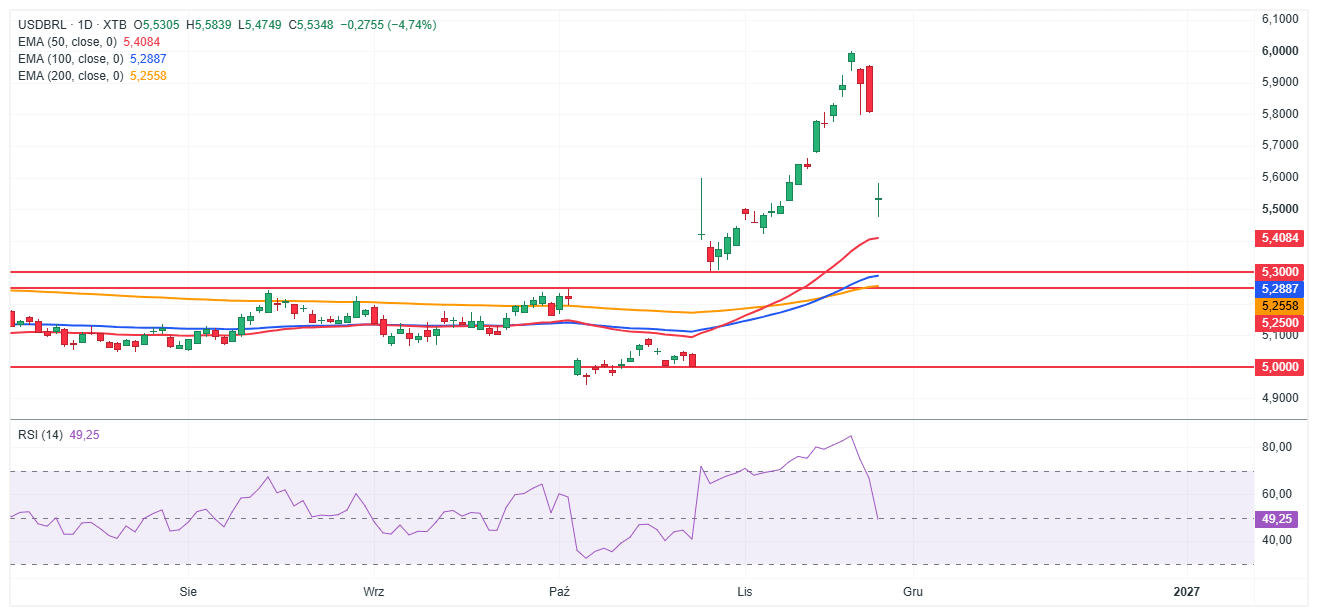
The daily USD/BRL chart illustrates the extent of the real’s recent weakness and the sharp reversal following the finance minister announcement.
Before the October election, the pair was trading around 5.00. Following the result, USD/BRL opened near 5.60 on Monday, October 26, creating a visible gap on the daily chart.
The dollar subsequently strengthened over the following weeks, with the pair approaching 6.00 towards the end of November.
The latest political announcement has reversed that direction, driving USD/BRL down towards 5.53 and erasing a substantial portion of the real’s recent losses.
The immediate focus is whether the pair can sustain its move below the 5.80 reference level. Continued selling pressure could indicate that investors are increasingly confident in Brazil’s fiscal outlook. However, a recovery towards previous levels would suggest that the latest rally is being treated as a short-term reaction rather than a fundamental change in sentiment.
Price Forecast – What Traders Are Watching
The near-term direction of USD/BRL will depend heavily on whether the market continues to interpret Trabuco’s appointment as a credible signal of fiscal discipline.
Factors supporting further real appreciation:
- Continued confidence in the incoming finance minister.
- Progress towards spending controls and improved government revenues.
- Sustained foreign investor interest in Brazilian equities and bonds.
- Continued demand for higher-yielding Brazilian assets.
Factors that could weaken the real:
- Political resistance to Trabuco’s appointment or proposed policies.
- Concerns that fiscal reforms will be insufficient.
- Renewed pressure on Brazilian government debt.
- A stronger US dollar and deterioration in global risk appetite.
The move towards 5.53 represents a significant change in short-term momentum. However, confirmation of a sustained trend reversal will require evidence that the government’s fiscal direction is changing rather than simply a positive initial response to a ministerial appointment.
Market Outlook for the Coming Sessions
The Brazilian real has staged a substantial recovery, with Lula’s decision to appoint Luiz Carlos Trabuco providing a significant boost to market confidence.
The immediate reaction has been positive across both currencies and equities. However, Brazil’s elevated public debt and the political challenges surrounding fiscal reform remain important risks.
For currency traders, USD/BRL will remain particularly sensitive to developments surrounding the incoming finance minister, government spending plans and investor confidence in Brazil’s economic management.
The key question is whether Trabuco can translate his appointment into meaningful fiscal discipline. If he succeeds in securing political support and implementing credible measures, the real could retain a stronger footing. If internal opposition prevents progress, the latest rally could prove vulnerable to reversal.
The near-term outlook for the Brazilian real has improved, but sustaining its gains will depend on policy delivery rather than the appointment announcement alone.
Today Markets IQ Analysis
This report is provided by Today Markets IQ, powered by Octalas Market Intelligence, with market commentary and research contributed by Currency Hedger.
Explore Our Services & Platforms
Free Multi Currency Account
Currency Hedger Signup
Free AI Market Analysis
Today Markets IQ Desktop
Deliverable FX Services
Visit Currency Hedger
Disclaimer: This material is provided for informational and educational purposes only and does not constitute investment advice, financial advice, trading recommendations or an offer to buy or sell any financial instrument. Financial markets involve risk, and past performance is not a reliable indicator of future results. Traders should conduct their own research and consider their financial circumstances before making investment decisions.

Leave A Comment