

Pound Tests 1.3500 Resistance as Markets Price Further Monetary Tightening
GBP/USD is approaching a critical turning point as the Bank of England prepares to deliver its first interest-rate increase since August 2023. The Monetary Policy Committee is widely expected to raise Bank Rate from 3.75% to 4.00%, but with markets already assigning a 97.4% probability to the move, the pound’s next direction will depend primarily on the Bank’s forward guidance.
Sterling is trading around 1.3464 after recovering approximately 2.5% from its October low near 1.3140. The pair has broken above an important technical zone between 1.3410 and 1.3430, shifting the immediate advantage towards buyers. However, resistance at 1.3500 has already attracted selling interest, while the Relative Strength Index is approaching overbought territory.
The central question is whether the Bank of England validates market expectations for an extended tightening cycle or signals that the expected increase is primarily a precautionary response to persistent inflation risks. A less hawkish outlook could undermine sterling despite the rate increase itself.
Market Snapshot
| Indicator | Latest position |
|---|---|
| GBP/USD | 1.3464 |
| Expected Bank Rate | 4.00% |
| Current Bank Rate | 3.75% |
| Expected rate increase | 25 basis points |
| Market probability of increase | 97.4% |
| Expected MPC vote | 7–2 |
| UK headline CPI, September | 3.5% |
| UK core inflation | 2.8% |
| Inflation target | 2.0% |
| GBP/USD October low | 1.3140 |
| Recent recovery | Approximately 2.5% |
| RSI | 65.5 |
| Immediate resistance | 1.3500 |
| Key support zone | 1.3410–1.3430 |
Bank of England Expected to Raise Rates to 4%
The Bank of England is expected to increase its benchmark interest rate from 3.75% to 4.00%, marking its first rate increase since August 2023.
Economists surveyed by Reuters anticipate a 7–2 vote in favour of the increase. The decision is scheduled for 1:00 p.m. Polish time, followed by Governor Andrew Bailey’s press conference 30 minutes later.
The move is largely reflected in financial markets, meaning the announcement itself may have limited influence on GBP/USD. Instead, traders will focus on the voting breakdown, updated economic projections, the accompanying statement and Bailey’s assessment of the inflation outlook.
The September meeting produced a 6–3 vote to leave rates unchanged. A shift towards a 7–2 majority would therefore indicate a stronger preference for tightening monetary policy.
External members Alan Taylor and Swati Dhingra are expected to oppose the increase, citing spare capacity in the economy. A more hawkish outcome, such as an 8–1 vote or a unanimous decision, could provide additional support for sterling.
UK Inflation Remains Above Target
Inflation is a central factor behind the expected policy change.
UK headline CPI increased to 3.5% in September, exceeding the Bank of England’s 2% target and its earlier July projection of 3%. Core inflation also accelerated to 2.8%.
Both measures have moved higher after falling towards approximately 2.6% around the middle of the year. The narrowing gap between headline and core inflation suggests that price pressures remain a concern beyond the immediate impact of energy costs.
Energy prices are adding to the challenge. Oil is hovering around $100 per barrel, while gas prices are reported to be approximately three times higher than before the US-Iran conflict.
The Bank of England is therefore facing a difficult policy decision. It must address the risk that higher energy costs become embedded in broader inflation expectations without placing unnecessary pressure on an economy that may still have spare capacity.
Economic Growth Provides Additional Support for Tightening
The UK economy has also demonstrated resilience.
GDP recorded its strongest year-over-year growth in August since 2022, while the UK was among the fastest-growing G7 economies during the first half of the year.
Investment associated with artificial intelligence may be contributing to economic activity, although there is currently limited evidence of significant second-round inflationary effects.
Companies expect wage increases of approximately 3.5% next year, broadly consistent with expectations for 2026. This suggests that wage growth remains a factor for policymakers to monitor, although it does not necessarily point to an accelerating wage-price spiral.
The latest government budget, which includes limited household support partly financed through a bank tax, is not expected to materially alter the immediate inflation outlook.
The Bank must therefore balance relatively strong economic activity and above-target inflation against evidence of spare capacity and uncertainty surrounding future growth.
The Biggest Risk for Sterling: Hawkish Decision, Dovish Commentary
Although a rate increase is almost fully priced in, financial markets are also anticipating further tightening.
Current market pricing suggests Bank Rate could rise to approximately:
| Expected timing | Implied Bank Rate |
|---|---|
| Current decision | 4.00% |
| February | 4.26% |
| April | 4.50% |
| End of 2027 | Close to 4.70% |
This implies almost three additional 25-basis-point increases beyond the expected November move.
However, policymakers may not share this outlook. Chief Economist Huw Pill has questioned whether four rate increases within a single year would be necessary. Many economists anticipate a much more limited tightening cycle, potentially involving only one further increase in early 2027 followed by an extended pause.
The probability of another increase as early as December is approximately 26%.
This creates a significant risk for sterling. If the Bank raises rates but indicates that markets are overestimating the scale of future tightening, the pound could weaken.
This is the classic hawkish decision with dovish commentary scenario: the immediate policy action supports the currency, but the forward guidance undermines expectations of higher future returns.
GBP/USD Technical Analysis: The Pound Tests the Upper End of Its Trading Range
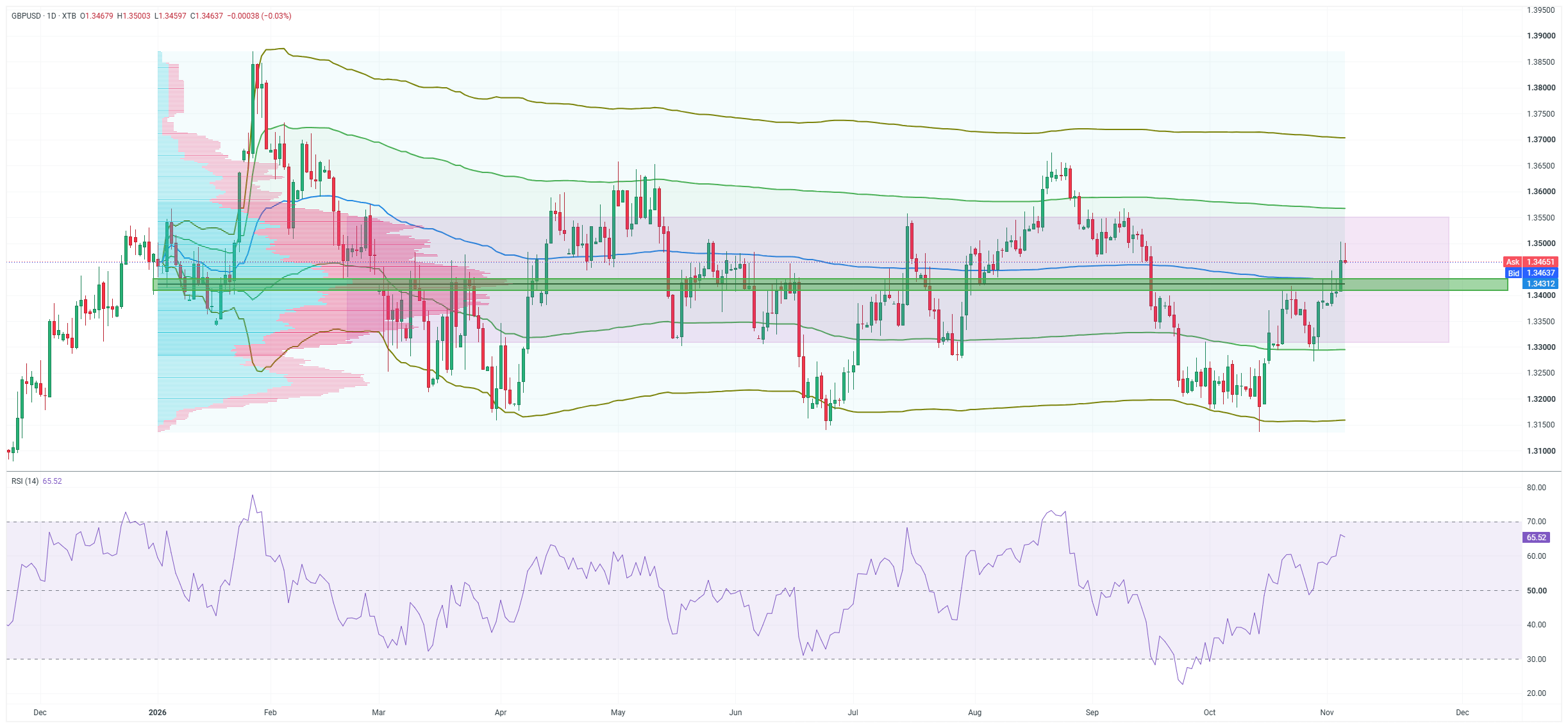
GBP/USD is trading around 1.3464, having recovered strongly from its October low near 1.3140.
The rebound began after the pair reached the lower band of two standard deviations. Since then, sterling has advanced approximately 2.5% and moved above the important 1.3410–1.3430 technical zone.
This area contains the volume profile control point, representing the highest trading volume since the beginning of the year. The year-to-date anchored volume-weighted average price is also positioned nearby, around 1.3431.
Holding above this area strengthens the near-term bullish structure.
However, the latest price action suggests that buying momentum is becoming less convincing at higher levels. GBP/USD tested 1.3500 before retreating, leaving a noticeable upper candle shadow. The RSI stands at 65.5, approaching overbought territory and indicating that further gains could become increasingly vulnerable to a correction.
GBPUSD: The pound is testing the upper end of the range
Key GBP/USD Technical Levels
| Technical level | Price | Significance |
|---|---|---|
| Major resistance | 1.3650–1.3670 | August highs |
| Upper resistance | 1.3570 | First upper deviation band |
| Resistance | 1.3550 | Upper boundary of value zone |
| Immediate resistance | 1.3500 | Psychological barrier |
| Key support | 1.3430–1.3410 | Volume control zone and anchored VWAP |
| Downside support | 1.3300 | First lower deviation band |
| October low area | 1.3140–1.3150 | Lower end of broader range |
Bullish Scenario
A sustained move above 1.3500 would improve the near-term outlook for sterling.
A subsequent break above 1.3550 and 1.3570 could open the way towards the August highs between 1.3650 and 1.3670.
For this scenario to develop, the Bank of England would need to deliver a sufficiently hawkish message to support expectations of further monetary tightening.
Bearish Scenario
A dovish assessment of the future rate path could trigger profit-taking in sterling, particularly if the Bank challenges current market pricing.
A move below the 1.3410–1.3430 support zone would weaken the recent breakout and shift attention towards the middle of the broader trading range.
Further losses could expose 1.3300, with the lower end of the wider consolidation range located around 1.3150.
Bullish Sentiment
- Expected rate increase: The Bank of England is widely expected to raise Bank Rate to 4.00%, improving the immediate interest-rate differential outlook.
- Potential hawkish voting pattern: A vote stronger than the anticipated 7–2 split could reinforce expectations of further tightening.
- Inflation remains elevated: Headline CPI at 3.5% gives policymakers a reason to maintain a restrictive policy stance.
- Resilient economic growth: UK economic performance provides some support for a higher interest-rate environment.
- Technical breakout: GBP/USD is holding above the important 1.3410–1.3430 control zone.
- Potential resistance break: A sustained move above 1.3500 could attract additional buying interest.
Bearish Sentiment
- Rate increase already priced in: With a 97.4% market probability, the immediate decision offers limited scope for a positive surprise.
- Dovish forward guidance: The Bank could challenge expectations for several additional rate increases.
- Spare economic capacity: Opposition from MPC members could highlight concerns about the economy’s ability to absorb further tightening.
- Overbought momentum: An RSI of 65.5 suggests that the pair is approaching a level where buying momentum could weaken.
- Resistance at 1.3500: The latest rejection at this level indicates that sellers remain active.
- Risk of a failed breakout: A decline below 1.3410–1.3430 could return GBP/USD towards the middle of its wider trading range.
GBP/USD Outlook for the Coming Sessions
The Bank of England decision is likely to determine whether sterling can extend its recent recovery or whether the market begins to unwind expectations of further tightening.
The immediate technical picture remains constructive while GBP/USD holds above 1.3410–1.3430. However, the 1.3500 resistance level is an important near-term barrier, and the latest rejection suggests that buyers may need a stronger policy signal to push the pair higher.
A hawkish vote and supportive forward guidance could open the way towards 1.3550 and 1.3570, with the August highs around 1.3650–1.3670 becoming the next major upside objective.
Conversely, a rate increase accompanied by dovish commentary could trigger a sterling reversal. A break below the control zone would weaken the bullish technical structure and expose 1.3300.
Since February, GBP/USD has remained within a broad consolidation range of approximately 1.3150–1.3650. The Bank of England decision may determine which side of this range receives the next serious test, although a decisive breakout is not guaranteed.
Today Markets Analysis
The Bank of England’s expected rate increase is not the main event for sterling. The real market test will be whether policymakers validate the aggressive tightening expectations currently reflected in interest-rate markets.
UK inflation remains above target, economic growth has been relatively resilient and energy prices continue to create uncertainty. These factors provide justification for a more restrictive policy stance.
However, the market’s expectations for further increases may prove too optimistic. If the Bank signals that the November move is primarily a risk-management decision rather than the beginning of a prolonged tightening cycle, sterling could weaken despite the increase.
Technically, GBP/USD remains supported above 1.3410–1.3430, but resistance at 1.3500 and the elevated RSI suggest that the pair is approaching an important decision point.
The combination of monetary-policy guidance and the reaction around these technical levels will be crucial in determining the next move.
Currency Hedger View
The GBP/USD outlook is particularly important for businesses managing payments and receipts between the United Kingdom and the United States.
A stronger pound reduces the sterling cost of dollar-denominated imports and supplier payments. However, UK businesses receiving revenue in US dollars may see the sterling value of those receipts decline as GBP/USD rises.
For US companies purchasing goods or services from UK suppliers, a stronger pound can increase the dollar cost of future payments.
The Bank of England decision could therefore create short-term uncertainty for businesses with upcoming international settlements. Companies with significant GBP or USD exposure should consider their payment dates, cash-flow requirements and tolerance for exchange-rate movements rather than relying solely on a particular market forecast.
Currency Hedger helps businesses assess deliverable foreign-exchange exposure and explore suitable approaches to managing cross-border payment and currency risk.
Manage your currency exposure:
Disclaimer
This article is provided for general market information and educational purposes only. It does not constitute investment advice, financial advice, a recommendation or an offer to buy or sell any financial instrument. Technical levels and market scenarios are based on the information available in the source material and are not guarantees of future price movements. Foreign-exchange markets are volatile and trading involves risk. Businesses should seek appropriate professional advice when assessing their currency exposures.

Leave A Comment