


Contributor: Currency Hedger | Market Analysis: Louis Roche, Today Markets
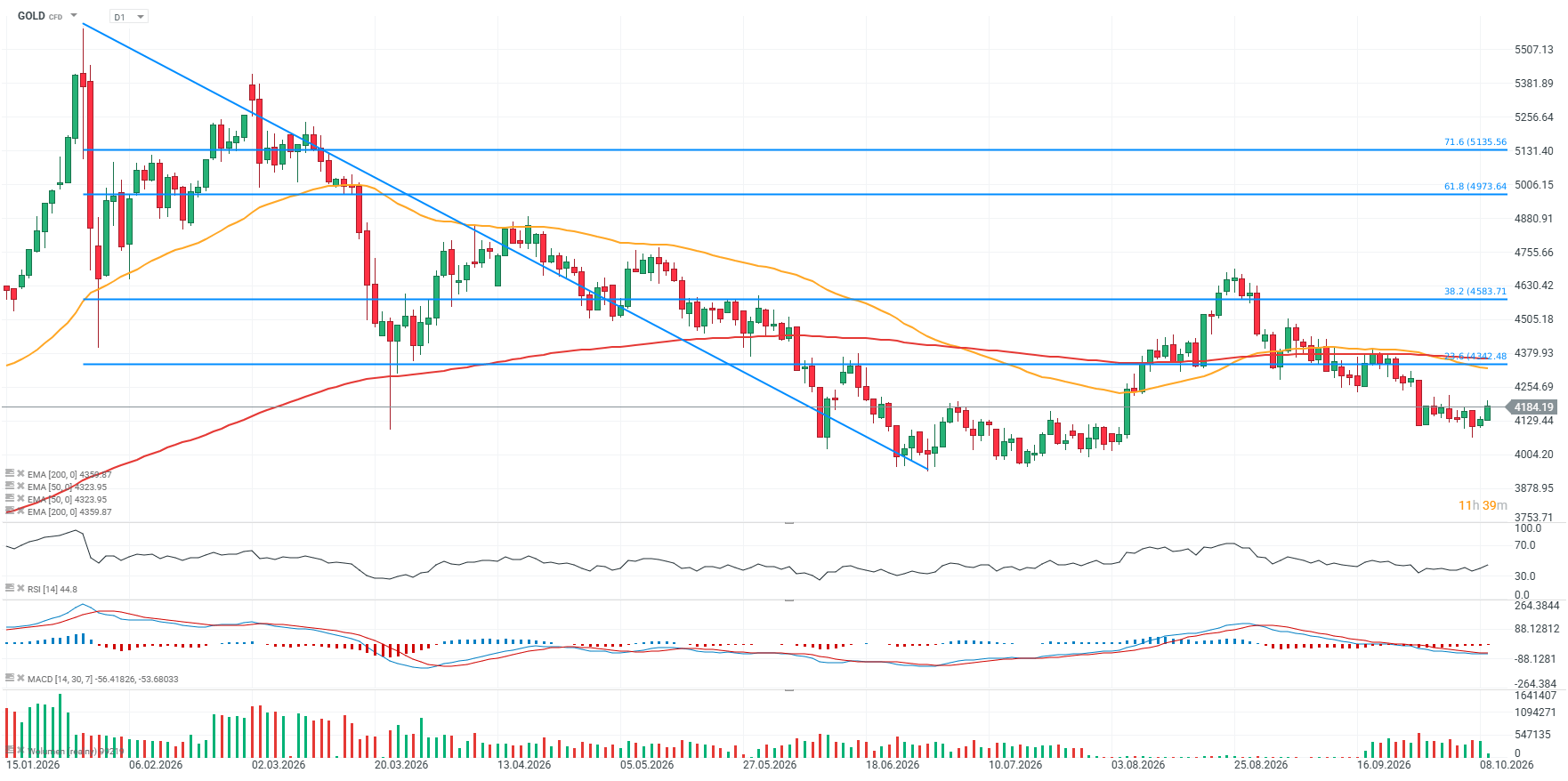
Gold is attempting to recover after retreating from its recent highs, with prices advancing by approximately 1.2% and approaching the $4,200-per-ounce level. The rebound suggests that buyers are defending the $4,070–$4,150 area as a potential short-term base, although a sustained recovery will depend on the direction of the US dollar, Treasury yields and expectations for Federal Reserve policy.
The outlook remains mixed. Concerns over US government debt, geopolitical uncertainty and resilient investment demand are supporting gold’s appeal as a safe-haven asset. However, elevated borrowing costs and uncertainty over the Fed’s next move could continue to restrict the metal’s upside.
Market Snapshot
| Indicator | Current market picture |
|---|---|
| Gold (GOLD) | Up approximately 1.2% |
| Key resistance | Around $4,200 per ounce |
| Potential support zone | $4,070–$4,150 |
| US Treasury yields | Elevated, but below the recent 5.35% peak cited in the source |
| US dollar | Relatively firm, creating headwinds for gold |
| ETF holdings | Reportedly above 101 million ounces |
| Market bias | Cautiously constructive, subject to confirmation |
Market figures and positioning observations are based on the supplied market report and should be checked against live data before publication.
Gold Price Outlook: Can Buyers Sustain the Recovery?
Gold’s latest advance indicates that investors are attempting to establish a firmer base following the recent decline. The $4,070–$4,150 area is an important zone to monitor because a sustained defence of this range could provide the foundation for a renewed move higher.
A break above $4,200 would be an initial sign that buyers are regaining control. If the metal can maintain momentum above this level, attention could turn towards higher resistance areas established during the preceding advance. However, an intraday rise alone is not enough to confirm a trend reversal. Gold needs to demonstrate that buying interest can absorb selling pressure as prices approach resistance.
Conversely, a failure to hold the recent base would weaken the recovery case and expose the market to another test of lower support. The immediate direction is likely to depend on whether safe-haven demand can offset the pressure created by elevated yields and a firm dollar.
Federal Reserve Uncertainty Keeps Volatility Elevated
The Federal Reserve remains one of the most important influences on gold’s near-term direction. Recent meeting minutes reportedly revealed divisions among policymakers over the reasons for the September rate increase, with some focused on inflation risks linked to price shocks and others concerned about inflation generated by stronger demand.
This disagreement leaves investors without a clear, predetermined path for future monetary policy. The possibility of further tightening remains relevant, while the pace and timing of any additional increases are uncertain.
For gold, the distinction is important. Higher interest rates and bond yields generally increase the opportunity cost of holding a non-yielding asset, making the metal less attractive relative to interest-bearing alternatives. Expectations of a less restrictive policy outlook, by contrast, could help gold regain momentum.
The supplied report cites market-implied probabilities of approximately 17% for an October rate increase and 81% for a December increase. These figures are time-sensitive and should be verified before publication. More broadly, changes in rate expectations may prove as important as the actual policy decision.
US Debt Concerns Offer a Counterweight to High Yields
Concerns about the scale of US government debt may provide an additional source of support for gold. Investors may seek to diversify exposure away from government assets and fiat currencies when fiscal sustainability becomes a greater concern.
This creates a competing force in the current market. Elevated Treasury yields and dollar strength can weigh on gold in the short term, while longer-term concerns about debt, purchasing power and financial stability may reinforce its role as a portfolio diversifier.
The balance between these forces will be important in determining whether the latest recovery develops into a broader advance or remains a temporary rebound within a corrective phase.
Geopolitical Risk and the Strait of Hormuz
Geopolitical tensions surrounding the Strait of Hormuz remain another factor to monitor. Any escalation that threatens shipping routes or energy supplies could increase demand for safe-haven assets, including gold.
However, the relationship is not straightforward. A sustained disruption to energy flows could push oil prices higher, adding to inflationary pressure and potentially strengthening expectations that central banks will maintain restrictive monetary policy.
Gold could therefore face opposing effects from the same geopolitical event: stronger safe-haven demand on one side and higher inflation expectations and yields on the other. The market’s response will depend on which channel dominates.
Gold ETF Holdings Signal Underlying Investment Interest
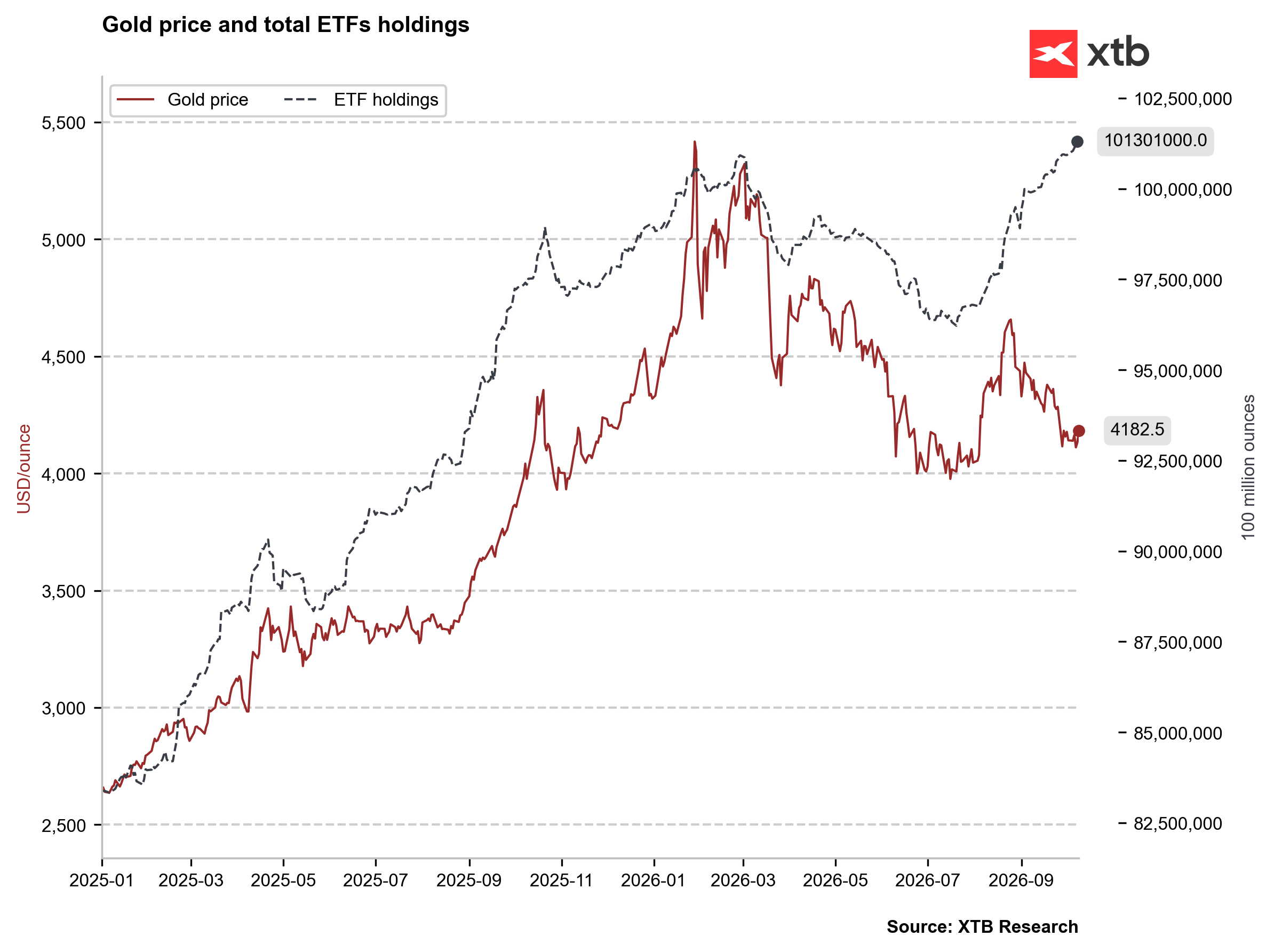
The supplied report highlights a divergence between gold prices and exchange-traded fund holdings. While gold has pulled back from its recent highs, aggregate ETF holdings are reportedly above 101 million ounces.
If confirmed, this divergence would suggest that some investors continue to build or maintain exposure despite the price correction. Sustained ETF inflows could provide a constructive medium-term signal, particularly if they are accompanied by stronger physical demand.
Nevertheless, ETF holdings should not be treated as a guarantee of higher prices. Short-term movements can still be dominated by changes in the dollar, real yields, futures positioning and expectations for monetary policy. The key question is whether continued investment demand will translate into sufficient buying pressure to push gold through resistance.
GOLD (D1 timeframe)
COMEX and Shanghai Positioning: A Divergence to Watch
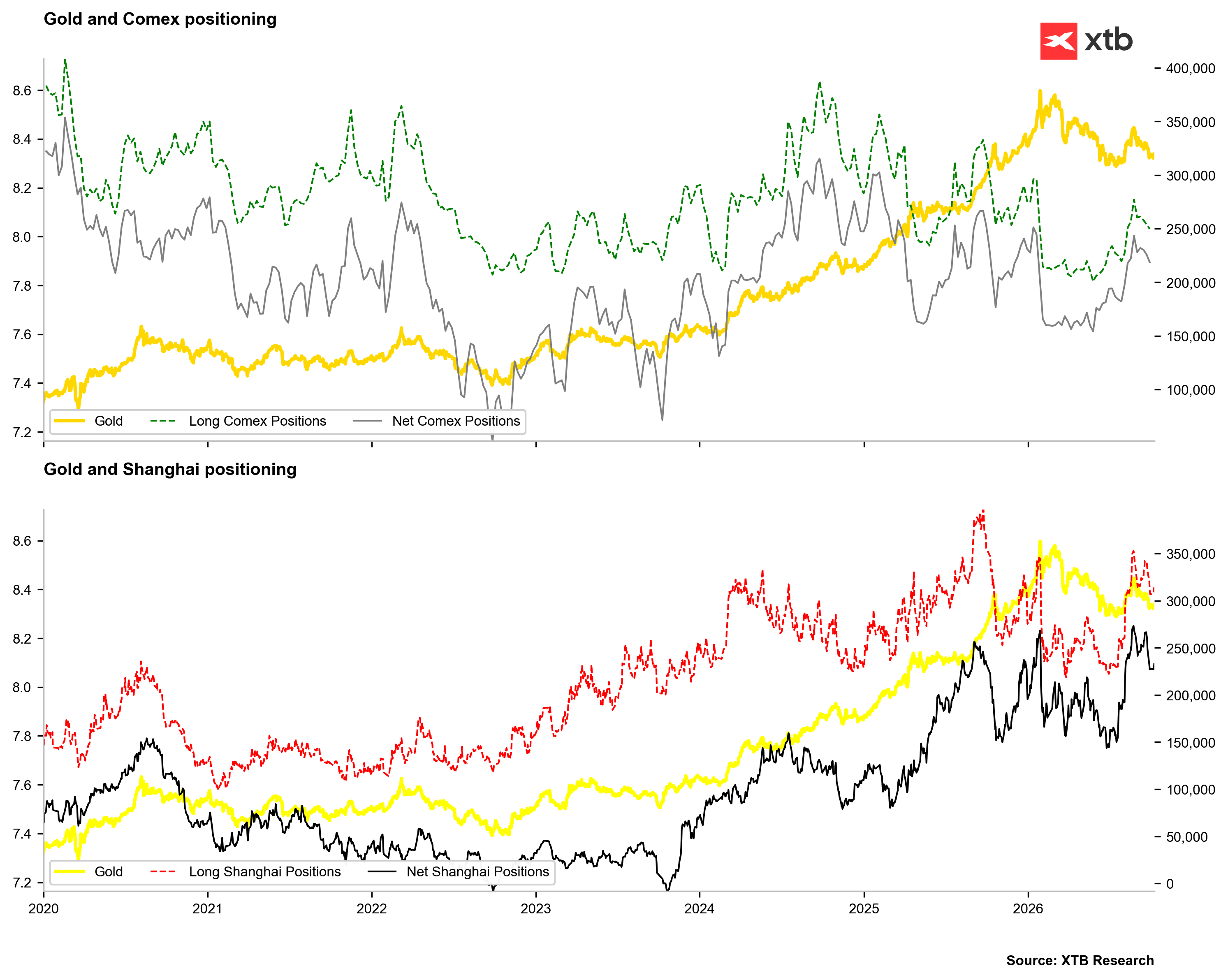
The positioning picture described in the supplied report is moderately constructive. COMEX long and net positions have reportedly recovered from their lows but remain below previous peaks. This may indicate that speculative exposure has moderated, potentially reducing the risk of an aggressive liquidation if prices weaken again.
Shanghai positioning, by contrast, is described as remaining relatively elevated compared with much of the period since 2020. This may point to more persistent demand from Asian investors, while Western futures positioning appears more sensitive to interest-rate expectations and dollar movements.
If these trends are confirmed, the contrast could indicate that underlying demand remains present even as short-term investors reassess the US monetary outlook. However, positioning data can change quickly and should be assessed alongside actual price action and fund flows.
Bullish and Bearish Scenarios
Bullish scenario
Gold holds the $4,070–$4,150 support area and breaks convincingly above $4,200. A softer dollar, declining yields, continued ETF inflows or renewed geopolitical concerns could help extend the recovery. A sustained move above resistance would strengthen the case for a broader rebound.
Bearish scenario
Gold fails to maintain its recent base, while Treasury yields remain elevated and the dollar strengthens further. Renewed expectations of Fed tightening could reduce demand for non-yielding assets and push prices back towards the lower end of the recent range. A break below support would weaken the recovery structure.
Neutral scenario
Gold continues to consolidate between the recent support zone and $4,200 as investors wait for clearer signals on monetary policy, yields and geopolitical developments. In this scenario, volatility may remain elevated without a sustained directional move.
Gold Price Forecast for the Coming Sessions
Gold’s short-term outlook is cautiously constructive while prices remain above the $4,070–$4,150 area, but confirmation is needed before a stronger bullish view can be established.
The first test is whether buyers can sustain a move through $4,200. A successful break could attract additional momentum-driven demand, particularly if the dollar and yields begin to ease. If resistance holds, the metal may remain range-bound as traders balance safe-haven demand against the cost of holding gold in a high-yield environment.
The next directional move is likely to be shaped by US interest-rate expectations, Treasury market developments, dollar movements and changes in geopolitical risk. Investors should also monitor whether reported ETF demand remains firm during any further price weakness.
Overall outlook: Gold has room to recover if support holds, but the market remains vulnerable to renewed pressure from higher yields and dollar strength. Confirmation above $4,200 would improve the near-term technical picture, while a break below the recent base would increase the risk of another decline.
Analysis — Louis Roche, Today Markets
Gold is approaching a critical point in its short-term recovery. The recent advance suggests that buyers are becoming more active following the correction, while reported ETF holdings and resilient Asian positioning point to continued interest in the metal.
However, the recovery is taking place against a challenging monetary backdrop. Elevated yields and uncertainty surrounding the Federal Reserve could limit further gains, particularly if inflation concerns encourage policymakers to maintain a restrictive stance.
The most important signal will be the market’s ability to hold support and establish acceptance above $4,200. Until that happens, gold’s rebound should be treated as an attempt to stabilise rather than definitive evidence that the previous upward trend has resumed.
Currency Hedger View
Gold’s outlook reflects the same macroeconomic forces that influence currency markets: interest-rate expectations, dollar strength, inflation risks and geopolitical uncertainty. A stronger US dollar can place pressure on gold while also affecting the cost of international transactions and the value of overseas revenues.
Businesses with cross-border exposure should monitor these developments alongside their own currency requirements. Sudden changes in monetary-policy expectations or geopolitical conditions can produce rapid movements across foreign exchange and commodity markets, making forward planning and exposure management particularly important.
Currency Hedger monitors foreign exchange markets alongside broader commodity and macroeconomic conditions, helping businesses assess and manage their international currency exposure.
Open a Currency Hedger Account: https://currencyhedger.numito.com/onboarding?utm_source=chatgpt.com
Explore Currency Hedger at https://currencyhedger.com/
Disclaimer
This article is for informational and educational purposes only and does not constitute investment advice, a recommendation or an offer to buy or sell any financial instrument. Gold prices can be volatile, and precious metals trading involves a risk of loss. Forecasts and scenarios are conditional, not guaranteed outcomes. Readers should conduct their own research and consider their financial circumstances before making investment decisions.

Leave A Comment