


- The Indian Rupee rallies further on RBI’s forceful measures to curb US Dollar’s demand.
- Oil prices recover due to ongoing Middle East tensions.
- The US Dollar corrects ahead of the US CPI data for September.
The Indian Rupee (INR) extends the rally against the US Dollar (USD) for the third trading day on Wednesday, driven by fresh Reserve Bank of India’s (RBI) measures to curb the US Dollar’s (USD) demand. In the opening trade, the USD/INR pair is down 0.35% to slightly below 95.00, the lowest level seen in over a month.
Over the weekend, the RBI unveiled several measures, including special window for Public Sector Undertaking’s (PSU) Oil Marketing Companies (OMCs) for buying US Dollars against crude oil imports and tighter hedging rules, in an attempt to curtail demand for US Dollars.
Meanwhile, market experts doubt that the near-term rally in the Indian currency is sustainable due to external pressures.
RBI steps seen stabilising INR but not reversing broader depreciation
Strategists at OCBC argue that the RBI’s “increasingly forceful response may help contain near-term INR depreciation pressures,” but they remain “cautious about extrapolating the latest rebound into a sustained recovery.” They note that “higher hedging costs may temper forward USD demand, but could also discourage genuine corporate hedging,” while “the special USD window for oil companies shifts demand away from the spot market rather than reducing India’s underlying US dollar requirements.”
OCBC adds that “we may still see room for some near-term INR gains, but the sustainability of the move will depend on whether portfolio outflows moderate and external pressures from oil prices and US yields ease.” In their view, “for now, the policy measures may help establish a firmer near-term footing for INR, rather than mark a decisive reversal in its broader depreciation trend.”
Oil prices rebound as Middle East risks remain intact
In the opening trade, the MCX Crude Oil contract expiring on October 19 is up almost 0.5% to near Rs. 9,000. Oil prices have recovered from its monthly low of Rs. 8,338 in the past week as supply risks from the Middle East remain intact due to tensions between Saudi Arabia and Iran-backed Houthis.
Currencies from economies, such as India, which rely heavily on oil imports to meet their energy needs, tend to underperform in a high-oil-price environment.
The Houthis attacked an administrative building belonging to state-owned oil firm Saudi Aramco in the city of Dhahran, causing a limited fire, Saudi Arabia’s energy ministry said on Wednesday, Reuters reported.
Lower US Dollar weighs on USD/INR
The correction in the US Dollar ahead of the release of the United States (US) Consumer Price Index (CPI) data for September at 12:30 GMT has also weakened the USD/INR pair.
In the Asian trade, the US Dollar Index (DXY), which gauges the Greenback’s value against six major currencies, trades 0.1% lower to near 102.10. The DXY has retreated from its yearly high of 102.61 posted on Monday.
Investors will pay close attention to the US CPI data to get fresh cues regarding the Federal Reserve’s (Fed) monetary policy outlook.
The US CPI report will likely to show that the headline inflation rose to 3.6% Year-on-Year (YoY) from 3.4% in August. The core CPI – which excludes volatile food and energy items – is seen arriving at 2.5% YoY, higher than the previous reading of 2.4%.
USD/INR Technical Analysis
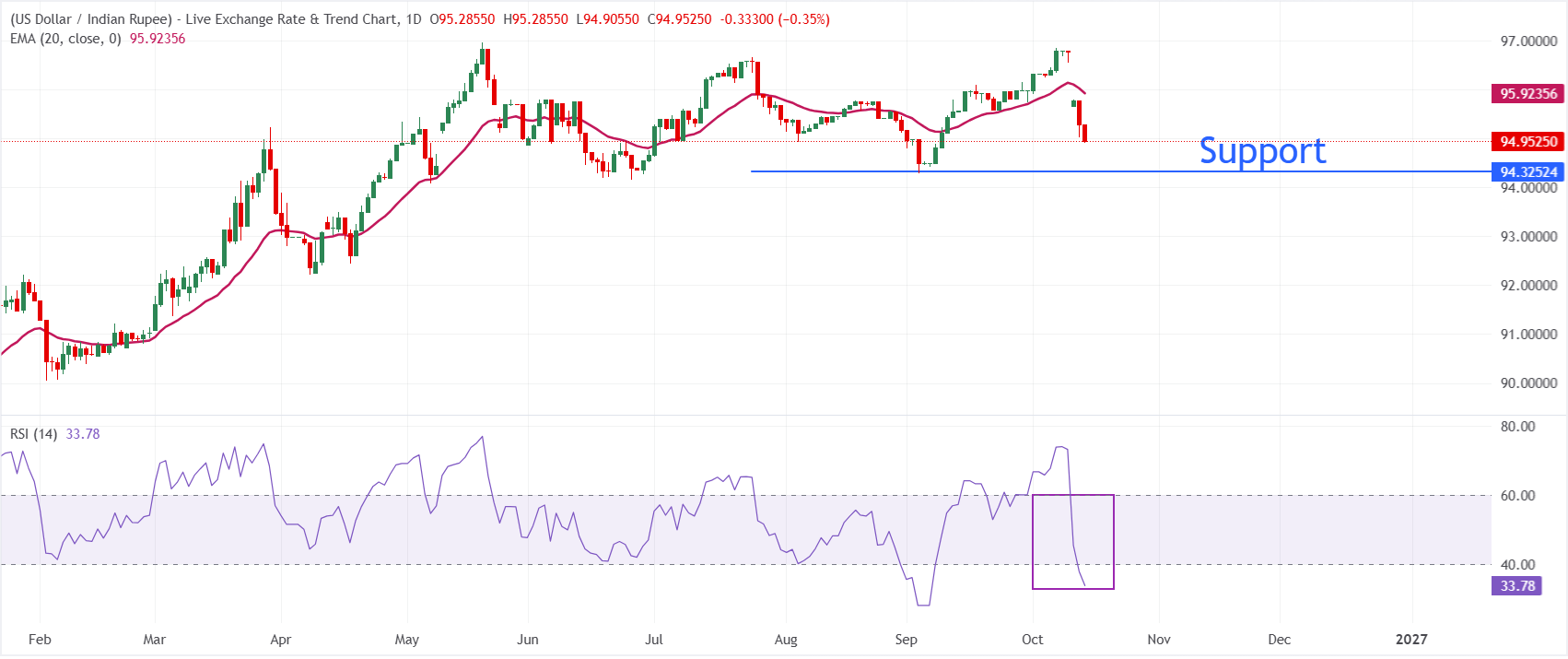
In the daily chart, USD/INR trades at 94.95, keeping a bearish near-term tone as spot holds below the 20-day Exponential Moving Average (EMA) at 95.92.
The break under the short-term trend gauge suggests the pair remains under corrective pressure after recent overbought conditions, while the Relative Strength Index (14) easing toward 34 hints at fading bullish momentum rather than outright oversold stress.
On the topside, immediate resistance is located at the 20-day EMA near 95.92, where any recovery would likely meet initial supply and define whether the latest pullback is merely a pause within the broader uptrend or the start of a deeper correction. Looking down, the pair could extend its decline towards the September low near 94.30.

Leave A Comment