


Gold prices extended their decline for a fourth consecutive session on Thursday, falling below $3,700 per ounce to their lowest level in more than a year. A stronger US dollar, renewed expectations of Federal Reserve interest rate increases and persistent market uncertainty have combined to put significant pressure on the precious metal.
Gold has lost more than 5% over the past week, marking a sharp reversal from its January peak above $5,589 per ounce. The scale of the decline highlights how quickly sentiment has changed, with investors increasingly favouring the US dollar over non-yielding bullion.
Although global equity markets have attempted to recover, the metals market remains under pressure. The immediate question for traders is whether gold can defend the $3,690–$3,700 support area or whether a sustained break lower will expose the psychologically important $3,500 level.
Gold Market Snapshot
| Market Indicator | Latest Position |
|---|---|
| Gold price | Below $3,700 per ounce |
| Weekly performance | Down more than 5% |
| Recent losing streak | Fourth consecutive session |
| January peak | Above $5,589 per ounce |
| Previous support | $3,800 |
| Immediate support | $3,690–$3,700 |
| Next major downside target | $3,500 |
| Initial recovery resistance | $3,800 |
| Further resistance | $3,880 |
| Technical trend | Bearish |
| Main market driver | US dollar strength and hawkish Fed expectations |
Why Is Gold Falling So Sharply?
The strongest immediate influence on gold has been the resurgence of the US dollar. The dollar has become the best-performing major currency on a broad basis, making dollar-denominated gold more expensive for holders of other currencies and reducing demand for bullion.
The relationship between gold and the dollar remains particularly important in the current environment. When the dollar strengthens, investors generally require fewer dollars to purchase an ounce of gold, creating additional downward pressure on the precious metal.
The dollar’s recovery has also been supported by changing expectations for Federal Reserve policy. Stronger-than-expected inflation data have increased market expectations of further interest rate increases, with the latest pricing indicating a 92% probability of a 25-basis-point increase next month and a 7% probability of a 50-basis-point increase.
This shift in rate expectations has strengthened the appeal of holding US currency rather than non-yielding assets such as gold.
Treasury Yields Offer a Different Signal
One notable feature of the current sell-off is that US Treasury yields have moved lower during the week, despite the more hawkish interest rate outlook.
The US 10-year Treasury yield has returned below 5.1%, suggesting that rising yields are not the primary explanation for gold’s latest weakness.
Instead, the strength of the US dollar appears to be the more influential factor. Investors are seeking exposure to the dollar amid geopolitical concerns and continued volatility across equity markets.
In this environment, gold is losing some of its appeal as investors favour dollar liquidity and the potential returns associated with higher US interest rates.
Technical Analysis: Gold Breaks Below Key Support
The technical picture has deteriorated considerably. Gold is trading well below important long-term support levels, including its 200-day simple moving average, reinforcing the bearish medium-term outlook.
The break below $3,800 earlier in the week was particularly significant. This level had previously provided support but is now an important short-term resistance area.
Gold is also trading within a descending channel, indicating that selling pressure remains dominant.
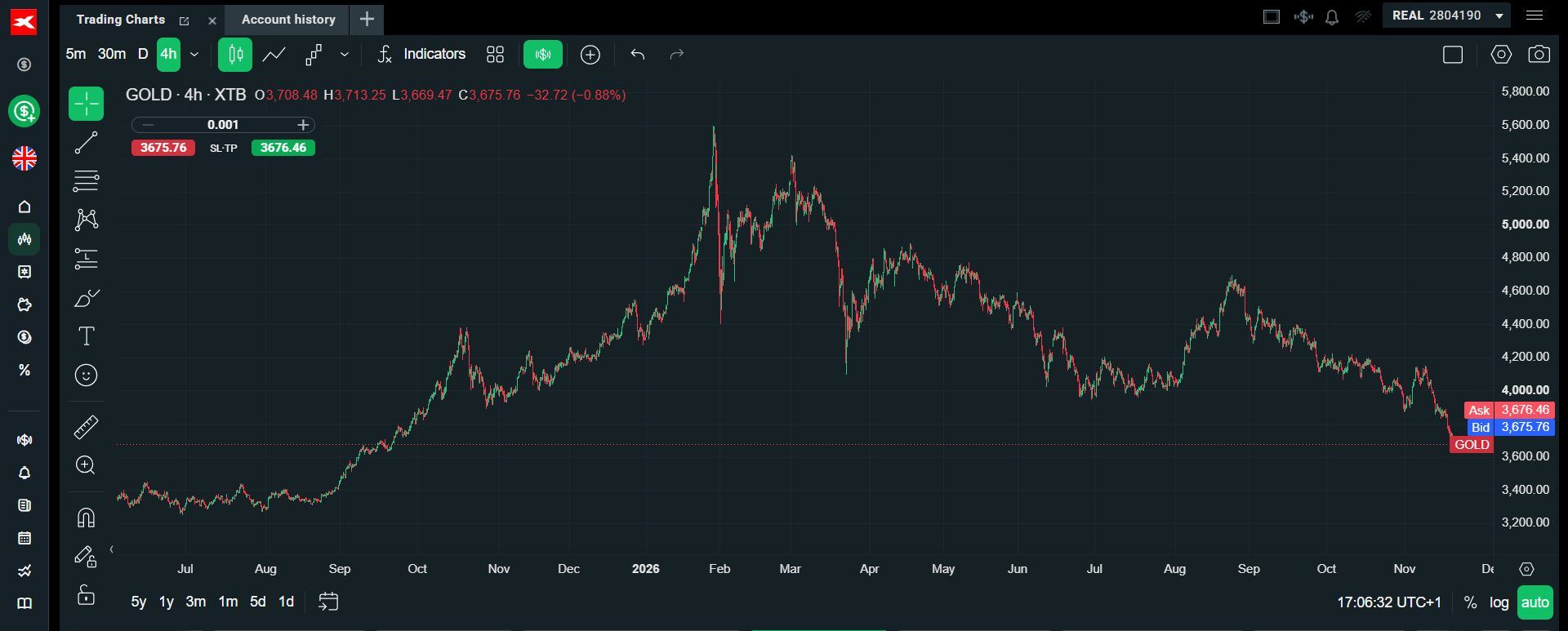
The immediate technical test is the $3,690–$3,700 support zone. A decisive break below this area could open the way towards $3,500, which represents both a psychologically important price level and a key Fibonacci support area.
A recovery, meanwhile, would initially need to overcome resistance at $3,800. Further resistance is located around $3,880, corresponding with the midpoint of the descending channel.
Bullish Sentiment
- Oversold conditions: Gold is approaching oversold territory on the Relative Strength Index (RSI), potentially creating conditions for a short-term recovery.
- Lower Treasury yields: The decline in US 10-year yields below 5.1% could provide some relief if the relationship between yields and gold becomes more influential.
- Potential technical stabilisation: A sustained defence of the $3,690–$3,700 support zone could encourage short-covering and a recovery towards $3,800.
- Changing market expectations: Any reduction in expectations for further Federal Reserve rate increases could weaken the dollar and improve gold’s appeal.
Bearish Sentiment
- Stronger US dollar: Broad-based dollar strength remains the most significant immediate headwind for gold.
- Hawkish Federal Reserve expectations: Market pricing for another US rate increase next month is undermining demand for non-yielding bullion.
- Breakdown below $3,800: The loss of this important support level has weakened the technical structure and turned it into resistance.
- Bearish medium-term trend: Gold remains below key long-term technical support, including the 200-day moving average.
- Elevated market volatility: Continued uncertainty across equity markets may encourage investors to favour dollar exposure over gold.
Chart 1: Gold, can it find support around $3690?
Gold Price Forecast: What Traders Are Watching
The immediate outlook for gold remains bearish, with the $3,690–$3,700 area representing the most important near-term technical level.
A confirmed break below this support zone would increase the likelihood of further losses, bringing $3,500 into focus. This level could attract buying interest because of its psychological significance and its position as a key Fibonacci support area.
However, the market is approaching oversold conditions, which could limit the pace of further declines and create opportunities for a temporary rebound.
For any recovery to gain credibility, gold would first need to reclaim $3,800. A move above this level could open the way towards $3,880, although the descending channel suggests that selling pressure may re-emerge around resistance.
The direction of the US dollar and changing expectations for Federal Reserve policy are likely to remain the key fundamental influences.
Gold Supply Outlook
The supplied market information does not identify a significant change in gold production, mine supply or physical availability. The latest decline is therefore more clearly associated with currency movements, interest rate expectations and investor positioning than with a reported change in physical supply.
Traders will continue to monitor broader market conditions alongside any developments that could alter demand for investment-grade bullion.
Gold Demand Outlook
Investment demand is facing pressure as the US dollar strengthens and expectations of higher interest rates increase the opportunity cost of holding gold.
Geopolitical concerns and equity market volatility remain relevant, but the current market behaviour suggests that investors are prioritising dollar exposure.
The demand outlook could improve if the dollar loses momentum, Federal Reserve expectations become less hawkish or risk sentiment deteriorates sufficiently to renew interest in traditional defensive assets.
Market Outlook for the Coming Sessions
Gold enters the next trading sessions with a bearish bias. The combination of a stronger US dollar, hawkish Federal Reserve expectations and a breakdown below $3,800 has weakened both the fundamental and technical outlook.
The immediate focus will be whether buyers can defend the $3,690–$3,700 support zone. If this area fails, the next major downside objective is around $3,500.
A short-term recovery remains possible because of increasingly oversold technical conditions, but any rebound towards $3,800 or $3,880 may encounter selling pressure.
For the bearish outlook to change, traders will need to see a sustained improvement in gold’s price structure, supported by a weaker US dollar or a meaningful shift in interest rate expectations.
For now, the balance of risks remains tilted to the downside, with the dollar likely to dictate gold’s direction over the coming sessions.
Currency Hedger – Market Contributor
Currency movements and changes in interest rate expectations remain important influences on global commodity markets. Currency Hedger provides foreign exchange solutions, international payments and currency risk management services for businesses operating across borders.
Disclaimer
This article is provided for informational and educational purposes only and does not constitute investment advice, financial advice or a recommendation to buy or sell any financial instrument. Gold and other financial markets involve risk, and prices can move rapidly in response to economic data, monetary policy decisions and geopolitical developments. Traders should conduct their own research and consider their financial circumstances and risk tolerance before making investment decisions.

Leave A Comment