

Currency Hedger No Comments

USD/JPY climbs as US Dollar strength outweighs hawkish BoJ, geopolitical risks

  • USD/JPY edges higher, supported by the resilience of the US Dollar amid geopolitical tensions.
  • The Japanese Yen remains under pressure despite a hawkish tone from the Bank of Japan.
  • Markets stay focused on Middle East tensions and their impact on energy prices and safe-haven flows.

USD/JPY trades around 159.00 on Wednesday at the time of writing, up 0.18% on the day. The pair continues to draw support from sustained demand for the US Dollar (USD) in an environment marked by persistent geopolitical uncertainty.

The Japanese Yen (JPY) struggles to attract buyers despite the release of the Bank of Japan (BoJ) meeting minutes, which indicate that policymakers see room for further rate hikes if the economic outlook evolves as expected. This relatively hawkish stance is offset by concerns over the impact of rising energy prices on Japan’s economy, which is heavily reliant on imports. The surge in Oil prices, driven by the Middle East war, is worsening Japan’s terms of trade and adding further pressure on the currency.

At the same time, the US Dollar remains firm, supported by its safe-haven status. Investors remain cautious as they monitor developments in discussions between Washington and Tehran, with ceasefire proposals circulating but no confirmed breakthrough. Recent military developments in the region continue to fuel risk aversion and reinforce flows into the Greenback.

On the monetary policy front, comments from Federal Reserve (Fed) officials, including Michael Barr, suggest that interest rates may need to remain steady for some time due to inflation still running above target. This outlook helps maintain yield differentials in favor of the US Dollar against the Japanese Yen.

Analysts at BNY also highlight that Japanese activity data show signs of improvement, with a rebound in industrial production and exports. However, these positive signals have not been sufficient to support the JPY, as markets remain focused on yield spreads and global risk dynamics.

Meanwhile, Societe Generale economists note that the pair is testing the upper bound of its multi-year range, with the risk of a bullish breakout if levels near 160 are cleared. They point to the potential for a move toward the highs seen in 2024, as the US Dollar continues to hold the upper hand.

Finally, OCBC Bank emphasizes the key role of energy prices in the JPY’s current weakness, while warning that Japanese authorities could intervene in the foreign exchange market if USD/JPY moves sustainably above the 160 threshold. This could limit further upside in the short term, without necessarily altering the broader bullish trend.

US Dollar Price Today

The table below shows the percentage change of US Dollar (USD) against listed major currencies today. US Dollar was the strongest against the Australian Dollar.

USDEURGBPJPYCADAUDNZDCHF
USD0.21%0.17%0.19%0.14%0.50%0.32%0.34%
EUR-0.21%-0.04%0.02%-0.08%0.29%0.10%0.12%
GBP-0.17%0.04%0.04%-0.02%0.33%0.14%0.17%
JPY-0.19%-0.02%-0.04%-0.06%0.30%0.10%0.13%
CAD-0.14%0.08%0.02%0.06%0.37%0.19%0.20%
AUD-0.50%-0.29%-0.33%-0.30%-0.37%-0.18%-0.17%
NZD-0.32%-0.10%-0.14%-0.10%-0.19%0.18%0.01%
CHF-0.34%-0.12%-0.17%-0.13%-0.20%0.17%-0.01%

The heat map shows percentage changes of major currencies against each other. The base currency is picked from the left column, while the quote currency is picked from the top row. For example, if you pick the US Dollar from the left column and move along the horizontal line to the Japanese Yen, the percentage change displayed in the box will represent USD (base)/JPY (quote).


Currency Hedger No Comments

EUR/USD under pressure as Iran pushes back against US ceasefire proposal

  • EUR/USD remains on the defensive as the US Dollar stays firm amid mixed US-Iran ceasefire signals.
  • Iran pushes back against US peace proposals, limiting ceasefire hopes
  • Oil-driven inflation concerns boost ECB rate hike bets while the Fed is seen holding rates.

The Euro (EUR) trades under pressure against the US Dollar (USD) on Wednesday, as the Greenback remains well supported amid conflicting headlines surrounding US-Iran ceasefire efforts. While Washington is pushing for a diplomatic breakthrough, uncertainty over Tehran’s response continues to underpin demand for the safe-haven Greenback.

At the time of writing, EUR/USD is trading around 1.1585, down about 0.20% on the day. Meanwhile, the US Dollar Index (DXY), which tracks the Greenback’s value against a basket of six major currencies, is 99.40 after marking an intraday low of 99.07.

Iran signaled little willingness to align with US-led proposals, with state-linked media Press TV reporting that Tehran will end the conflict strictly on its own terms. A senior political-security official said Iran “will not allow Trump to dictate the timing of the war’s end,” adding that any resolution would only come when Iran’s conditions are met.

Iran has set clear conditions for any deal. These include a full stop to attacks and assassinations, guarantees the war will not restart, payment for war damages, an end to fighting across all regional fronts, and recognition of its control over the Strait of Hormuz.

This comes after the United States reportedly proposed a 15-point plan, including a one-month ceasefire to kick-start negotiations. The proposal is said to involve curbs on Iran’s nuclear program and guarantees to keep the Strait of Hormuz open in exchange for potential sanctions relief.

The mixed signals from both sides suggest that a meaningful breakthrough remains unlikely in the near term, raising the risk of a prolonged conflict. This is keeping Oil-driven inflation concerns alive and complicating the policy outlook for major central banks.

Traders are now fully pricing in two rate hikes from the European Central Bank (ECB), while expectations for Federal Reserve (Fed) rate cuts this year have largely been priced out, with markets increasingly anticipating that the Fed will hold rates through 2026.

However, a Reuters poll published on Wednesday showed that 60 economists showed that 38 expect the ECB to keep its deposit rate at 2.00% this year, although 21 now see at least one rate hike in 2026.

Earlier in the day, ECB President Christine Lagarde said, “the ECB won’t act before it has sufficient information,” adding that “if the shock gives rise to a large though not-too-persistent overshoot of our target, some measured adjustment of policy could be warranted.” She also noted, “We must identify when higher energy costs risk spilling over into broad-based inflation.”

Currency Hedger No Comments

Currency Talk – GBP/AUD AUD/NZD EUR/AUD

The Overbalance analysis aims to identify three financial instruments, analyzed primarily on the daily/four-hour (D1/H4) timeframe. The analysis uses only the Overbalance methodology, which helps determine where a trend may continue or where it may reverse.
Today’s analysis covers three instruments, evaluated solely in terms of 1:1 correction structures.

GBPAUD
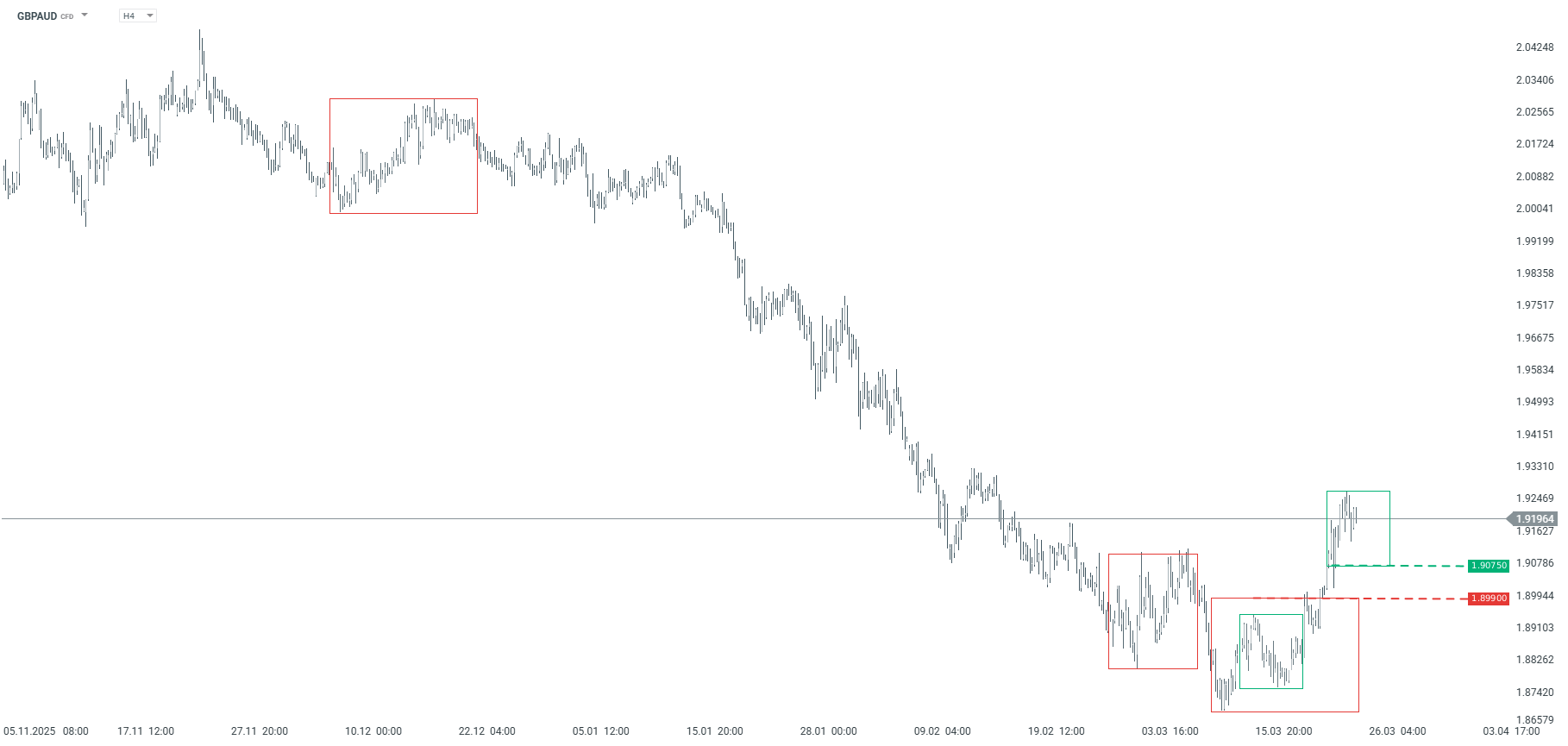
Since last November, the GBPAUD currency pair has been trading in a downtrend; however, in mid-March, the upper boundary of the broad 1:1 pattern was broken at the 1.8990 level, which may indicate a shift in sentiment toward an uptrend. Currently, the 1.8975 level should be considered key short-term support, as it marks the lower boundary of the local 1:1 bullish pattern. According to the Overbalance methodology, as long as this level holds, further expansion of the upward movement is possible. Conversely, a drop back below 1.8990 could signal a resumption of the downward trend.

GBPAUD – H4 timeframe. Source: xStation

AUDNZD
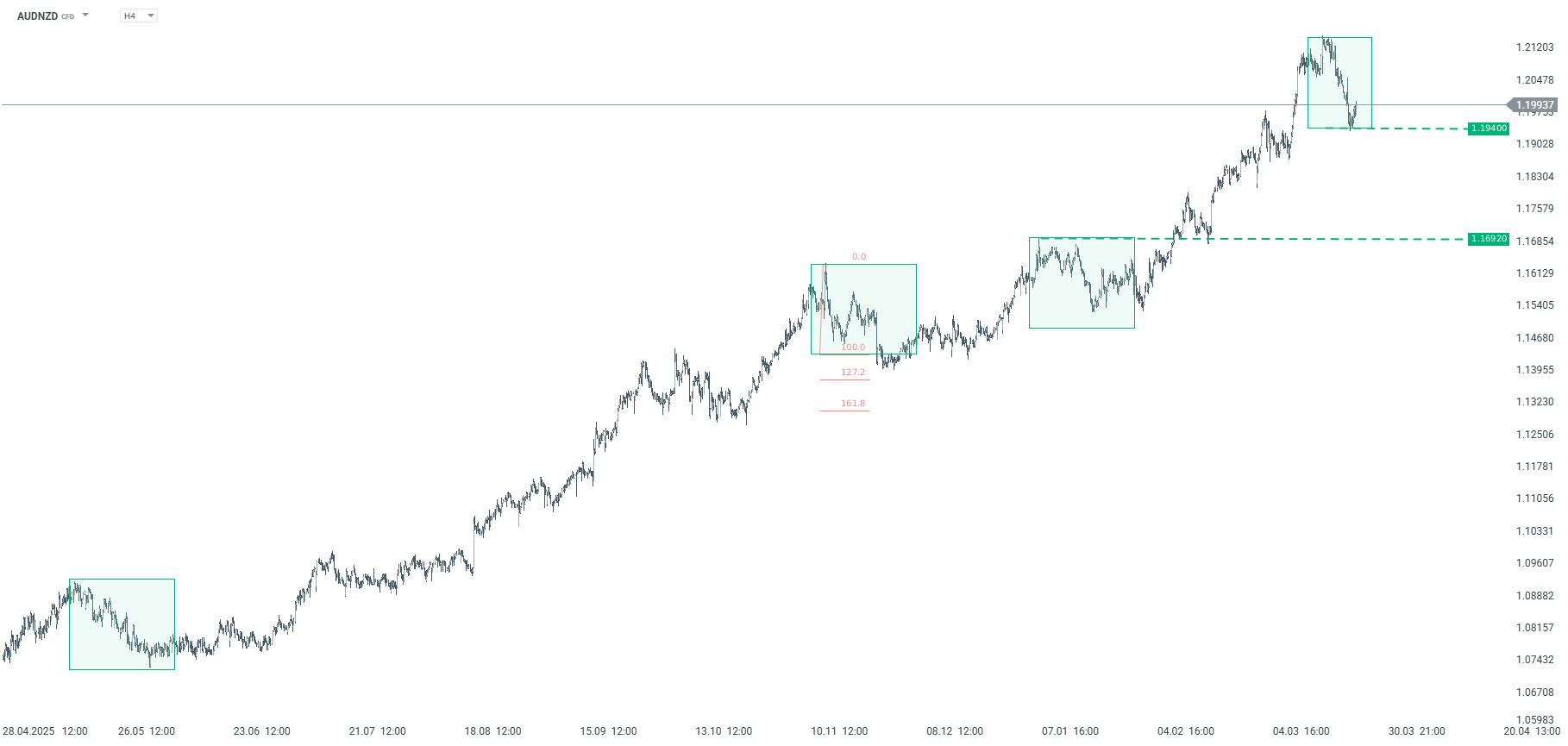
The AUDNZD exchange rate has been in an uptrend since April of last year. Due to the prolonged period without a major correction, the recent downward move is similar in magnitude to previous corrections, allowing us to identify support at the 1.1730 level, where the lower boundary of the 1:1 pattern is located. According to the Overbalance methodology, as long as this level holds, the uptrend remains in effect.

AUDNZD – H4 timeframe. Source: xStation

EURAUD
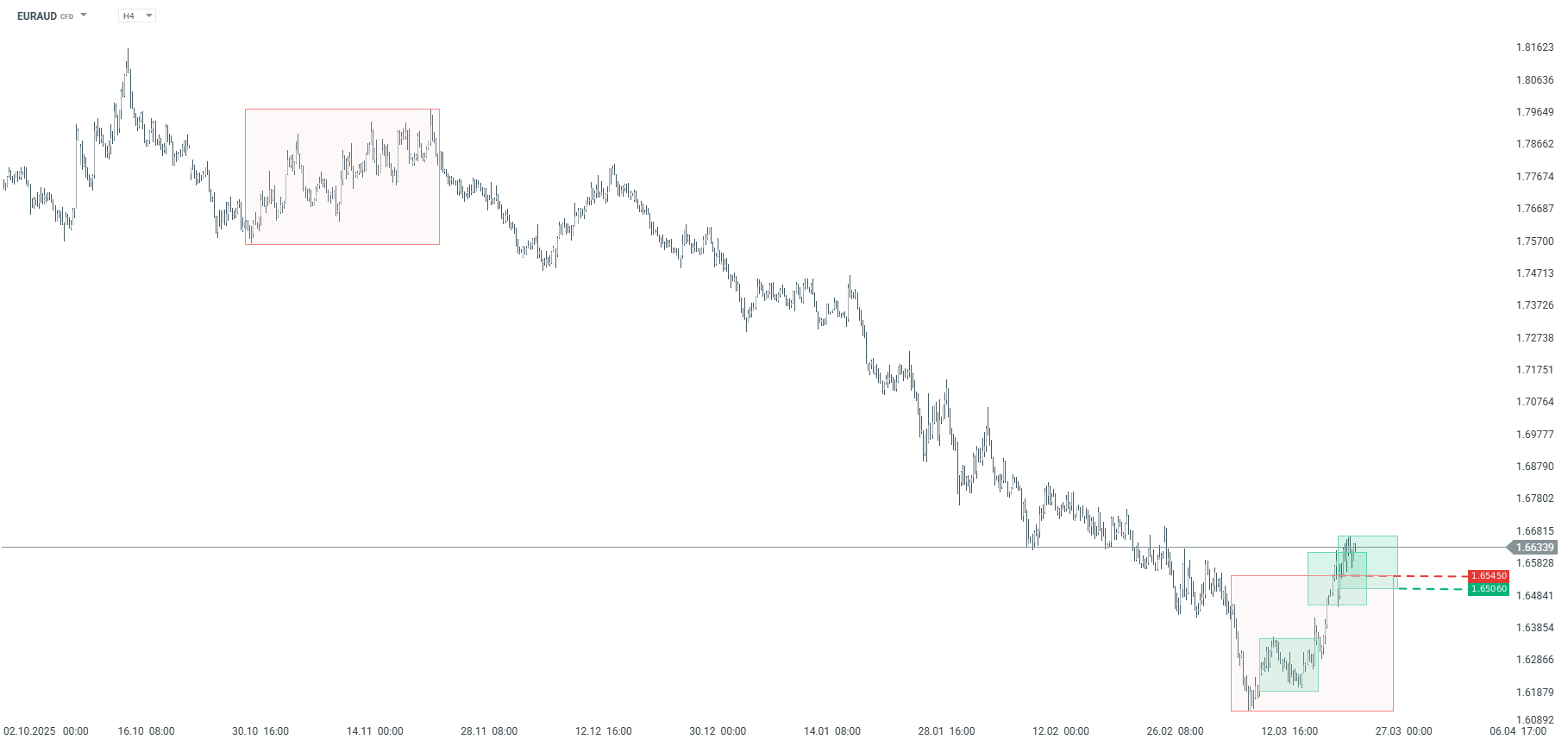
Since last October, the EURAUD pair has been trading in a downtrend; however, in recent days, the 1.6545 level has been broken, which may suggest the start of an upward correction or even a trend reversal. According to the Overbalance methodology, as long as the price remains above this level, the base case scenario remains a continuation of the uptrend. Conversely, a return below 1.6545, as well as a break below the 1.6506 level—where the lower boundary of the local 1:1 uptrend pattern lies—could signal a return to the downtrend. For now, the base case remains an upward correction.

EURAUD – H4 timeframe. Source: xStation

The material on this page does not constitute financial advice and does not take into account your level of understanding, investment objectives, financial situation or any other specific needs. All information provided, including opinions, market research, mathematical results and technical analyzes published on the Website or transmitted To you by other means, it is provided for information purposes only and should in no way be construed as an offer or solicitation for a transaction in any financial instrument, nor should the information provided be construed as advice of a legal or financial nature on which any investment decisions you make should be based exclusively To your level of understanding, investment objectives, financial situation, or other specific needs, any decision to act on the information published on the Website or sent to you by other means is entirely at your own risk if you In doubt or unsure about your understanding of a particular product, instrument, service or transaction, you should seek professional or legal advice before trading. Investing in CFDs carries a high level of risk, as they are leveraged products and have small movements Often the market can result in much larger movements in the value of your investment, and this can work against you or in your favor. Please ensure you fully understand the risks involved, taking into account investments objectives and level of experience, before trading and, if necessary, seek independent advice.

Currency Hedger No Comments

Australian Dollar underperforms as Iran pushes back hopes of peace talks

  • The Australian Dollar underperforms across the board as risk-aversion revives after Iran dismisses peace talks with the US.
  • US President Trump announced on Monday that military attacks on Iran’s power plants have been postponed.
  • Weak Australian PMI data has also weighed on the Australian Dollar.

The Australian Dollar (AUD) trades lower against its major currency peers, trading 0.6% down to near 0.6760 during the Asian trading session on Tuesday. The antipodean has come under pressure as remarks from Iran that they are not involved in any peace talks with the United States (US), which were contrary to comments from President Donald Trump, have revived the risk-aversion mood.

Australian Dollar Price Today

The table below shows the percentage change of Australian Dollar (AUD) against listed major currencies today. Australian Dollar was the weakest against the US Dollar.

USDEURGBPJPYCADAUDNZDCHF
USD0.21%0.21%0.14%0.18%0.53%0.35%0.26%
EUR-0.21%-0.02%-0.07%-0.03%0.33%0.14%0.05%
GBP-0.21%0.02%-0.04%-0.02%0.34%0.16%0.07%
JPY-0.14%0.07%0.04%0.05%0.39%0.21%0.12%
CAD-0.18%0.03%0.02%-0.05%0.34%0.16%0.08%
AUD-0.53%-0.33%-0.34%-0.39%-0.34%-0.17%-0.29%
NZD-0.35%-0.14%-0.16%-0.21%-0.16%0.17%-0.09%
CHF-0.26%-0.05%-0.07%-0.12%-0.08%0.29%0.09%

The heat map shows percentage changes of major currencies against each other. The base currency is picked from the left column, while the quote currency is picked from the top row. For example, if you pick the Australian Dollar from the left column and move along the horizontal line to the US Dollar, the percentage change displayed in the box will represent AUD (base)/USD (quote).

On Monday, US President Trump announced that he has instructed the Department of War to pause military attacks on Iran’s power plants for five days, as we are having “very good and productive conversations” with Tehran regarding a complete and total resolution of our hostilities in the Middle East.

The revival of risk-off sentiment has offered support to the US Dollar, which declined significantly after US President Trump’s remarks. As of writing, the US Dollar Index (DXY), which tracks the Greenback’s value against six major currencies, trades 0.25% higher to near 99.40.

In addition to deteriorating market sentiment, weak preliminary Australian S&P Global Purchasing Managers’ Index (PMI) data for March has also weighed on the Australian Dollar. Earlier in the day, the data showed that the overall business activity swung to contraction due to a sharp decline in the services sector output.

The Composite PMI arrived at 47.0 against 52.4 in February. A figure below 50.0 is considered a contraction in the business activity.

Meanwhile, investors await the Australian Consumer Price Index (CPI) data for February, which will be released on Wednesday. However, the impact of the Feb inflation data is expected to be limited on the Reserve Bank of Australia’s (RBA) monetary policy outlook, as it would lack the impact of the recent surge in energy prices due to the Iran conflict.

Currency Hedger No Comments

Pound Sterling weakens as Middle East tensions escalate

  • GBP/USD depreciates amid rising Middle East conflict. 
  • Gulf states are near direct involvement in the Iran conflict, with Saudi Arabia signaling a potential military shift. 
  • Traders await Tuesday’s flash S&P Global PMI data for March from both economies.

The GBP/USD pair faces selling pressure after registering modest gains in the previous day, trading near 1.3400 during the Asian session on Tuesday. The risk-sensitive pair weakens amid rising risk aversion as US-aligned Gulf states move closer to direct involvement in the Iran conflict, with Saudi Arabia signaling a potential military shift, according to a Wall Street Journal report.

Israel launched its latest attack on Iran despite US President Donald Trump signaling a pause in strikes on energy infrastructure after what he described as productive talks with Tehran. However, Iran’s Foreign Minister Abbas Araghchi denied any engagement with Washington. Iranian Parliament Speaker Mohammad Bagher Ghalibaf also said on Monday that no negotiations had taken place with the US. Meanwhile, senior military adviser Mohsen Rezaei stated that the conflict would persist until Iran receives full compensation for the damage incurred.

Traders await Tuesday’s flash S&P Global Purchasing Managers’ Index (PMI) data for March headlines the calendar on both sides of the pair. UK manufacturing PMI is expected at 51.1, down from 51.7, with services forecast at 53.0 versus 53.9 previously; any further softening would test the hawkish BoE repricing.

The Bank of England (BoE) kept interest rates steady at 3.75% at its March meeting on Thursday, as widely expected. BoE Governor Andrew Bailey said the Middle East conflict will cause a “shock to the economy” and push up inflation in the near term, adding that restoring safe shipping through the Strait of Hormuz is key to addressing rising energy prices.

Pound Sterling Price Today

The table below shows the percentage change of British Pound (GBP) against listed major currencies today. British Pound was the weakest against the US Dollar.

USDEURGBPJPYCADAUDNZDCHF
USD0.21%0.24%0.14%0.18%0.55%0.36%0.20%
EUR-0.21%0.00%-0.07%-0.03%0.34%0.14%-0.01%
GBP-0.24%-0.00%-0.06%-0.04%0.34%0.14%-0.01%
JPY-0.14%0.07%0.06%0.05%0.42%0.22%0.07%
CAD-0.18%0.03%0.04%-0.05%0.37%0.17%0.03%
AUD-0.55%-0.34%-0.34%-0.42%-0.37%-0.19%-0.37%
NZD-0.36%-0.14%-0.14%-0.22%-0.17%0.19%-0.15%
CHF-0.20%0.00%0.01%-0.07%-0.03%0.37%0.15%

The heat map shows percentage changes of major currencies against each other. The base currency is picked from the left column, while the quote currency is picked from the top row. For example, if you pick the British Pound from the left column and move along the horizontal line to the US Dollar, the percentage change displayed in the box will represent GBP (base)/USD (quote).

Currency Hedger No Comments

EUR/USD slips below 1.1600 as Middle East tensions escalate

  • EUR/USD weakens after fresh Israeli strikes hit Tehran.
  • President Trump announced a five-day truce following productive talks with Iran.
  • Iran’s Foreign Minister Abbas Araghchi denied any direct talks with Washington.

EUR/USD loses ground after registering modest gains in the previous session, trading around 1.1590 during the Asian hours on Tuesday. The pair depreciates as the US Dollar (USD) gains on increased risk aversion amid escalating Middle East conflict.

The Guardian reported on Tuesday that the Israeli military noted that it had launched a fresh wave of strikes on Tehran. This action came after US President Donald Trump signalled a pause in US attacks against energy infrastructure after what he said were productive talks with Iran. The Israeli Defense Forces (IDF) stated that it would continue operations in line with Israeli government directives until told otherwise.

Iran’s Foreign Minister, Abbas Araghchi, stated that there was “no dialogue” between Tehran and Washington. Meanwhile, Iranian Parliament Speaker Mohammad Bagher Ghalibaf said in a social media post on Monday that “no negotiations have been held with the US.” Mohsen Rezaei, the senior military adviser to Iranian Supreme Leader Mojtaba Khamenei, said that the war will continue until Iran receives full compensation for the damage it has sustained.

Reuters reported on Monday that San Francisco Federal Reserve Bank President Mary Daly said that unless the Iran conflict resolves quickly and the central bank can simply “look through” a temporary increase in oil prices, it is not clear what the next move on interest rates will need to be.

Rising oil prices are fueling inflation concerns and strengthening the European Central Bank’s (ECB) hawkish stance. The ECB left rates unchanged at last week’s meeting, citing the Iran conflict as a source of “significantly more uncertain” outlook.

Officials pointed to increasing inflation risks alongside weaker growth prospects, leading markets to boost expectations of potential rate hikes later this year. Policymakers are scheduled to speak on Monday, and any hawkish signals could provide support to the Euro.