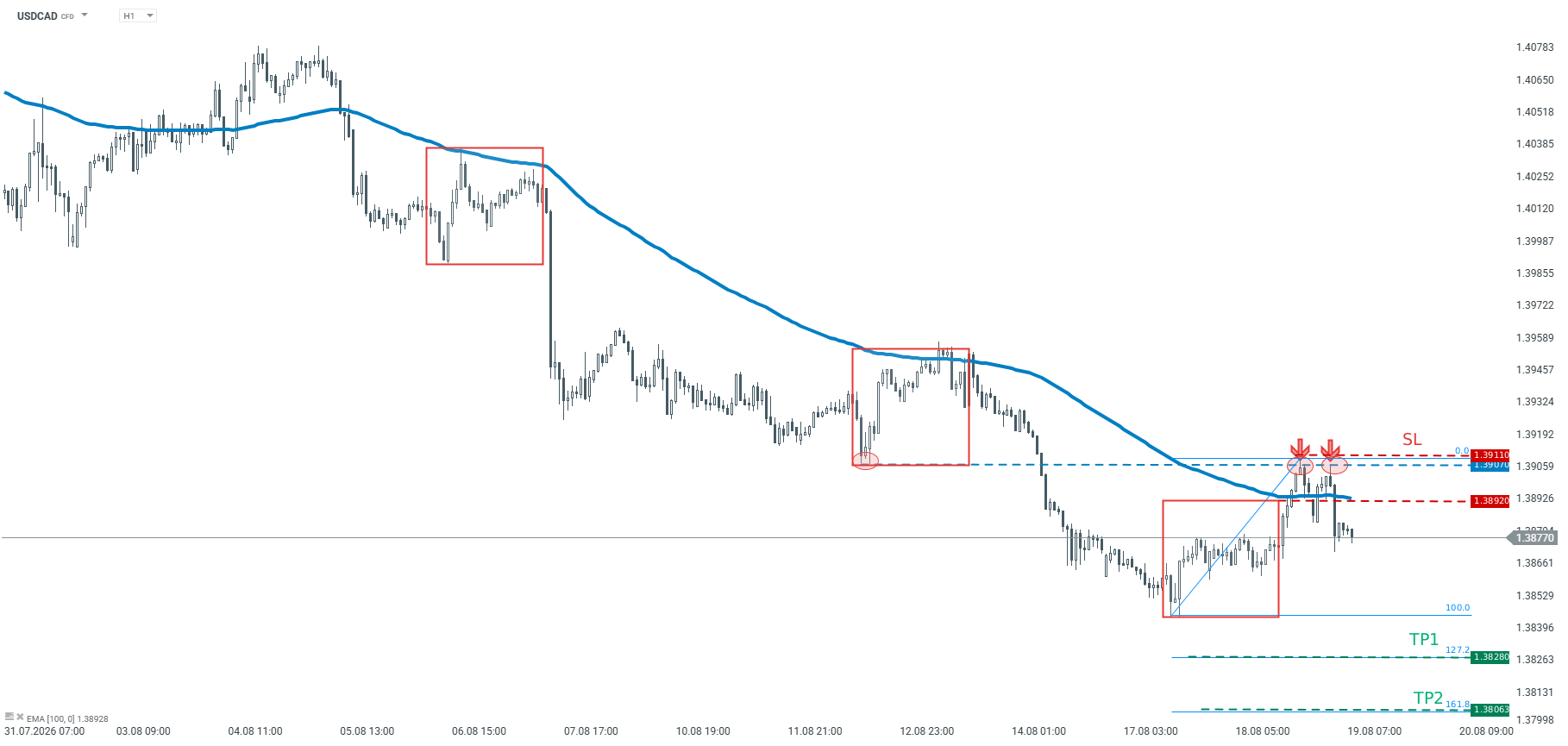
Facts: USDCAD is trading in a downward trend since the beginning of July The pair reacted to the key resistance at 1.3907
Recommendation: Trade: Short USDCAD at market price Target: 1.3828, 1.3806 Stop: 1.3911
Opinion: USDCAD has been trading in a local downward move since the beginning of July. Looking at the pair at the H1 interval, one can see that the price reacted to the key resistance at 1.3907, following a local upward correction. The resistance is a result of the previous low from August 12. In addition the price returned below the upper limit of 1:1 structure, which according to the Overbalance methodology supports a downward scenario. The pair also sits below the 100-period moving average from the H1 interval. We recommend going short USDCAD at market price with two targets: 1.3828 and 1.3806 . We also recommend placing a stop loss order at 1.3911. Source: xStation
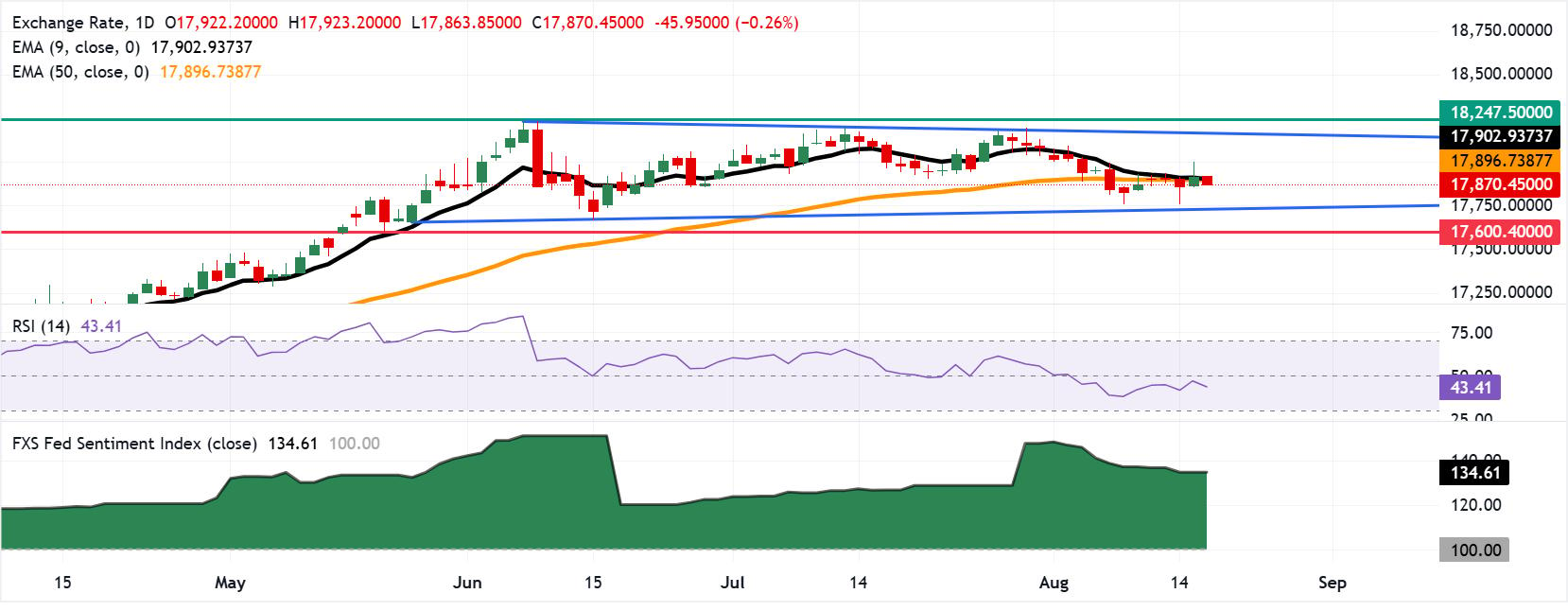
USD/IDR may fall toward the lower rectangle boundary around 17,750.
The 14-day Relative Strength Index at 43.48 signals fading bullish momentum.
The pair may rebound toward the immediate barrier at the 50-day EMA of 17,896.
USD/IDR depreciates after registering modest gains in the previous day, trading around 17,870 during the Asian hours on Wednesday. The technical analysis of the daily chart suggests that the pair is remaining within the rectangle, indicating a consolidation phase.
The USD/IDR pair is holding a bearish near-term bias as spot remains capped beneath both the nine-period and 50-period Exponential Moving Averages (EMAs). The clustering of these short- and medium-term EMAs just above price suggests topside attempts are vulnerable, while the 14-day Relative Strength Index (RSI) at 43.48 points to fading bullish momentum without yet reaching oversold territory, keeping the pair under mild downside pressure.
The USD/IDR pair may fall toward the lower boundary of the rectangle around 17,750, followed by the three-month low of 17,600, which was recorded on May 20.
USD gains as risk aversion weighs on Asia FX
Strategists at UOB Group highlight that renewed caution in global markets has reinforced demand for the Dollar, noting that the “USD firmed up against most Asia FX as risk aversion returned as the key near-term driver.” They point out that the shift in sentiment has left regional currencies on the back foot, with investors gravitating toward the relative safety of the Greenback as risk appetite fades.
On the upside, the immediate barrier lies at the 50-day EMA of 17,896, followed by the nine-day EMA at 17,902. A break above these moving averages would reinforce the bullish bias and support the USD/IDR pair to approach the upper boundary of the rectangle around 18,170, followed by the all-time high of 18,247, reached on June 8.
Goolsbee’s cautious optimism on inflation keeps Dollar focus on Fed path
Fed’s Goolsbee delivered a notably softer tone, with an FXS Speechtracker score of 4.6/10, well below the 6.8/10 historical average, signaling reduced hawkish conviction. The emphasis on “a little bit better” inflation readings and hope that tariff- and oil-driven price spikes prove one-off suggests growing confidence that inflation can drift back toward 2%, but without declaring victory. The characterization of the US economy as “steady” reinforces a gradualist stance, implying the Fed can stay patient while watching incoming data.
The FXS Fed Sentiment Index fell 2.36 points to 134.61, indicating a modest pullback in perceived hawkishness. Despite the decline, the index remains firmly above the 100 neutral mark, underscoring that Fed policy is still viewed as hawkish overall, even as Goolsbee’s softer tone drags the FXS Speechtracker score below the established baseline.
The British Pound moves mildly against the Japanese Yen after the UK CPI data for July.
The UK headline CPI growth remains higher at 2.9% YoY, as expected, while the core CPI remains steady at 2.6% YoY.
Hawkish BoJ bets help Japanese Yen stage a strong recovery.
The British Pound (GBP) reflects a slight market action against the Japanese Yen (JPY) near its day’s low at around 215.70 after the release of the United Kingdom (UK) Consumer Price Index (CPI) data for July.
The Office for National Statistics (ONS) has reported that the headline inflation accelerated to 2.9% Year-on-Year (YoY), as expected, from 2.5% in June. The core CPI – which excludes volatile components of food, energy, alcohol and tobacco – grew at a steady pace of 2.6% YoY, while it was expected to slow down to 2.5%.
On a monthly basis, the headline CPI data arrives at 0.35, as expected, higher than the previous reading of 0.1%.
Signs of headline price pressures re-accelerating after slowing down in June indicate that UK inflation concerns remain intact, a scenario that could force traders to reassess Bank of England (BoE) interest rate expectations. Currently, financial markets expect the BoE to hold policy rates at their current levels the entire year.
UK wages seen easing as TD Securities expects BoE to stay on hold
According to TD Securities, the UK labour market is set to “continue along the steady but lacklustre path seen since the start of the year,” with June delivering a “100k change in employment on a 3m/3m basis (mkt: 120k; prior: 148k).” On the wage side, the bank expects “a fair drop in the headline average weekly earnings growth measure to 4.0% 3m/y (mkt: 4.0%) from 4.3% in May, as March’s outsized bonus figures fall out of scope and reverse the upward pressures seen in the past three months.”
TD Securities anticipates that “ex-bonus wage growth should remain at 3.4% 3m/y (mkt: 3.4%) while private earnings ex-bonus growth is set to dip to 2.7% 3m/y (mkt: 2.8%; prior: 2.9%).” The bank notes that “the latter two measures sit within reach of levels consistent with the BoE’s inflation target,” a development that is “likely reassuring the majority of the MPC that labour market dynamics are limiting second-round inflation pressures and supporting a majority vote to keep Bank Rate on hold.”
Meanwhile, the Japanese Yen (JPY) outperforms its major currency peers on Wednesday after two weeks of underperformance, as financial markets are confident that the Bank of Japan (BoJ) will raise interest rates by 25 basis points (bps) to 1.25% in the September policy meeting.
USD/CHF drops as weak US retail sales and cooling inflation lower September rate hike odds to 35%.
CME FedWatch tool suggests traders are now pricing in just a 35% chance of a rate hike in September.
The Swiss National Bank kept its policy rate at 0% and is expected to hold rates there through 2027.
USD/CHF depreciates after registering modest gains in the previous day, trading around 0.8120 during the Asian hours on Wednesday. The pair depreciates as the US Dollar (USD) weakens amid easing expectations of a US interest rate hike next month. Recent economic data showed that US Retail Sales dropped in July for the first time in nine months, compounding concerns after unexpected job losses last month and tame CPI inflation figures.
While the Fed left interest rates unchanged at its last meeting, three officials dissented in favor of a rate hike, leaving traders looking to the upcoming minutes for deeper insight into the division within the central bank. According to the CME FedWatch tool, traders now price in just a 35% chance of a rate hike at the Fed’s September meeting, down significantly from 47% a month earlier.
Switzerland’s economic growth, excluding major sporting events, accelerated sharply to 1.5% quarter-on-quarter in the second quarter of 2026. This momentum was reinforced by foreign exchange interventions, which helped protect Swiss exporters by curbing safe-haven capital flows into the Swiss Franc and preventing excessive currency appreciation.
Meanwhile, inflationary pressures continued to ease, with Swiss inflation slowing to 0.4% in July, its lowest level in four months. In response, the Swiss National Bank (SNB) maintained its policy rate at 0% during its latest meeting and is expected to hold interest rates at this level through 2027, treating any further rate cuts as a contingency rather than the baseline path. While financial markets are pricing in a rate hike as early as March 2027, most economists anticipate the first increase will occur in early 2028.
Analysts at Rabobank highlighted that, “for years, the Swiss central bank has struggled with the impact of haven flows into the CHF,” noting that the recent bout of Swiss Franc softness is likely a welcome development for the SNB after its prolonged battle against persistent inflows.
USD/CAD attracts some sellers after Trump paused 50% tariffs against Canada for a three-day period
Oil prices rise to a three-week high and further underpin the Loonie, also exerting pressure on the pair.
Modest USD weakness contributes to the intraday slide as traders await the release of FOMC Minutes.
The USD/CAD pair meets with fresh supply during the Asian session on Wednesday and, for now, seems to have stalled its recovery from the lowest level since June 3, touched earlier this week. Spot prices currently trade around the 1.3880 area, though the downside seems cushioned as traders keenly await the release of FOMC Minutes.
The Canadian Dollar (CAD) gets a minor lift after US President Donald Trump announced a pause on 50% tariffs against Canada for a three-day period following overnight negotiations with Canadian Prime Minister Mark Carney. Moreover, crude oil prices climbed to a nearly three-week high amid the US-Iran standoff over the Strait of Hormuz, further underpinning the commodity-linked Loonie. This, along with the emergence of some US Dollar (USD) selling, exerts downward pressure on the USD/CAD pair.
The US data released last week pointed to signs of cooling inflation and a slowdown in consumer spending, prompting traders to scale back their bets for an immediate interest rate hike by the US Federal Reserve (Fed). This, in turn, keeps a lid on the USD recovery from a two-month low, touched on Monday. However, inflation risks stemming from rising energy prices might force the US central bank to adopt a more hawkish stance, which remains supportive of elevated US bond yields and should limit USD losses.
Moreover, CME Group’s FedWatch Tool indicates that traders are still pricing in around a 68% chance of a Fed rate hike by the year-end. Hence, FOMC Minutes will be scrutinized closely for more cues about the Fed’s policy path, which will play a key role in influencing the USD and provide a fresh impetus to the USD/CAD pair. Nevertheless, the fundamental backdrop suggests that the path of least resistance for spot prices remains to the downside, and any attempted recovery move is more likely to be sold into.
Technical Analysis
The USD/CAD pair holds above the 200-day Simple Moving Average (SMA) near 1.3848, suggesting a supportive broader trend backdrop. A convincing break below, however, would expose the next relevant support near the 1.3820-1.3815 region before spot prices weaken further below the 1.3800 mark. On the topside, initial resistance is seen at 1.3910, or the overnight swing high, above which the momentum could extend further towards reclaiming the 1.4000 psychological mark.
Australia’s Wage Price Index grew 3.2% year-on-year in Q2 2026, matching expectations despite hitting a multi-quarter low.
RBA Deputy Governor Andrew Hauser warned inflation remains too high, requiring tighter monetary policy to cool economic demand.
Weak US Retail Sales and cooling inflation reduce September rate hike probabilities to 35%.
AUD/USD extends its losses for the second successive day, trading around 0.7080 during the Asian hours on Wednesday. Addressing the broader economic backdrop, Reserve Bank of Australia (RBA) Deputy Governor Andrew Hauser emphasized on Wednesday that inflation remains unacceptably high. Hauser stated that monetary policy must work to reduce demand in the economy and bring price pressures down. While the central bank is not anticipating a recession, it is seeing a general slowdown and remains deeply concerned about upside risks to inflation. Hauser warned that if inflation fails to cool, the RBA will have no choice but to raise interest rates again.
Australia’s seasonally adjusted Wage Price Index increased 3.2% year-on-year in Q2 2026, holding steady from the revised figure in Q1 and matching market expectations. While quarterly wages grew by 0.8%, maintaining the same pace seen over the previous four quarters, the annual figure represents the weakest wage growth since Q4 2024.
Aussie upside risk persists as UOB lifts near-term focus to 0.7150
Analysts at UOB Group maintain that “the risk for AUD is on the upside,” a view they have held since early August and reiterated on 17 August when spot was trading around 0.7080. At that point, they cautioned that “the risk for AUD remains on the upside but note that AUD must surpass 0.7100 before a move to 0.7120 can be expected.” The currency has since “quickly broken above both 0.7100 and 0.7120,” briefly reaching “a high of 0.7129 before retreating,” and UOB now flags “0.7150” as “the next level to monitor.” The bank adds that “only a breach of 0.7070” – with the prior “strong support” noted at 0.7050 – “would mean that the upside risk has faded.”
However, the downside of the AUD/USD pair could be restrained as the US Dollar (USD) weakens amid easing expectations of a US interest rate hike next month. Recent economic data showed that US Retail Sales dropped in July for the first time in nine months, compounding concerns after unexpected job losses last month and tame CPI inflation figures.
While the Fed left interest rates unchanged at its last meeting, three officials dissented in favor of a rate hike, leaving traders looking to the upcoming minutes for deeper insight into the division within the central bank. According to the CME FedWatch tool, traders now price in just a 35% chance of a rate hike at the Fed’s September meeting, down significantly from 47% a month earlier.
AUD/USD: Daily Chart
Technical Analysis:
In the daily chart, AUD/USD trades at 0.7080, retaining a bullish near-term bias as spot holds above both the nine-period and 50-period Exponential Moving Averages (EMAs). The short-term EMA clustering just beneath price suggests a constructive underlying bid, while the 14-day Relative Strength Index (RSI) at 58.4 stays in positive territory without yet reaching overbought conditions, hinting that bulls still have room to extend the advance. The technical analysis of the daily chart suggests that the pair is remaining within the ascending channel, indicating an ongoing bullish bias.
On the downside, initial support is seen around the nine-period EMA at 0.7071, followed by the 50-period EMA at 0.7029, where a deeper pullback would test the integrity of the current uptrend; below there, horizontal levels at 0.6833 and 0.6400 form a more distant structural floor. On the topside, the next significant hurdle emerges at the horizontal resistance at 0.7278, and a sustained break above this barrier would open the way for a continuation of the broader recovery phase in the pair.
The South Korean won traded around 1,399 per dollar, reaching its strongest level since late September 2025, as a softer US dollar supported demand for the local currency. The dollar index remained near multi-month lows as Treasury yields eased from recent highs, while investors scaled back expectations for further Fed rate hikes following softer US economic data, narrowing the dollar’s yield advantage. Additionally, persistent dollar-selling flows from Korean exporters continued to support the won amid strong semiconductor-related export receipts. The conversion of SK hynix’s ADR proceeds into won has also been a key factor behind the currency’s sharp appreciation in recent weeks, boosting domestic dollar supply. Meanwhile, higher oil prices near three-week highs and renewed US-Iran tensions could pose a headwind for the won, as the lack of progress in peace efforts raises concerns over potential disruptions to Middle Eastern oil supplies and higher import costs for South Korea.
USD/CAD lacks a firm intraday directional bias on Tuesday amid a combination of diverging forces.
Rising oil prices underpin the Loonie, while hawkish Fed bets provide a goodish lift to the USD.
The technical setup favors bearish traders and backs the case for a further near-term depreciation.
The USD/CAD pair struggles to capitalize on the overnight bounce from its lowest level since June 3, around the 1.3845 zone, also representing the 200-day Simple Moving Average (SMA) support, and oscillates in a narrow band on Tuesday. Spot prices extend the range-bound price action through the early European session and currently trade around the 1.3870-1.3875 region, unchanged for the day amid mixed cues.
Crude oil prices climb to an over two-week high amid the US-Iran standoff over the Strait of Hormuz. This, along with Monday’s hot Canadian consumer inflation figures, continues to underpin the commodity-linked Loonie and acts as a tailwind for the USD/CAD pair. The downside, however, remains cushioned amid a strong follow-through US Dollar (USD) recovery from a two-month low, bolstered by bets for at least one rate hike by the US Federal Reserve (Fed) on the back of oil-driven inflation risks.
Meanwhile, momentum indicators suggest that bearish sentiment dominates even as spot prices stabilize above the longer-term trend support. In fact, the Relative Strength Index (14) sits in oversold territory near 29, hinting at stretched downside conditions, while the Moving Average Convergence Divergence (MACD) indicator remains below zero with negative readings. Moreover, the USD/CAD pair has found acceptance below the 50% Fibonacci retracement level of the April-June rally, validating the negative outlook.
However, a convincing break below the 200-day SMA at 1.3848 is needed to back the case for deeper losses to the 61.8% Fibo. level at 1.3822. Some follow-through selling would expose the 78.6% level at 1.3708, before the USD/CAD pair extends the fall toward the structural floor near 1.3562.
On the topside, initial resistance is located at the 50.0% retracement at 1.3902, followed by the 38.2% level at 1.3982 and then the 23.6% retracement at 1.4081, with the cycle high anchor around 1.4242 acting as a more distant barrier.
To provide the best experiences, we use technologies like cookies to store and/or access device information. Consenting to these technologies will allow us to process data such as browsing behavior or unique IDs on this site. Not consenting or withdrawing consent, may adversely affect certain features and functions.
Functional
Always active
The technical storage or access is strictly necessary for the legitimate purpose of enabling the use of a specific service explicitly requested by the subscriber or user, or for the sole purpose of carrying out the transmission of a communication over an electronic communications network.
Preferences
The technical storage or access is necessary for the legitimate purpose of storing preferences that are not requested by the subscriber or user.
Statistics
The technical storage or access that is used exclusively for statistical purposes.The technical storage or access that is used exclusively for anonymous statistical purposes. Without a subpoena, voluntary compliance on the part of your Internet Service Provider, or additional records from a third party, information stored or retrieved for this purpose alone cannot usually be used to identify you.
Marketing
The technical storage or access is required to create user profiles to send advertising, or to track the user on a website or across several websites for similar marketing purposes.