AUD/USD gains as weak Retail Sales pressure the Greenback.
Bullish RSI supports upside, but 0.7094 caps momentum.
Break above 0.7100 exposes 0.7190 and 0.7200 next.
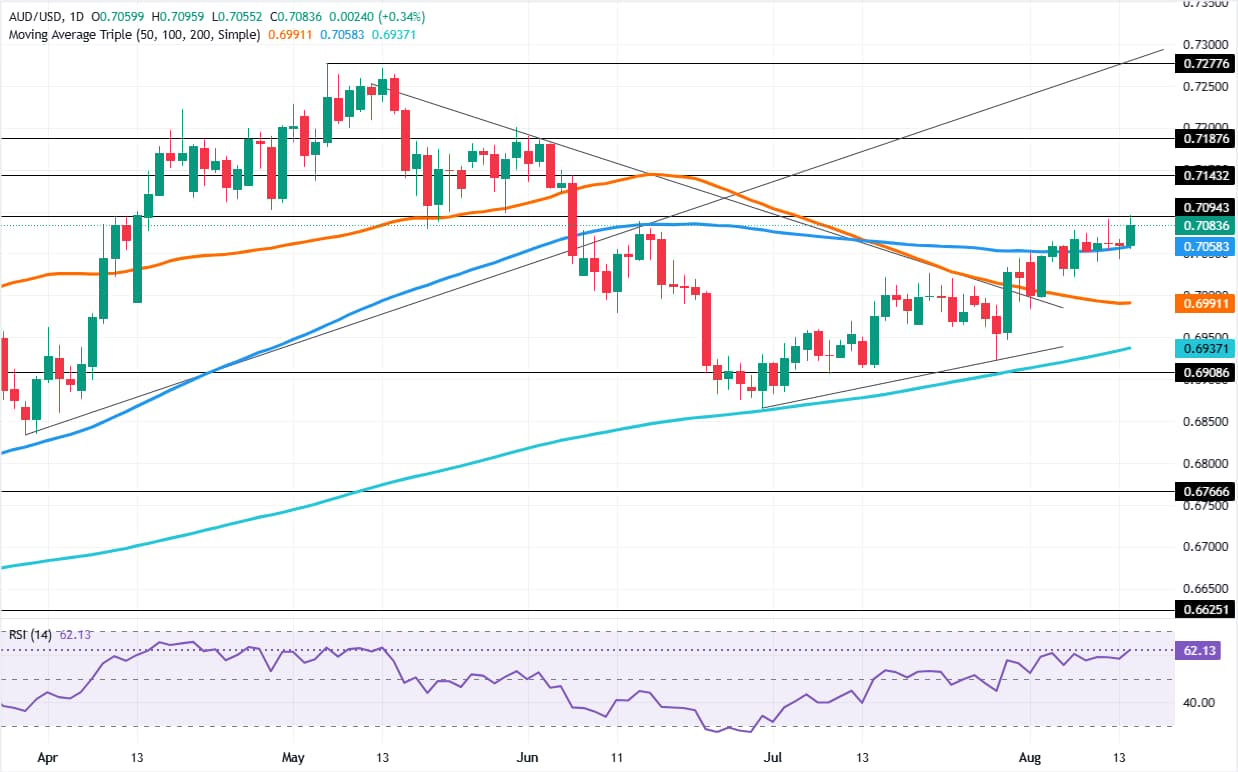
The Australian Dollar advanced on Friday after US Retail Sales disappointed investors, increasing speculation that the Federal Reserve might not raise rates, as the economy showed tentative signs of weakness. The AUD/USD trades at 0.7083, up 0.34%
AUD/USD Price Forecast: Technical outlook
The daily chart shows the AUD/USD is bullish, but buyers remain unable to decisively crack the January 29 high of 0.7094, which could open the door for further upside. Momentum shifted bullish since mid-July, as depicted in the Relative Strength Index (RSI).
From a market structure perspective, the pair has not shifted bullish until buyers regain the June 1 peak at 0.7190. Hence, the first AUD/USD resistance is 0.7100, followed by the latter. On further strength, the next stop is 0.7200.
On the downside, the 100-day Simple Moving Average (SMA) at 0.7058 is the first support. Once cleared, the 50-day SMA emerges as the next demand zone at 0.6991, followed by the 200-day SMA at 0.6937.
AUD/USD falls further to near 0.7050 as the Australian Dollar faces selling pressure.
Financial markets seem unconvinced by the RBA’s hawkish remarks.
The US Dollar gains even as traders have trimmed hawkish Fed bets.
The Australian Dollar (AUD) trades 0.17% lower at around 0.7050 against the US Dollar (USD) during the early European trading session on Thursday. The Aussie pair extends Wednesday’s correction, which started after revisiting the two-month high near 0.7090, as financial markets remain unconvinced by the Reserve Bank of Australia’s (RBA) hawkish tone.
On Tuesday, the RBA left its Official Cash Rate (OCR) unchanged at 4.35%, as expected, and explicitly said that the central bank won’t hesitate to raise interest rates further, citing upside inflation risks.
Contrary to the RBA’s hawkish remarks, financial markets believe that the RBA’s appetite to tighten monetary conditions appears very weak.
Analysts at Standard Chartered note that, at the press conference, Governor Bullock “talked up the uncertainty around the RBA’s central forecasts and did not rule out the need for more policy tightening in the immediate future if upside inflation risks materialise.”
Despite this hawkish nuance, Standard Chartered emphasises that “our base case remains no more RBA rate hikes in the foreseeable future.” The bank cautions, however, that “the risk to our view is skewed towards a hike in Q4 if demand does not slow sufficiently or if energy prices revisit recent highs, exacerbating both capacity and price pressures.”
Ultimately, “easing labour-market conditions, if sustained, should help contain underlying wage and price pressures in the economy,” supporting their view that further tightening is not the central scenario even as the RBA keeps its options open,” Standard Chartered added.
Meanwhile, an upbeat US Dollar, despite traders paring back hawkish Federal Reserve (Fed) bets for the September meeting, is also hurting the Aussie pair.
AUD/USD Technical Analysis
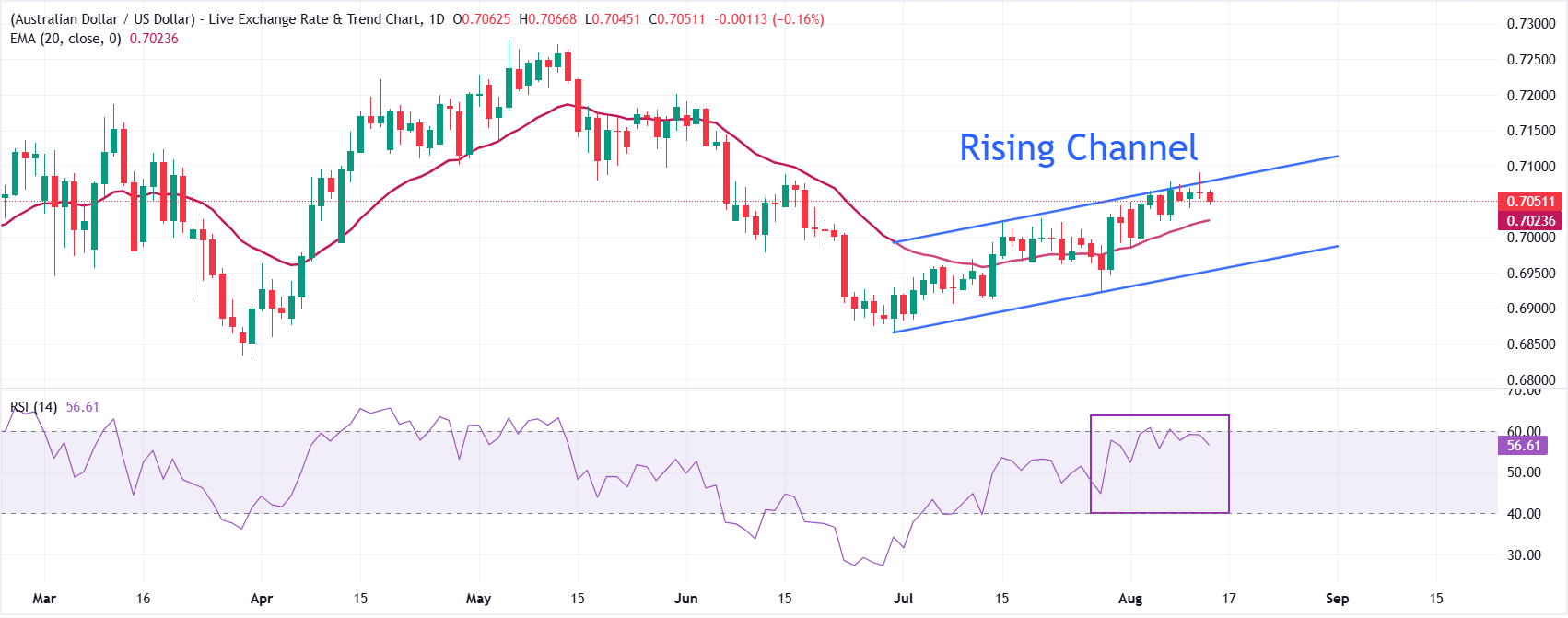
AUD/USD trades lower at around 0.7050, but is holding a constructive bullish bias as it remains within an upward parallel channel. The pair is trading above the 20-day exponential moving average (EMA) at 0.7024, which suggests underlying demand, while the channel top near 0.7077 caps the immediate topside.
The Relative Strength Index (RSI) at 56.69 stays in positive territory, hinting that bullish momentum is intact though not overstretched.
On the downside, initial support is located at the 20-day EMA at 0.7024, ahead of the lower boundary of the rising channel around 0.6951, with a deeper structural floor toward 0.6866. On the topside, a sustained break above the channel resistance at 0.7077 would open the way for further gains within the broader ascending structure. Above 0.7077, major hurdles are the round-level resistance at 0.7100, followed by the June 5 high at 0.7144.
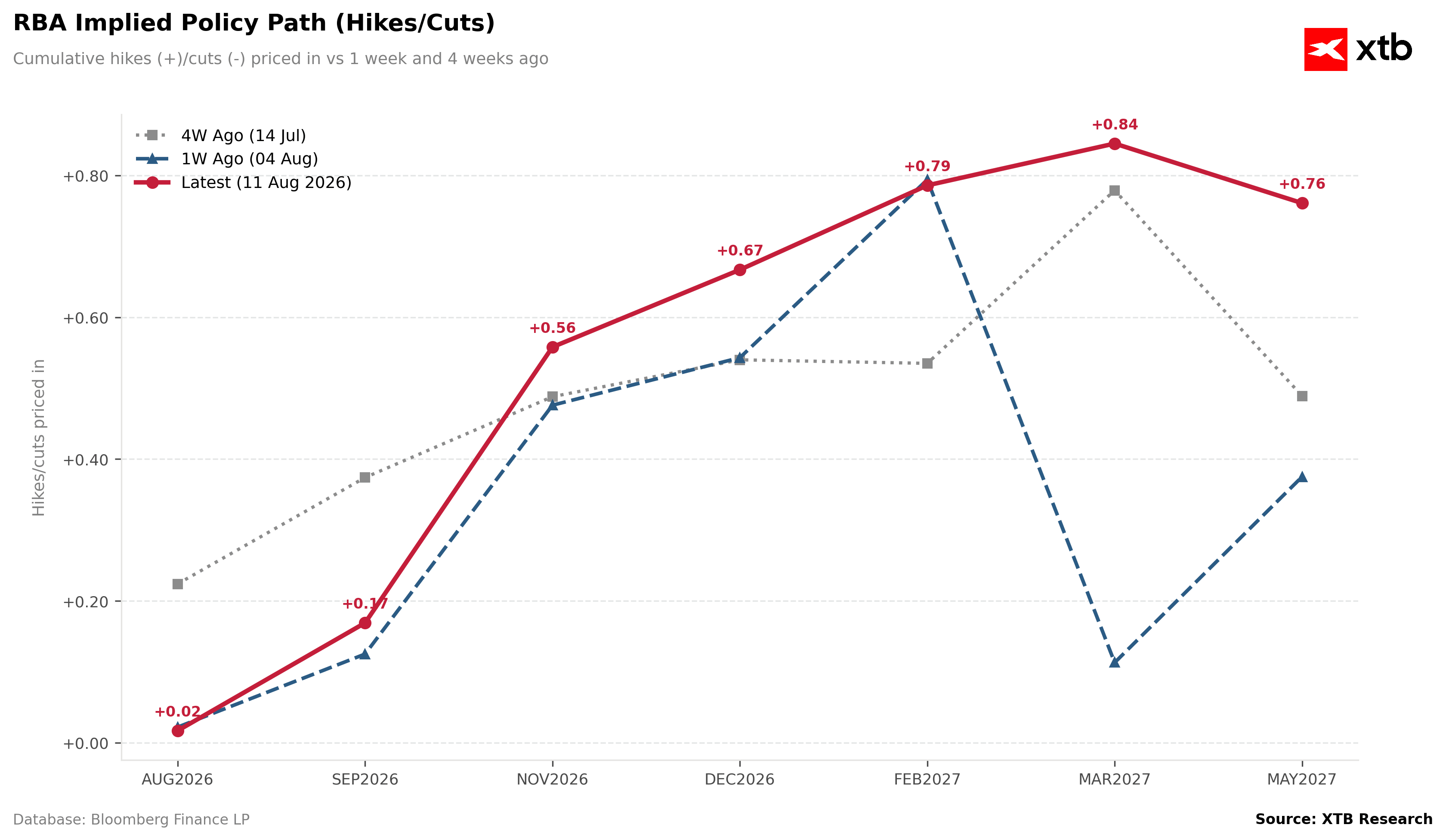
The AUDUSD exchange rate has been moving in an uptrend since early July, reinforced by the dovish tone of the July FOMC meeting. Currently, the swap market prices in roughly a 50% chance of a September rate hike, marking a sharp decline from expectations prior to the Fed’s latest decision (when probability sat near 100%). Monetary support for the dollar weakened further following an unexpected decline in US payrolls according to the latest NFP report. Furthermore, consensus estimates for the upcoming inflation report project CPI falling to 3.4% YoY—its lowest level since April 2026. Despite a recent correction, US Treasury yields remain higher than before Kevin Warsh took over as Fed Chair, meaning that even a higher-than-expected CPI reading is unlikely to back the Fed into a corner regarding rate hikes, thereby limiting the potential for a pro-dollar surprise. Conversely, market pricing for Australian rate hikes shifted higher following today’s RBA decision. While the Australian central bank kept interest rates on hold at 4.35% and presented more dovish economic forecasts, Governor Michele Bullock’s comments keep markets on high alert. In addition to acknowledging the potential need for further hikes, Bullock signaled that the RBA requires more time to feel confident that inflation is cooling down—especially given the recent record employment surge of 76,000 jobs. Recent shifts in central bank communications, alongside dynamics in bond and interest rate markets, support a continuation of the AUDUSD uptrend. A potential dip in global risk appetite stemming from escalation in the Middle East remains a key risk factor, though volatility on the pair is becoming increasingly desensitized to geopolitical swings.
Shift in Australian monetary policy expectations (red: current pricing, blue: one week ago, gray: 4 weeks ago). Source: XTB Research, Bloomberg WIPR OIS data.
Methodology
This recommendation was prepared based on a technical analysis of the AUDUSD chart and a fundamental analysis of the respective economies (monetary policy in Australia and the US). The directional bias was determined using moving averages and market expectations regarding central bank policies. Take Profit and Stop Loss levels were established using Fibonacci retracements and price action:
TP1 is set at the late May / early June resistance level.
TP2 is set at the 78.6% Fibonacci level.
SL is placed at the July support level, which coincides with the 100-day dark violet EMA.
AUD/NZD falls as the Australian Dollar weakens following the Reserve Bank of Australia’s latest interest rate decision.
The RBA kept the Official Cash Rate unchanged at 4.35% for the second consecutive meeting.
New Zealand Prime Minister Christopher Luxon called an urgent caucus meeting Wednesday to address growing speculation about his leadership.
AUD/NZD pares its daily gains, trading around 1.1960 during the Asian hours on Tuesday. The Australian Dollar (AUD) has drifted lower following the Reserve Bank of Australia’s (RBA) latest monetary policy decision, keeping the currency cross on a weaker footing. As widely anticipated by financial markets after second-quarter inflation figures came in lower than projected, the RBA opted to leave the Official Cash Rate unchanged at 4.35% for its second consecutive meeting.
RBA statement eyed for fresh guidance on inflation and growth
Brown Brothers Harriman’s Elias Haddad highlighted that the communications will be critical, noting that “The RBA’s August Statement on Monetary Policy will shed light on the bank’s inflation and growth outlook.” This detailed update is expected to help investors refine their views on how long the RBA can sustain its current hawkish stance and what that implies for the Australian Dollar’s carry appeal over the remainder of the year.
Meanwhile, central bank policy across the Tasman faces its own set of complications. Rising oil prices, driven by uncertainty over the potential reopening of the Strait of Hormuz, have sparked fresh debate on how the Reserve Bank of New Zealand (RBNZ) might approach its September policy meeting. Markets are exercising caution ahead of New Zealand’s third-quarter inflation expectation figures, particularly after the Q2 data showed an unexpected acceleration.
Compounding the regional uncertainty, New Zealand Prime Minister Christopher Luxon has called an urgent, in-person caucus meeting for Wednesday morning to confront growing speculation surrounding his leadership. Following a turbulent week marked by reports of MPs receiving calls about a potential leadership challenge, Luxon is acting decisively to suppress internal dissent before it metastasizes into a campaign-defining issue for the National Party.
AUD/USD holds losses as US Dollar safe-haven demand rises amid heightened US-Iran tensions and Strait of Hormuz risks.
A surprising decline of 23,000 Nonfarm Payrolls in July curbed hopes for an immediate interest rate increase by the Fed.
RBA is widely expected to keep its cash rate unchanged at 4.35% on Tuesday.
AUD/USD inches lower after registering modest gains in the previous day, trading around 0.7060 during the Asian hours on Monday. The pair holds losses as the US Dollar (USD) receives support from broad risk aversion.
Geopolitical tensions remain high as the ongoing United States (US)-Iran conflict enters a critical diplomatic phase, with intense military engagements and strategic pressure surrounding the Strait of Hormuz driving market caution. Although Iranian officials noted on Sunday that Oman-mediated negotiations regarding the management of the strait are making progress, safe-haven demand for the Greenback remains firmly intact.
Weaker-than-expected US employment data has dampened expectations for a near-term Federal Reserve (Fed) rate hike. Nonfarm Payrolls (NFP) unexpectedly dropped by 23,000 in July, while sharp downward revisions to the previous two months highlighted weakening labor market conditions. Investors are now focused on upcoming inflation reports for further clues on monetary policy.
Traders look ahead to the Reserve Bank of Australia’s (RBA) monetary policy decision on Tuesday. The central bank is widely expected to keep its cash rate unchanged at 4.35% for a second straight meeting. Traders will closely watch the RBA’s updated forecasts and Governor Michele Bullock’s comments for clues on the future policy path.
Rabo sees November RBA risk keeping modest upside bias in AUD/USD
Strategists at Rabobank note that, in their view, there is still “risk of one more rate hike this year in November,” with markets likely to look to the RBA’s 11 August policy meeting for “more clarity on rate hike risks.” Against this backdrop, the bank says it continues to “forecast a modest upside bias in AUD/USD out to 12 months,” a view it anchors “mostly on the back of a moderately softer tone in the USD and the view that Fed rate hike expectations are overdone.”
AUD/USD is seen consolidating on Friday as traders seem hesitant ahead of the US NFP report.
Geopolitical uncertainties and Fed hike bets underpin the USD, capping the upside for the pair.
Spot prices remain on track to end the week on a flattish note and look to the RBA next week.
The AUD/USD pair steadies around the 0.7030-0.7025 region during the Asian session on Friday as traders opt to wait for the release of the closely watched US monthly employment details before placing fresh directional bets. Nevertheless, spot prices, for now, seem to have stalled the previous day’s retracement slide from the highest level since June 17 and seem poised to end the week on a flattish note amid mixed cues.
The optimism over a potential US-Iran peace deal seems to have faded amid reports Iran is reviewing a plan that would ban US and Israeli vessels from the Strait of Hormuz. According to the initial draft published by Iranian state news agency Fars on Thursday, other nations that have harmed Iran would not be allowed to transit until compensation is paid. This, in turn, prompts traders to price in the geopolitical risk premium, which supports the safe-haven US Dollar (USD) and caps the AUD/USD pair.
Meanwhile, Iran’s Houthi allies in Yemen struck a Saudi tanker in the Red Sea, fueling concerns about energy supply disruptions through another key route. This led to the overnight spike in crude oil prices and revives inflation fears, bolstering bets for a rate hike by the US Federal Reserve (Fed). The outlook remains supportive of elevated US Treasury bond yields, which is seen as another factor acting as a tailwind for the Greenback and keeping the AUD/USD pair depressed for the second consecutive day.
USD bulls, however, seem hesitant and look to the key US Nonfarm Payrolls (NFP) report for more cues about the Fed’s future policy path. The crucial data will play a key role in influencing the near-term USD price dynamics and provide some impetus to the AUD/USD pair. The market attention will then shift to the Reserve Bank of Australia (RBA) policy meeting next week. Apart from this, further developments surrounding the Middle East crisis would help in determining the near-term trajectory for the pair.
Analysts at Standard Chartered expect the RBA to leave the cash rate unchanged at 4.35% at its 11 August meeting, noting that “Q2 trimmed mean inflation held steady at 0.8% q/q – as we had expected – and below the RBA’s prior forecast (0.9%).” They add that this outcome, “together with the recent retracement in oil prices, should take the pressure off the RBA to tighten policy further in the near term.”
Against that backdrop, Standard Chartered says “our base case remains that the RBA is done with rate hikes in the foreseeable future,” although it cautions that “the risk to our view is skewed towards another RBA rate hike in Q4, if the central bank remains unconvinced that demand is slowing sufficiently to contain underlying price pressures.”
AUD/USD daily chart
Technical Analysis
The AUD/USD pair is consolidating between its key moving averages, holding above the 200-day Simple Moving Average (SMA) at 0.6923 while remaining capped by the 100-day SMA at 0.7052. This keeps the near-term bias neutral and hints at a range-bound tone rather than a directional breakout.
AUD weakens on safe-haven shift due to geopolitical tensions in the Strait of Hormuz.
China’s Trade Balance beat expectations, though moderating export and import growth presents a mixed picture.
AUD/JPY could rebound as Japanese Yen retreats despite joint Tokyo-Washington currency intervention efforts.
AUD/JPY halts its three-day winning streak, trading around 111.30 during the Asian hours on Friday. The currency cross depreciates as the Australian Dollar (AUD) loses ground, driven by a surge in global safe-haven demand. Escalating tensions in the Strait of Hormuz have rattled market stability, sparking widespread skepticism over whether this vital shipping route will reopen anytime soon.
Meanwhile, China’s latest trade figures present a mixed economic picture that could carry significant implications for Australia, given the close trading relationship between the two nations. China’s June Trade Balance in US Dollar terms came in at $112.5 billion, topping expectations of $107.0 billion though falling short of the previous $125.62 billion figure. In Chinese Yuan terms, the Trade Surplus widened to 767 billion, beating the estimated 740 billion, but trailing the prior 859.05 billion reading. July exports grew 23.9% year-over-year compared to June’s 27% rise, while imports expanded by 27.5% over the same period, moderating from the previous 36% growth rate.
RBA hike risk keeps modest upside bias in AUD
Rabobank’s FX strategists continue to see scope for further RBA tightening, arguing that “there is still risk of one more rate hike this year in November.” They note that “the market will be hoping that the RBA’s August 11 policy meeting will provide more clarity on rate hike risks,” particularly in light of shifting expectations around the policy path. Against this backdrop, Rabobank maintains “a modest upside bias in Australian Dollar out to 12 months.
Despite these pressures, the AUD/JPY cross could regain traction as the Japanese Yen (JPY) gives back some of its recent gains. Those initial gains were sparked by joint currency intervention from Tokyo and Washington, which has fueled speculation that authorities might step in again.
However, the JPY’s quick retreat highlights ongoing skepticism about whether official intervention can overcome its structural weakness, a weakness continually dragged down by wide interest rate differentials, escalating fiscal concerns, and stubbornly high energy and import costs.
Asian currency slide seen as catalyst for US Dollar intervention
Analysts at ING argue that the recent bout of weakness across key Asian currencies may have been a key trigger for official action in the US Dollar/Japanese Yen pair. They note that “large falls in the Japanese yen, Korean won and Taiwanese dollar might have been one of the reasons the US Treasury stepped in with USD/JPY intervention,” and suggest the move “could be well-timed if the Fed doesn’t hike and the Dollar falls,” potentially aligning policy dynamics with efforts to stabilise the Yen.
AUD/USD edges down from three-week lows at 0.7064 but maintains its near-term positive bias intact.
Australian Trade Balance showed an unexpected surplus in June as commodity exports surged.
The US Dollar is failing to find support from macroeconomic data this week.
The Australian Dollar (AUD) posts moderate losses against the US Dollar (USD) on Thursday, retreating to the 0.7040 area from three-week highs at 0.7064 on Wednesday. The pair, however, maintains its near-term bullish structure, with investors biding their time ahead of Friday’s key US Nonfarm payrolls report and awaiting clarity on the US-Iran negotiations.
Data from Australia released on Thursday was supportive, as June’s Trade Balance revealed an unexpected surplus, with commodity exports jumping to four-year highs. Australia’s foreign trade posted an AUD 1.929 million surplus, against expectations of an AUD 1.1 million deficit, and following a downwardly revised deficit of AUD 2.367 million in May.
In the US, on the contrary, the ADP Employment Change disappointed on Wednesday, showing 44K net employment creation in July, less than half of June’s 98K and well below the 70K market consensus. Later on Wednesday, the US ISM Services Purchasing Managers’ Index showed healthy growth, but also short of the market expectations, with prices jumping and employment falling.
Dollar bulls remain capped as markets eye US payrolls
ING’s FX strategists highlight that “news of a deal between Iran and Oman to open a safe shipping route in the Strait of Hormuz has kept the FX market in risk-on mode, favouring a rotation from the Dollar to higher-beta currencies.” However, they stress that “G10 moves have been contained this week, likely because tomorrow’s US payrolls report remains the key catalyst and a notoriously difficult one to predict,” keeping traders wary of aggressive positioning.
ING also points out that “markets are also waiting for the next headlines on US-Iran negotiations.” In their view, “there appears to be little pessimism left in FX markets, and positive headlines on that topic may not generate sustainable USD weakness.” With “payrolls looming tomorrow,” the bank expects that “a wait-and-see stance may keep volatility contained and the Dollar broadly range-bound.”
To provide the best experiences, we use technologies like cookies to store and/or access device information. Consenting to these technologies will allow us to process data such as browsing behavior or unique IDs on this site. Not consenting or withdrawing consent, may adversely affect certain features and functions.
Functional
Always active
The technical storage or access is strictly necessary for the legitimate purpose of enabling the use of a specific service explicitly requested by the subscriber or user, or for the sole purpose of carrying out the transmission of a communication over an electronic communications network.
Preferences
The technical storage or access is necessary for the legitimate purpose of storing preferences that are not requested by the subscriber or user.
Statistics
The technical storage or access that is used exclusively for statistical purposes.The technical storage or access that is used exclusively for anonymous statistical purposes. Without a subpoena, voluntary compliance on the part of your Internet Service Provider, or additional records from a third party, information stored or retrieved for this purpose alone cannot usually be used to identify you.
Marketing
The technical storage or access is required to create user profiles to send advertising, or to track the user on a website or across several websites for similar marketing purposes.