Following a record intervention by the Japanese Ministry of Finance and the US Department of the Treasury, the yen strengthened by over 5%, recovering losses incurred over the last 5 months, since the outbreak of the war in Iran. After reaching a local low below the 156 level, the USDJPY pair has returned to growth.
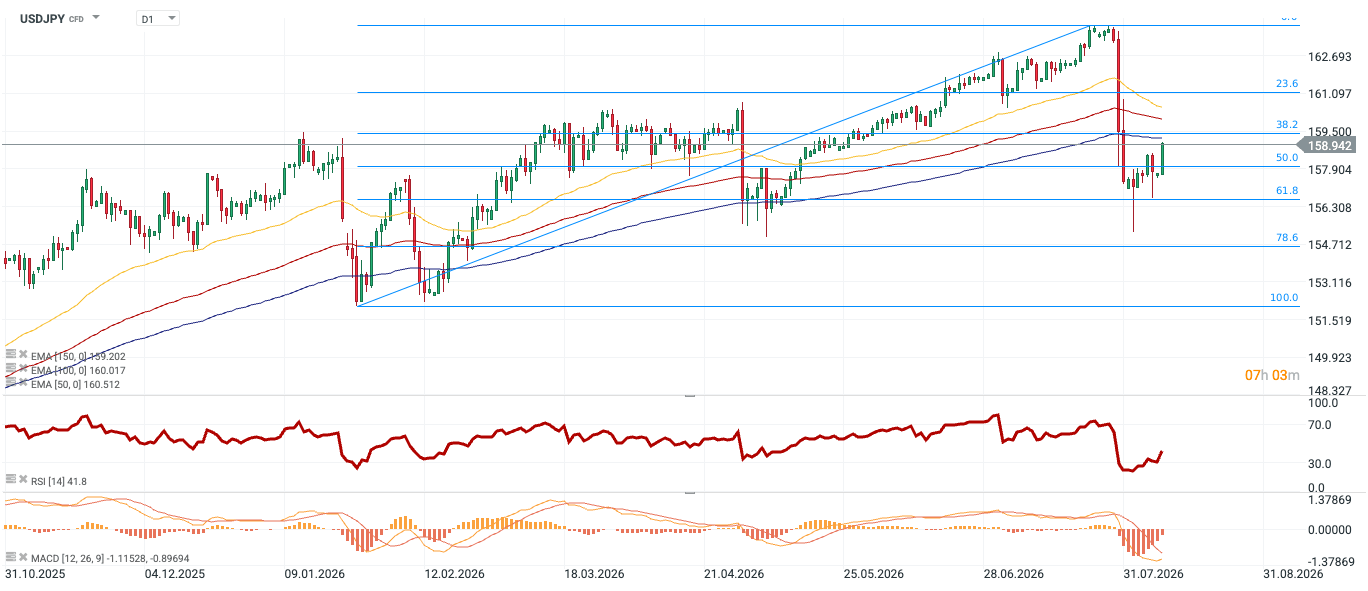
The fundamentals have not changed significantly and continue to exert pressure on the Japanese currency. The key issue remains the carry trade, or trading on the interest rate differential. As long as the discrepancy between the projected interest rate levels in the United States and Japan remains significant, even interventions amounting to nearly 90 billion dollars may prove insufficient to permanently reverse the trend. Figure 2: USDJPY (31.10.2025 – 10.08.2026)
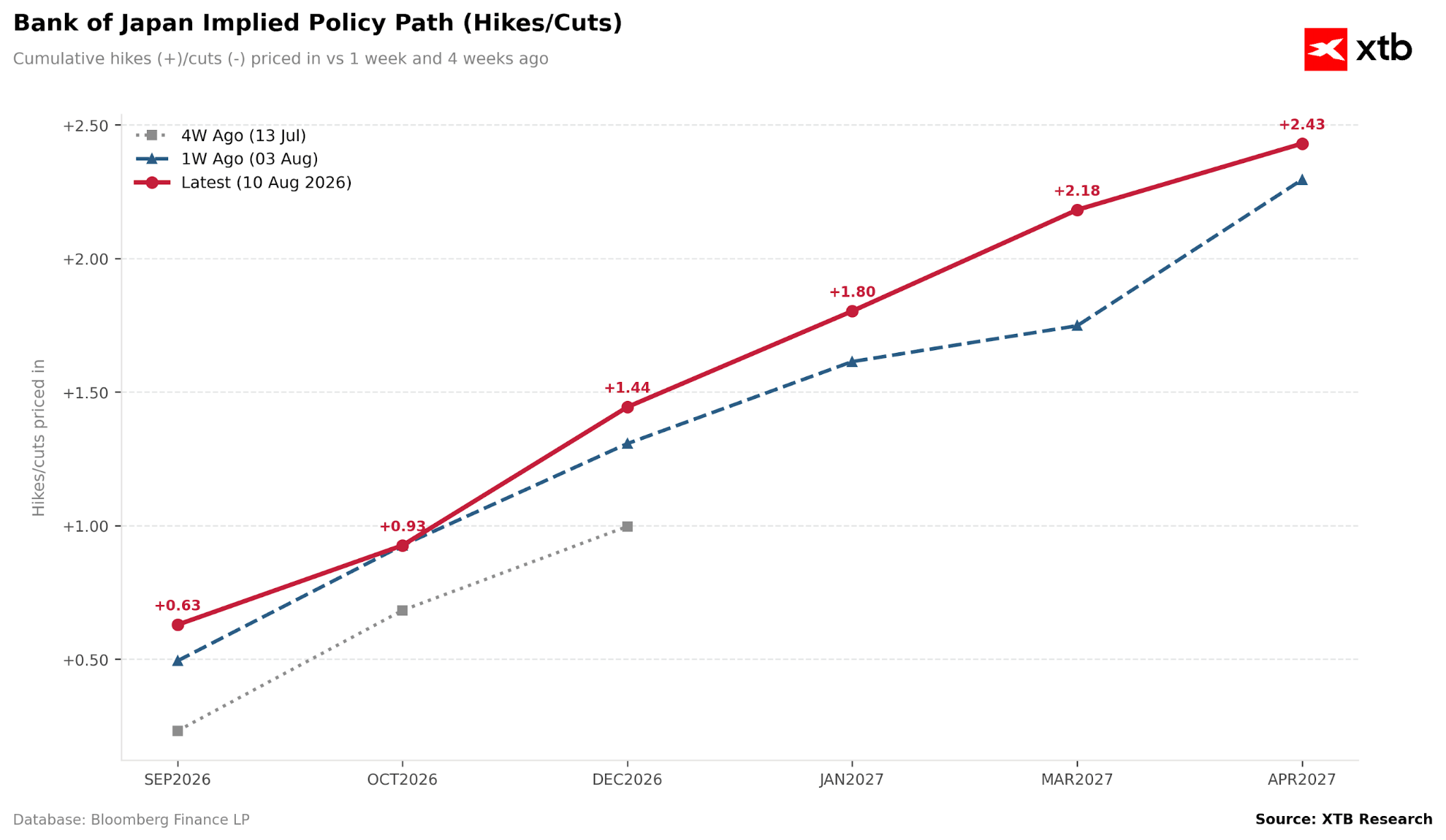
Source: xStation, 10.08.2026 Currently, the interest rate differential between both sides of the ocean stands at 2.675%. Market valuations suggest that it will narrow slightly in the coming months, reaching approximately 2.35% in July 2027. However, it seems that investors expect more decisive action from the Bank of Japan, with the next opportunity appearing only on 18 September. A decision to raise interest rates then could serve as a significant declaration for the market, leading to increased bets on subsequent hikes in the following months. Currently, such a move is priced at approximately 60%.
Figure 3: Bank of Japan Implied Policy Path (Hikes/Cuts) (2026-2027)
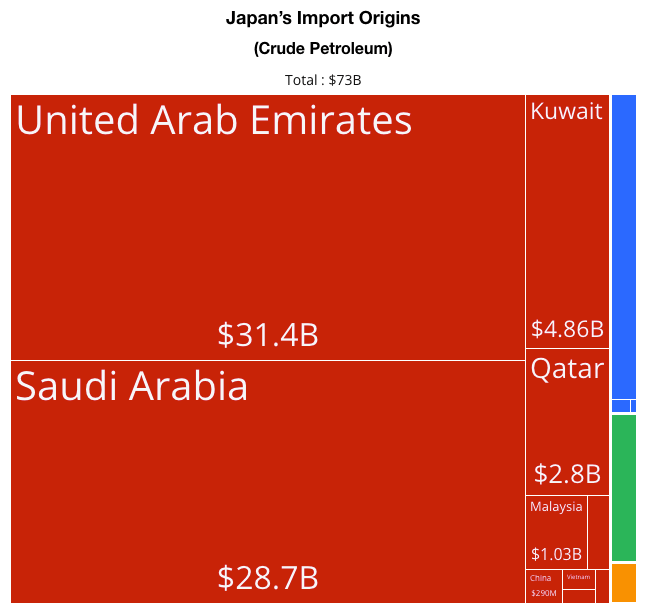
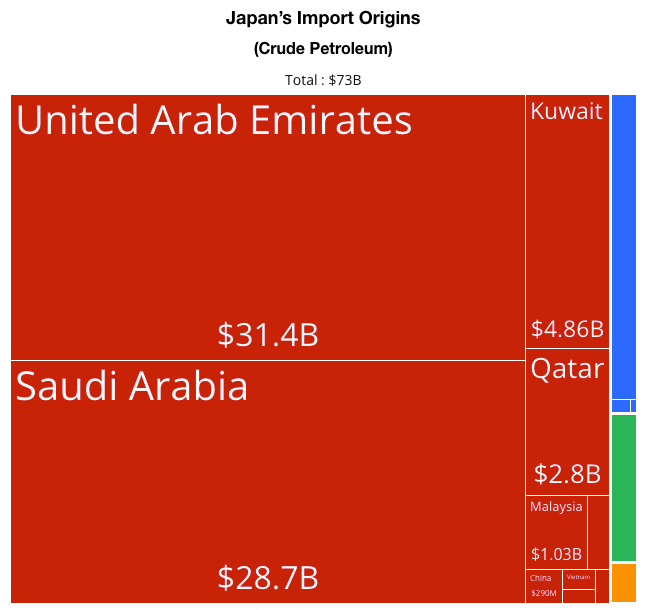
Source: XTB Research, 10.08.2026 In the meantime, the market’s attention will focus on the United States and the developing situation in the Middle East. Japan is almost entirely dependent on imports for its energy needs, and under standard conditions, nearly 90% of its crude oil comes from the Middle East. Figure 4: Japan’s Crude Oil Import Structure (2024)
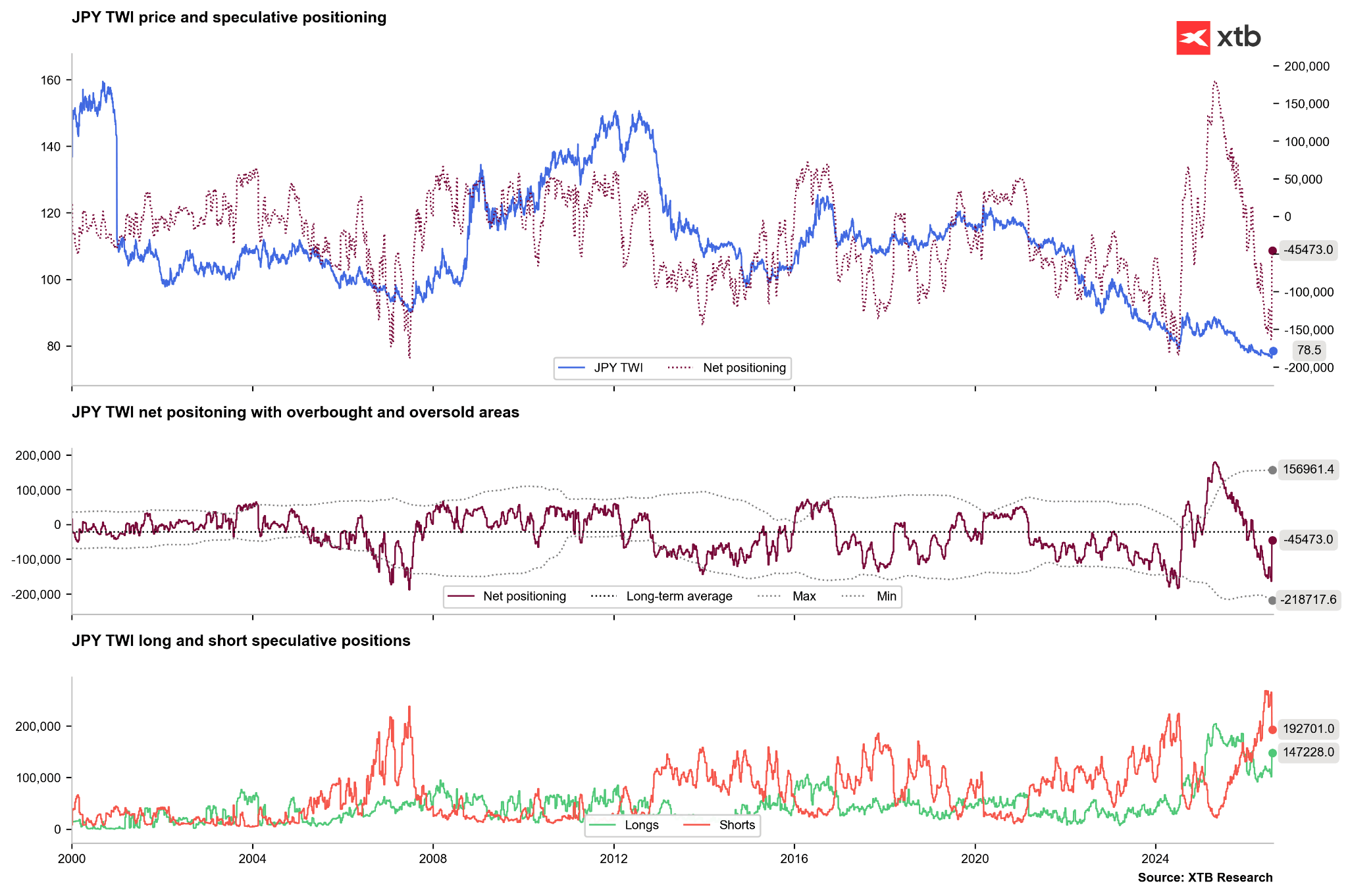
Source: OEC, 10.08.2026 However, further interventions cannot be ruled out, which the markets seem to fear. Positioning on the yen has changed significantly after many investors withdrew speculative short positions for fear of further actions aimed at defending the exchange rate. Figure 5: Yen Positioning (2000 – 2026)
Source: XTB Research, 10.08.2026
US Dollar (USD)
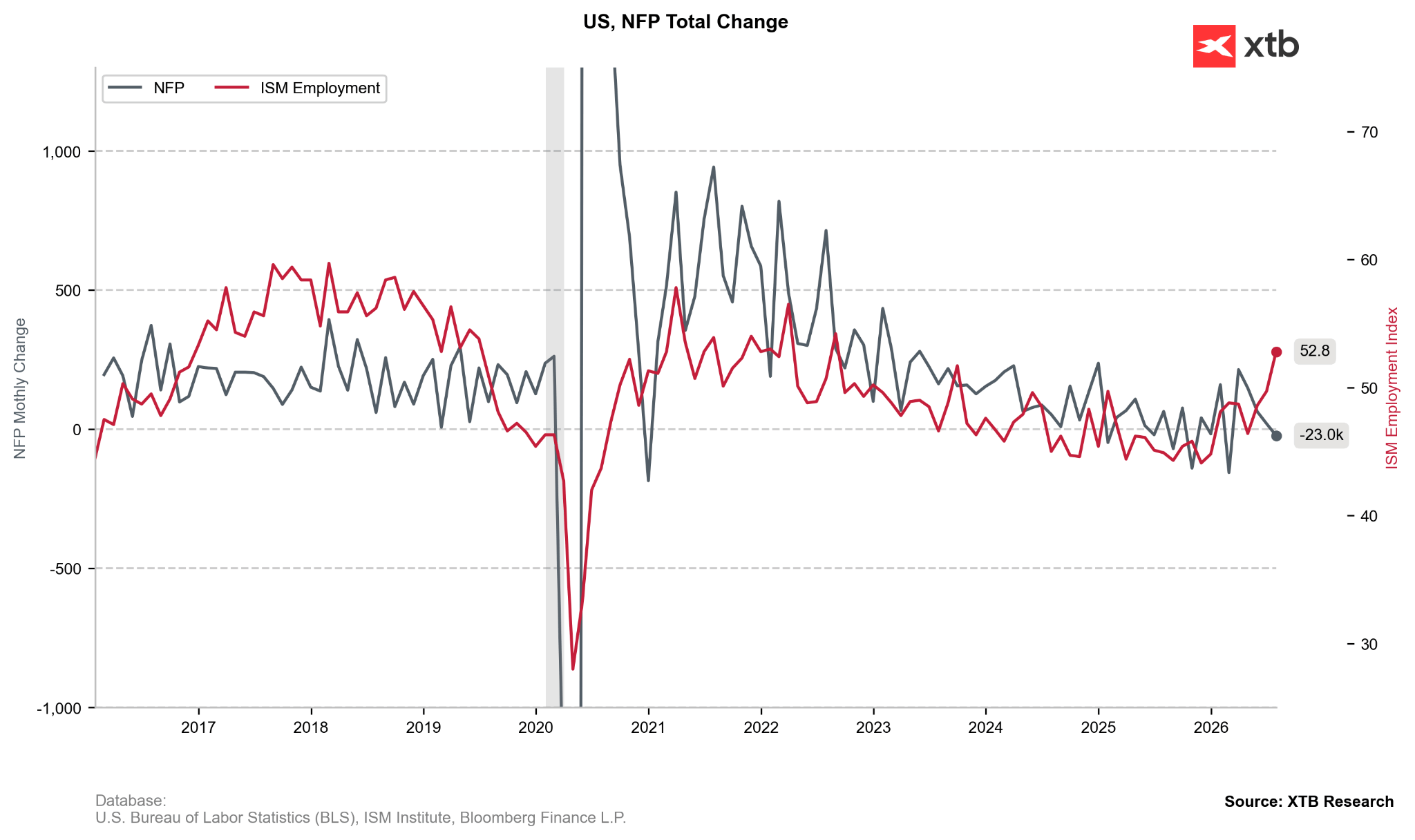
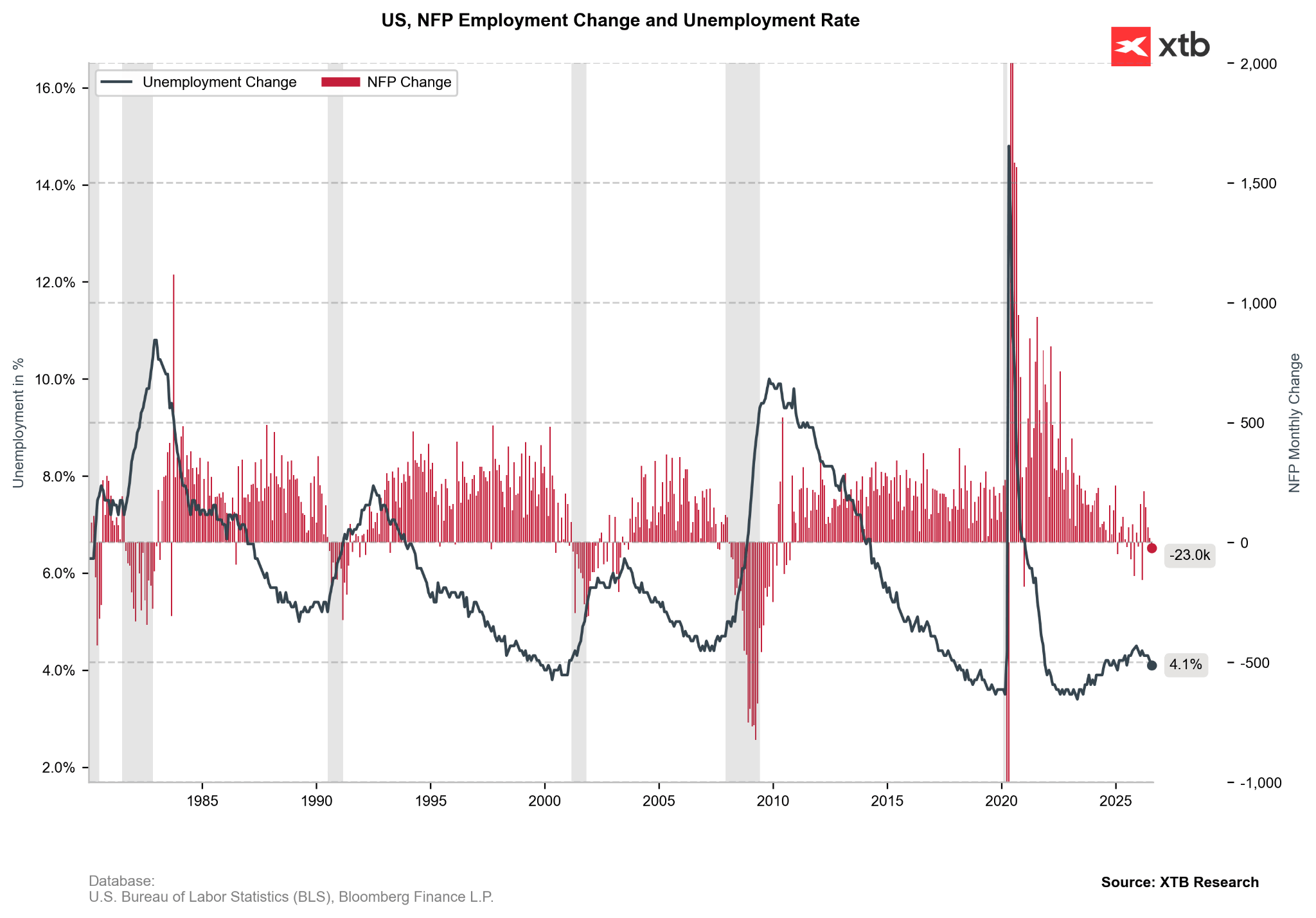
The July NFP report has been published. The number of new jobs in the US economy fell by 23 thousand, missing expectations by 5 standard deviations. Although extreme phenomena occur much more frequently in the world of macroeconomics (the so-called fat tails), assuming the data follows a normal distribution, we would have to wait 290,000 years for another such reading. Figure 6: NFP and Employment Component in ISM PMI (2016 – 2026)
Source: XTB Research, 10.08.2026 The market reaction was certainly noticeable, though not as strong as many might have expected. The dollar’s losses were limited by, among other things, a decline in the unemployment rate (to 4.1%) and problems with seasonal adjustment of the data (the decline resulted mainly from a lower number of jobs in the public education sector). Figure 7: NFP and Unemployment Rate (1980 – 2026)
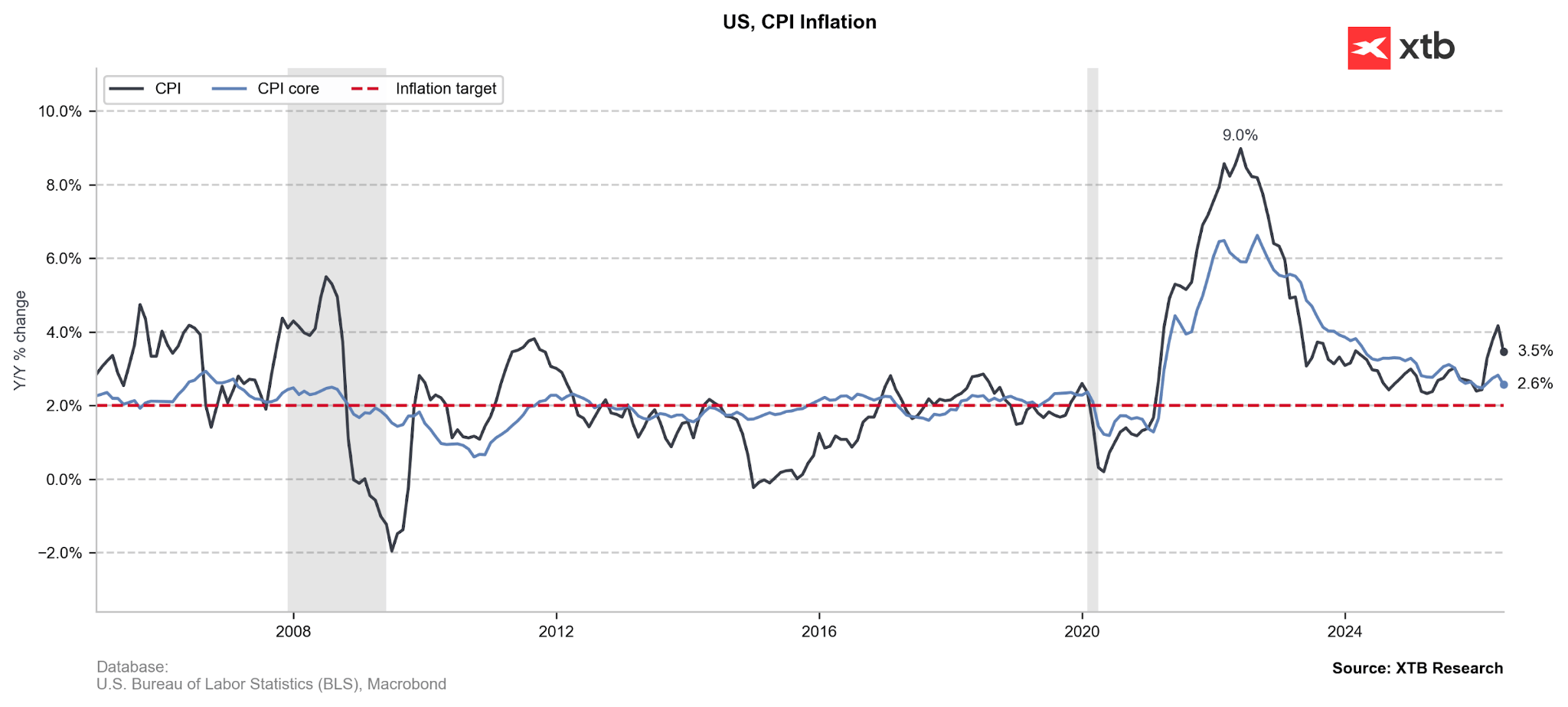
Source: XTB Research, 10.08.2026 It is worth noting, however, that higher energy prices have affected companies in the retail, leisure, and hospitality sectors (this despite the World Cup ending in July). Investors are currently unsure which direction the Fed will take in September; looking at market valuations, the chances of a hike can be compared to a coin toss. All eyes are on the July inflation reading scheduled for Wednesday. If, despite rising oil and gas prices, it shows similar values to June, we expect the committee led by Kevin Warsh to refrain from a hike until the next meeting. Figure 8: US CPI Inflation (2004 – 2026)
Source: XTB Research, 10.08.2026 For Warsh himself, this would be an exceptionally comfortable situation. In the event of intensifying inflation concerns, the committee would be almost forced to raise rates, especially in the face of revived discussions regarding the Fed’s independence. The topic returned to the table after further threats from Donald Trump directed at Lisa Cook, one of the FOMC decision-makers. These appeared more than a month after the Supreme Court deemed the president’s recent actions in this area unlawful.
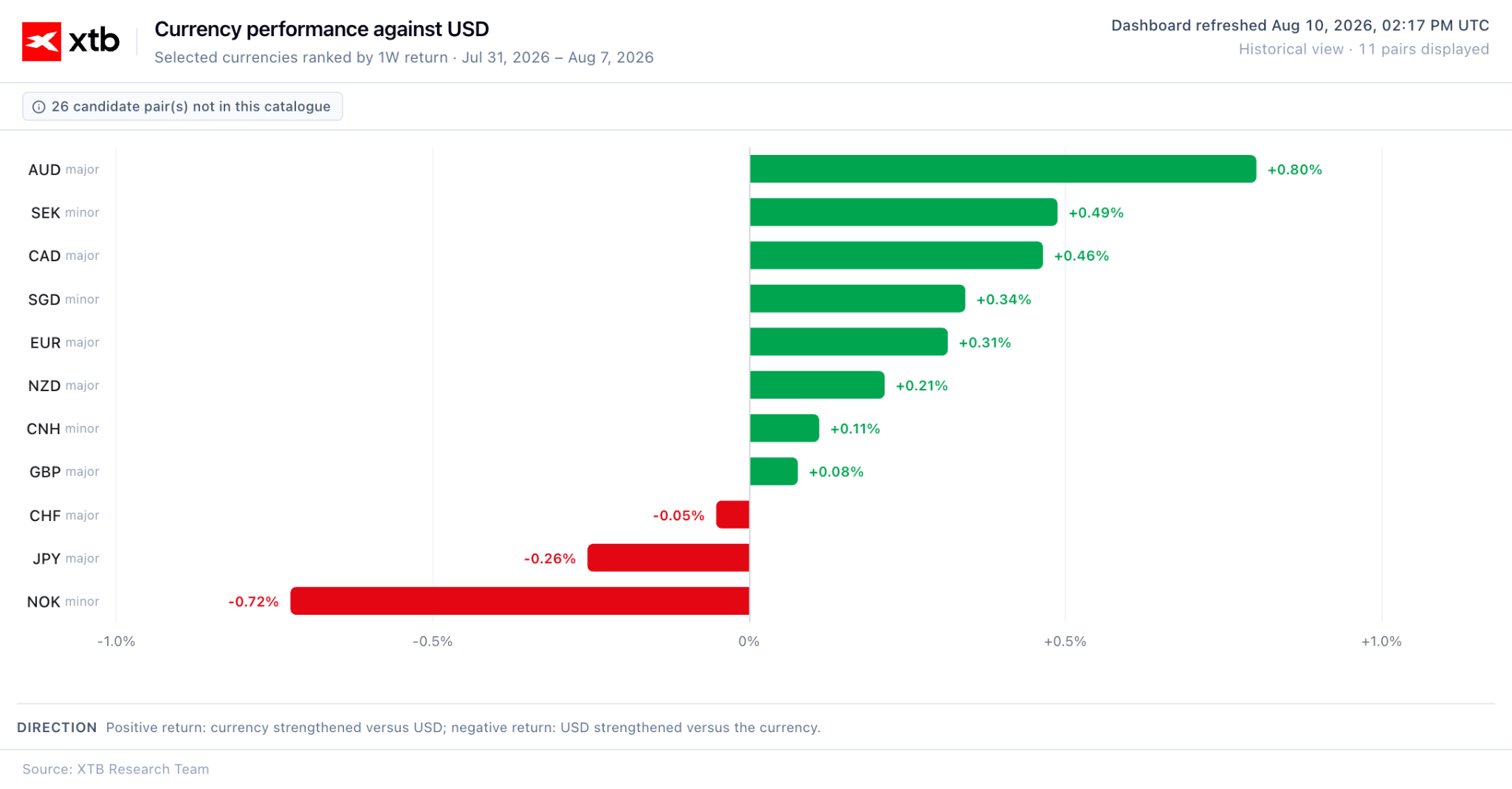
The dollar has come bottom of the G10 currency rankings for the past week.
The market does not believe that Kevin Warsh, the new Fed chairman, is a hawk.
Oil prices are falling, which is also putting pressure on the US dollar.
Higher GDP growth and inflation are fuelling expectations of interest rate rises in the eurozone.
The yen is strengthening following the first coordinated intervention by the US and Japan in 15 years.
In recent months, the market has repeatedly cast doubt on Donald Trump’s promises and announcements. This phenomenon has become so widespread that it has even been given its own name (TACO, i.e. Trump Always Chickens Out). In keeping with this motto, the US President backed down from a planned attack on Iran over the weekend, which, as he himself put it, was to be “the biggest since the Second World War”.
However, what proved more significant for the currency was investors’ scepticism regarding statements made by another US official. Kevin Warsh, the new Fed chairman, continued to emphasise his uncompromising stance on inflation, seeking to convince the markets of his supposed hawkishness. Whilst this was sufficient in June, by July investors were expecting much more.
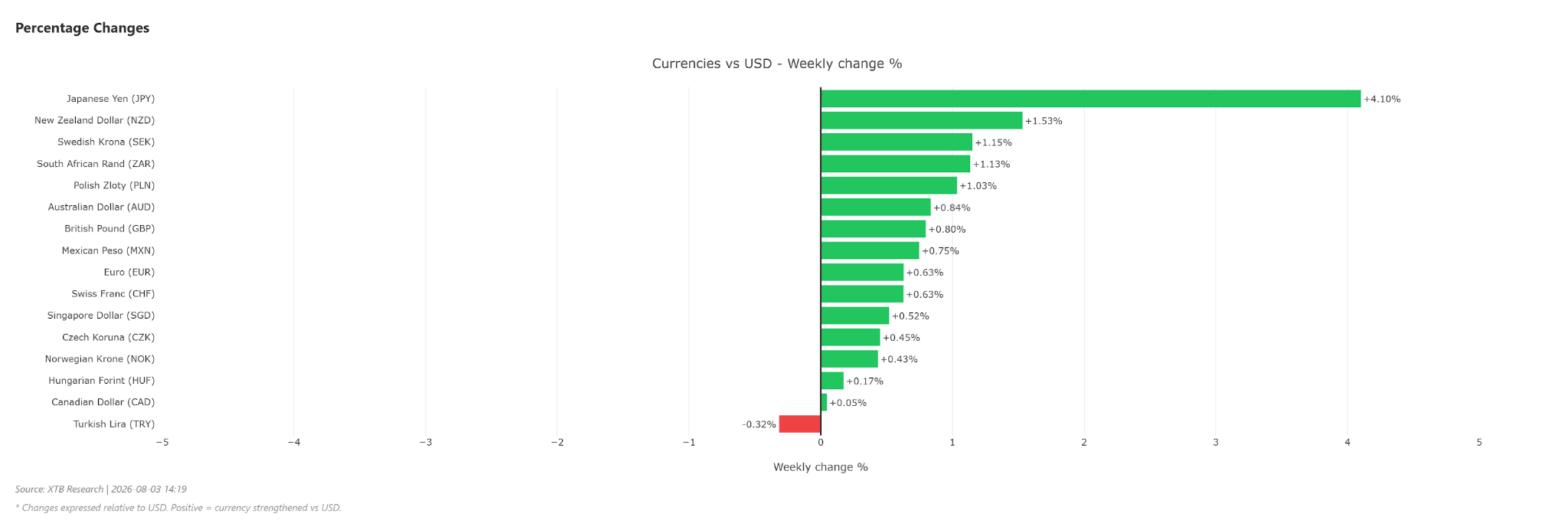
Chart 1: Exchange rates of selected currencies [vs. USD] (27 July – 3 August)
Source: Bloomberg, 3 August 2026 The US dollar has therefore come under pressure, weakening against almost every currency we analyse on a regular basis. Currencies with a higher beta (e.g. the Swedish krona or the Polish zloty) performed particularly well, as did those whose economies could suffer most from a deepening energy crisis (e.g. the South African rand or the South Korean won). At the very top of the list was, of course, the Japanese yen, which was bolstered last Thursday by the first joint currency intervention by the United States and Japan since 2011.
US dollar (USD)
The dollar is being weighed down by both the fall in energy commodity prices (of which it is a net exporter) and a dovish revision to market expectations regarding the Fed’s interest rate path. The Federal Open Market Committee (FOMC) decided last week to hold rates steady. The vote was 9 to 3. Only three policymakers voted in favour of a rate rise, and Warsh was not among them (the others were Beth Hammack, Neel Kashkari and Lorie Logan). During the conference itself, the Fed Chair stuck to his decision not to provide forward guidance. Although he spoke for nearly 45 minutes, few of the words that came out of his mouth were of any great significance from a market perspective. He avoided answering both questions regarding the justification for the pause and those concerning the current economic situation.
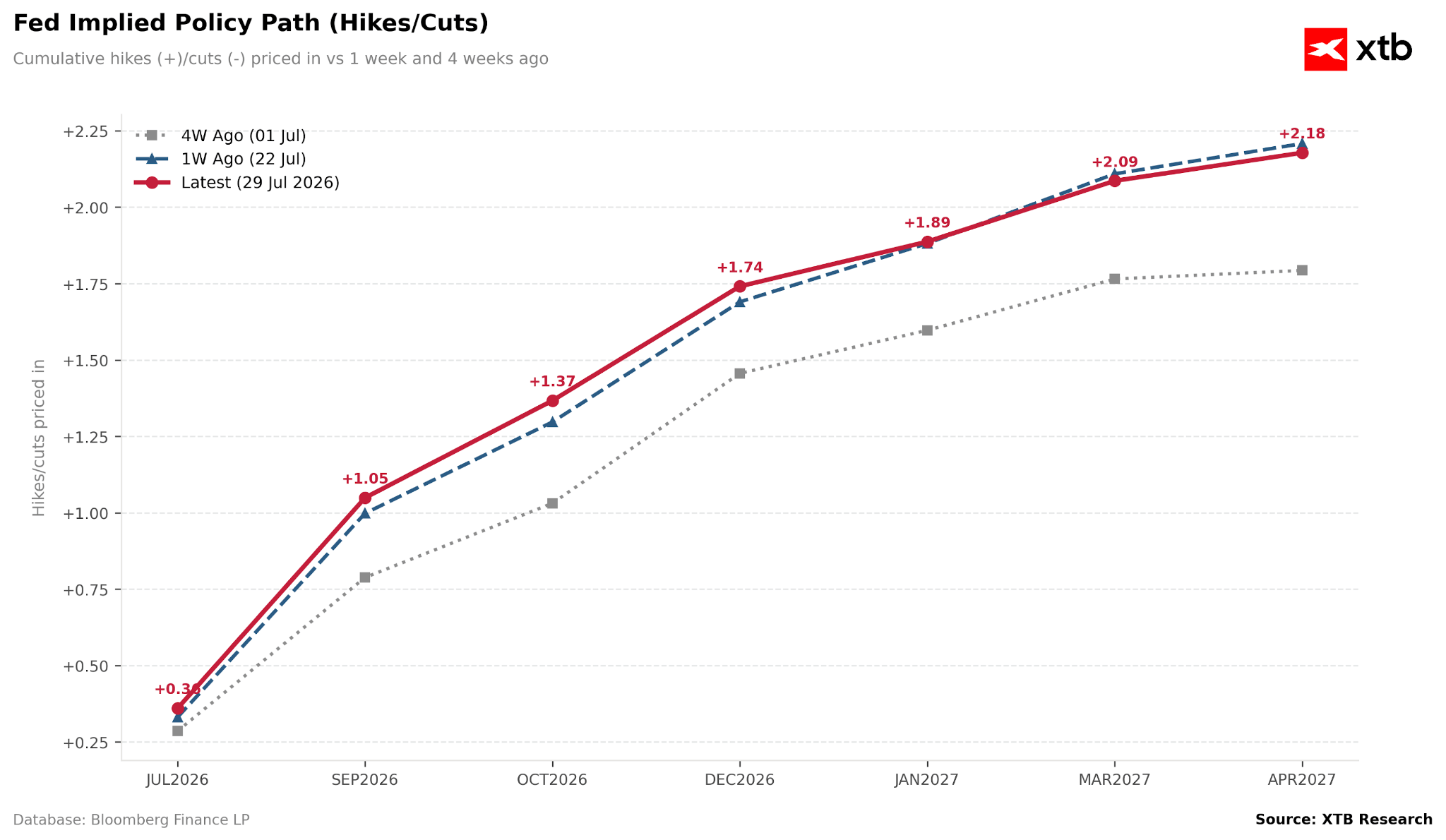
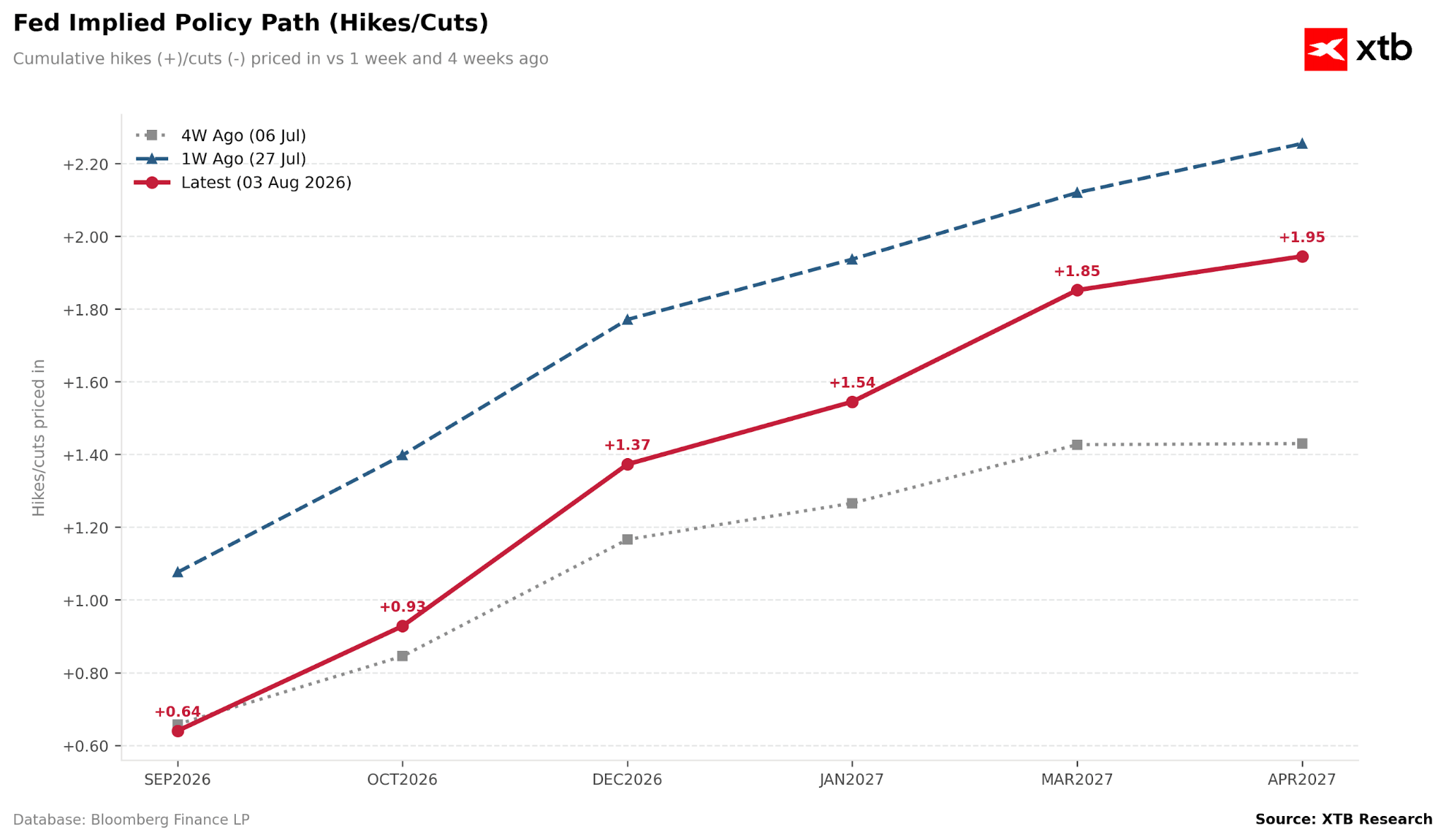
He mainly emphasised that the energy shock is hampering the committee’s work, and that the rise in CAPEX among hyperscalers should translate into future economic growth. This is largely consistent with his past comments on AI, when he argued that the productivity surge driven by artificial intelligence would, over time, have a disinflationary effect. The question is being raised once again as to whether Kevin Warsh is a dove in hawk’s clothing. The market seems increasingly sceptical that hawkish statements will be followed by concrete action, leading to a pullback in bets on interest rate rises. It currently assigns a probability of just over 60 per cent to a rate rise in September. Prior to the meeting, this was fully priced in. Chart 2: Market pricing of interest rate rises ahead of the FOMC decision (2026–2027)
Source: XTB Research, 29 July 2026 Chart 3: Market pricing of interest rate rises following the FOMC decision (2026–2027)
Source: XTB Research, 3 August 2026 It is worth recalling that almost exactly a year ago, he openly sided with the president, stating on FOX News that Donald Trump’s frustration with Powell’s conduct of monetary policy was entirely justified, and criticising the institution for being too slow to cut interest rates and for placing too much emphasis on historical economic data.
Euro (EUR)
In the eurozone, attention last week was focused not on monetary policy but on macroeconomic data. There are increasing signs that, following the pause in July, the time has come for a rate rise. The probability of a rate rise in September is estimated at almost 90 per cent. In recent days, both GDP growth (up 0.4 per cent quarter-on-quarter, compared with expectations of 0.2 per cent) and core inflation (2.5 per cent, consensus 2.4 per cent) have come in higher than expected. Both figures are consistent with further monetary tightening.
G10
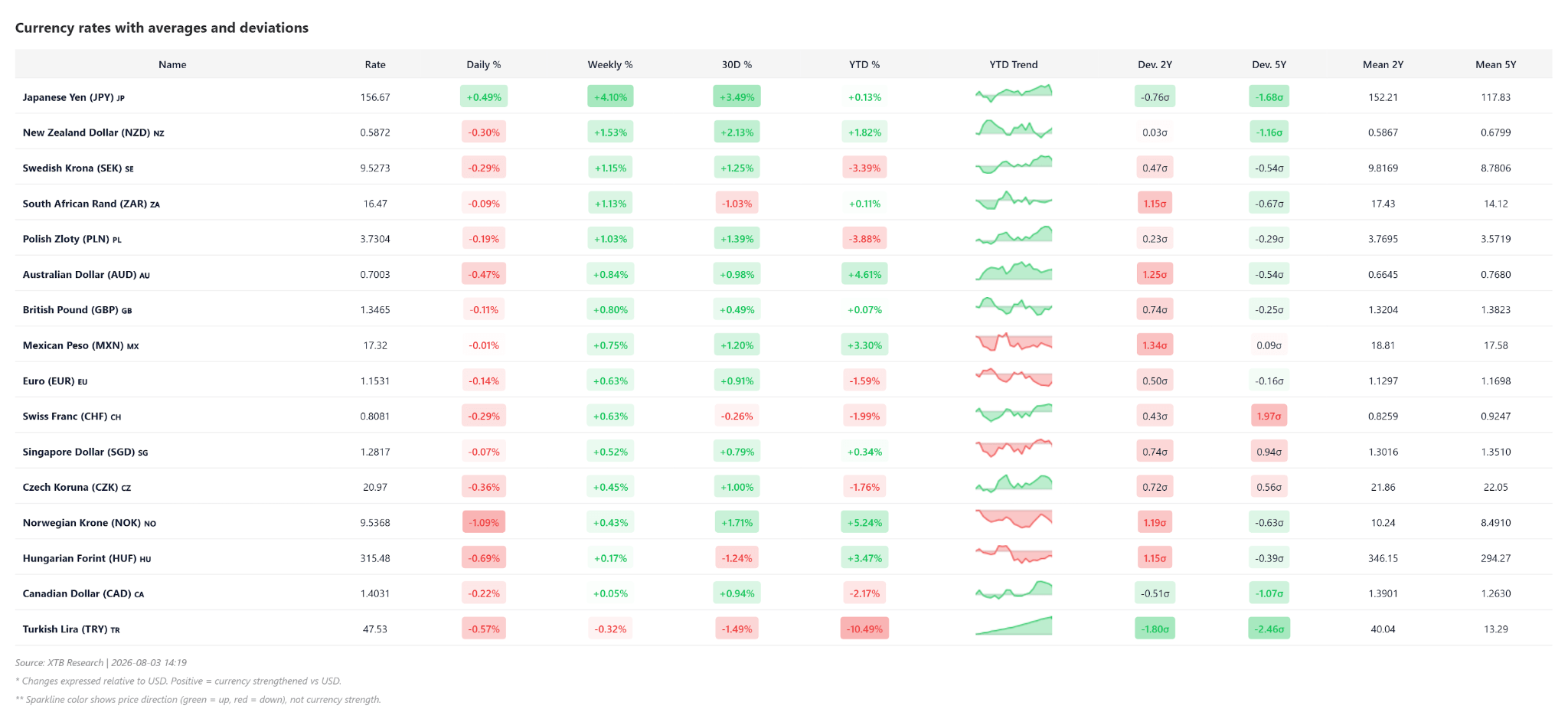
Chart 4: Exchange rates of selected currencies [vs. USD]
Source: Bloomberg, 3 August 2026
Japanese yen (JPY)
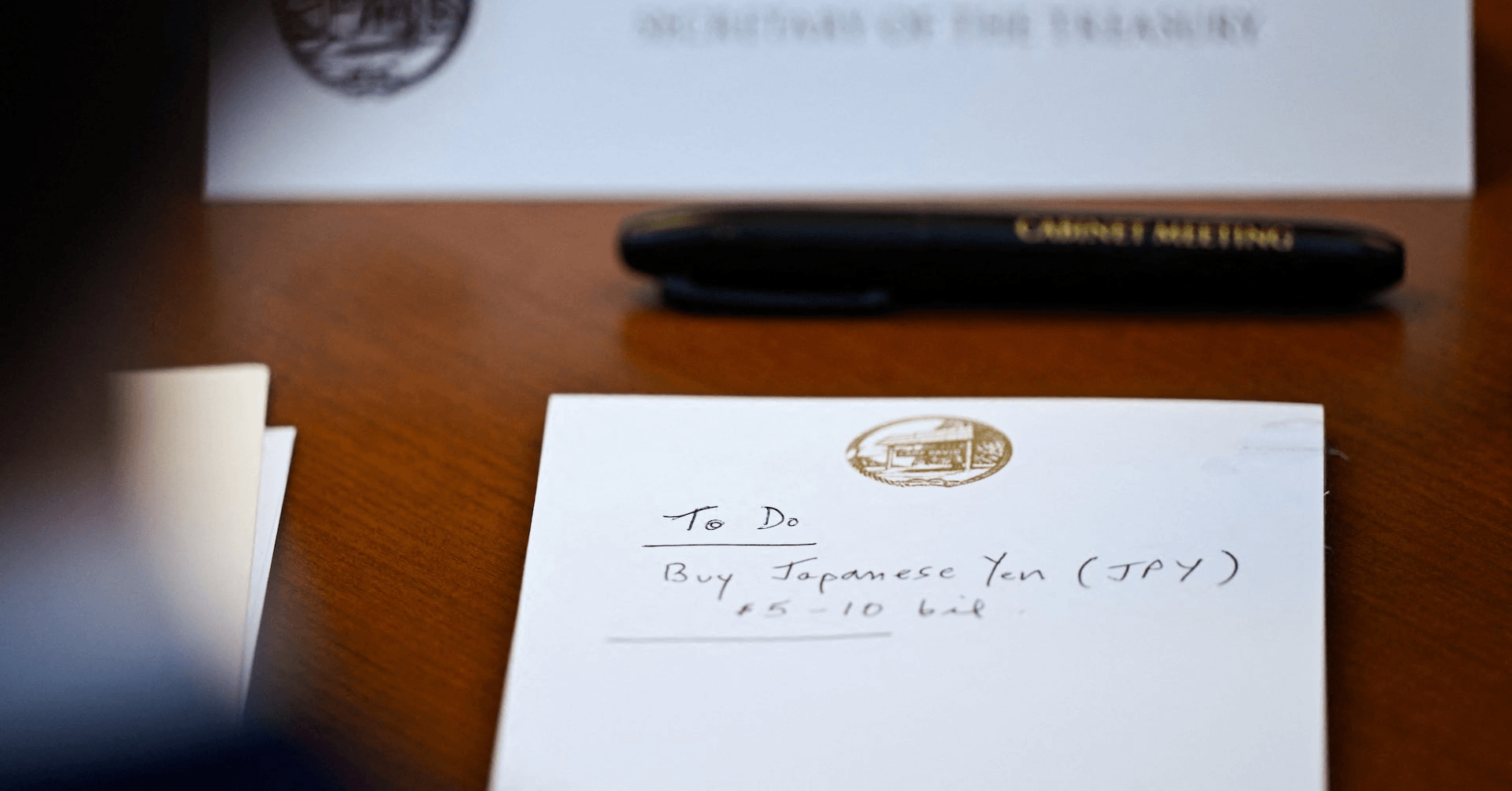
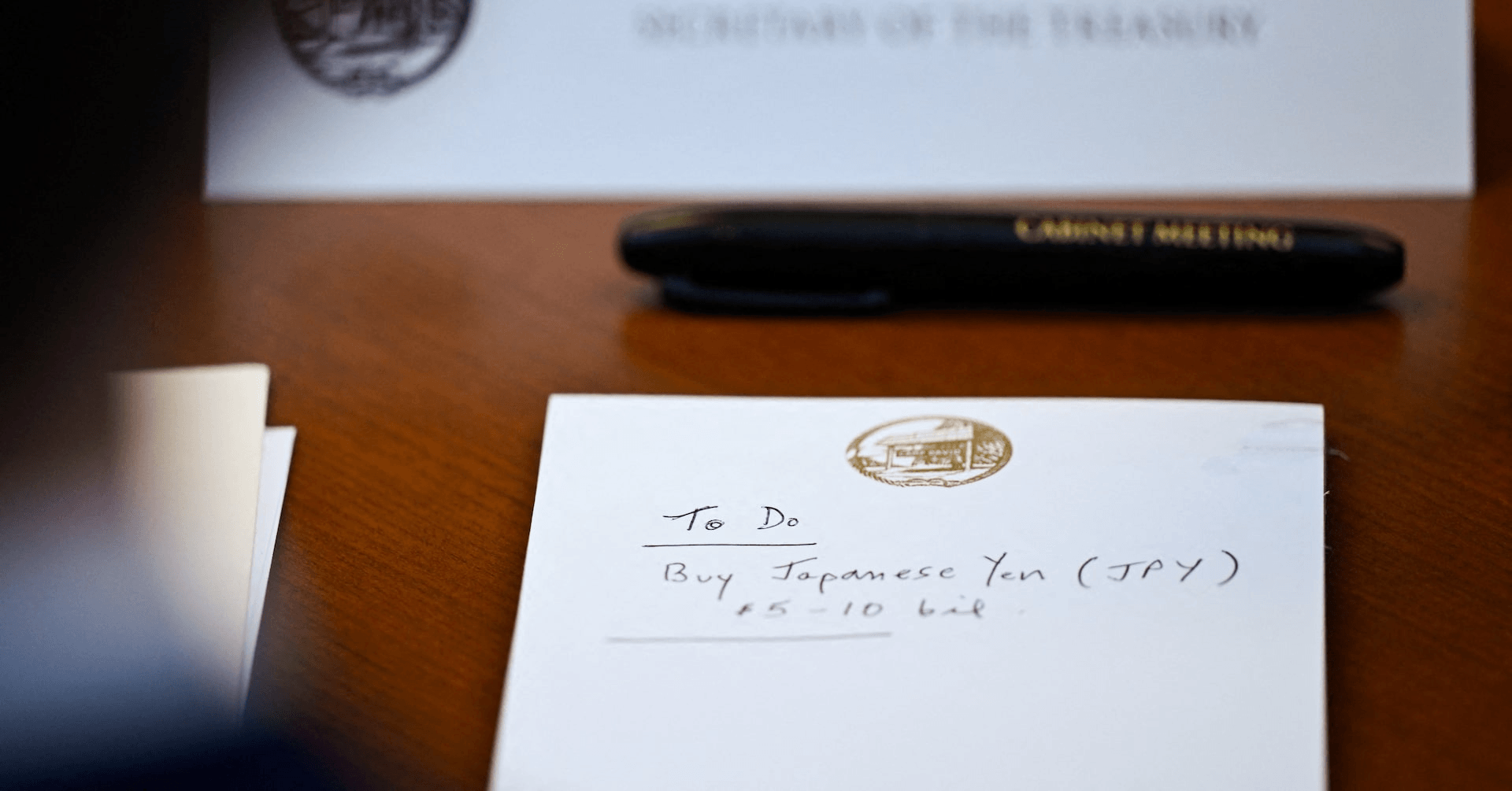
After reaching its highest level since 1986 (163.99), the USDJPY pair experienced a very sharp fall. This move was driven by the first coordinated intervention by the US and Japan since 2011. At that time, the yen had weakened following a massive earthquake. As emphasised by the US Treasury Secretary, Scott Bessent, and the Japanese Finance Minister, Satsuki Katayama, both sides remain ready to take further measures to stabilise the exchange rate. According to data provided by the Bank of Japan, the scale of the Japanese intervention may have reached as much as 59 billion dollars, which would be an unprecedented move (in terms of the scale of a single-day intervention). Although we cannot estimate the scale of US operations using official data, there are strong indications that it amounted to between 5 and 10 billion dollars. This is at least what is suggested by a note left by Scott Bessent during a meeting in Maryland.
Source: Reuters President Trump confirmed the US intervention at the weekend: “Japan has been very good to us, except, of course, for the attack on Pearl Harbour. (…) Their yen is weakening and they needed a bit of help. And we are always ready to help Japan.” Today, Minister Katayama published an official letter confirming the intervention.
After reaching its highest level since 1986 (163.99), the USDJPY pair recorded a very dynamic decline. The movement was driven by the first coordinated intervention by the US and Japan since 2011. At that time, the yen was weakened following a massive earthquake. US Treasury Secretary Scott Bessent and Japan’s Minister of Finance Satsuki Katayama emphasised that both sides are prepared to take further action to stabilise the exchange rate.
Historic intervention
According to data provided by the Bank of Japan, the scale of the Japanese intervention may have reached as much as 59 billion dollars, which would be unprecedented given the scale of a one-day intervention. Although we cannot estimate the scale of the US action using official data, many indications suggest it reached 5-10 billion dollars. This is suggested, at least, by a note left by Scott Bessent during a meeting in Maryland.
Source: Reuters The US intervention was confirmed over the weekend by President Trump: “Japan has been very good to us, except, of course, for the attack on Pearl Harbor. (…) They have a weakening yen and they needed a little help. And we are always ready to help Japan.” Today, an official letter confirming the intervention was published by Minister Katayama.
Is the Mar-a-Lago accord returning?
Due to US cooperation in the recent intervention aimed at strengthening the yen, the issue of broader White House policy is returning to the fore. A return to actions aimed at weakening the US currency, which would support domestic exports, seems possible. At the beginning of 2025, such actions were termed the “Mar-a-Lago Accord,” a modern attempt to repeat the premises of the 1985 Plaza Accord.
What is behind the earlier weakening of the yen?
Key to this was the return of the carry trade, i.e., trading on interest rate differentials.
How does this work?
This strategy is based on borrowing a currency (in this case, the yen) at near-zero interest rates and immediately exchanging it for another (e.g., the dollar) to make investments in a market offering higher returns. Although the Bank of Japan has moved away from its ultra-loose monetary policy and implemented five interest rate hikes in recent months, bringing the reference interest rate to its highest level in over 20 years (1%), it still remains far below levels seen in the United States (3.75%) and many other developed economies, such as Australia (4.35%), Norway (4.25%), the UK (3.75%), or the eurozone (2.4% – deposit rate).
BoJ holds rates
In line with market expectations, the Bank of Japan kept interest rates unchanged overnight from Thursday to Friday. The main interest rate remains at 1%. The decision was made by a vote of 8 to 1. One of the hawks, Hajime Takata, voted in favour of a hike. Due to government initiatives aimed at supporting households regarding energy prices, the BoJ revised down its inflation forecast for the 2026 fiscal year, lowering it from 2.8% to 2.5%. At the same time, the inflation forecast for 2027 was raised from 2.3% to 2.4%. The meeting was treated as a pause to assess the impact of recent tightening. Naoki Tamura, a board member, suggested the possibility of raising rates at intervals of a few months by 25 basis points until reaching a level of approx. 2%. This is largely consistent with market valuations. The market-implied probability of a hike in September can be compared to a coin toss. An upward move before the end of the year is fully priced in. It is possible that the BoJ will raise rates twice in the mentioned period.
What is the inflation situation?
The quarterly report published in July showed that households estimate prices will grow at a rate of 10.8% over the next five years. The survey has never shown such high values (though it should be noted that it has only been conducted for 20 years). Although this figure is inflated by the survey methodology – an average is presented, which is contaminated by irrationally high expectations of part of the society – the anxiety regarding rising price pressure cannot be underestimated. The median (5%) is also growing very dynamically, which may be a more reliable indicator in this regard. Inflation grew in the last four months by 0.4%, 0.1%, 0.4%, and 0.3% respectively on a monthly basis – when annualised, this data suggests price growth in the region of 4-5%. After excluding the most volatile energy and food prices, the situation looks better, but much still points to a significant rise in the indicator from current levels (1.6%). Significant factors may include, among others, relatively dynamic wage growth (3.2% in May).
Dependence on energy imports
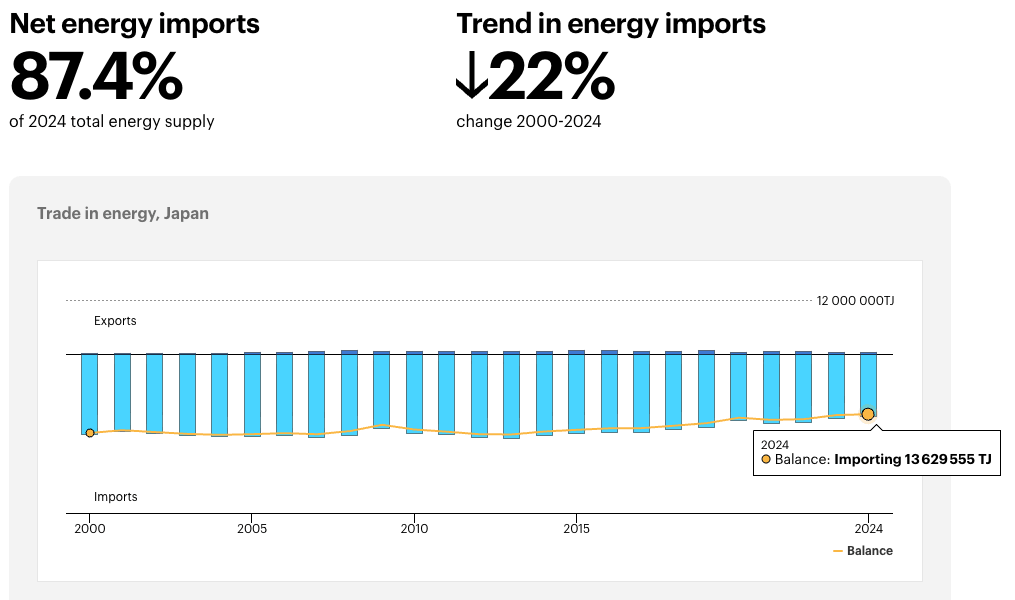
A weaker yen is not just a matter of carry trade. The outbreak of war in the Middle East plays a significantly important role, which brought oil and LNG prices to their highest levels since 2022, when Russia launched a full-scale attack on Ukraine. Nearly 90% of Japan’s energy demand comes from imports, and under normal conditions, its main suppliers are Middle Eastern countries.
Figure 1: Japan’s Energy Sector Trade Balance (1998 – 2026)
Source: IEA, 03.08.2026 The prolonged lack of de-escalation in the conflict between the United States and Iran may translate not only into a significant increase in inflationary pressure but also into problems maintaining the continuity of key energy resource supplies. Figure 2: Structure of Japan’s Crude Oil Imports (2024)
Source: OEC, 03.08.2026
Technical analysis
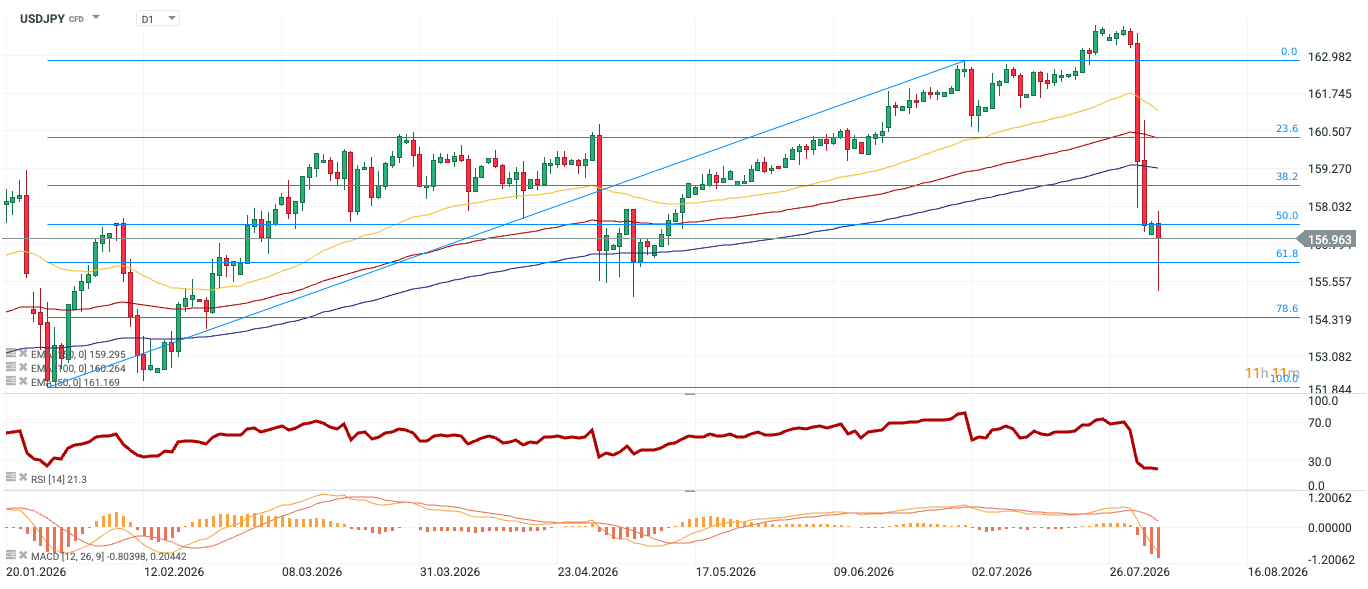
Figure 3: USDJPY [D1] (20.01.2026 – 03.08.2026)
Source: xStation, 03.08.2026 After reaching a local peak near the 164 level, the market experienced a sharp collapse. The price broke through key structural supports with momentum and is currently in the 157 region. It is worth noting, however, that a long lower wick formed on one of the recent candles – this signifies the first serious attempt at defence and a reaction from demand. The price drastically broke down through the band of moving averages (EMA 50, EMA 100, and EMA 200). For a long time, these averages (blue, red, and yellow lines) served as dynamic supports in the uptrend. Currently, this setup has been negated. The closest of them (blue, around 159.3) now constitutes the first very important dynamic resistance in the case of a possible rebound.
The long lower wick of the bearish candle tested the 78.6 Fibo retracement. Currently, the price has rebounded and is fighting to hold above the 61.8 retracement. The RSI indicator is at the 21.3 level. This is an extreme oversold zone (below 30). Although in strong downtrends, the RSI can stay in this zone for a long time, such a low value is a strong warning signal of a possible upward correction or at least a transition into consolidation to “cool down” the indicator. MACD confirms a strong downtrend. The lines have crossed downwards and are moving away from the zero level, and the histogram is growing in the negative zone. There are no divergences here at this moment.
USD/JPY falls to around 156.45 in Monday’s early European session.
Japan and the US confirm a joint JPY-buying intervention, signal more action.
Trump said Iran talks would resume Monday after calling off planned strikes.
The USD/JPY pair tumbles to near 156.45 during the early European trading hours on Monday. The Japanese Yen (JPY) climbs amid speculation that Japanese authorities may have intervened to prop up the currency again after coordinated action between the US and Japan last week.
Japan’s Finance Minister Satsuki Katayama said on Monday that Japan and the United States (US) conducted coordinated Yen-buying intervention and will not hesitate to take further action, per Reuters. Katayama confirmed a rare bilateral action to halt the JPY’s slide to fresh 40-year lows.
Meanwhile, US Treasury Secretary Scott Bessent said that Washington wouldn’t hesitate to step into the market again. US President Donald Trump said on Sunday the US was helping Japan prop up the JPY as a sign of friendship and to help the world economy.
“It seems likely that authorities would intervene further in the coming days if the yen begins to unwind the recent move, as was the case in May of this year,” Goldman Sachs Group Inc. strategists including Kamakshya Trivedi wrote in a note. “We continue to think intervention is an effective tool for authorities to buy some time before fundamental factors turn more positive.”
Uncertainty in the Middle East remains high despite hopes of a breakthrough between the US and Iran. Bloomberg reported on Monday that Trump said that a new round of Iran talks would begin Monday afternoon after he cancelled a planned attack on Iran partially in response to pleas from US allies in the Middle East, including Saudi Arabia.
However, Iranian officials said that Trump’s claim that Tehran had requested a pause “was nothing but a new lie.” Any signs of renewed escalation in the Middle East could boost the Greenback against the JPY in the near term.
Yen seen as undervalued as Japan authorities urged to back firmer currency stance
Strategists at BNY Mellon note that official rhetoric is turning more supportive of the Yen, pointing out that U.S. Treasury Secretary Scott Bessent said on Thursday that the Japanese Yen “looks very undervalued and should strengthen further,” while also stressing that “excessive volatility in the currency isn’t healthy.” In their view, “reported intervention and a firmer BoJ message could change that quickly.” BNY Mellon argues that stronger intervention would demonstrate that the authorities are prepared to resist further depreciation, while clearer policy guidance would “reduce the credibility discount embedded in JPY assets.”
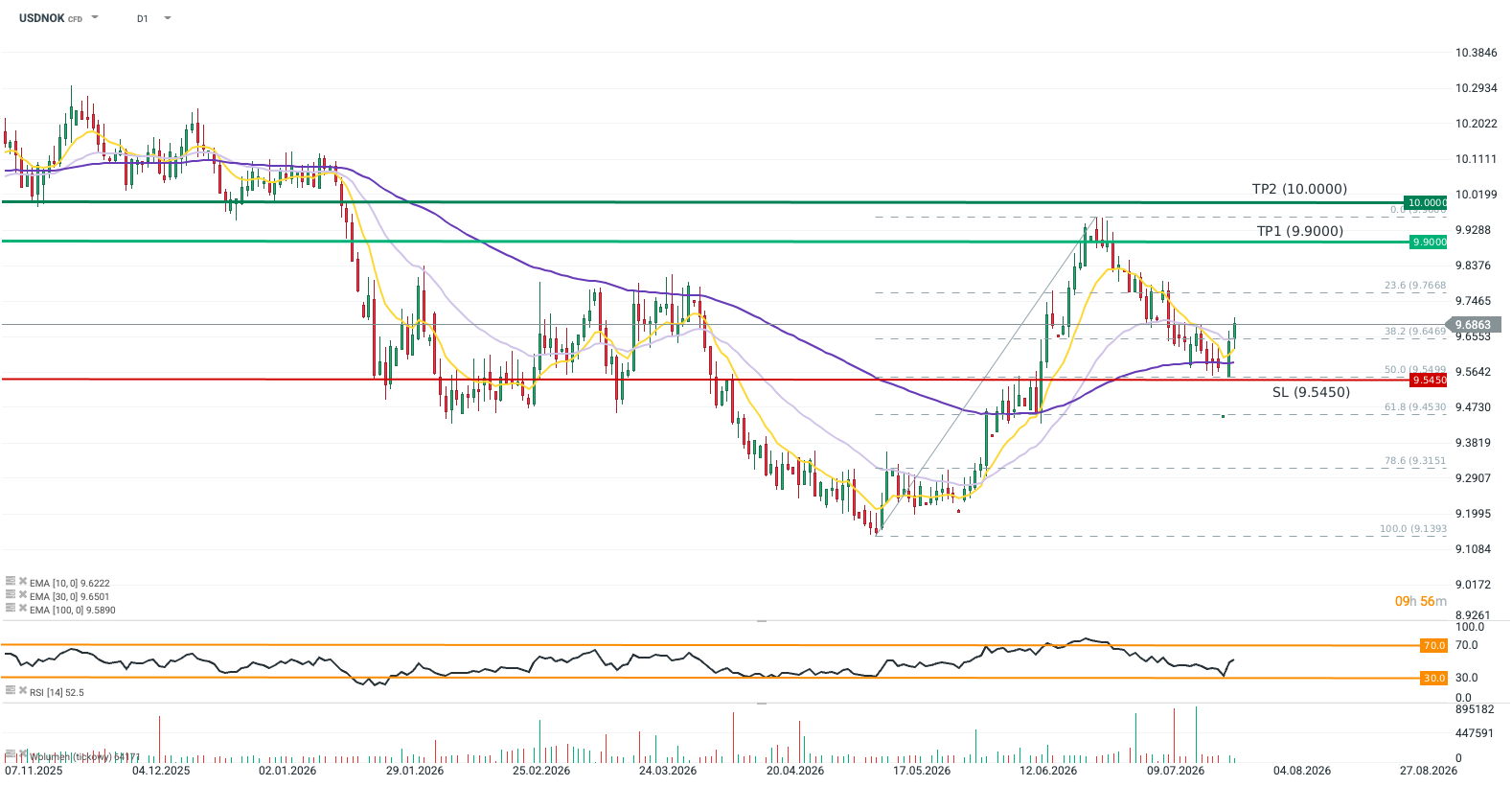
USDNOK returned today above the 10- and 30-day exponential moving averages (EMA10 and EMA30).
The yield spread between US and Norwegian 10-year government bonds (US-NOR) has widened by approximately 8 basis points over the past month (today vs. June 26).
The swap market is fully pricing in a September interest rate hike in the US.
After breaking out to a 5-month high in late June, USDNOK entered a local downtrend driven by the resurgence of military actions in the Persian Gulf and rising oil prices. The ~4% correction ended on Monday, and the exchange rate is currently attempting to break out of this downtrend, aided by falling oil prices that are weakening the Norwegian krone. A rebound in USDNOK should be supported by the Federal Reserve’s increasingly hawkish stance. During the central banking forum in Sintra, Kevin Warsh explicitly identified inflation as enemy number one, emphasizing that the Fed will not tolerate inflation above target and suggesting it will not take AI-driven productivity gains for granted. A hawkish Fed is also backed by the recent series of US economic data (jobless claims at their lowest since 1969, a stable unemployment rate, and better-than-expected PMI readings indicating expansion in the private sector). The gathering economic momentum, accompanied by sticky inflation above 3%, is driving interest rate expectations across all time horizons (e.g., the year-end rate implied by the swap market rose from 4.00% to 4.05% over the past month). Expectations for Norges Bank are also hawkish (the swap market is pricing in a 25 bps hike by the end of the year), but they are gaining momentum more slowly than those for the US, as evidenced by the upward trend in the 10-year yield spread between the two economies. A renewal of upward pressure on oil prices could naturally strengthen the NOK; however, geopolitical risk simultaneously supports the dollar, which should limit any non-monetary-policy-driven declines in USDNOK.
Methodology
This recommendation was prepared based on a technical analysis of the USDNOK chart and a fundamental analysis of the respective economies (monetary policy in Norway and the United States). The directional bias was determined using moving averages and market expectations regarding central bank policies. Take Profit and Stop Loss levels were established using Fibonacci retracements and price action:
TP1 is set at the recent peak.
TP2 is set at the next key resistance level.
SL is placed at the 61.8% Fibonacci retracement level of the April–May 2026 downward wave.
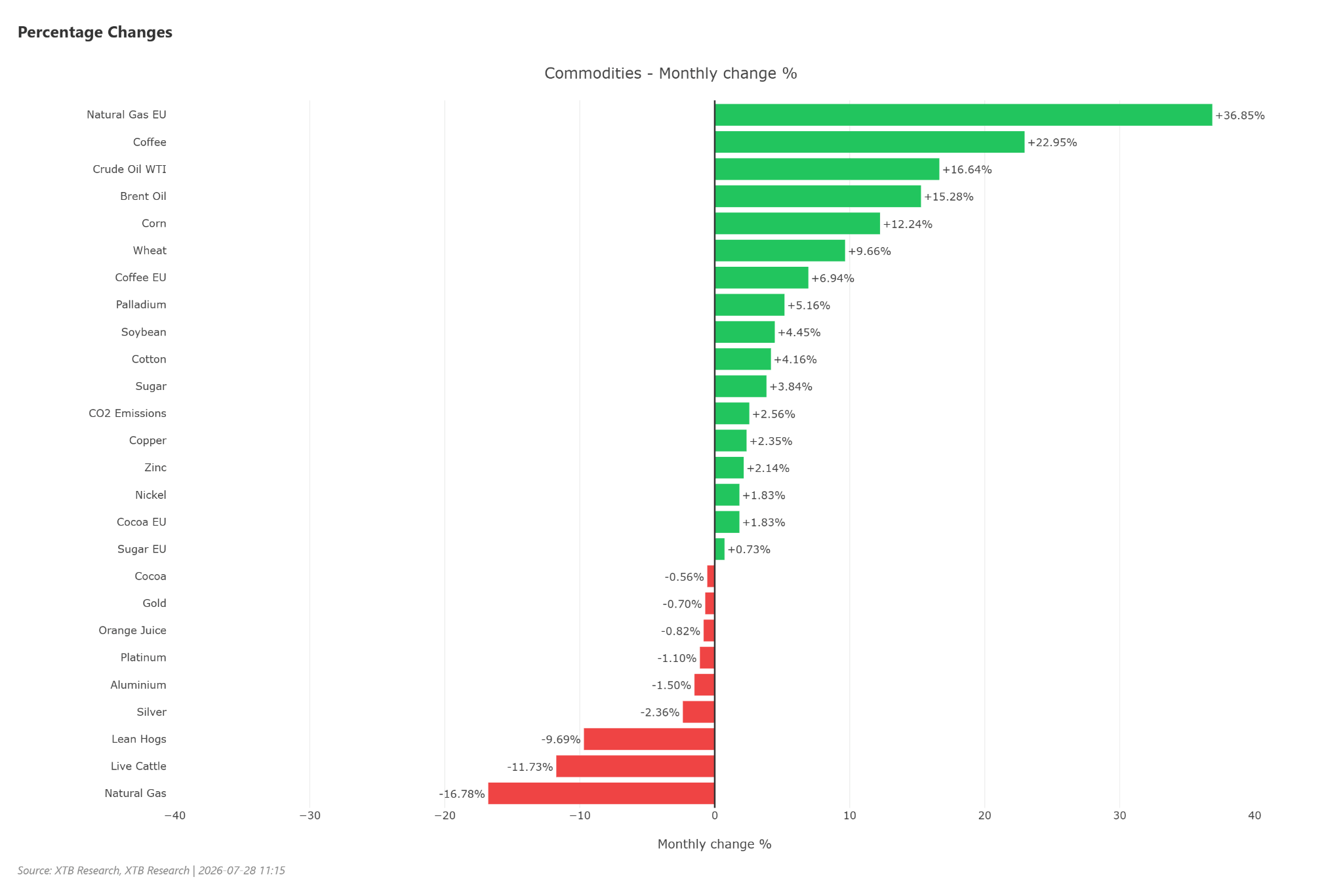
Bearish sentiment dominates the commodity market today, reflected by a negative average daily change of -0.41% with only six assets rising. The energy sector is seeing the sharpest decline—Brent crude is down 2.24% today (over 8.4% weekly), and WTI has fallen by 1.96%, driven by increasing hopes for a US-Iran diplomatic agreement. On the opposite pole are agricultural commodities, where coffee is the leader of growth, appreciating by 5.73%, which pushes its valuation to an extreme level of +2.18 standard deviations (Z-score) above the 5-year average. Despite current corrections, industrial and precious metals still maintain historically high valuations, indicated by extreme deviations for copper (+3.06σ), gold (+2.76σ), and aluminum (+2.12σ). In the global context, it is worth noting reports of an expected economic slowdown in India due to the oil shock and stock market turmoil in Asia, which may affect future industrial demand. In the coming days, investor attention should focus on the upcoming Fed meeting and central bank decisions, which will define the further direction of the market. Commodity Price Changes in the Last Month
Over the last month, TTF natural gas, coffee, and crude oil gained the most. On the other hand, we have American natural gas and livestock. Source: XTB Oversold and Overbought Commodities
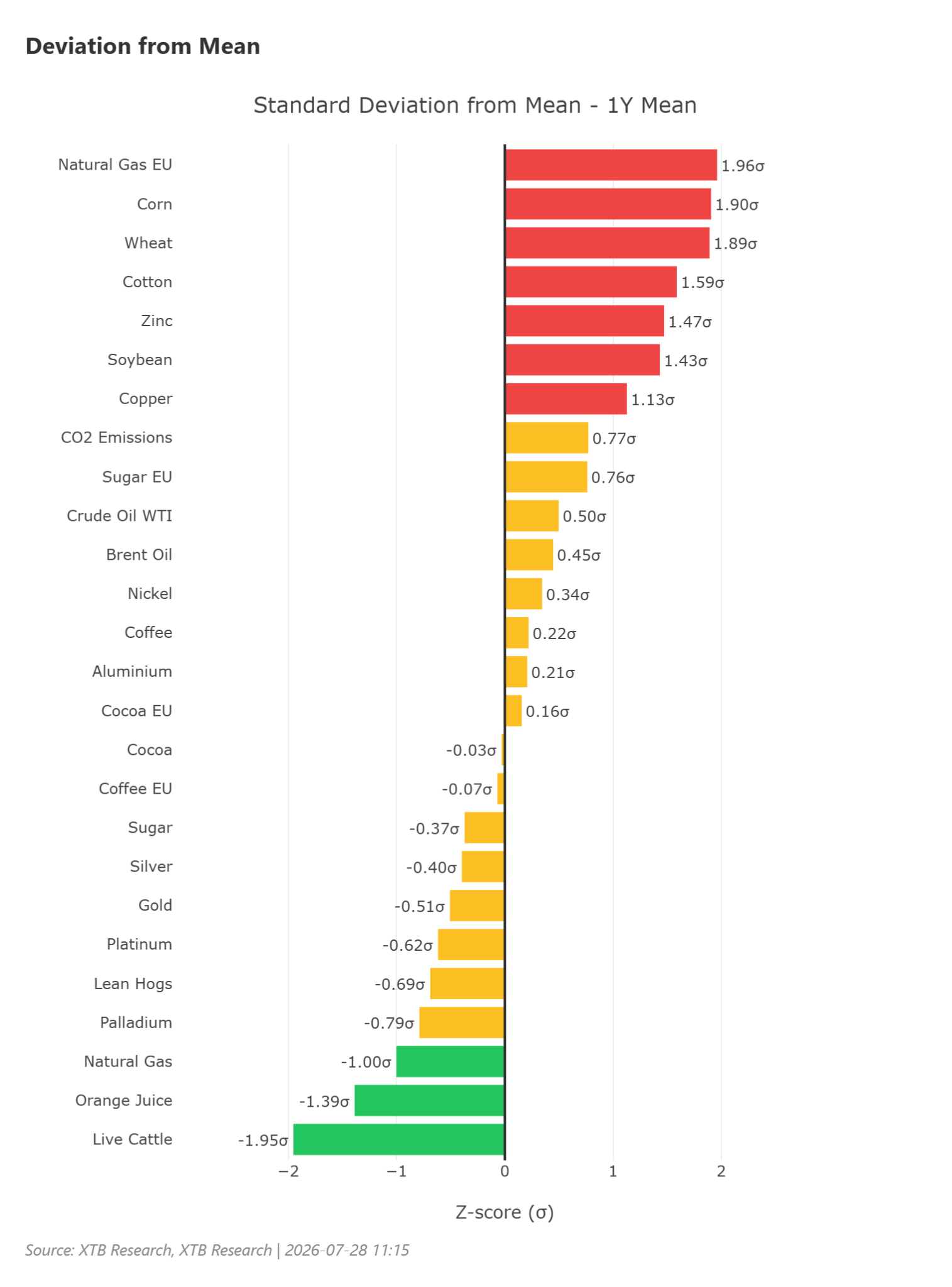
From a short-term perspective, cattle is very strongly oversold, reaching nearly 2 standard deviations from the 1-year average. In contrast, TTF natural gas, corn, wheat, and cotton can be treated as slightly overbought. Source: XTB
🛢️ Crude Oil
Crude oil prices continue strong declines in response to reports of a halt in mutual attacks and attempts to engage in diplomatic talks between the US and Iran.
Iran is set to discuss with Oman the resumption of ship traffic in the Strait of Hormuz. During the last session, only one tanker passed through Hormuz, while through Bab el-Mandab, there is a rebound to 7 tankers (compared to an average of 10 tankers in recent months).
The price of Brent crude fell to around $87 for the September contract, while the October contract is trading below $84. WTI crude, in turn, dropped below $81 per barrel.
If an agreement with Iran is reached, a significant oversupply, estimated at up to 2 million barrels per day in Q4 2026, will quickly appear on the oil market. Nevertheless, it is worth remembering that earlier IEA forecasts changed virtually from report to report, so everything will depend on the navigability of key straits in the Middle East.
Reloading is resuming at the CPC terminal in Kazakhstan after disruptions caused by drone attacks. It is worth noting that the oil and fuel market is also disrupted by Ukrainian attacks on Russian oil infrastructure. It is estimated that up to 50% of fuel production capacity in Russia is shut down due to the attacks, leading to domestic supply problems.
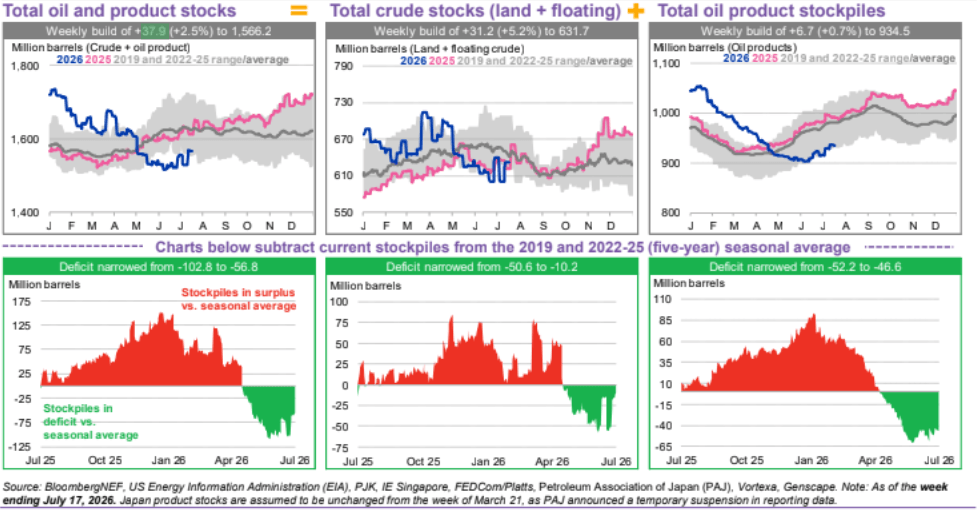
Global stocks of crude oil and petroleum products increased by 2.5% (by 37.9 million barrels) in the week ended July 17, narrowing the deficit relative to the 5-year average.
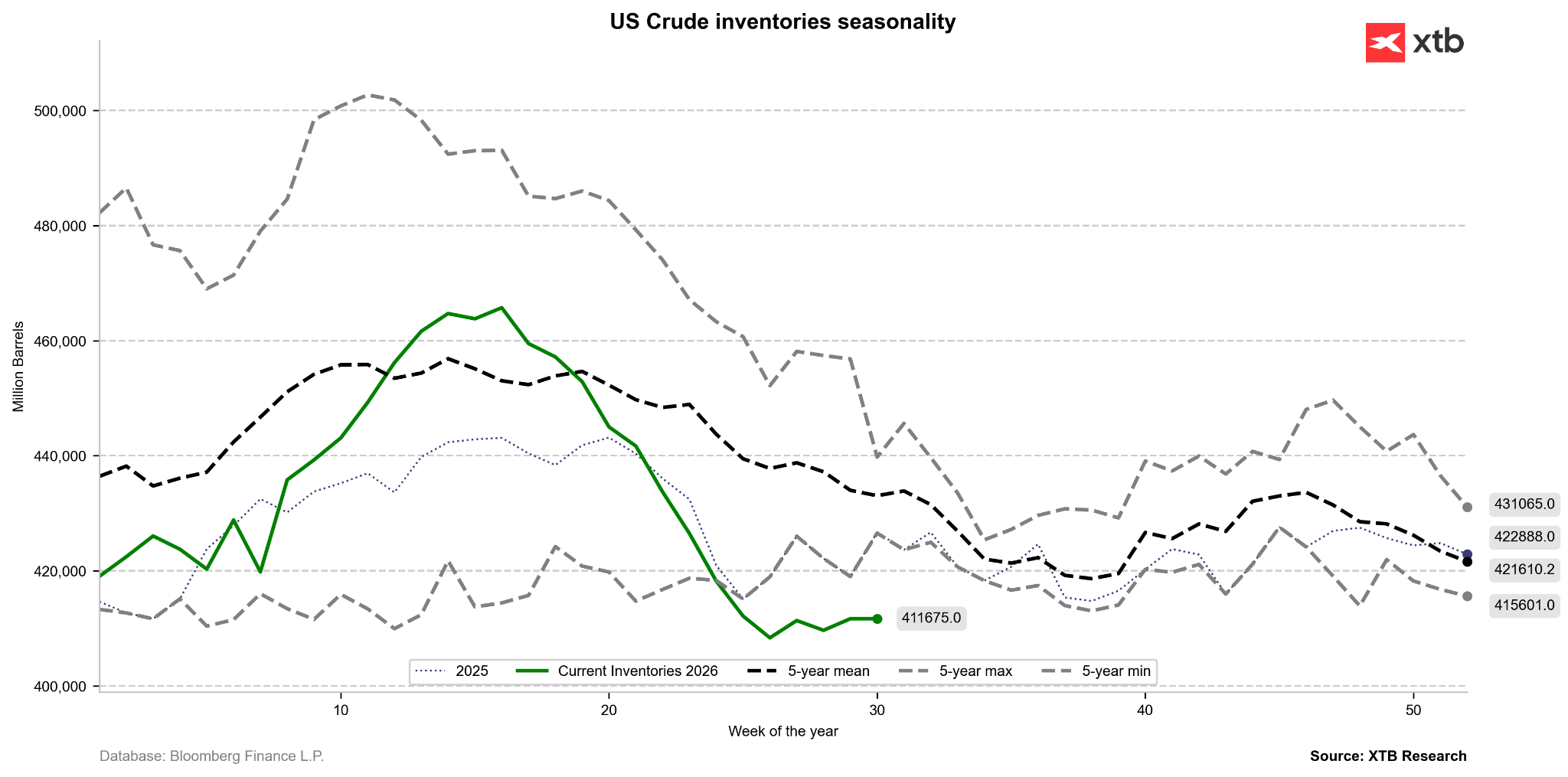
US crude oil stocks also rose, although the latest reports indicate a further decline in reserves, close to 300 million barrels.
According to Citi, the IEA may coordinate further releases of reserves and stocks if the situation does not normalize in the near future. The previous program of releasing 400 million barrels is expected to be completed within 1-2 months.
A noticeable acceleration in fuel processing in China is observed, which may be related to the normalization of the situation or the desire to sell fuels (e.g., to Russia) due to high margins. Utilized processing capacities at state refineries increased from approx. 67% at the beginning of July to 75% currently. In private refineries, the increase is from approx. 43% to 48%.
Maritime Routes via Iran and JMIC
Proposed maritime routes via Iran and JMIC. It is worth remembering that using the Iranian route carries the probability of Iran collecting fees. Source: Bloomberg Finance LP Global Oil and Products Stocks
Global oil and products stocks have increased recently. Source: BloombergNEF Oil Production and Export in Iran
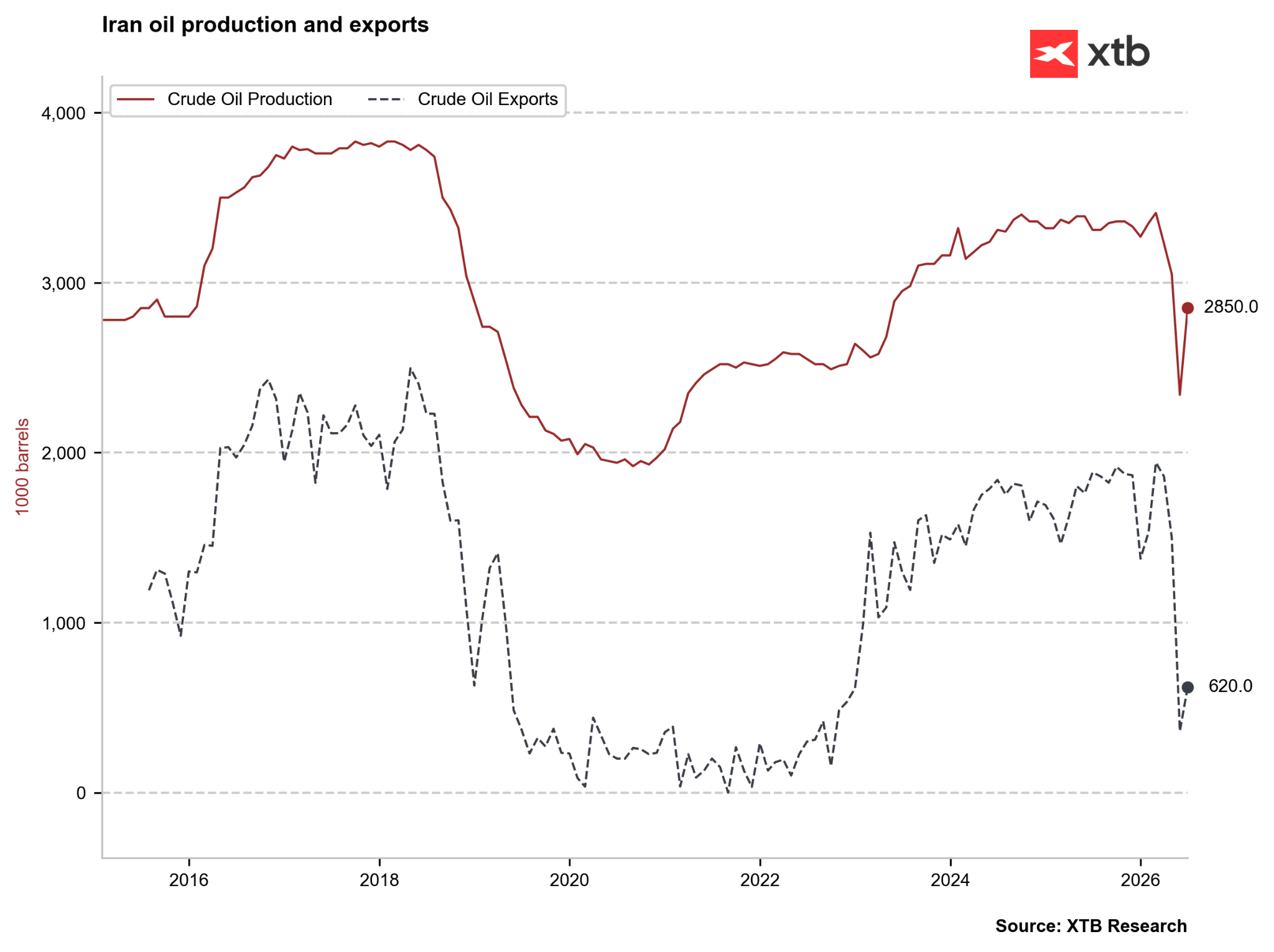
Iran’s production has clearly rebounded, but exports remain approximately 3 times lower than pre-war levels. Source: Bloomberg Finance LP, XTB Oil Price vs. Crack Spread
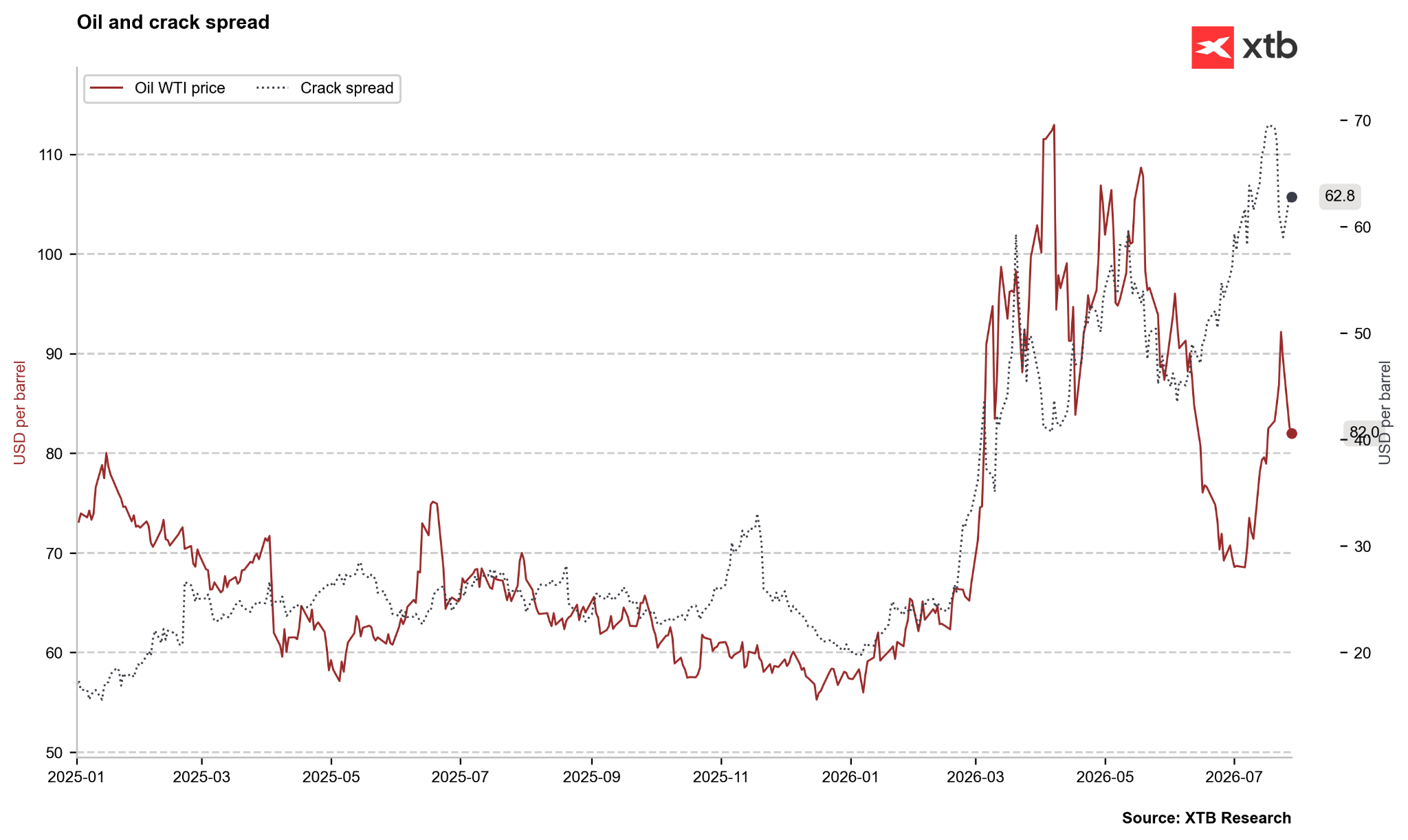
Crude oil is falling, while the crack spread is showing a small rebound and remains near historical highs. Source: Bloomberg Finance LP, XTB US Crude Oil Inventories
US crude oil inventories are stabilizing. Source: Bloomberg Finance LP, XTB
💨 Natural Gas (TTF + Henry Hub)
Prices for gas contracts in Europe (TTF) continue to fall, declining by another 3.1% to 56.46 EUR/MWh (64.21 USD/MWh) after an earlier drop at the beginning of the week reaching up to 10% due to optimism surrounding de-escalation in the Middle East.
Although gas prices in Europe are falling, an increase in demand in Asia is observed, which may divert supplies from the US to the eastern market, potentially leading to issues with replenishing storage before the winter season.
Currently, storage fill is about 55%, compared to a 5-year average of 71%, with a goal of 90% before November 1.
Natural gas prices in the US are also falling sharply, which may be a symptom of sentiment regarding the potential opening of the Strait of Hormuz. However, it is worth remembering that Qatar will not resume LNG supplies at a normal level until at least mid-September, which is why LNG exports from the US will remain high for many weeks to come.
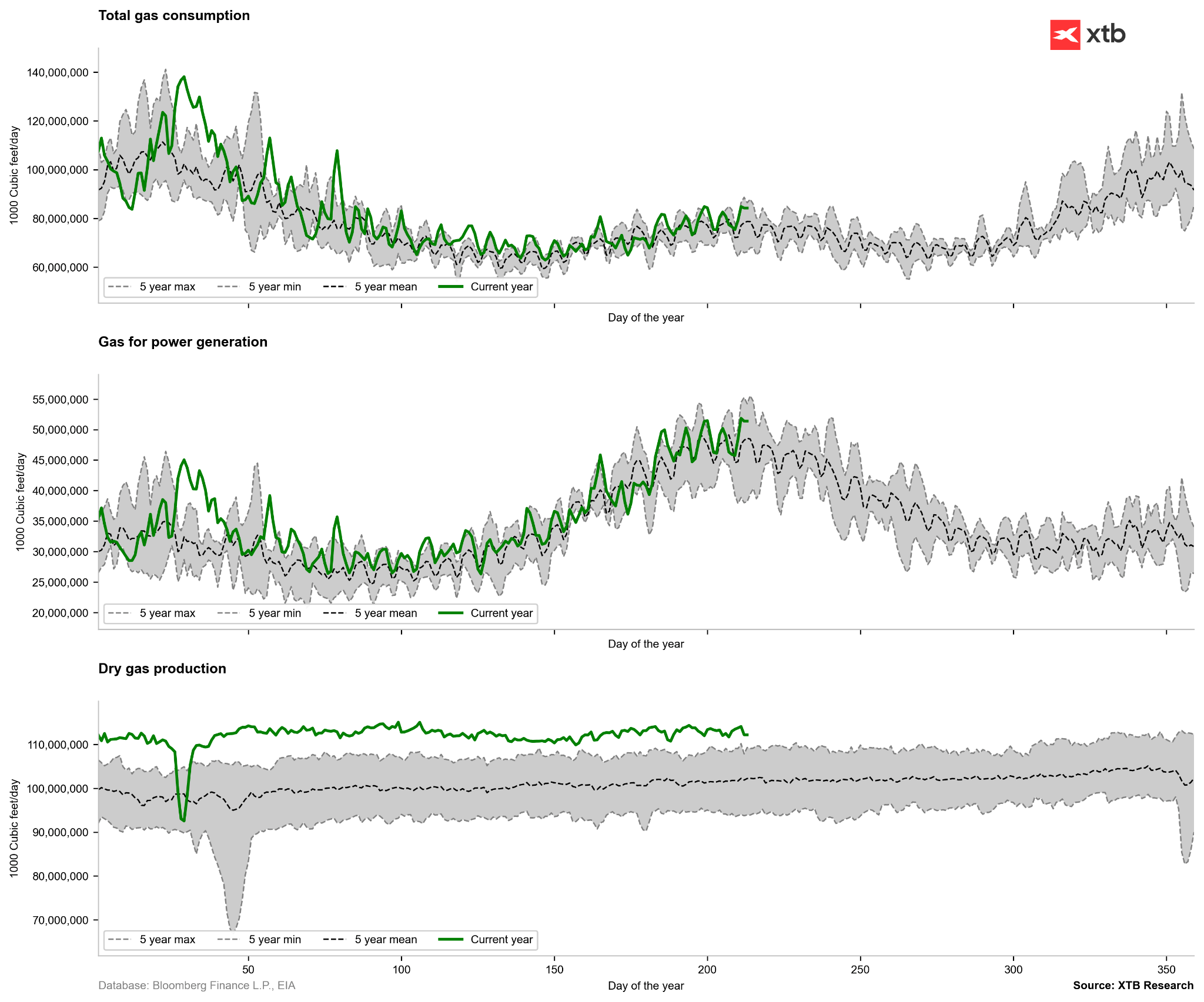
A slight cooling in the Midwest region has caused US gas consumption forecasts to decrease.
Additionally, strong El Niño suggests that gas consumption during the winter may be lower, indicating that current inventories will be sufficient.
Gas production on Monday was 113.1 bcfd, an increase of 3.7% y/y, while demand was 81.4 bcfd, an increase of 2.7%. LNG exports were 18.1 bcfd.
EIA raised the forecast for average gas production to 111.2 bcfd at the beginning of July.
Natural Gas Demand
Gas demand remains above the 5-year average during the seasonal peak consumption period. Gas consumption for electricity production should fall in the coming weeks. Source: Bloomberg Finance LP, XTB Comparative Gas Stocks
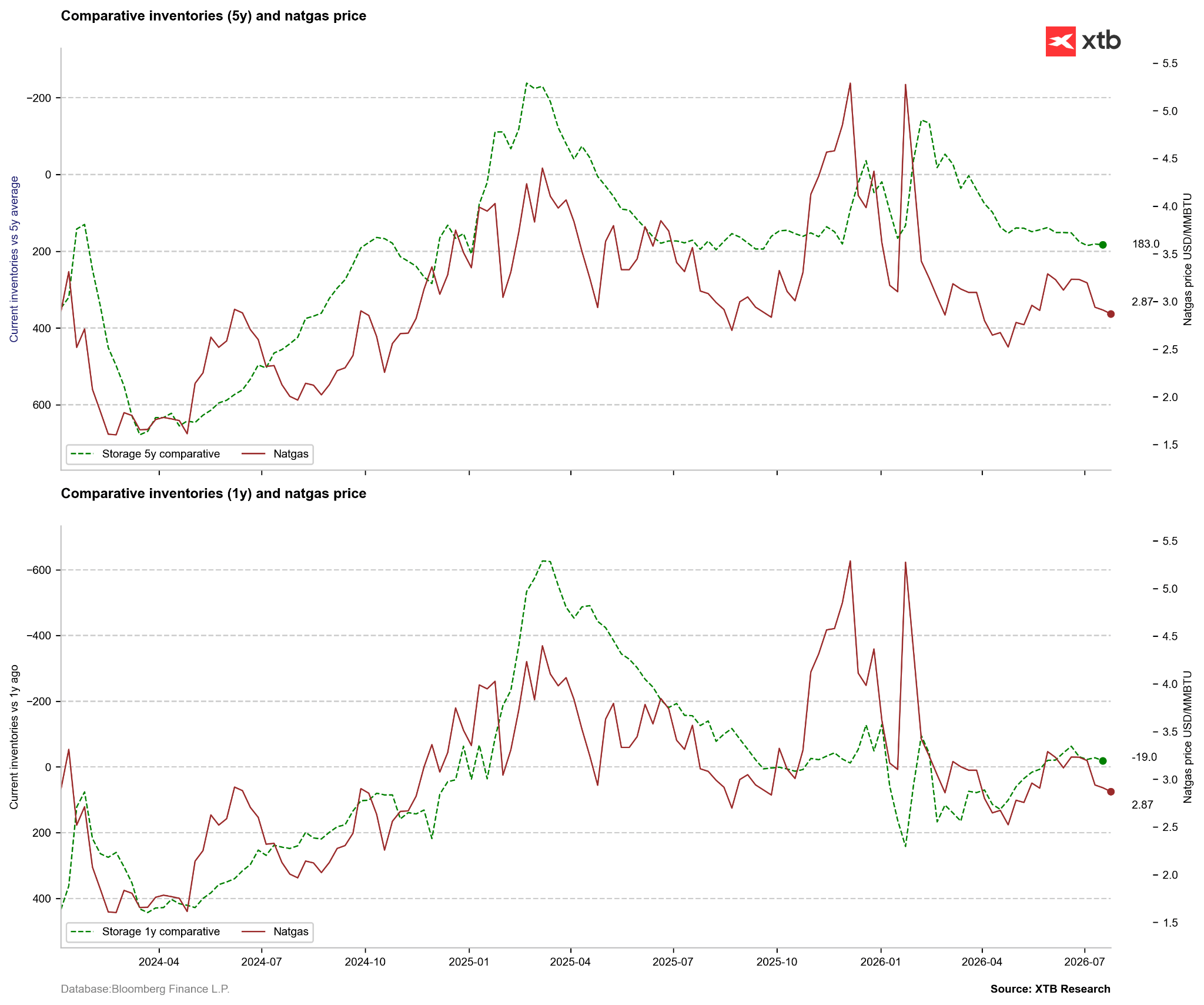
Comparative stocks have stopped increasing but remain at relatively high levels. Nevertheless, this potentially indicates an undervaluation of gas prices. Source: Bloomberg Finance LP, XTB Natural Gas Price Seasonality
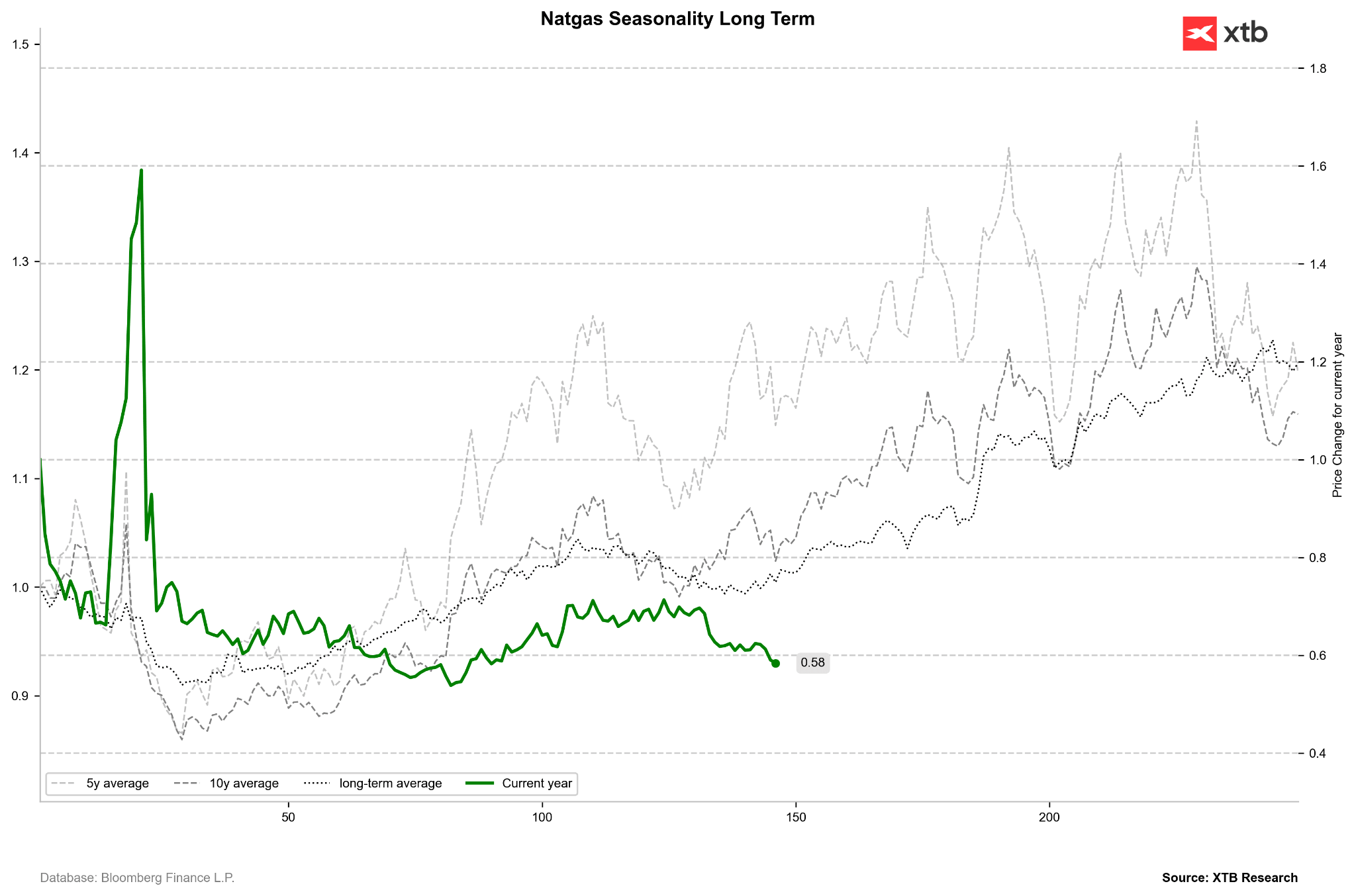
The current price behavior is completely contrary to short-term and long-term seasonality. It is worth remembering that the next two roll-overs will be relatively flat. Source: Bloomberg Finance LP, XTB Temperature Forecasts
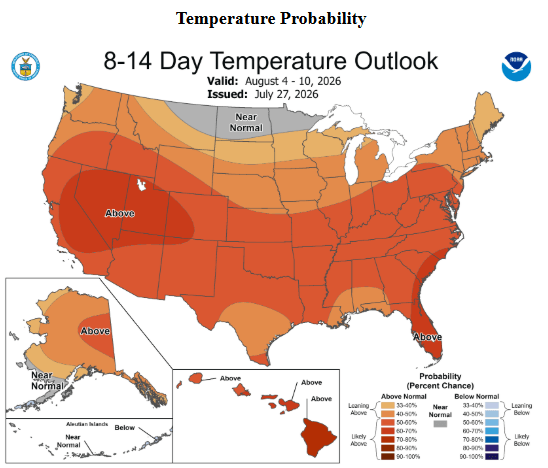
Although temperatures have been slightly lower than previously forecasted recently, a return to higher temperatures is expected at the beginning of August. Source: NOAA Technical Analysis of Gas Prices
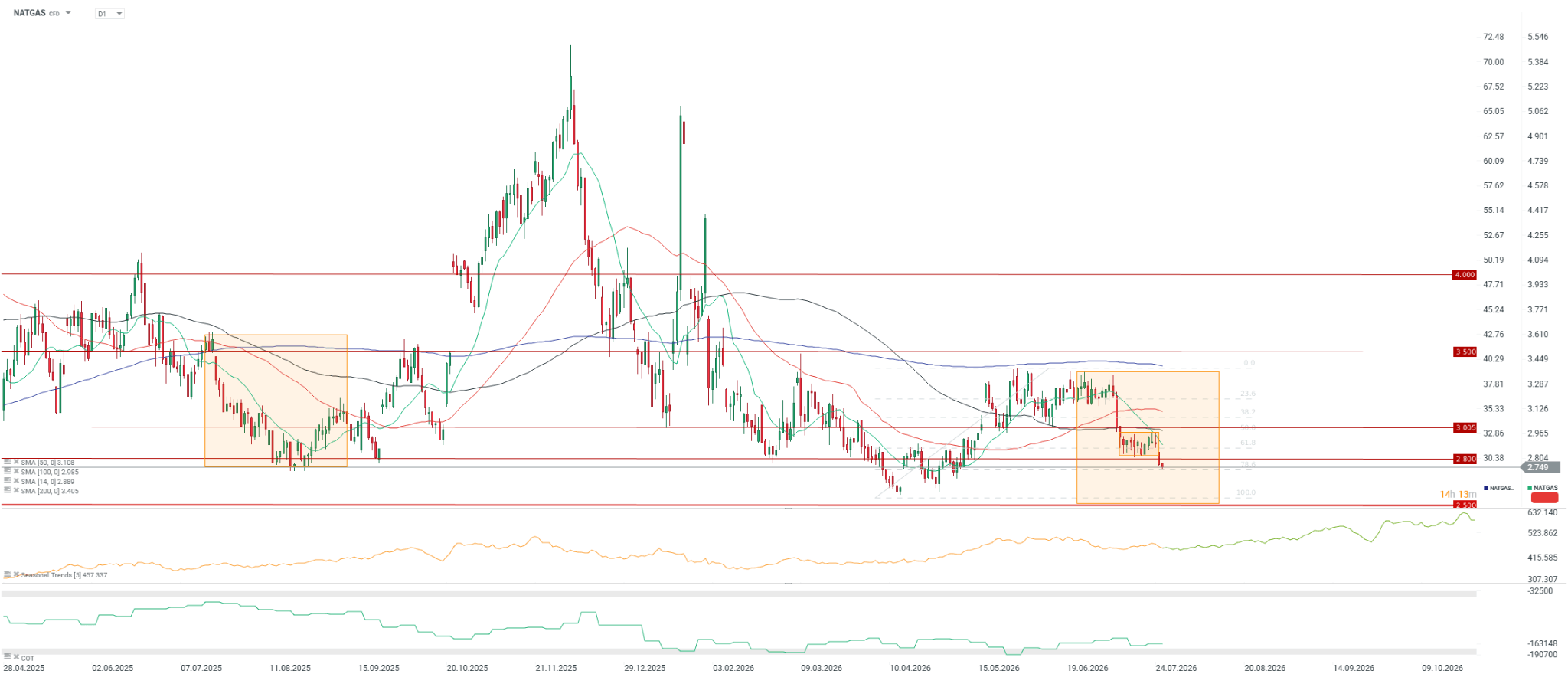
The price finally breaks out of the consolidation downwards and tests the last support at the 78.6 retracement. Last year, the downward wave in the summer period ended only in the second half of August. A similar range would currently indicate 2.5 USD/MMBTU. Source: xStation5
🟡 Gold
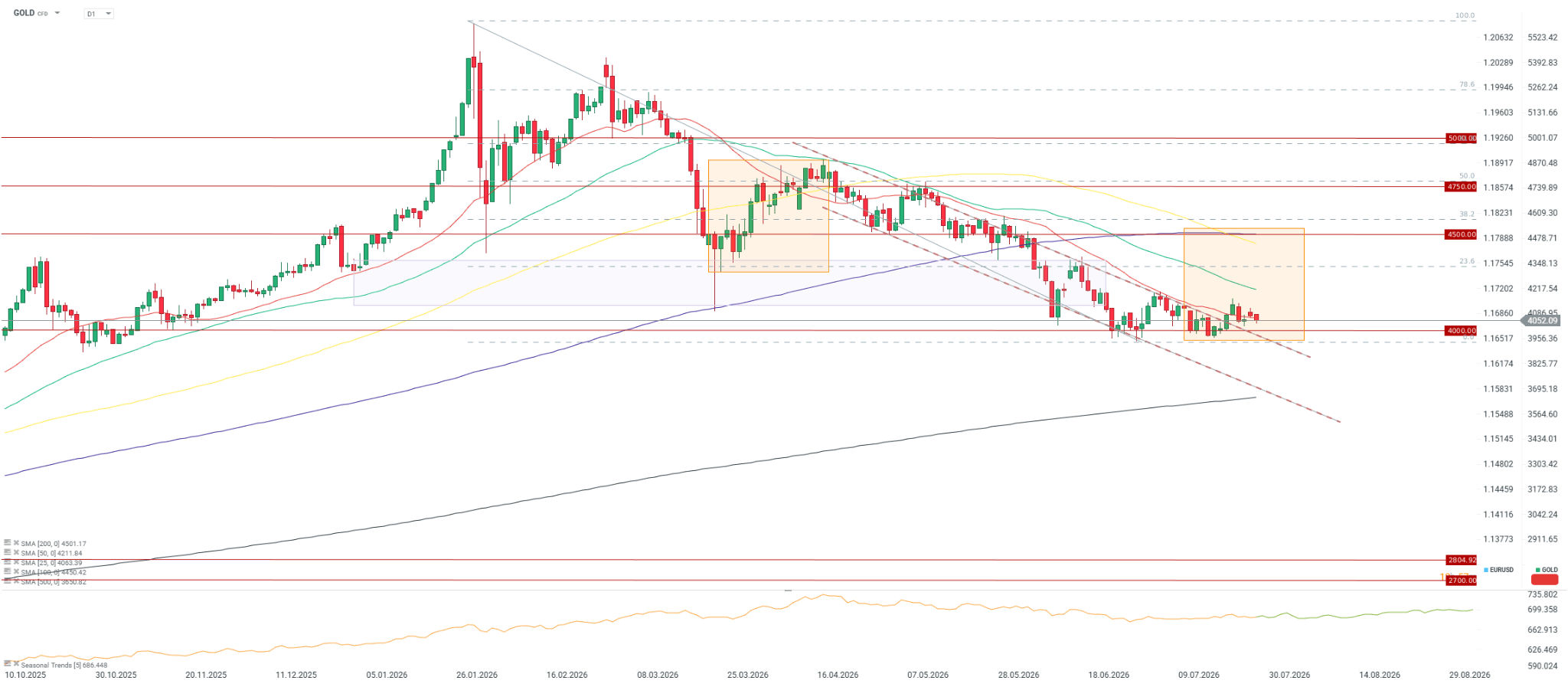
Gold prices fell below $4050 per ounce ahead of the upcoming Federal Reserve meeting.
Markets are pricing in slightly over 33% chance of a 25 basis point Fed rate hike. At the same time, a full rate hike is priced in for September.
A potential rate increase or hawkish rhetoric from the Fed could strengthen bond yields and the dollar’s exchange rate, posing a risk of breaking the support at $4,000 per ounce and capital outflow from ETF funds.
Gold has remained above $4,000 per ounce since the end of June thanks to dip buying and steady demand from central banks.
A temporary pause in the fighting in the Middle East has eased concerns about further inflation growth.
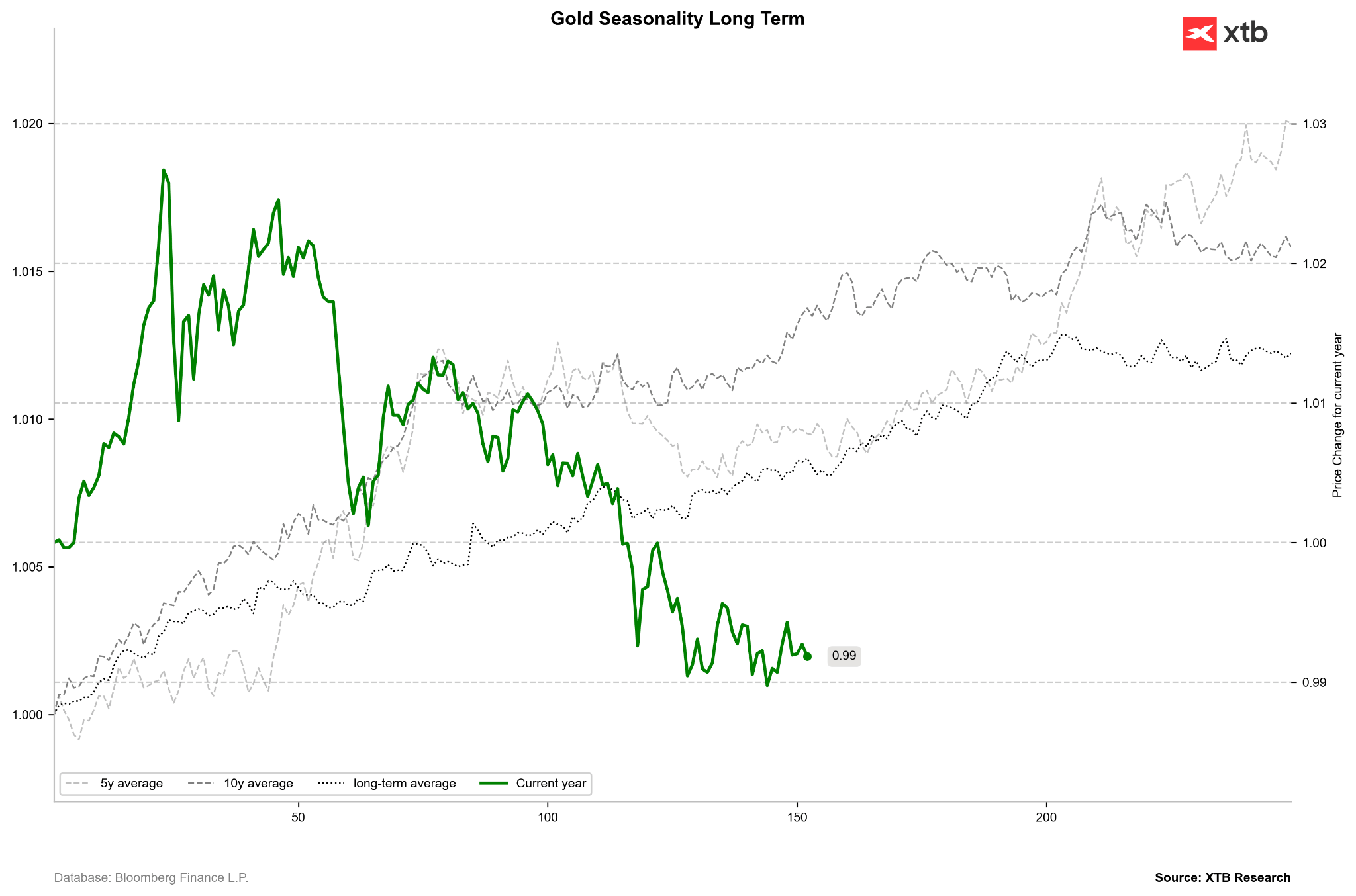
Gold Seasonality
Gold should currently be in the phase of a seasonal rebound start. Nevertheless, we have been observing consolidation for about a month after sharp declines. Source: Bloomberg Finance LP, XTB Fed Interest Rate Expectations
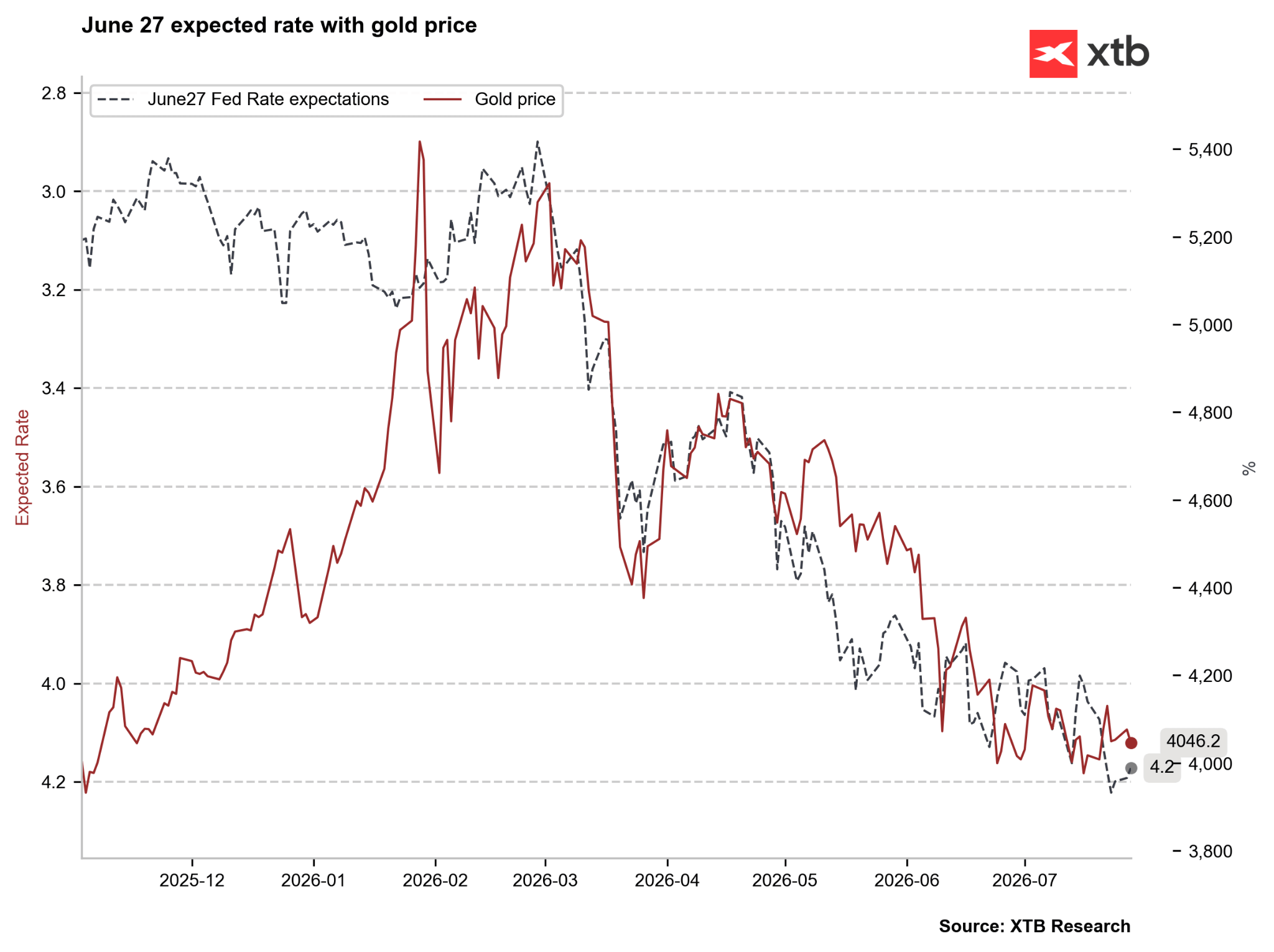
The effective rate is expected to be 4.2% by June next year, which would mean two full rate hikes from the current level. Gold is well priced relative to these expectations. Source: Bloomberg Finance LP, XTB Gold Purchases by ETFs
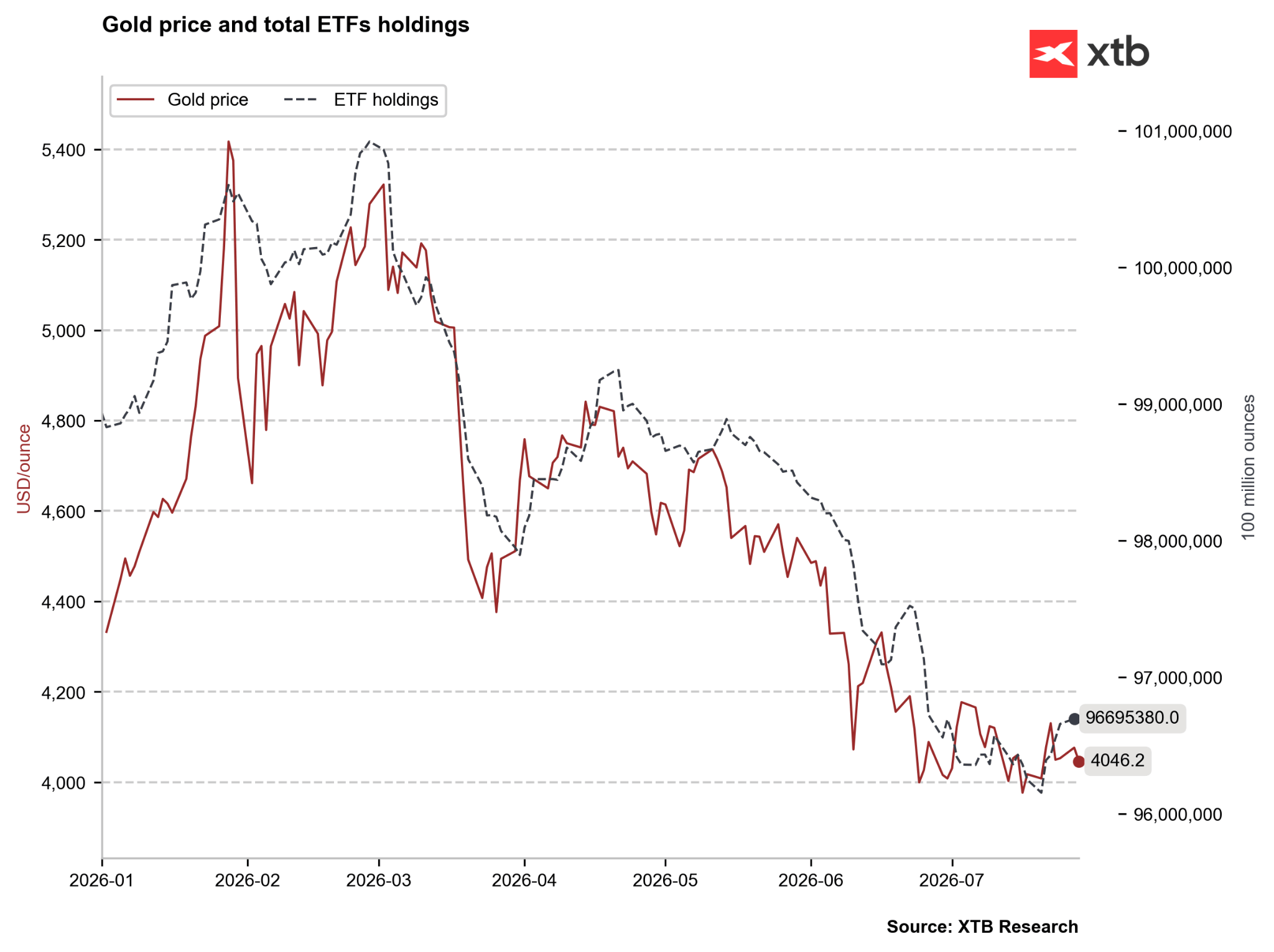
Despite mixed sentiment recently, ETFs are buying gold, and the rebound is already larger than in June. A dovish message from Warsh could push gold back towards $4200 per ounce. Source: Bloomberg Finance LP, XTB Gold Technical Analysis
The price of gold is trying to stay above the 25-period average, following the recent attempt to break out of the descending trend channel. Source: xStation5
🍫 Cocoa
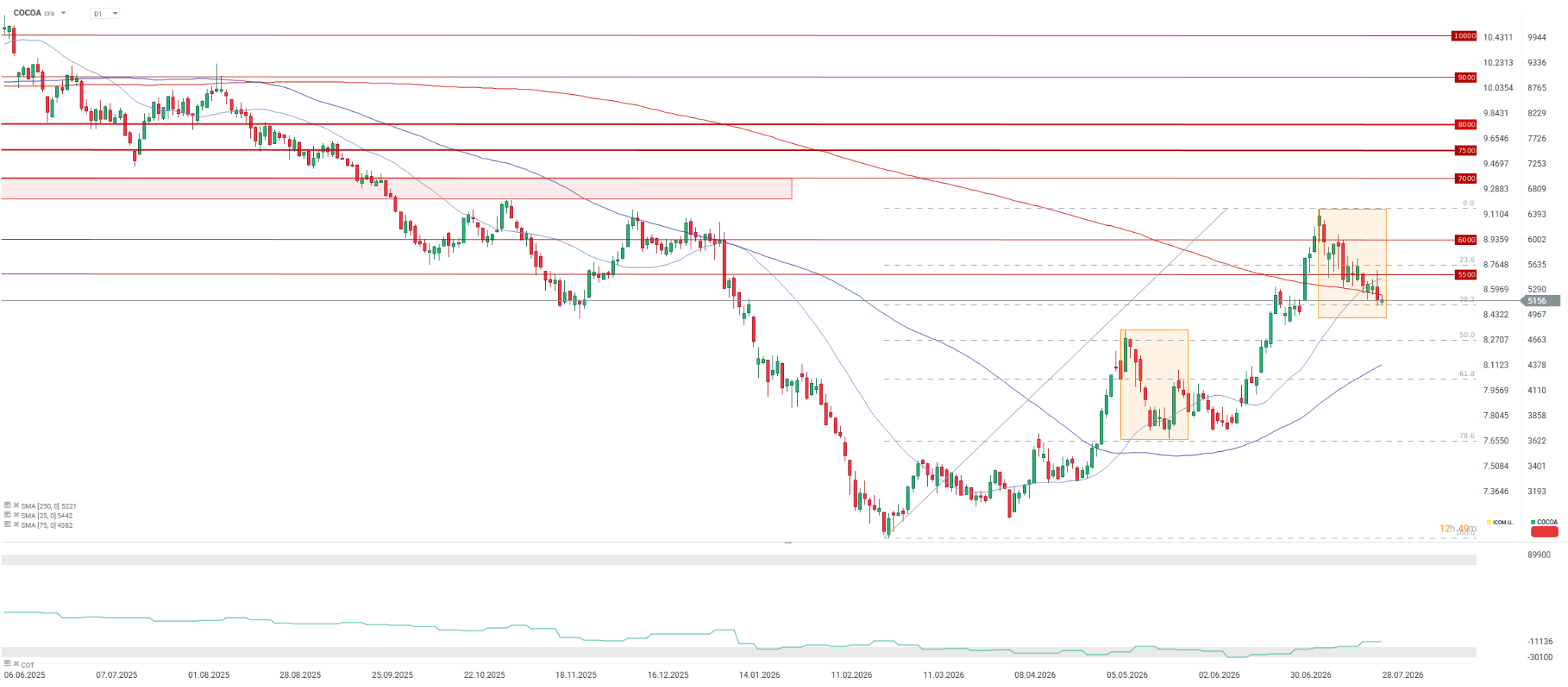
Cocoa futures prices have fallen significantly to levels below $5200 per tonne and below £4000 per tonne, representing a decline of 1/3 compared to the previous year.
Giants like Lindt, Barry Callebaut, and Nestlé have reported a drop in chocolate sales volume (e.g., Lindt down 7.5% in H1) due to high prices of finished products.
Sales in traditional markets continue to look weak, but a clear improvement is observed in Asia.
Corporations are focusing on innovation and social media trends (e.g., Dubai-style chocolate) to regain customers. However, it is worth noting that the amount of cocoa itself in finished products is simultaneously decreasing.
Favorable weather conditions in Côte d’Ivoire, Ghana, and Nigeria are supporting preparations for the main harvests beginning at the turn of August and September.
Cocoa deliveries to ports in Côte d’Ivoire since the start of the season reached 2.11 million tonnes compared to 1.75 million tonnes a year earlier.
The CCC regulator in Côte d’Ivoire has begun a campaign to deliver fertilizers and seedlings to farmers across an area of 1.5 million hectares.
Preliminary expectations for the 26/27 season indicate cocoa production in Côte d’Ivoire at 1.8 million tonnes, which would be a decrease of nearly 20% compared to the current production level.
Transgraph Consulting indicates that the cocoa market surplus in 26/27 will shrink to just 80 thousand tonnes from over 400 thousand tonnes in the current season, which is mainly related to falling production.
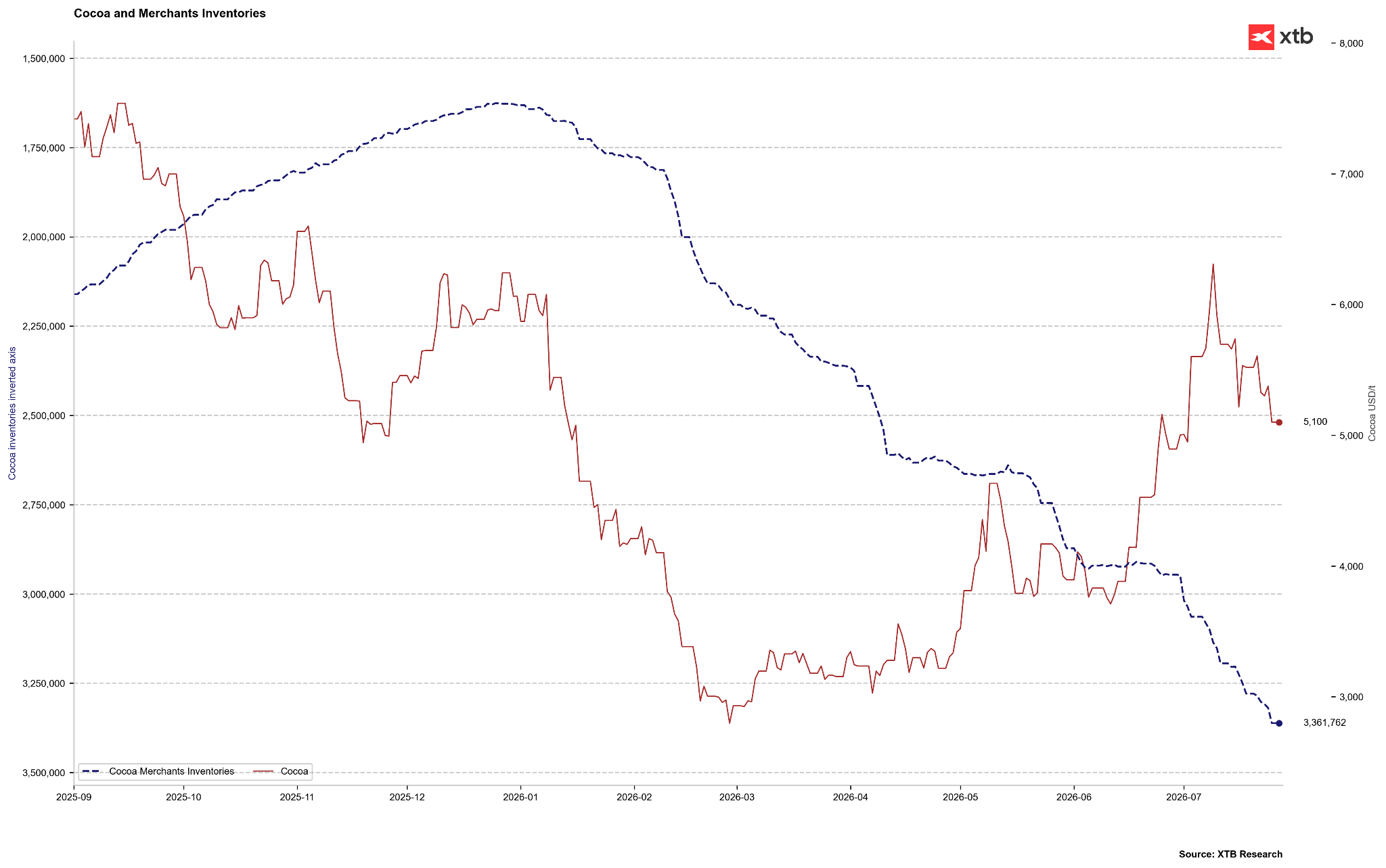
Cocoa Stocks on Exchanges
The real picture of the market is currently shown by the strong increase in cocoa stocks on exchanges, despite the fact that seasonally we should already be observing a slight decrease, as we are 2 months before the start of the next harvest season. Source: Bloomberg Finance LP, XTB Speculator Positions in the Cocoa Market
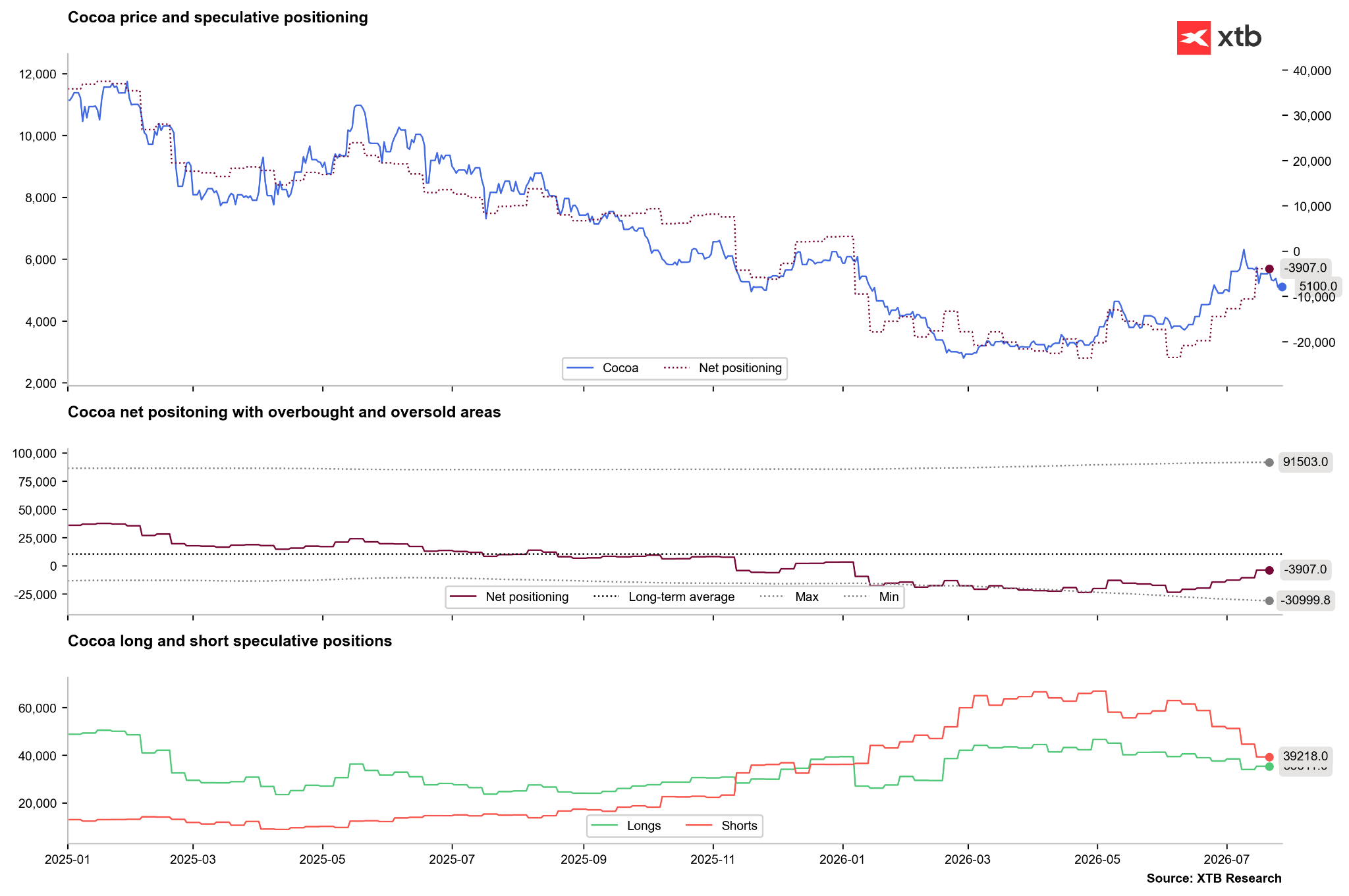
In recent weeks, speculators have reduced a lot of short positions. Source: Bloomberg Finance LP, XTB Cocoa Price Technical Analysis
The price of cocoa has experienced a sharp drop to $5150 per tonne and is holding at the support related to the 38.2 retracement of the last upward wave and at the range of the largest correction in the current upward trend. However, the price is below the 25-period average and below the 250-period average. The key support is the area around 4700 at the 50.0 retracement. Source: xStation5
The past week was marked by crude oil prices returning to triple digits on expiring September contracts and a continuation of the equity market selloff. Geopolitics once again served as the primary driver for investors, fueled not only by the situation in the Middle East but also by broad new US tariffs. Wall Street earnings season delivered solid corporate results, though these proved insufficient to lift investor sentiment. A fresh wave of reports from tech giants such as Microsoft and Apple might alter that dynamic. Furthermore, decision day arrives for two key central banks, namely the Federal Reserve and the Bank of Japan. Given this concentration of high-impact events, three markets warrant close attention in the coming days: USD/JPY , Gold and US100 .
USDJPY
The Japanese currency has struggled recently, with the past week defined by mounting inflationary pressure in Japan driven in part by higher global energy costs. This week brings a direct showdown between two major central banks. On Wednesday, the FOMC will announce its policy decision, followed by the second press conference from the new Fed Chair Kevin Warsh. On Friday, the Bank of Japan will present its stance on interest rates, preceded in the morning by the Tokyo consumer price index release. Market consensus anticipates that both the Fed and the BoJ will hold interest rates at current levels, with the BoJ policy rate currently at 1.0 percent. Investors will focus heavily on potential guidance regarding future monetary tightening, particularly given that the yen trades near 40-year lows alongside rising import costs. Historical currency interventions in Japan demonstrate that verbal pressure alone, lacking decisive BoJ action, offers only temporary relief for the yen. Moreover, sentiment conveyed by the US central bank remains the primary catalyst for USD/JPY trends. Should the Fed maintain a hawkish stance while the BoJ holds back from aggressive signals due to growth concerns, USDJPY could resume its upward trajectory toward the 165 level. Conversely, a hawkish surprise from the BoJ, supported by a hotter Tokyo CPI reading and upwardly revised inflation forecasts, could trigger a sharp rally in the yen and force a rapid unwinding of massive speculative short positions.
Gold
While last week was shaped by shifting sentiment surrounding Middle Eastern geopolitical tensions and oil prices, this week presents a direct test for the gold market from US monetary policy and incoming economic data. The principal catalyst for volatility will be Wednesday’s FOMC decision, followed on Thursday by US GDP figures and the June PCE inflation metric, which remains the Federal Reserve’s preferred inflation gauge. Gold continues to show high sensitivity to real interest rates and the trajectory of US Treasury yields. The bullion’s historic gains during periods when rate cuts are priced in clearly illustrate this relationship: as real yields decline, capital shifts smoothly into non-yielding assets. If Thursday’s PCE report points to persistent inflationary pressures and the Fed signals that rates must remain elevated for longer, gold could stay under pressure, particularly if crude oil marches back toward 100 dollars per barrel. In the alternative scenario, featuring a cooler PCE reading and waning geopolitical risk, the precious metal would gain strong momentum to break out of its recent downtrend.
US100 (Nasdaq 100 Futures)
The past week delivered another wave of selling across the global semiconductor and AI memory sectors. This week introduces the next slate of Big Tech quarterly earnings on Wall Street, coinciding directly with the Federal Reserve meeting. On Wednesday, Microsoft and Meta Platforms will report their quarterly results, followed by Apple and Amazon on Thursday. These announcements overlap with the FOMC interest rate decision on Wednesday and the US GDP and PCE releases on Thursday. Investors will scrutinize not only top-line revenue growth but primarily the return on capital expenditure dedicated to artificial intelligence infrastructure. Stretched valuations among Big Tech firms leave a remarkably narrow margin for error. Market dynamics seen during previous tech corrections demonstrate that even minor disappointment regarding forward margin outlooks can trigger index-wide selling, regardless of robust current earnings. Strong reports from market leaders coupled with measured commentary from the Fed could provide the US100 with the momentum needed to rebound from its recent pullbacks. Conversely, disappointing forward guidance paired with hawkish rhetoric from Kevin Warsh risks deepening the ongoing correction.
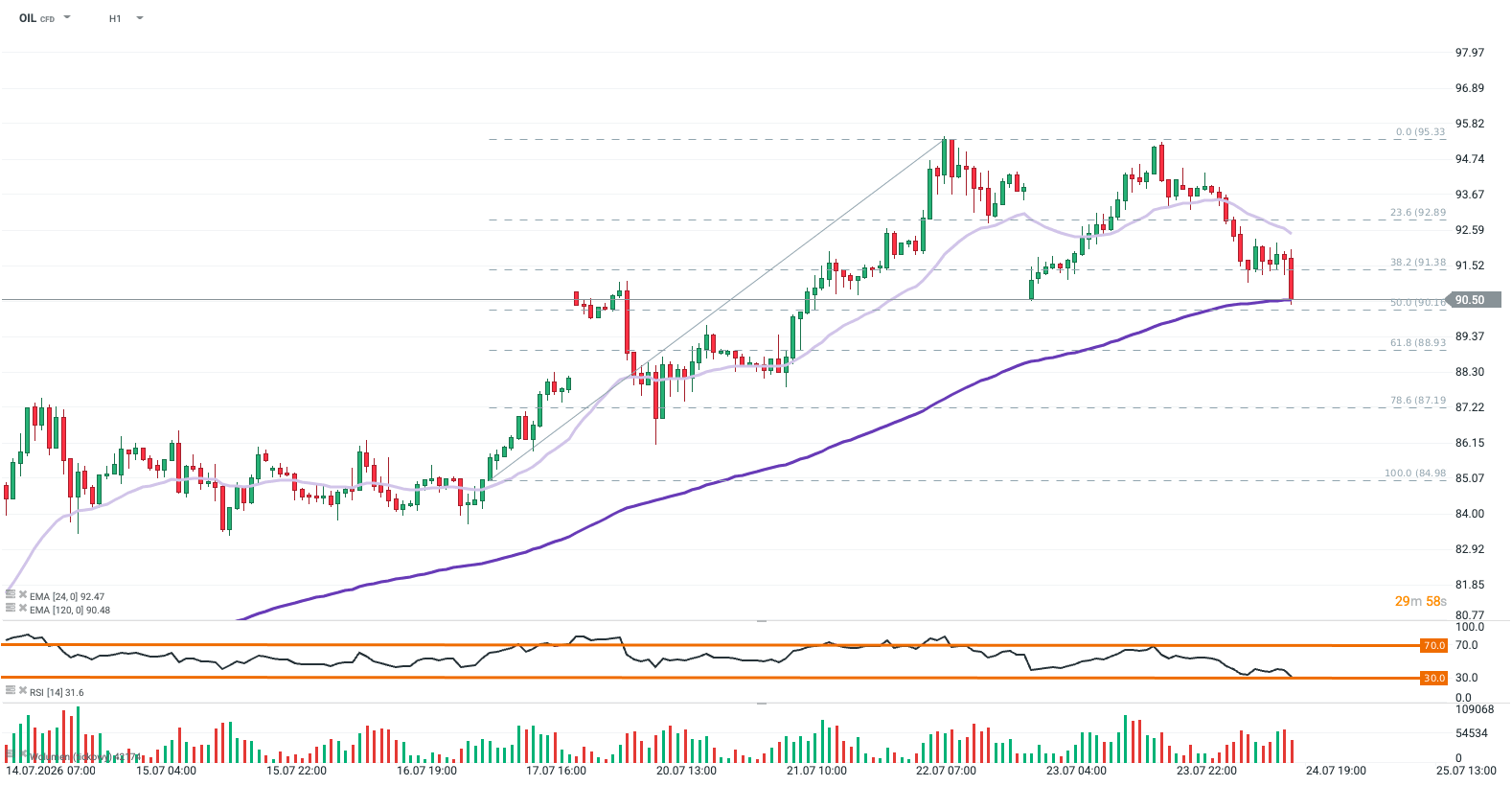
Brent futures (OIL) down 3.5%! Diplomacy is back? Oil prices sharply turned lower following reports that, under pressure from Beijing, Pakistan and Iran are considering a return to the negotiating table with the US. Brent futures (OIL) immediately pulled back by 1% to around $90.50 per barrel, deepening today’s losses and erasing nearly all of yesterday’s gains (currently: -3.5%).
Mixed Signals from the Middle East: A Potential Return of Diplomacy?
Following the recent escalation of Middle East tensions and oil prices returning to a monthly high, the market is eagerly snapping up the slightest mention of returning diplomacy, attempting to extract some end-of-week optimism. Over the longer term, Pakistan’s efforts alone will not be enough, especially since both sides of the conflict are playing solely to safeguard their own interests, and reports of resuming talks are accompanied by further warnings for US citizens in the region.
Below are the key headlines from recent hours:
Omani delegation in Tehran regarding the Strait of Hormuz: An Omani delegation arrived in Iran to discuss mechanisms for managing ship traffic in the Strait of Hormuz. Tehran advocates co-managing the waterway alongside Oman, but the US and Gulf states reject such a setup.
China and Pakistan push for a resumption of peace talks: Under pressure from China, Pakistan is considering attempting to resume stalled negotiations between the US and Iran aimed at ending the nearly five-month-old war. Exploratory discussions took place this week in Islamabad during a visit by the Iranian interior minister.
Tough rhetoric from Iran’s foreign minister: Abbas Araghchi stated that Iran will not bow to the US nor tolerate threats, pointing to Washington’s stance as the main obstacle to peace talks. He also reported continuous consultations with Russia and China, pledging unconditional protection of Iran’s interests in the Strait of Hormuz.
US warning for citizens in the Middle East: The US Embassy in Jordan urged Americans to reconsider travel to the Middle East due to escalation risks and potential attacks by Iran and its allies. Warnings were issued regarding airspace closures and flight cancellations, and citizens were advised to avoid US military bases in Jordan.
Trump warns Iran’s allies: In his latest social media post, the US President stated that Russia or China supplying weapons to Iran “will end badly for them.” Donald Trump added, however, that Xi and Putin said they do not plan such sales.
Technical Analysis: OIL (Brent Futures)
Reports of potential de-escalation in the Middle East sparked selling pressure on Brent crude (OIL). On the H1 chart, price dynamically dropped into a key support zone defined by the 120-period EMA ($90.48) and the 50.0% Fibonacci retracement ($90.16). A breakdown below this area could open the door for further declines toward the 61.8% Fibo level ($88.93). Conversely, defending current levels could favor a corrective bounce. The immediate resistance lies at the 38.2% Fibo retracement ($91.38), followed by the 24-period EMA ($92.47). The RSI is approaching oversold territory (32.1), suggesting the possibility of a temporary easing in bearish pressure, especially if no new pro-war comments emerge from the White House.
To provide the best experiences, we use technologies like cookies to store and/or access device information. Consenting to these technologies will allow us to process data such as browsing behavior or unique IDs on this site. Not consenting or withdrawing consent, may adversely affect certain features and functions.
Functional
Always active
The technical storage or access is strictly necessary for the legitimate purpose of enabling the use of a specific service explicitly requested by the subscriber or user, or for the sole purpose of carrying out the transmission of a communication over an electronic communications network.
Preferences
The technical storage or access is necessary for the legitimate purpose of storing preferences that are not requested by the subscriber or user.
Statistics
The technical storage or access that is used exclusively for statistical purposes.The technical storage or access that is used exclusively for anonymous statistical purposes. Without a subpoena, voluntary compliance on the part of your Internet Service Provider, or additional records from a third party, information stored or retrieved for this purpose alone cannot usually be used to identify you.
Marketing
The technical storage or access is required to create user profiles to send advertising, or to track the user on a website or across several websites for similar marketing purposes.