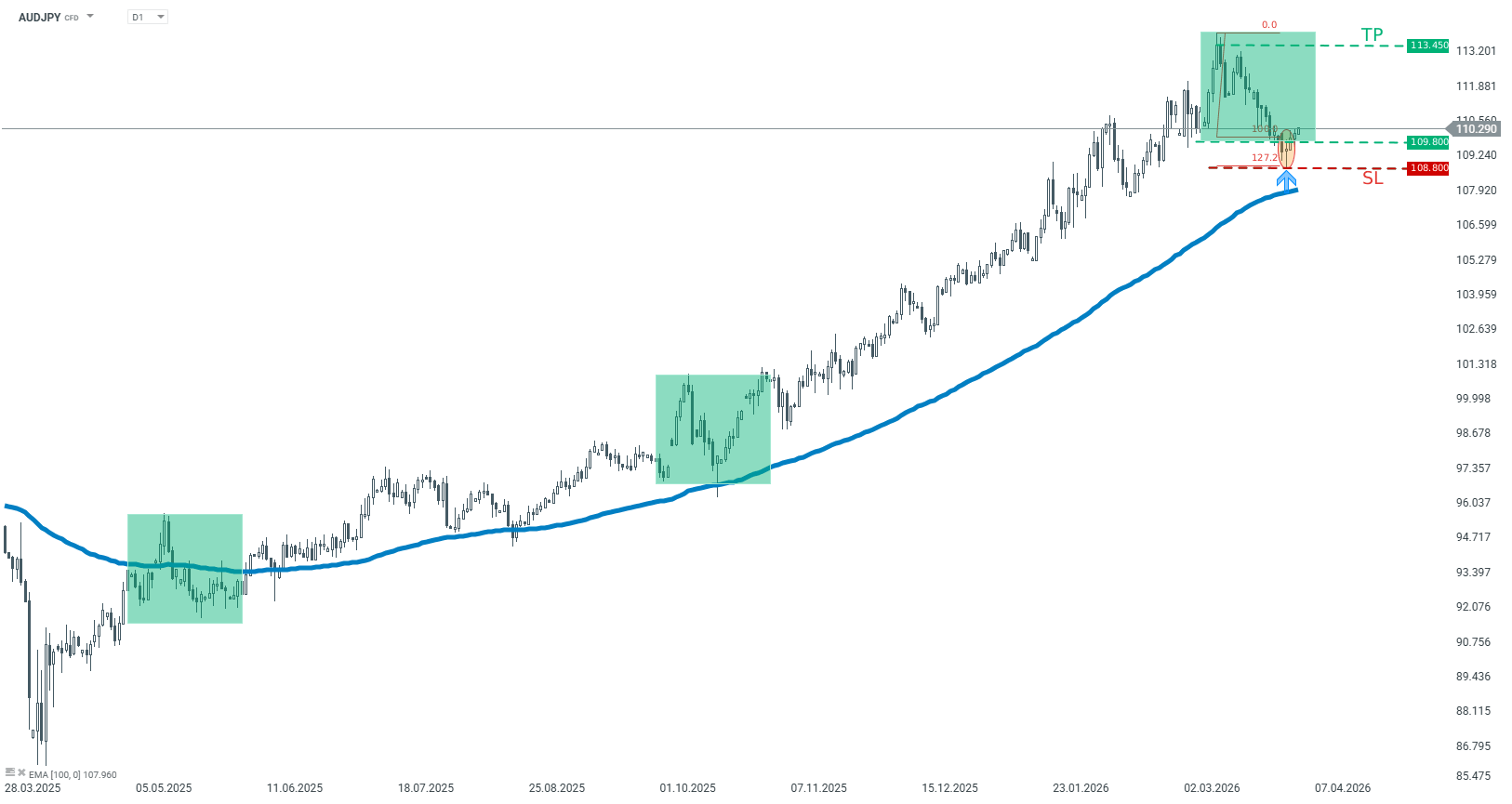
Facts: Pair bounced off the lower limit of the 1:1 structure at 109.80 The main sentiment remains bullish from April 2025
Recommendation: Trade: Long AUDJPY at market price Target: 113.45 Stop: 108.80
Opinion: Looking at the D1 interval on AUDJPY chart, one can see that the price bounced off the key support. The support is marked with the lower limit of 1:1 structure at 109.80. In addition, the price sits above the 100-period moving average from the D1 interval. Taking this into account, another upward impulse is the base case scenario. We recommend going long AUDJPY at market price with a target of 113.45. We also recommend placing a stop loss order at 108.80. Source: xStation5
EUR/JPY edges higher to near 184.15 in Friday’s early European session.
The positive outlook of the cross remains intact above the 100-day EMA, with bullish RSI momentum.
The initial support level is located at 183.50; the first upside barrier emerges at 184.80.
The EUR/JPY cross gathers strength around 184.15 during the early European session on Friday. Trading volumes are likely to be thin due to the Good Friday holiday. Meanwhile, hawkish remarks from European Central Bank (ECB) policymakers provide some support to the Euro (EUR) against the Japanese Yen (JPY). ECB Governing Council member Francois Villeroy de Galhau said on Thursday that the central bank’s next interest rate move will very likely be an increase, although it is still too early to say when it will start hiking.
On the other hand, escalations in the Middle East could boost a safe-haven demand, supporting the JPY. US President Donald Trump pressures Iran to make a deal after a military strike destroys a bridge near Tehran. Iran’s foreign minister Abbas Araghchi stated that Washington’s recent strikes on civilian infrastructure will not force the country to back down, adding that such actions “convey the defeat and moral collapse of an enemy in disarray.”
Technical Analysis:
In the daily chart, the near-term bias of EUR/JPY is mildly bullish as price holds above the rising 100-day exponential moving average near 182.10 and consolidates just under the upper Bollinger Band, indicating sustained upside pressure after the recent advance. The Bollinger middle band around 183.50 now tracks below spot and acts as dynamic trend support, while the latest RSI reading just above 54 confirms positive, but not overextended, momentum consistent with a grinding uptrend rather than a climax move.
Immediate support emerges at the 183.50 Bollinger middle band, followed by the 182.50–182.10 area where recent lows converge with the 100-day EMA. A break below this zone would weaken the bullish structure and expose deeper retracement toward 181.50. On the topside, initial resistance stands at the recent upper Bollinger Band region around 184.80, with a daily close above this threshold opening the door toward the 186.00 area where prior band highs cluster and upside risk would intensify.
USD/JPY holds steady around 159.60 in Friday’s early Asian session.
Persistent tensions in the Middle East underpin the US Dollar, but US tariff threats might cap its upside.
BoJ authorities warned that they may adjust policy if Yen weakness persists.
The USD/JPY pair trades on a flat note near 159.60 during the Asian trading hours on Friday. Trading volumes are likely to be thin due to the Good Friday holiday. All eyes will be on the US March Nonfarm Payrolls (NFP) report, which will be published later on Friday.
Heightened geopolitical tensions in the Middle East drive up oil prices and lift the US Dollar (USD) against the Japanese Yen (JPY). US President Donald Trump pressures Iran to make a deal after a military strike destroys a bridge near Tehran. Meanwhile, Iran’s foreign minister, Abbas Araghchi, stated that Washington’s recent strikes on civilian infrastructure will not force the country to back down, adding that such actions “convey the defeat and moral collapse of an enemy in disarray.”
On the other hand, chaos around U.S. tariff policy might cap the upside for the Greenback. The Trump administration plans to slap up to 100% on certain imported medicines from companies that don’t reach deals with his administration in the coming months, per Bloomberg. A White House statement said that the new levy applies to patented drugs made in countries that lack tariff deals with the US by companies that don’t have most-favored-nation-pricing agreements with the administration.
Fears that Japanese authorities would step in to support the domestic currency could support the JPY and act as a headwind for the pair. Japan’s top currency diplomat, Atsushi Mimura, said on Monday that officials may need to take “decisive” steps if speculative moves persist in the currency market.
The Overbalance analysis aims to identify three financial instruments, analyzed primarily on the daily/four-hour (D1/H4) timeframe. The analysis uses only the Overbalance methodology, which helps determine where a trend may continue or where it may reverse. Today’s analysis covers three instruments, evaluated solely in terms of 1:1 correction structures.
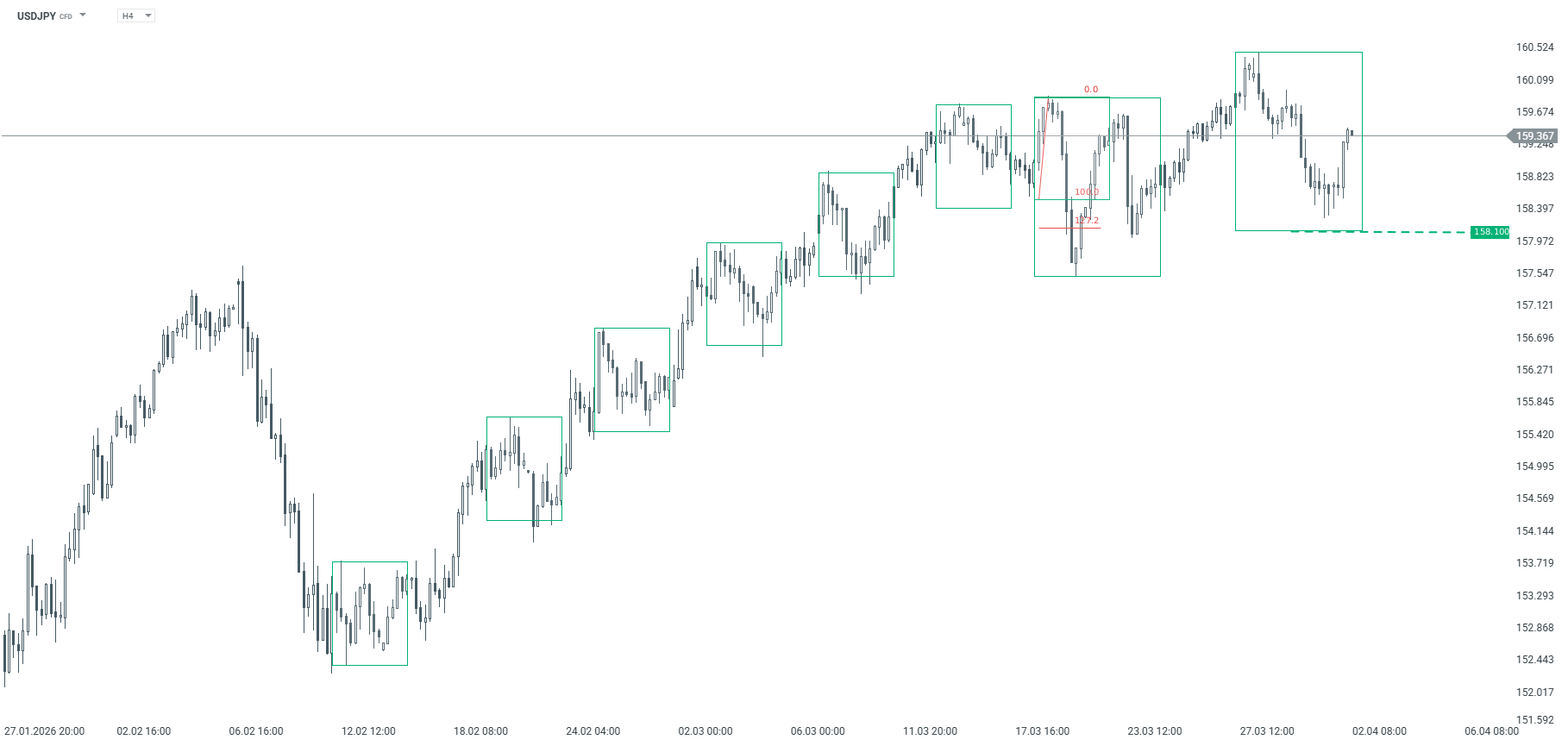
USDJPY Since February 12, the USDJPY has been trading in a strong uptrend. Initially, the movement was controlled by a 1:1 corrective pattern with a range of approximately 140 pips; however, in mid-March, a deeper correction occurred, after which the market established a new high. As a result, the current largest corrective pattern has a range of approximately 240 pips. At this point, the key support level is 158.10, derived from the lower boundary of this pattern. As long as this level holds, the uptrend remains in place. A break below it, however, could open the way for a larger correction or even a trend reversal.
USDJPY – H4 chart. Source: xStation
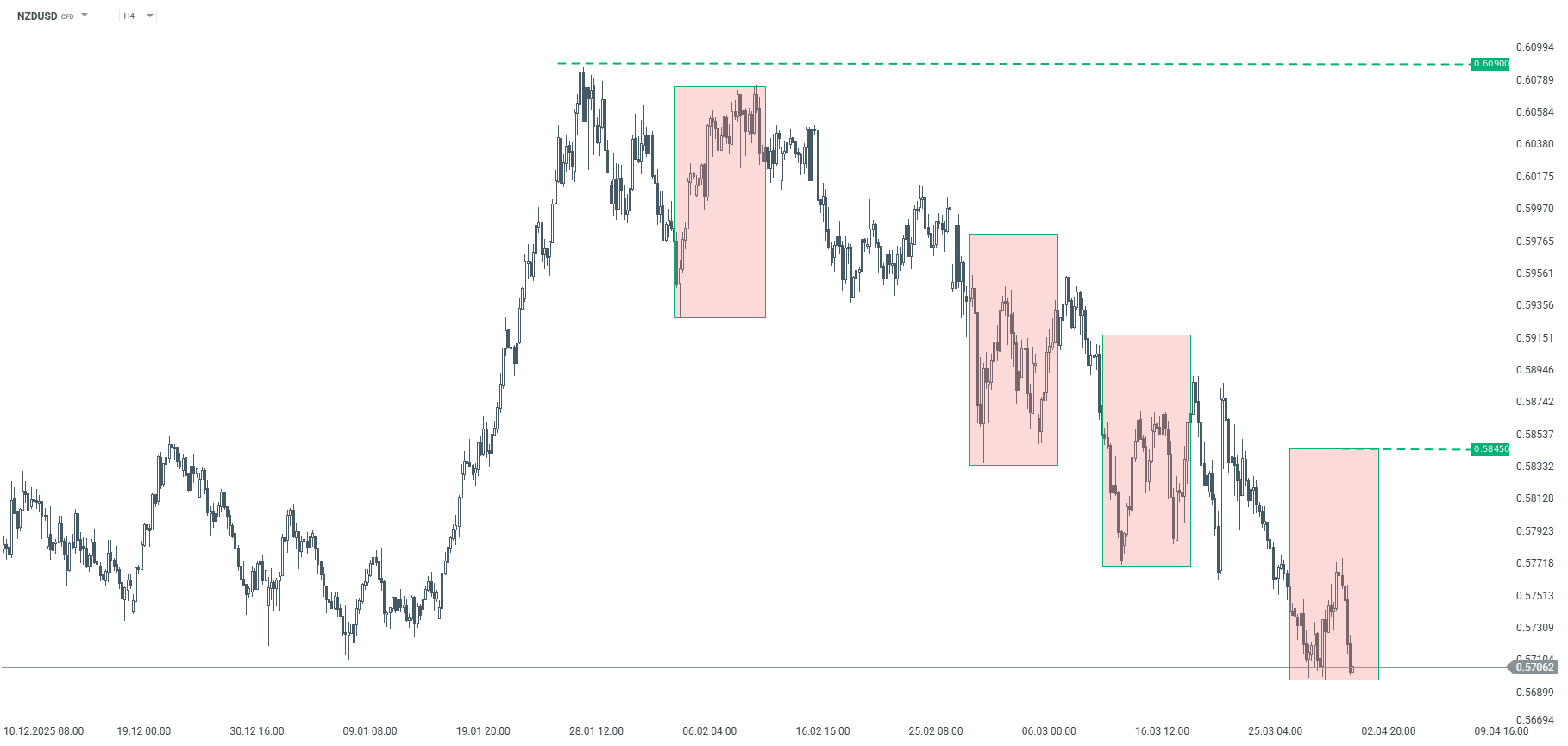
NZDUSD The NZDUSD pair has been trending downward since late January. We are currently seeing an upward corrective move. If the correction continues, the key resistance level remains at 0.5845, where the upper boundary of the 1:1 correction pattern is located. According to the Overbalance methodology, the downtrend remains in effect until this level is negated.
NZDUSD – H4 chart. Source: xStation
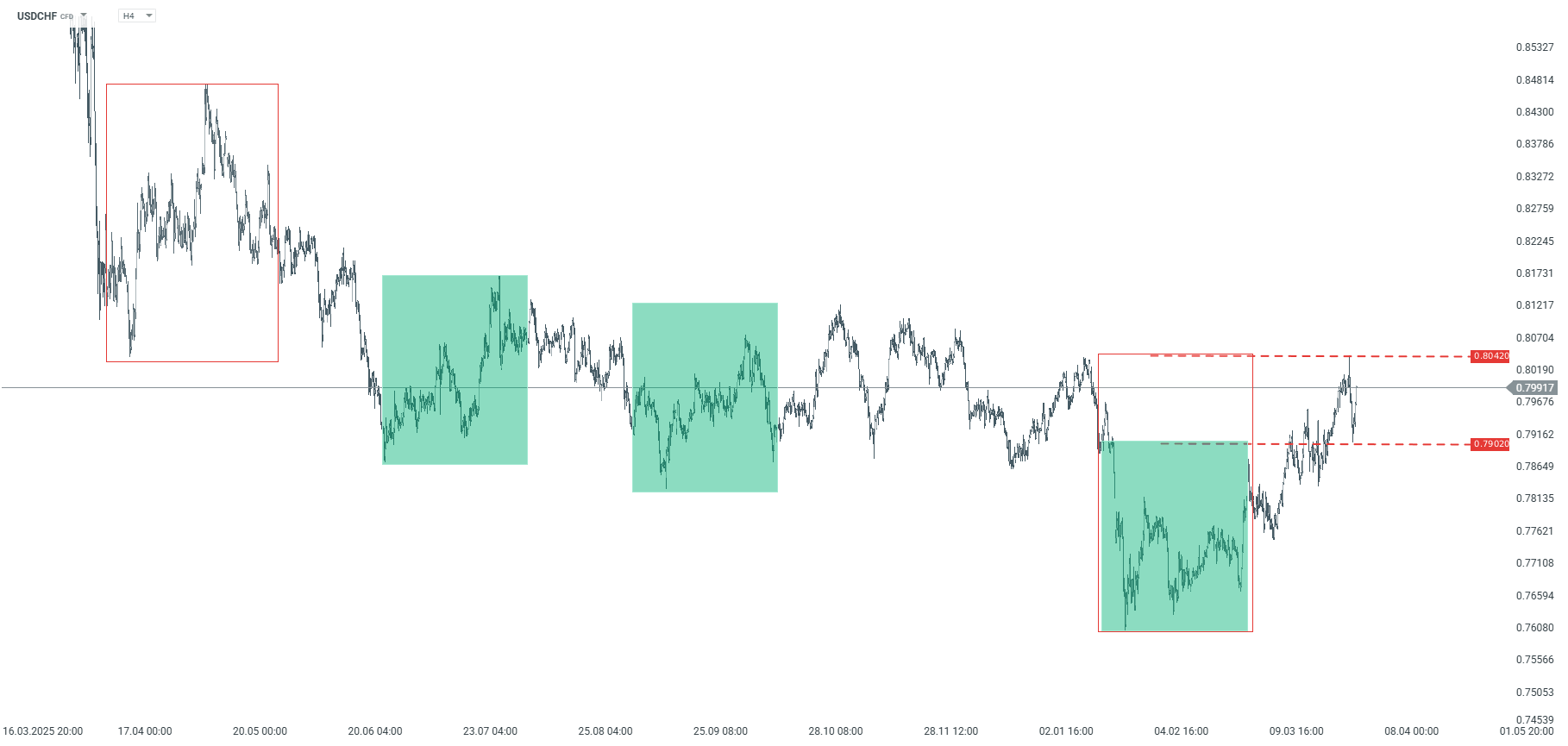
USDCHF Since early January, USDCHF has been in a downtrend. However, an upward correction has been developing since late January, and its range has already exceeded smaller geometric patterns, including the 0.7902 level. Nevertheless, the price has failed to break through the key resistance at 0.8042, where the upper boundary of the largest corrective pattern is located. According to the Overbalance methodology, the downtrend remains in effect until this level is broken. The decline could accelerate after falling below the 0.7902 level, which is the lower boundary of the smaller geometric pattern. Conversely, a break above 0.8042 could lead to a shift to an uptrend.
USDCHF – H4 timeframe. Source: xStation
The material on this page does not constitute financial advice and does not take into account your level of understanding, investment objectives, financial situation or any other specific needs. All information provided, including opinions, market research, mathematical results and technical analyzes published on the Website or transmitted To you by other means, it is provided for information purposes only and should in no way be construed as an offer or solicitation for a transaction in any financial instrument, nor should the information provided be construed as advice of a legal or financial nature on which any investment decisions you make should be based exclusively To your level of understanding, investment objectives, financial situation, or other specific needs, any decision to act on the information published on the Website or sent to you by other means is entirely at your own risk if you In doubt or unsure about your understanding of a particular product, instrument, service or transaction, you should seek professional or legal advice before trading. Investing in CFDs carries a high level of risk, as they are leveraged products and have small movements Often the market can result in much larger movements in the value of your investment, and this can work against you or in your favor. Please ensure you fully understand the risks involved, taking into account investments objectives and level of experience, before trading and, if necessary, seek independent advice.
EUR/JPY may encounter initial resistance near 184.70 at the upper ascending triangle boundary.
The Relative Strength Index near 52 indicates steady momentum.
Immediate support is seen at the nine-day EMA near 183.80.
EUR/JPY depreciates after two days of gains, trading around 183.90 during the Asian hours on Thursday. The technical analysis of the daily chart suggests the currency cross is moving sideways within an ascending triangle pattern, indicating consolidation. However, the structure reflects rising support levels meeting a relatively flat resistance zone, signaling building pressure that could lead to a breakout. A sustained move above resistance would confirm bullish continuation.
The near-term bias is mildly bullish as the EUR/JPY cross holds above the 50-day Exponential Moving Average and the nine-day EMA tracks just beneath spot, reinforcing a shallow upward slope. The Relative Strength Index (RSI) near 52 stays above its midline and confirms steady, rather than aggressive, upside momentum, with recent pullbacks finding demand before the medium-term average.
The EUR/JPY cross may find the initial resistance around the upper ascending triangle boundary at 184.70. A successful break above this triangle would reinforce the bullish bias and lead the currency cross to explore the region around the all-time high of 186.88, reached on January 23.
On the downside, the immediate support lies at the nine-day EMA of 183.80, followed by the 50-day EMA at 183.39. Further support lies at the lower boundary of the ascending triangle around 182.80. A break below the channel would expose a nearly four-month low of 180.81, recorded on February 12.
EUR/JPY: Daily Chart
(The technical analysis of this story was written with the help of an AI tool.)
Euro Price Today
The table below shows the percentage change of Euro (EUR) against listed major currencies today. Euro was the weakest against the US Dollar.
USD
EUR
GBP
JPY
CAD
AUD
NZD
CHF
USD
0.46%
0.55%
0.37%
0.28%
0.72%
0.71%
0.53%
EUR
-0.46%
0.09%
-0.11%
-0.21%
0.27%
0.26%
0.06%
GBP
-0.55%
-0.09%
-0.19%
-0.28%
0.18%
0.19%
-0.03%
JPY
-0.37%
0.11%
0.19%
-0.10%
0.35%
0.34%
0.15%
CAD
-0.28%
0.21%
0.28%
0.10%
0.45%
0.43%
0.25%
AUD
-0.72%
-0.27%
-0.18%
-0.35%
-0.45%
-0.01%
-0.23%
NZD
-0.71%
-0.26%
-0.19%
-0.34%
-0.43%
0.00%
-0.20%
CHF
-0.53%
-0.06%
0.03%
-0.15%
-0.25%
0.23%
0.20%
The heat map shows percentage changes of major currencies against each other. The base currency is picked from the left column, while the quote currency is picked from the top row. For example, if you pick the Euro from the left column and move along the horizontal line to the US Dollar, the percentage change displayed in the box will represent EUR (base)/USD (quote).
USD/JPY edges higher to around 159.20 in Thursday’s Asian session.
Trump said his core “objectives are nearing completion” in Iran.
Japan’s Mimura said authorities may take a ‘decisive’ step if speculative moves persist.
The USD/JPY pair gains momentum to near 159.20 during the Asian trading hours on Thursday. The US Dollar (USD) strengthens against the Japanese Yen (JPY) following US President Donald Trump’s speech from the White House.
Trump said on Thursday that the US is “systemically dismantling the regime’s ability to threaten America or project power outside of their borders.” He added that Iran’s ability to launch missiles and drones has been curtailed.
A White House official stated that the US President will focus on the operation having met or exceeded all of its benchmarks, including destroying Iran’s ballistic missiles and production facilities. Uncertainty surrounding the US-Iran ceasefire and persistent tensions in the Middle East continue to boost the Greenback in the near term.
Fears that Japanese authorities would step in to support the domestic currency could help limit the JPY’s losses. Japan’s top currency diplomat, Atsushi Mimura, said on Monday that officials may need to take “decisive” steps if speculative moves persist in the currency market.
“We are hearing that speculative moves are increasing in the currency market, in addition to the crude futures market. If this situation continues, it may be time to take decisive measures,” said Mimura.
EUR/JPY tests the immediate resistance at the nine-day EMA of 183.70.
The Relative Strength Index hovers near the 50 mid-line, indicating balanced momentum.
The initial support appears at the 50-day EMA at 183.36.
EUR/JPY extends its gains for the second consecutive day, trading around 183.60 during the Asian hours on Wednesday. The technical analysis of the daily chart suggests the currency cross moves sideways within the ascending triangle pattern, reflecting buying pressure.
The near-term bias is mildly bullish as the EUR/PY cross holds above the 50-day Exponential Moving Average (EMA), continuing to offer a rising trend base. The nine-day EMA remains above the 50-day EMA, keeping a short-term positive alignment despite the recent consolidation under the 184.00 area.
Momentum is balanced, with the Relative Strength Index (RSI) hovering close to the 50 mid-line after recovering from last week’s dip, which points to stabilizing demand rather than aggressive buying pressure.
The EUR/JPY cross is testing the immediate barrier at the nine-day EMA of 183.70, followed by the upper ascending triangle boundary around 184.60. Further advances above the triangle would reinforce the bullish bias and lead the currency cross to explore the region around the all-time high of 186.88, reached on January 23.
On the downside, the primary support lies at the 50-day EMA at 183.36, followed by the lower boundary of the ascending triangle around 182.70. A break below the channel would expose the three-month low of 180.81, recorded on February 12.
EUR/JPY: Daily Chart
(The technical analysis of this story was written with the help of an AI tool.)
Euro Price Today
The table below shows the percentage change of Euro (EUR) against listed major currencies today. Euro was the strongest against the New Zealand Dollar.
USD
EUR
GBP
JPY
CAD
AUD
NZD
CHF
USD
-0.09%
-0.09%
0.10%
-0.03%
-0.05%
0.17%
-0.21%
EUR
0.09%
-0.01%
0.18%
0.06%
0.05%
0.28%
-0.11%
GBP
0.09%
0.00%
0.19%
0.06%
0.06%
0.29%
-0.09%
JPY
-0.10%
-0.18%
-0.19%
-0.11%
-0.10%
0.09%
-0.25%
CAD
0.03%
-0.06%
-0.06%
0.11%
0.00%
0.20%
-0.18%
AUD
0.05%
-0.05%
-0.06%
0.10%
-0.01%
0.22%
-0.15%
NZD
-0.17%
-0.28%
-0.29%
-0.09%
-0.20%
-0.22%
-0.37%
CHF
0.21%
0.11%
0.09%
0.25%
0.18%
0.15%
0.37%
The heat map shows percentage changes of major currencies against each other. The base currency is picked from the left column, while the quote currency is picked from the top row. For example, if you pick the Euro from the left column and move along the horizontal line to the US Dollar, the percentage change displayed in the box will represent EUR (base)/USD (quote).
USD/JPY faces rejection ahead of the 160.00 psychological mark amid a modest USD downtick.
Intervention fears further benefit the JPY and contribute to capping the upside for spot prices.
The technical setup favors a bullish outlook amid reduced BoJ rate hike bets and geopolitical uncertainties.
The USD/JPY pair attracts fresh sellers following a modest Asian session uptick to the 160.00 neighborhood on Tuesday, though it manages to hold above the previous day’s swing low. Spot prices currently trade around the 159.70-159.75 region, unchanged for the day, as traders seem reluctant amid mixed fundamental cues.
Against the backdrop of economic concerns stemming from the Iran war, softer Tokyo consumer inflation figures temper bets for an immediate policy tightening by the Bank of Japan (BoJ). This, in turn, undermines the Japanese Yen (JPY) and supports the USD/JPY pair. However, hopes for a de-escalation of tensions in the Middle East weigh on the US Dollar (USD) and cap spot prices amid JPY intervention fears.
From a technical perspective, the near-term tone stays mildly bullish as the USD/JPY pair holds well above the rising 200-day Exponential Moving Average (EMA), keeping the broader uptrend intact despite the recent hesitation above the 160.00 psychological mark. Furthermore, the lack of follow-through selling favors bulls and suggests that the path of least resistance for spot prices remains to the upside.
Meanwhile, the Moving Average Convergence Divergence (MACD) indicator has flattened around the zero line after losing upside traction, suggesting fading bullish momentum rather than a clear reversal. Adding to this, the Relative Strength Index (RSI) near 59 remains in positive territory without overbought signals, which validates the positive outlook and supports a bias for dip-buying while momentum consolidates.
The aforementioned structure favors renewed tests of 160.30, the recent swing high, followed by a higher barrier at 161.00, where a breakout would reopen the path toward fresh cycle highs. On the downside, immediate support aligns at 159.00, with a deeper floor at 158.40 that guarded prior pullbacks. A daily close below the latter would expose 157.70 as the next downside level for the USD/JPY pair.
(The technical analysis of this story was written with the help of an AI tool.)
To provide the best experiences, we use technologies like cookies to store and/or access device information. Consenting to these technologies will allow us to process data such as browsing behavior or unique IDs on this site. Not consenting or withdrawing consent, may adversely affect certain features and functions.
Functional
Always active
The technical storage or access is strictly necessary for the legitimate purpose of enabling the use of a specific service explicitly requested by the subscriber or user, or for the sole purpose of carrying out the transmission of a communication over an electronic communications network.
Preferences
The technical storage or access is necessary for the legitimate purpose of storing preferences that are not requested by the subscriber or user.
Statistics
The technical storage or access that is used exclusively for statistical purposes.The technical storage or access that is used exclusively for anonymous statistical purposes. Without a subpoena, voluntary compliance on the part of your Internet Service Provider, or additional records from a third party, information stored or retrieved for this purpose alone cannot usually be used to identify you.
Marketing
The technical storage or access is required to create user profiles to send advertising, or to track the user on a website or across several websites for similar marketing purposes.