

Currency Hedger No Comments

USD/INR gains further due to higher oil prices, FIIs selling pressure

  • The Indian Rupee weakens further against the US Dollar amid higher oil prices.
  • The selling pressure from FIIs in the Indian stock market has increased.
  • Investors expect the Fed to hold interest rates steady next week.

The Indian Rupee (INR) opens positively against the US Dollar (USD) on Friday, extending its losing streak for the fifth trading day. The USD/INR pair trades firmly near the weekly high of 94.38 as the Indian currency continues to underperform in the wake of higher energy prices and the resumption of significant foreign selling in the Indianย stockย market.

In addition to the above-mentioned headwinds for the Indian Rupee, the upbeat US Dollar is also supporting the USD/INR pair. As of writing, the US Dollar Index (DXY), which tracks the Greenbackโ€™s value against six major currencies, trades firmly near the 10-day high of around 99.00.

Investors fear prolonged Hormuz closure

Higher oil prices amid the suspension of oil flows through the Strait of Hormuz, a vital passage to almost 20% of global energy supply, by Iran as part of retaliation against the United States (US), have undermined the Indian Rupee.

During the press time, the WTI Oil price holds onto weekly gains at around $95.00. Currencies from economies, such as India, which rely heavily on oil imports to meet their energy needs, underperform in a high oil price environment.

Investors doubt that the Hormuz will open soon, as Iran has not yet agreed to resume peace talks with the US, blaming Washington for the continuous blockade of Iranian sea ports.

Meanwhile, a report from CNN has shown that US military officials are developing new plans to target Iranโ€™s capabilities in the Strait of Hormuz in the event the current ceasefire with Iran fails.

FIIs remain net sellers in last four trading days

So farย this week, FIIs have remained net sellers in all four trading days and have offloaded their stake worth Rs. 8,311.99 crore. Foreign investors have resumed selling after a brief pause in the last three trading days of the previous week. Elevated oil prices have dimmed the interest of overseas investors in the Indian stock market amid concerns over India Inc.’s forward earnings and the expectations that the government would trim its capital expenditure to offset obligations towards rising energy prices.

Investors shift focus to the Fed policy

Going forward, the major trigger for global markets will be the monetary policy announcement by theย Federal Reserveย (Fed) on Wednesday. The Fed is widely anticipated to leave interest rates unchanged in the range of 3.50%-3.75% and warn of upside inflation risks in the wake of higher energy prices. Investors will pay close attention to cues regarding whether the Fed plans to hike interestย ratesย anytime this year.

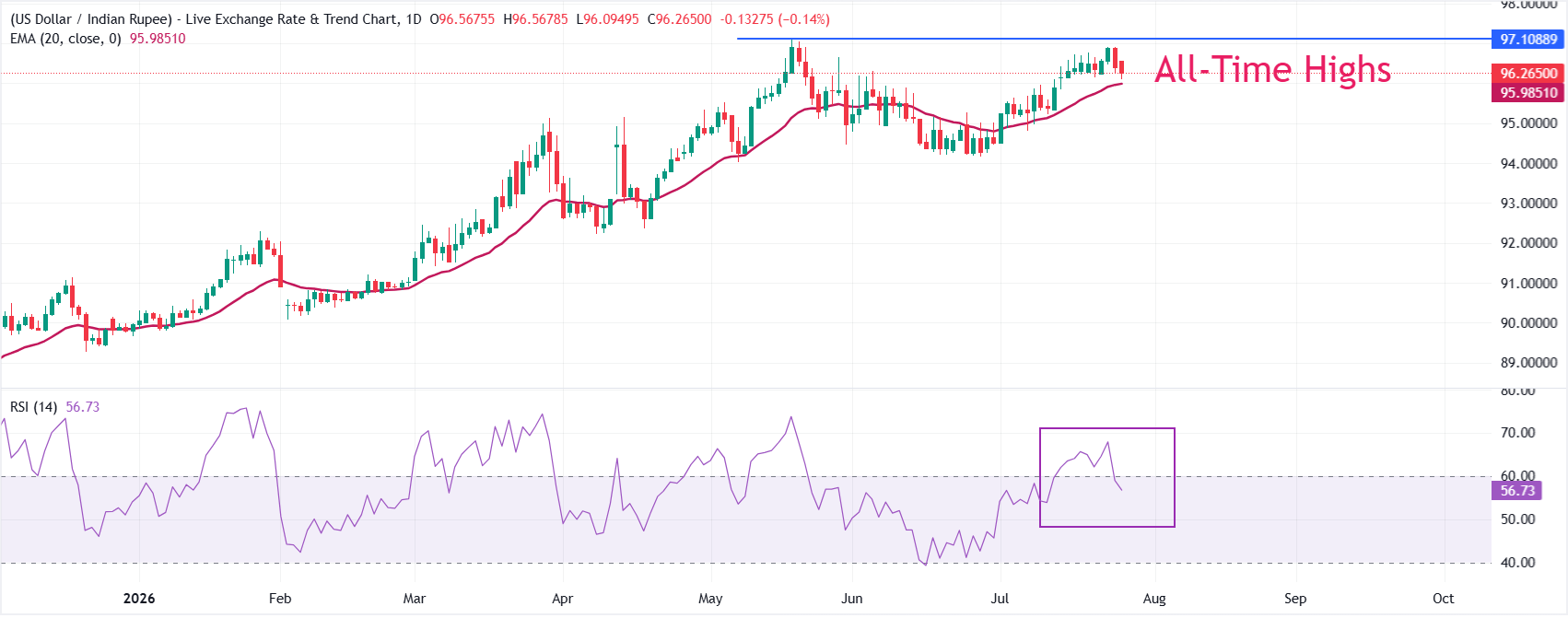
Technical Analysis: USD/INR strives to revisit all-time high around 95.20

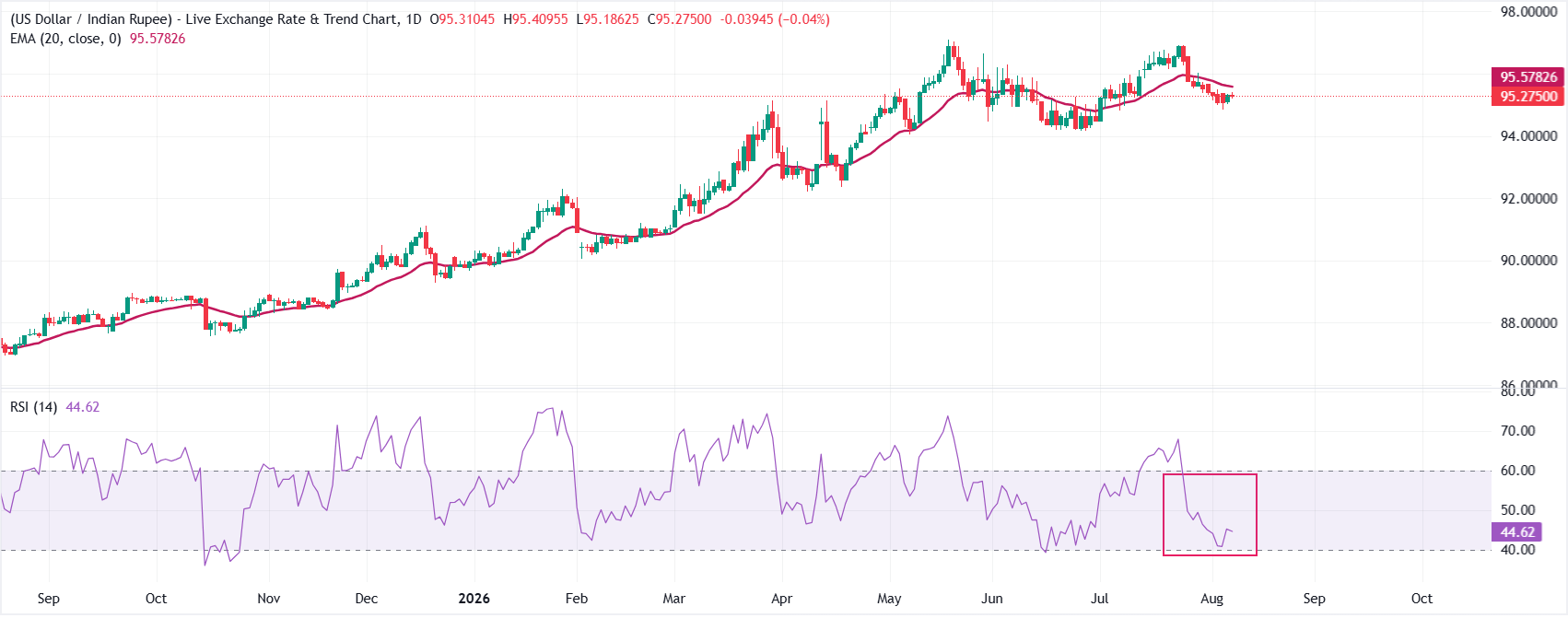
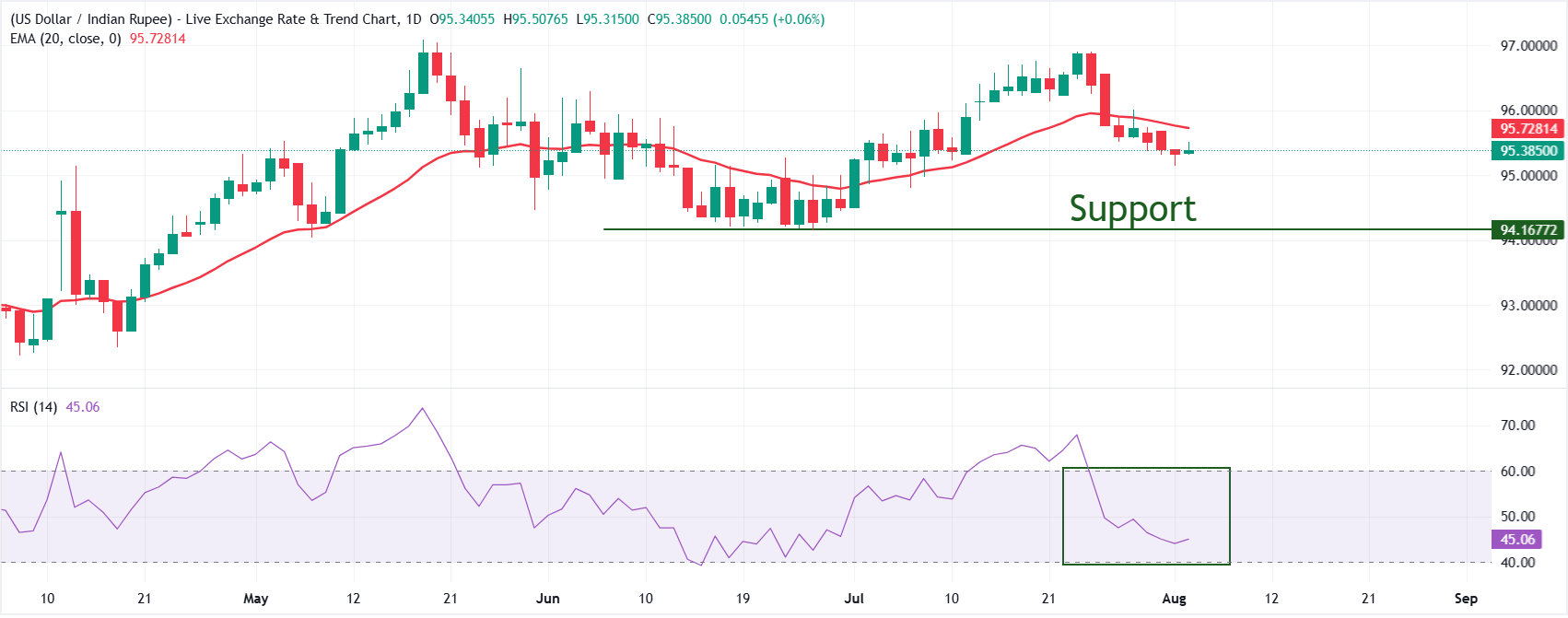
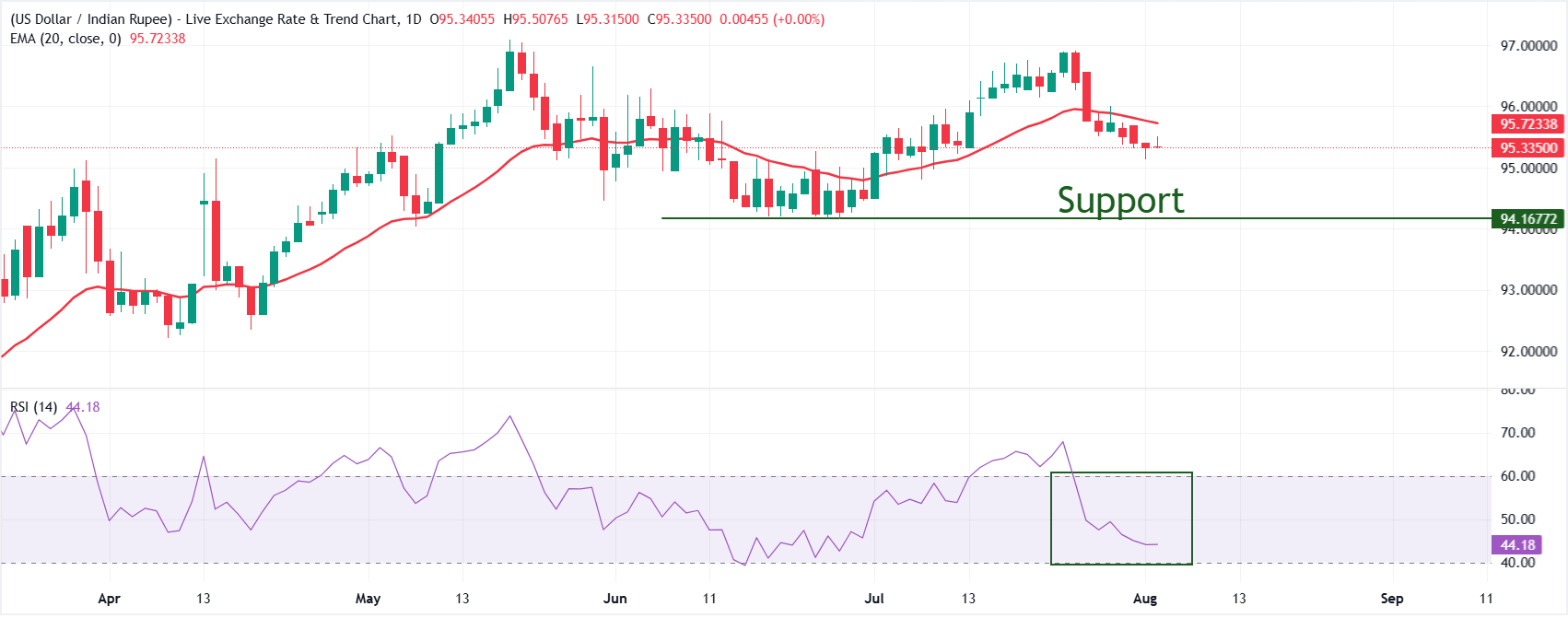
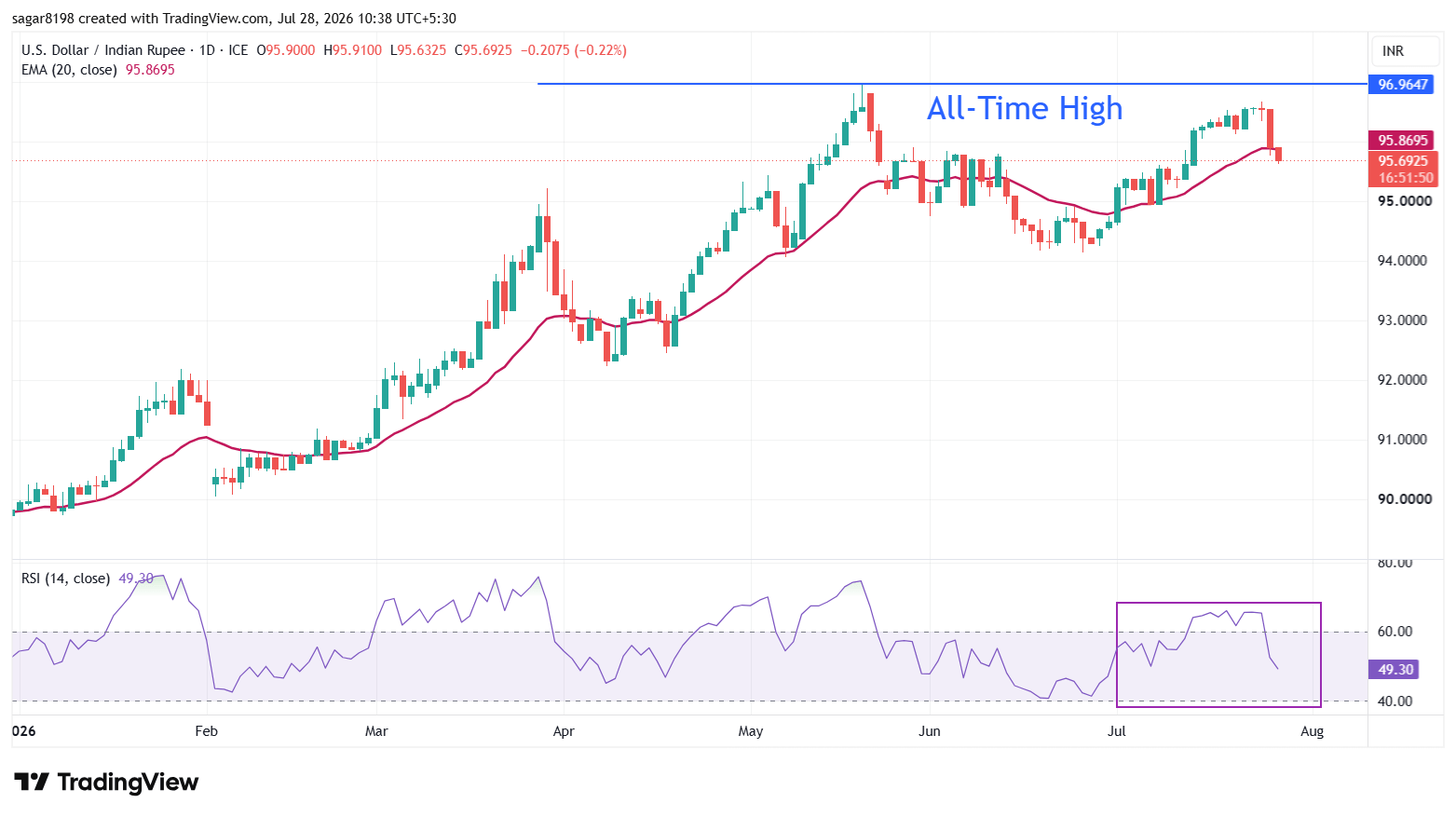
USD/INRย trades higher above 94.20 at the press time, holding a constructive bullish bias as spot remains firmly above the 20-period Exponential Moving Average (EMA) at 93.3565. The positioning over this short-term trend line suggests buyers retain control, while the Relative Strength Index (14) near 59 shows positive but not overstretched momentum, hinting that the advance could extend as long as the pair defends its underlying supports.

On the downside, initial support is seen at the 20-period EMA at 93.3565, which underpins the current structure and is likely to attract dip buyers on shallow pullbacks. A daily close below this dynamic floor would weaken the immediate bullish tone and expose deeper retracements, whereas holding above it keeps the door open for further gains toward the all-time high at around 95.20.

Currency Hedger No Comments

USD/INR jumps higher as Oil price recovery batters Indian Rupee

  • The Indian Rupee declines against the US Dollar amid renewed uncertainty over the US-Iran permanent ceasefire.
  • A sharp recovery in the Oil price has dragged the Indian Rupee.
  • Iran refuses to resume negotiations with the US due to its excessive demands.

The Indian Rupee (INR) trades lower against the US Dollar (USD) at the start of the week. Theย USD/INRย jumps to near 93.00 as renewed tensions between the United States (US) and Iran have lifted the oil prices and offered support to the US Dollar (USD).

Hormuz closure boosts oil prices

WTI Oil prices trade over 3.5% higher to near $88.00 in the Asian trade on Monday. The Oil price strengthens as Iran closed the Strait of Hormuz, a vital passage to almost 20% of global energy supply, again, as retaliation for the continued US blockade of Iranian sea ports and Washingtonโ€™s attack on one of Iranโ€™s commercial ships.

On Friday, Iran announced a temporary reopening of the Hormuz after US President Donald Trump announced a ceasefire between Israel and Lebanon.

Currencies from economies, such as India, which rely heavily on oil imports to meet their energy needs, tend to underperform in a high oil price environment.

Meanwhile, US President Trump has reiterated threats to obliterate every power plant and bridge in Iran, through a post on Truth Social, if the nation doesnโ€™t take a deal soon.

US Dollar gains on renewed US-Iran tensions

Heightened uncertainty surrounding the occurrence of another round of talks between the US and Iran has improved the safe-haven demand of the US Dollar. As of writing, the US Dollar Index (DXY), which tracks the Greenbackโ€™s value against six major currencies, trades marginally higher to near 98.35.

US Dollar Price Today

The table below shows the percentage change of US Dollar (USD) against listed major currencies today. US Dollar was the strongest against the Australian Dollar.

USDEURGBPJPYCADAUDNZDCHF
USD0.11%0.20%0.24%0.04%0.35%0.29%0.16%
EUR-0.11%0.09%0.09%-0.08%0.23%0.19%0.04%
GBP-0.20%-0.09%0.00%-0.16%0.14%0.10%-0.06%
JPY-0.24%-0.09%0.00%-0.15%0.14%0.05%-0.06%
CAD-0.04%0.08%0.16%0.15%0.29%0.22%0.10%
AUD-0.35%-0.23%-0.14%-0.14%-0.29%-0.05%-0.17%
NZD-0.29%-0.19%-0.10%-0.05%-0.22%0.05%-0.14%
CHF-0.16%-0.04%0.06%0.06%-0.10%0.17%0.14%

The heat map shows percentage changes of major currencies against each other. The base currency is picked from the left column, while the quote currency is picked from the top row. For example, if you pick the US Dollar from the left column and move along the horizontal line to the Japanese Yen, the percentage change displayed in the box will represent USD (base)/JPY (quote).

Tehran has refused to return to the table to resume negotiations over the permanent ceasefire with the US due to its โ€œexcessive demands, unrealistic expectations, constant shifts in stance, repeated contradictions, and the ongoing naval blockadeโ€, according to the Iranian Republicย Newsย Agency (IRNA).

FIIs continue raising stake in Indian stock market

Foreign Institutional Investors (FIIs) have remained net buyers in the last three trading days in the Indianย stockย market, and have raised their stake worth Rs. 1,731.71 crore. The sentiment of foreign investors toward the Indian equity market has improved since the announcement of the two-week ceasefire between the US and Iran, which will expire on April 22.

Overseas investors were not gung-ho on Indian equities since the announcement; however, the pace of selling reduced initially, and eventually they started turning out to be net buyers.

On the data front, investors await the US Retail Sales data for March, which will be released on Tuesday. The US Retail Sales data, a key measure of consumer spending, is estimated to have risen at a strong pace of 1.3% on a monthly basis, against a 0.6% growth seen in February.

Technical Analysis: USD/INR recovers above 20-day EMA

USD/INR recovers its Friday’s losses and rises further to near 93.25 on Monday, resulting in an improvement in the near-termย outlook, as it reclaims the 20-period exponential moving average (EMA), which is at 93.05.

The Relative Strength Index (RSI) continues to oscillate in the 40.00-60.00 zone, hinting at waning upside momentum rather than outright oversold conditions.

On the upside, the pair could recover further towards 94.00 if it manages a sustained move above the 20-day EMA. Looking down, the January 28 high at around 92.28 is the key support level; a close below 92.28 would expose the spot to the March 5 low at 91.40.

Currency Hedger No Comments

USD/INR edges lower at open ahead of Trumpโ€™s Iran deadline

  • The Indian Rupee trades marginally higher against the US Dollar in the opening trade.
  • Investors await Iranโ€™s final decision on Trumpโ€™s deadline at 08:00 PM ET, 05:30 AM IST on Wednesday.
  • The RBI is expected to maintain the status quo on Wednesday.

The Indian Rupee (INR) ticks up against the US Dollar (USD) in the opening trade on Tuesday. Theย USD/INRย pair edges down to near 93.00, while it is expected to remain range bound as investors stay on sidelines ahead of United States (US) President Donald Trumpโ€™s ultimatum to Iran either to reopen the Strait of Hormuz or face brutal consequences whose deadline is Tuesday, April 7, 08:00 PM Eastern Time (ET), which will be 05:30 AM IST on Wednesday.

Trump threatens hell if Iran misses deadline

Over the weekend, US President Trump warned, through a post on Truth.Social, that Washington will bomb Iranian power plants and bridges, if it doesnโ€™t reopen the Strait of Hormuz before the deadline.

Meanwhile, comments from Iran signal that it wonโ€™t back down, as it threatened reciprocal attacks on the regional US infrastructure and its allies. An advisor to Iran’s Parliament Speaker Mohammad Bagher Ghalibaf stated that โ€œTrump has about 20 hours to either surrender to Iran, or his allies will return to the Paleolithic Ageโ€.

Market participants worry that a fresh escalation in the ongoing war would boost oil prices, a scenario that is unfavorable for the Indian Rupee, being the currency of a nation that caters its 88%-89% of its domestic energy needs through oil imports.

The ongoing tensions in the Middle East have dampened the interest of foreign investors in the Indianย stockย market. Foreign Institutional Investors (FIIs) continue to dump their stake in the Indian equity market, and have offloaded their stake worth Rs. 26,429.45 crore in the three trading days of April gone by.

Investors await RBIโ€™s policy decision and FOMC minutes

On the domestic front, the next major trigger for the Indian Rupee will be the Reserve Bank of Indiaโ€™s (RBI) monetary policy announcement on Wednesday. The RBI is expected to leave its Repo Rate unchanged at 5.25%, as higher energy prices have prompted inflation expectations globally.

As the RBI is highly anticipated to maintain the status quo, investors will pay close attention to comments from the Indian central bank regarding theย outlookย of inflation, economic growth and key borrowing rates.

In the US, the Federal Open Market Committee (FOMC) minutes of the March policy meeting will be published on late Wednesday. In the policy meeting, the Fed decided to leave interestย ratesย unchanged in the range of 3.50%-3.75% and stated that โ€œhigher energy prices will push up inflation in the near termโ€.

Technical Analysis: USD/INR turns range bound as RSI sifts into 40.00-60.00 zone

USD/INR edges down to near 93.00 in the opening trade on Tuesday. The near-term bias appears neutral as the pair trades close to the 20-day Exponential Moving Average (EMA), which is at 92.95, capping rebounds. The overall trend remains bullish as the higher highs and higher lows structure has not broken yet.

The 14-day Relative Strength Index (RSI) shifts into the 40.00-60.00 zone from the bullish territory above 60.00, signifying that momentum has cooled down, but the bullish bias remains intact.

Initial support emerges at the March 9 high of 92.35, with a daily close below this level opening the room toward the March 5 low of 91.35. On the topside, immediate resistance stands at the April 2 high of 93.66; a break above that level would reassert the bullish trend, which will improve the odds of the price reclaiming the all-time high of 95.22.

Currency Hedger No Comments

Rupee Falls on Outflows, Trump Speech

The Indian rupee edged down to around 93.2 per dollar, extending gains for another session amid persistent capital outflows and heightened geopolitical tensions. The currency has been under pressure from spillovers of the Iran war, prompting the Reserve Bank of India to step up measures against arbitrage and forward contract manipulation.

After an earlier crackdown on banks failed to ease volatility, corporates were barred from rebooking cancelled foreign exchange contracts, and derivative trades with related parties were restricted. Analysts noted that while these measures aim to curb speculative activity, the rupee remains vulnerable as oil prices stay elevated and capital inflows remain limited. Adding to the downward pressure, President Donald Trumpโ€™s 20-minute prime-time address said the US is โ€œvery closeโ€ to completing its military objectives in Iran, while warning of potential escalation.

Currency Hedger No Comments

USD/INR tumbles at open as Middle East war de-escalates

  • The Indian Rupee recovers strongly against the US Dollar as both the US and Iran signal readiness to end the war.
  • Iran wants guarantees of no repetitive aggression from the US in return for peace.
  • FIIs continue to dump their stake in the Indian stock market.

The Indian Rupee (INR) opens higher against the US Dollar (USD) on Wednesday after a holiday due to the Shri Mahavir Jayanti the previous day. The USD/INR pair slumps to near 93.65 from the all-time high of 95.22 posted on Monday, as a significant de-escalation in the Middle East war, following comments from both the United States (US) and Iran signaling their willingness to end the war, has improved the appeal of risk-sensitive assets.

US and Iran show readiness to end Middle East war

On Tuesday, Iranโ€™s President Masoud Pezeshkian told European Union (EU) Council President Antรณnio Costa that his country is ready to end the war with the US, but it needs certain guarantees especially no repetition of aggression, Iranian stateย newsย agency reported.

These comments from Iran came after US President Donald Trump announced that Washington is willing to end the war with Iran despite the Strait of Hormuz remaining closed, a channel to almost 20% of global oil supply. Trump added that forcing the waterway back open would mean extending the military mission beyond his timeline of four to six weeks, Wall Street Journal (WSJ) reported.

Meaningful signs of US-Iran war de-escalation have diminished demand for safe-haven assets, such as the US Dollar. As of writing, the US Dollar Index (DXY), which tracks the Greenbackโ€™s value against six major currencies, trades subduedly near Tuesdayโ€™s low around 99.85. The USD Index fell almost 0.8% on Tuesday after posting a fresh 10-month high at around 100.65.

FIIs continue to pare stake in Indian stock market

Currencies from economies like India, which are in their developing stage, rely heavily on foreign investments for a strong financial system. The consistent outflow of foreign funds from the Indianย stockย market has battered the Indian Rupee significantly in the past months.

In March, Foreign Institutional Investors (FIIs) offloaded their stake worth Rs. 1,22,539.89 crore from the Indian stock market due to the war in the Middle East, assuming that higher oil prices in the wake of the war would be a drag on Nifty 50 Q4FY2025-26 earnings.

US data awaited

On Wednesday, investors will focus on the US ADP Employment Change and the ISMย Manufacturing PMIย data for March, and Retail Sales data for February, which will be published in the North American session. Economists expect US private sector to have created 40K fresh jobs, lower than 63K in February.

The ISM is expected to report that the Manufacturing PMI will tick higher to 52.5 from the previous reading of 52.4. US Retail Sales are estimated to have grown 0.5% after declining 0.2% in January.

Technical Analysis: USD/INR retraces from all-time highs of 95.22

USD/INRย corrects sharply from the all-time high of 95.22 to near 93.65 in the opening session on Wednesday. However, the continuation of higher highs and higher lows from the 90s area suggests that the bullish trend is bullish. The ascending 20-day Exponential Moving Average (EMA) near 93.13 confirms a strong bullish tone.

The 14-day Relative Strength Index (RSI) falls below 60.00 after remaining inside the 60.00-80.00 zone for a longer period, indicating the suspension of the bullish momentum with the upside bias remaining intact.

Initial support emerges at 20-day EMA, which is around 93.13, followed by previous peak levels in the 92.00-92.35 range. A downside break below the range would dent the overall bullish structure and open the way towards the March 5 low of 91.35. On the upside, the all-time high of 95.22 will be the major barrier for the spot price. A decisive break above the same would boost the odds of an extension of the advance toward 96.00.