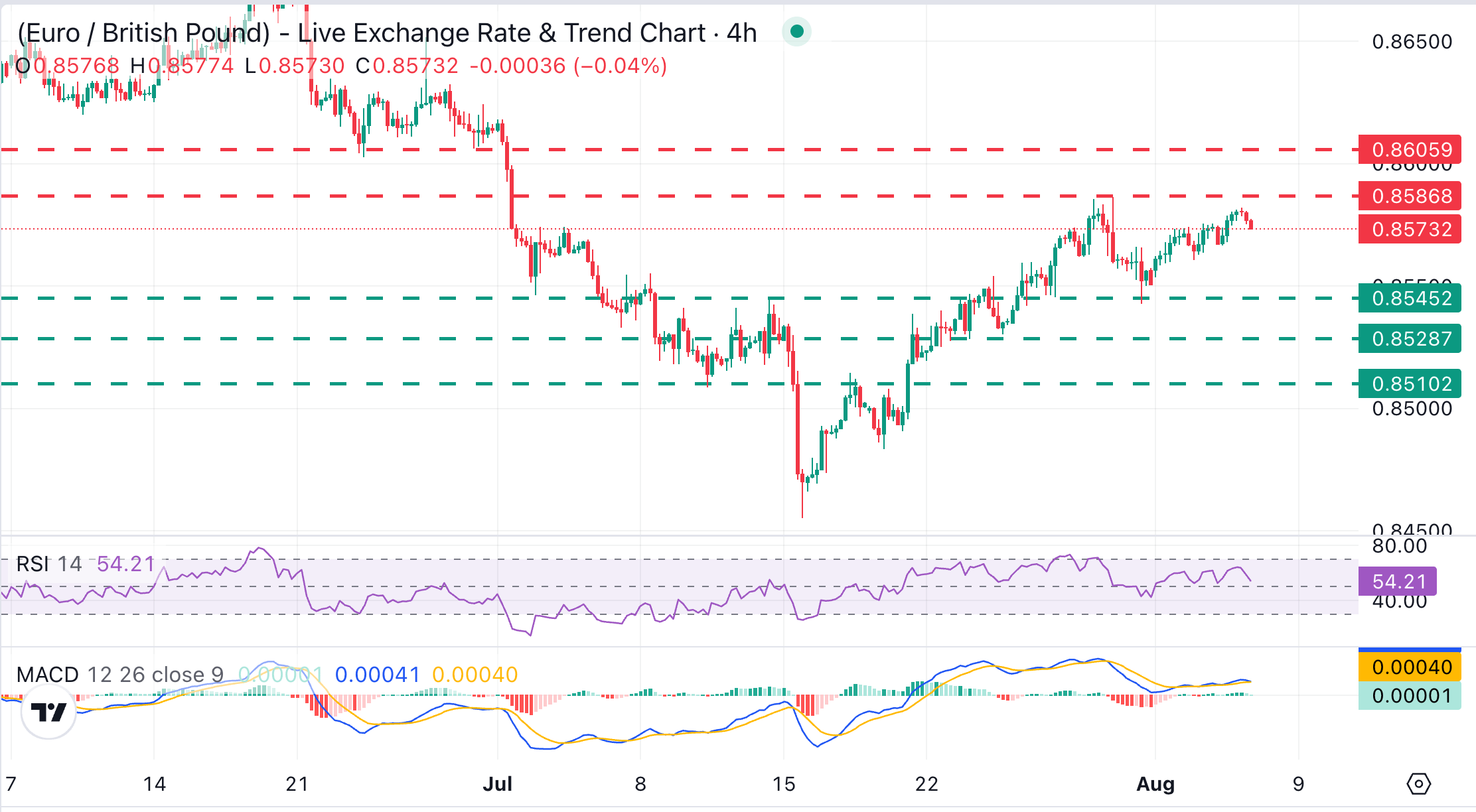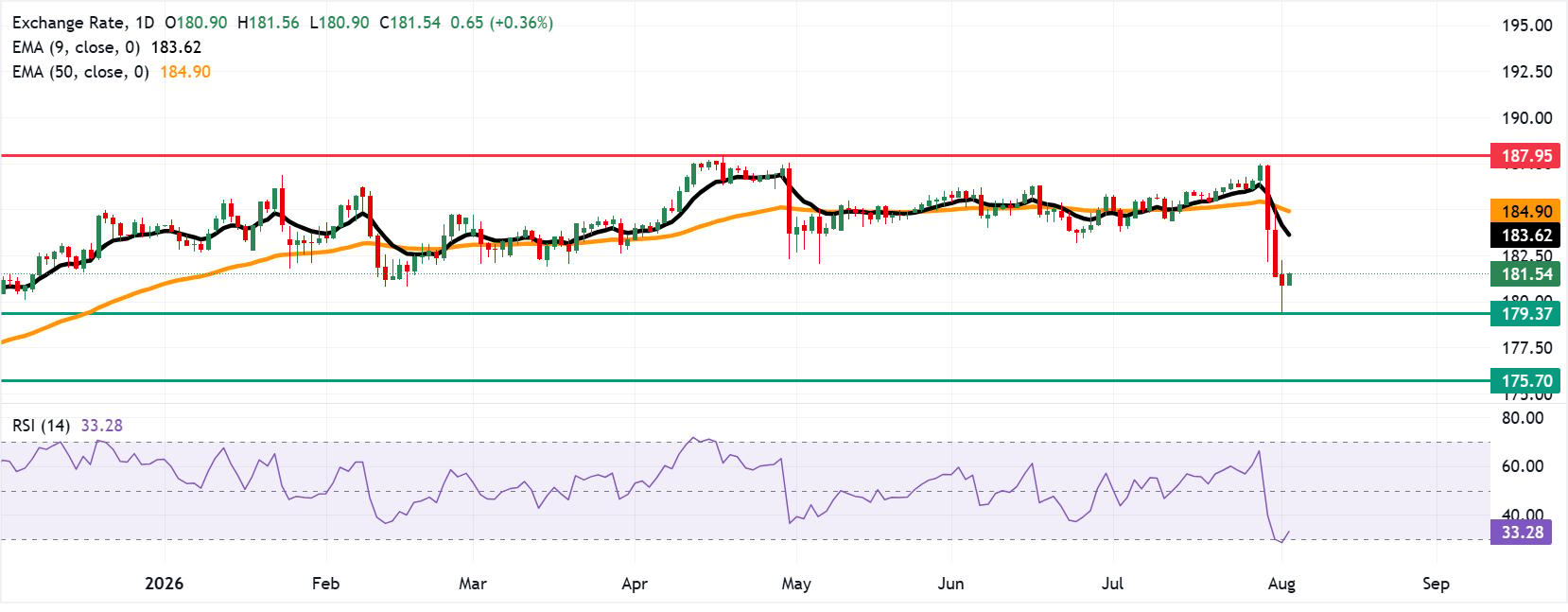


EUR/CAD caps near 1.6200 as Euro struggles due to risk-off mood

April 13, 2026
  • EUR/CAD stays silent as risk aversion rises following the failure of US–Iran peace talks.
  • Nordea analysts say resolving the US–Iran conflict wouldn’t remove the need for ECB tightening.
  • CAD may gain as oil prices rise amid renewed fears of a Strait of Hormuz blockade.

EUR/CAD holds position after paring its intraday losses, trading around 1.6200 during the Asian hours on Monday. However, the currency cross still remains in the negative territory as the Euro (EUR) struggles amid increased risk aversion after the failure of the United States (US)-Iran peace talks.

US Vice President JD Vance confirmed the US–Iran talks in Islamabad ended without a deal following 21 hours of negotiations. President Donald Trump confirmed on Truth Social that the blockade of ships entering and exiting Iranian ports will begin today, April 13, at 10:00 AM ET (14:00 GMT).

Eurozone annual inflation rose to 2.5% in March, the highest since January 2025, exceeding the European Central Bank’s (ECB) 2% target amid rising energy prices. ECB President Christine Lagarde emphasized that policy will remain restrictive until inflation sustainably returns to target.

Nordea’s Jan von Gerich and Tuuli Koivu, in their pre-ceasefire ECB outlook, projected four 25-basis-point rate hikes starting in June. They emphasize that broader price pressures persist and that even a resolution to the conflict would not eliminate the need for ECB tightening.

The EUR/CAD cross also struggles as the commodity-linked Canadian Dollar (CAD) may receive support from the rising oil prices, given Canada’s status as the largest crude exporter to the United States (US).

West Texas Intermediate (WTI) oil price trades over 7% higher near $96.90 per barrel at the time of writing. Crude oil prices rise as US–Iran tensions re-escalate and fears grow over a potential Strait of Hormuz blockade.

EUR/JPY holds losses near 186.50 as US–Iran talks fail

April 13, 2026
  • EUR/JPY struggles as the Euro faces challenges on increased risk aversion.
  • US Vice President JD Vance confirmed that US–Iran talks in Islamabad ended without a deal.
  • Rising energy costs boosted expectations of a near-term Bank of Japan rate hike.

EUR/JPY pares its daily losses but remains in the negative territory, trading around 186.60 during the Asian hours on Monday. The currency cross faced challenges as the risk-sensitive Euro (EUR) lost ground following the failure of the United States (US)-Iran peace talks. US Vice President JD Vance confirmed that the US–Iran talks in Islamabad ended without a deal following 21 hours of negotiations.

US President Donald Trump said Washington would begin blockading all ships entering or leaving the Strait of Hormuz, while US Central Command (CENTCOM) confirmed operations targeting maritime traffic to and from Iranian ports from 10 AM ET (14:00 GMT) on Monday.

Nordea’s Jan von Gerich and Tuuli Koivu, in their pre-ceasefire European Central Bank (ECB) outlook, projected four 25-basis-point rate hikes starting in June. While they now see downside risks to this view, they emphasize that broader price pressures persist and that even a resolution to the conflict would not eliminate the need for ECB tightening.

The downside of the EUR/JPY cross could be restrained as the Japanese Yen (JPY) struggles on stagflation concerns amid rising oil prices. Rising energy costs fueled expectations of a near-term Bank of Japan (BoJ) rate hike. The BoJ is set to hold its next policy decision on April 28, where officials will evaluate whether elevated global energy and commodity prices justify tightening.

The Sakura Report showed board members balancing upside inflation risks against downside growth risks following the April 6 branch managers’ meeting. All nine regions maintained that their economies were either “recovering moderately,” “picking up,” or “picking up moderately.”

EUR/USD Price Rebounds to near 1.1700 as bullish bias prevails

April 13, 2026
  • EUR/USD may face key resistance near 1.1750 at the upper ascending channel boundary.
  • The 14-day Relative Strength Index near 56 signals positive momentum.
  • The immediate support lies at the 50-day EMA near 1.1640.

EUR/USD edges higher after opening at a gap down, trading around 1.1690 during the Asian hours on Monday. The daily chart technical analysis indicates a bullish bias, as the pair is rising within an ascending channel.

The EUR/USD pair holds a modest bullish bias as it stays above both the nine-day and 50-day Exponential Moving Averages (EMAs). This constructive positioning is backed by a 14-day Relative Strength Index near 56, which suggests positive but not overstretched momentum, leaving room for further upside while the pair remains supported on dips.

On the upside, the EUR/USD pair may find its primary barrier at the upper boundary of the ascending channel around 1.1750, followed by the eight-week high of 1.1834, reached on February 23. Further advances above this confluence resistance zone would lead the pair in exploring the region around 1.2082, the highest since June 2021, reached on January 27.

The EUR/USD pair may find the immediate support at the 50-day EMA of 1.1640, aligned with the nine-day EMA of 1.1636. A break below these averages would weaken the price momentum and expose the lower ascending channel boundary around 1.1500, followed by the eight-month low of 1.1411, recorded on March 13.

EUR/USD: Daily Chart

(The technical analysis of this story was written with the help of an AI tool.)

Euro Price Today

The table below shows the percentage change of Euro (EUR) against listed major currencies today. Euro was the weakest against the US Dollar.

USDEURGBPJPYCADAUDNZDCHF
USD0.32%0.46%0.27%0.17%0.45%0.28%0.35%
EUR-0.32%0.12%-0.04%-0.14%0.11%-0.03%0.07%
GBP-0.46%-0.12%-0.17%-0.29%-0.02%-0.17%-0.10%
JPY-0.27%0.04%0.17%-0.15%0.14%-0.03%0.11%
CAD-0.17%0.14%0.29%0.15%0.32%0.13%0.19%
AUD-0.45%-0.11%0.02%-0.14%-0.32%-0.15%-0.02%
NZD-0.28%0.03%0.17%0.03%-0.13%0.15%0.10%
CHF-0.35%-0.07%0.10%-0.11%-0.19%0.02%-0.10%

The heat map shows percentage changes of major currencies against each other. The base currency is picked from the left column, while the quote currency is picked from the top row. For example, if you pick the Euro from the left column and move along the horizontal line to the US Dollar, the percentage change displayed in the box will represent EUR (base)/USD (quote).

EUR/JPY Price Eyes upper ascending channel boundary near 186.50

April 10, 2026
  • EUR/JPY may rise toward the 186.50 level near the ascending channel’s upper boundary.
  • The Relative Strength Index stands at 65.55, indicating strong upward momentum.
  • The initial support appears at the nine-day EMA of 184.94.

EUR/JPY extends its gains for the second successive day, trading around 186.10 during the Asian hours on Friday. The technical analysis of the daily chart indicates the currency cross is trending higher within an ascending channel, signaling a persistent bullish bias.

The EUR/JPY cross extends its advance above both the nine-day and 50-day Exponential Moving Averages (EMAs), which reinforce a constructive bullish bias. The rising Relative Strength Index (RSI) at 65.55 sits just below overbought territory, suggesting firm upward momentum.

The EUR/JPY cross may target the immediate resistance at the upper boundary of the ascending channel around 186.50. A break above the channel would reinforce the bullish outlook and open the door toward the all-time high of 186.88, recorded on January 23.

On the downside, the primary support lies at the nine-day EMA of 184.94. A move below this level could weaken the short-term price momentum, exposing the 50-day EMA at 183.76, followed by the channel’s lower boundary around 183.60. A break below this confluence support zone would cause the emergence of the bearish bias and open the doors for the EUR/JPY cross to navigate the region around a four-month low of 180.81, recorded on February 12.

EUR/JPY: Daily Chart

(The technical analysis of this story was written with the help of an AI tool.)

Euro Price Today

The table below shows the percentage change of Euro (EUR) against listed major currencies today. Euro was the strongest against the Australian Dollar.

USDEURGBPJPYCADAUDNZDCHF
USD0.03%0.07%0.10%0.04%0.19%0.17%0.05%
EUR-0.03%0.05%0.09%-0.01%0.17%0.14%0.02%
GBP-0.07%-0.05%0.04%-0.03%0.11%0.10%-0.10%
JPY-0.10%-0.09%-0.04%-0.07%0.09%0.03%-0.15%
CAD-0.04%0.00%0.03%0.07%0.13%0.12%-0.07%
AUD-0.19%-0.17%-0.11%-0.09%-0.13%-0.02%-0.22%
NZD-0.17%-0.14%-0.10%-0.03%-0.12%0.02%-0.20%
CHF-0.05%-0.02%0.10%0.15%0.07%0.22%0.20%

The heat map shows percentage changes of major currencies against each other. The base currency is picked from the left column, while the quote currency is picked from the top row. For example, if you pick the Euro from the left column and move along the horizontal line to the US Dollar, the percentage change displayed in the box will represent EUR (base)/USD (quote).

EUR/USD – Bears seem hesitant as breakout above 1.1670 remains in play

April 10, 2026
  • EUR/USD consolidates its weekly gains as Hormuz risks offer some support to the US Dollar.
  • The downside remains cushioned as traders await the latest US consumer inflation figures.
  • The technical setup favors bulls and backs the case for an extension of the weekly uptrend.

The EUR/USD pair struggles to capitalize on its weekly gains registered over the past four days and trades with a mild negative bias below the 1.1700 mark during the Asian session on Friday. The downside, however, remains cushioned amid the lack of any meaningful US Dollar (USD) buying and ahead of the US consumer inflation figures, due later today.

In the meantime, tensions around the Strait of Hormuz offer some support to Crude Oil prices, fueling inflationary concerns and bolstering hawkish US Federal Reserve (Fed) expectations. This, in turn, is seen acting as a tailwind for the safe-haven USD and undermining the EUR/USD pair. However, hopes of Iran ceasefire stabilizing hold back the USD bulls from placing aggressive bets ahead of the crucial US Consumer Price Index (CPI) and offer some support to the currency pair.

From a technical perspective, the overnight breakout through the 1.1670 confluence – comprising the 200-day Simple Moving Average (SMA) and the 38.2% Fibonacci retracement level of the January-March slide– favors the EUR/USD bulls. Moreover, momentum indicators underpin the constructive tone, with the Relative Strength Index (RSI) hovering near 58, while staying short of overbought conditions, and the Moving Average Convergence Divergence (MACD) in positive territory.

Meanwhile, initial resistance emerges at the 50.0% retracement around 1.1742, followed by the 61.8% Fibo. level at 1.1820, with further barriers at 1.1931 and the prior swing high region near 1.2072. On the downside, immediate support is located at the 200-day SMA at 1.1672 and the nearby 38.2% Fibo. retracement level at 1.1665, while deeper pullbacks would look toward the 23.6% level at 1.1568 and the March monthly swing low, just ahead of the 1.1400 round-figure mark.

EUR/USD daily chart

Chart Analysis EUR/USD

Currency Talk – EUR/CAD NZD/USD, USD/JPY

April 9, 2026

The Overbalance analysis aims to identify three financial instruments, analyzed primarily on the daily/four-hour (D1/H4) timeframe. The analysis uses only the Overbalance methodology, which helps determine where a trend may continue or where it may reverse.
Today’s analysis covers three instruments, evaluated solely in terms of 1:1 correction structures.

EURCAD
At the end of March, EURCAD prices broke out of a major 1:1 downtrend pattern at the 1.5948 level, paving the way for further gains. We are currently seeing a continuation of the uptrend, and counting from the March 9 low, we can identify a local 1:1 uptrend pattern. In the event of a correction, the key short-term support remains at the 1.6020 level, where the lower boundary of this pattern is located. Conversely, only a return of the price below 1.5948 could suggest a shift to a downtrend. For now, sentiment remains bullish.

EURCAD – H4 timeframe. Source: xStation

NZDUSD
Since February of this year, NZDUSD has been trending downward, with the market repeatedly forming corrections of similar magnitude. We are currently observing a test of the key resistance level resulting from the 1:1 Fibonacci retracement at 0.5828. A sustained break below this level could lead to a shift in sentiment toward an uptrend. On the other hand, defending this level and keeping the price within the downtrend could result in a return to declines and a test of recent lows at 0.5680. The current zone is of critical importance in the short term.

NZDUSD – H4 chart. Source: xStation

USDJPY
Since mid-February, USDJPY has been in a strong uptrend. Recently, one of the larger corrections occurred, covering a range of approximately 240 pips. The current correction has the same range as the previous one, marked in green, which allows us to identify key support at the 158.10 level, based on a 1:1 ratio. If this level holds, there is a chance for the uptrend to resume and for new highs to be tested. Conversely, a break below this level could lead to a trend reversal and a deepening of the decline.

USDJPY – H4 chart. Source: xStation

The material on this page does not constitute financial advice and does not take into account your level of understanding, investment objectives, financial situation or any other specific needs. All information provided, including opinions, market research, mathematical results and technical analyzes published on the Website or transmitted To you by other means, it is provided for information purposes only and should in no way be construed as an offer or solicitation for a transaction in any financial instrument, nor should the information provided be construed as advice of a legal or financial nature on which any investment decisions you make should be based exclusively To your level of understanding, investment objectives, financial situation, or other specific needs, any decision to act on the information published on the Website or sent to you by other means is entirely at your own risk if you In doubt or unsure about your understanding of a particular product, instrument, service or transaction, you should seek professional or legal advice before trading. Investing in CFDs carries a high level of risk, as they are leveraged products and have small movements Often the market can result in much larger movements in the value of your investment, and this can work against you or in your favor. Please ensure you fully understand the risks involved, taking into account investments objectives and level of experience, before trading and, if necessary, seek independent advice.

EUR/USD – Bulls await break above 200-SMA/38.2% Fibo. confluence near 1.1670

April 9, 2026
  • EUR/USD struggles to gain any meaningful traction during the Asian session amid mixed cues.
  • The Fed’s dovish outlook keeps the USD bulls on the defensive and lends support to the pair.
  • The fragile US-Iran ceasefire limits the USD downside and acts as a headwind for spot prices.

The EUR/USD pair finds some support near the 1.1650 region during the Asian session on Thursday, and for now, seems to have stalled the previous day’s late pullback from over a one-month high.

The US Federal Reserve’s (Fed) dovish outlook, signaling that it still sees one interest rate cut this year if inflation declines in line with expectations, caps the attempted US Dollar (USD) recovery move and acts as a tailwind for spot prices. Meanwhile, experts seem skeptical about the sustainability of the US-Iran ceasefire. This, in turn, benefits the Greenback’s safe-haven status and caps the upside for the EUR/USD pair.

The overnight failure to build on the momentum beyond the 1.1670 confluence hurdle – comprising the 200-day Simple Moving Average (SMA) and the 38.2% Fibonacci retracement level of the January-March downfall – warrants caution for bulls. That said, the Relative Strength Index (RSI) hovers around 56, and the Moving Average Convergence Divergence (MACD) holds in positive territory and edges higher, hinting that downside pressure is easing rather than a clear bullish reversal.

This makes it prudent to wait for a sustained strength above the said confluence barrier and the 1.1700 mark before positioning for further gains toward the 50% retracement at 1.1747 and the 61.8% Fibo. level at 1.1827, ahead of 1.1941 and 1.2086. On the downside, first support emerges at the 23.6% Fibo. retracement at 1.1568, with a deeper pullback exposing the cycle low region around 1.1409.

(The technical analysis of this story was written with the help of an AI tool.)

EUR/USD daily chart

Chart Analysis EUR/USD

EUR/USD – Rises above 1.1650, moving averages amid bullish reversal

April 8, 2026
  • EUR/USD may rise toward the six-week high of 1.1795.
  • The 14-day Relative Strength Index at 56 indicates positive momentum above the midline.
  • The immediate support lies at the 50-day EMA of 1.1632.

EUR/USD extends its winning streak for the third successive day, trading around 1.1670 during Asian hours on Wednesday. The daily chart technical analysis indicates a bullish reversal as the pair is rising above the descending channel pattern.

The EUR/USD pair has rebounded above the nine-day and 50-day Exponential Moving Averages (EMAs), framing a tentative bullish bias after an earlier downside phase.

The 14-day Relative Strength Index (RSI) momentum indicator at 56 shows positive momentum above the midline, backing the recovery and reducing immediate downside pressure. This configuration points to buyers regaining control as long as the EUR/USD pair holds above recent breakout levels, with scope for an extension higher if it can sustain above the shorter moving average cluster.

On the upside, the EUR/USD pair may target the six-week high of 1.1795, reached on March 2. Further advances would support the pair in exploring the region around 1.2082, the highest since June 2021, reached on January 27.

The EUR/USD pair may find the immediate support at the 50-day EMA of 1.1632, followed by the nine-day EMA of 1.1575. A return to the descending channel would put downward pressure on the pair to test the eight-month low of 1.1411, recorded on March 13. Further declines would put downward pressure on the pair to test the descending channel around 1.1220.

EUR/USD: Daily Chart

(The technical analysis of this story was written with the help of an AI tool.)

Euro Price Today

The table below shows the percentage change of Euro (EUR) against listed major currencies today. Euro was the strongest against the US Dollar.

USDEURGBPJPYCADAUDNZDCHF
USD-0.64%-0.77%-0.74%-0.32%-1.04%-1.49%-0.93%
EUR0.64%-0.14%-0.13%0.32%-0.40%-0.89%-0.30%
GBP0.77%0.14%0.00%0.46%-0.24%-0.72%-0.16%
JPY0.74%0.13%0.00%0.44%-0.26%-0.74%-0.17%
CAD0.32%-0.32%-0.46%-0.44%-0.70%-1.16%-0.61%
AUD1.04%0.40%0.24%0.26%0.70%-0.48%0.08%
NZD1.49%0.89%0.72%0.74%1.16%0.48%0.57%
CHF0.93%0.30%0.16%0.17%0.61%-0.08%-0.57%

The heat map shows percentage changes of major currencies against each other. The base currency is picked from the left column, while the quote currency is picked from the top row. For example, if you pick the Euro from the left column and move along the horizontal line to the US Dollar, the percentage change displayed in the box will represent EUR (base)/USD (quote).