
USD/CHF Price Forecast: Breaks below key SMAs, eyes on 0.7800

April 18, 2026
  • USD/CHF falls below all major SMAs, confirming bearish structure shift.
  • RSI in bearish territory reflects strong selling pressure since April.
  • Break below 0.7800 exposes 0.7775 and 0.7748 support levels.

USD/CHF finishes the week on a lower note, down 0.87% for the week and 0.27% in the day, as markets turn optimistic about a possible US-Iran deal over the weekend. In the meantime, the technical picture remains bearish, as the pair tumbled below key moving averages, hitting a five-week low at 0.7775.

USD/CHF Price Forecast: Technical outlook

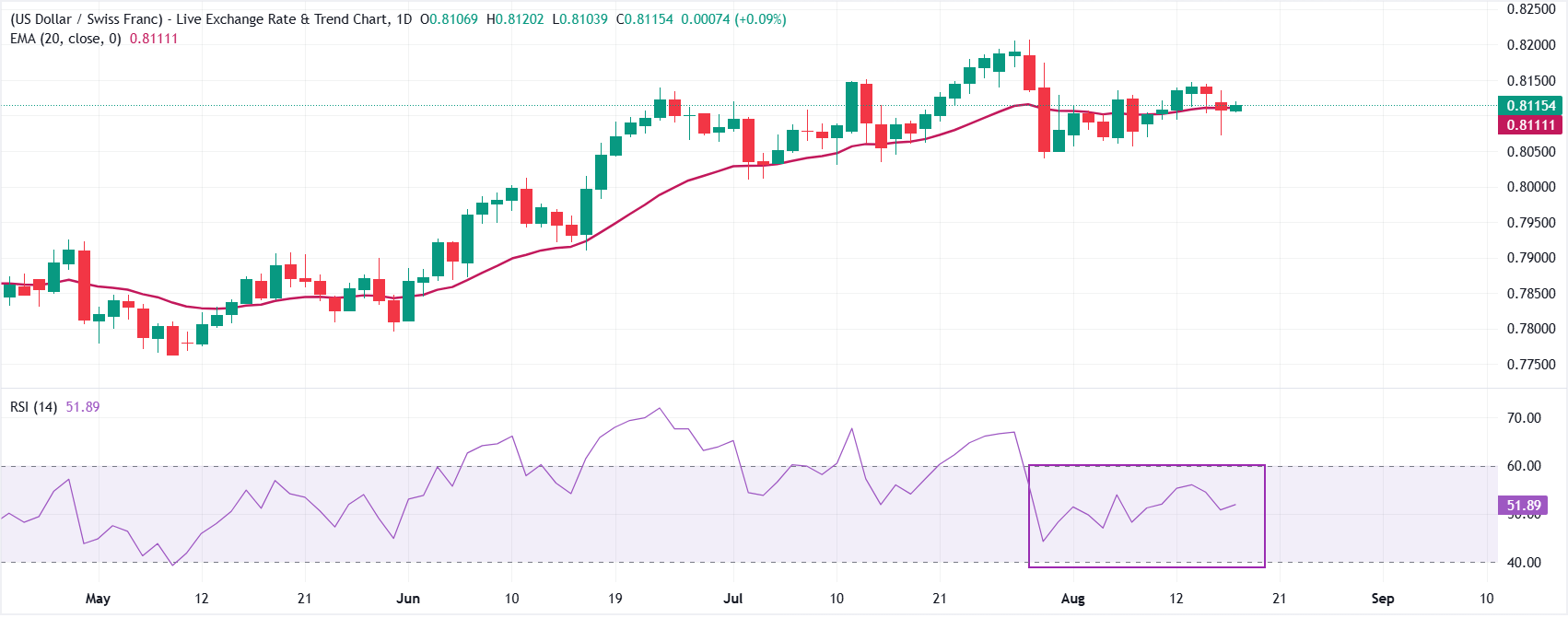
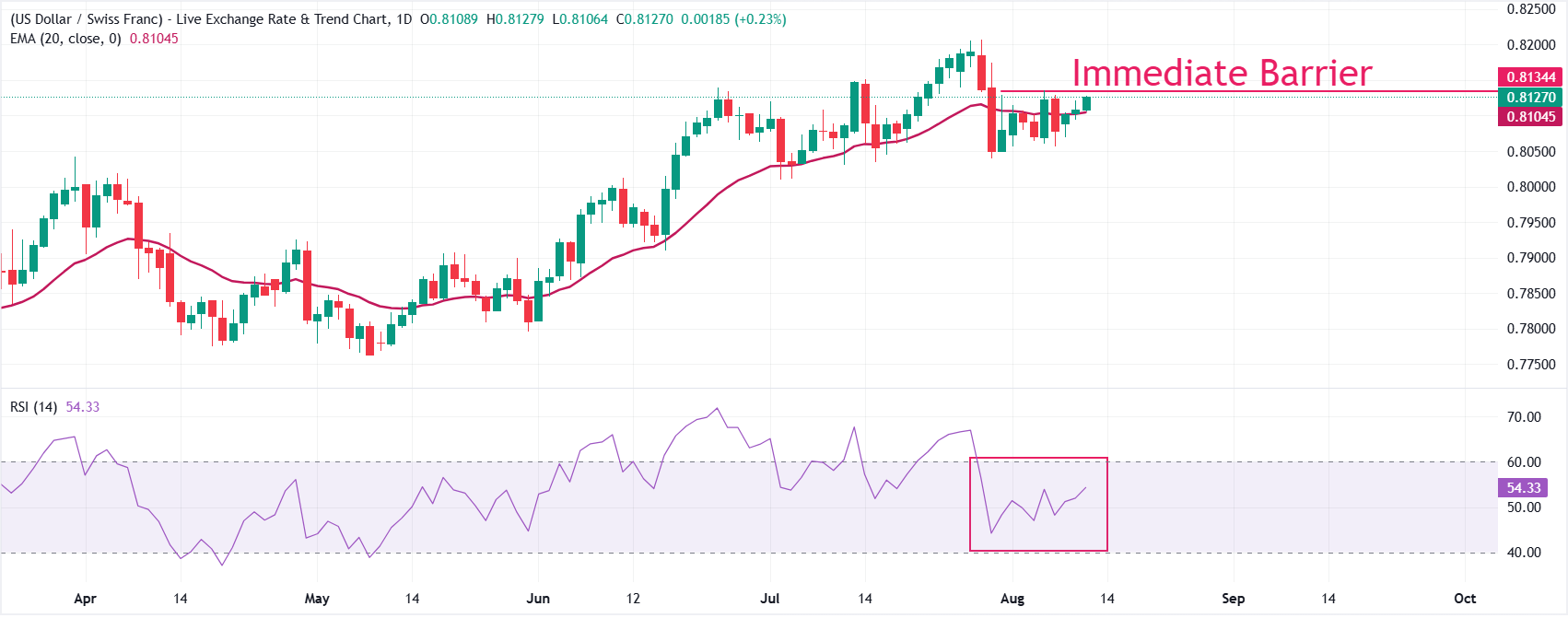
The daily chart shows the pair ended the day below the 50-day Simple Moving Average (SMA) at 0.7825—the last of a group of four that included the 20-, 100-, and 200-day SMAs —, opening the door for further downside. The Relative Strength Index (RSI) is also in bearish territory, indicating that bears have been aggressive since April 9, when the index pierced below its 50-neutral level.

For a bearish continuation, the USD/CHF must clear key support at 0.7800. A breach of the latter will expose a key support trendline around 0.7775/80, followed by the March 10 daily low at 0.7748. Fresh buying interest is seen at 0.7700.

On the other hand, a break of resistance at the 50-day SMA would expose the 100-day SMA at 0.7871, ahead of the 20-day SMA at 0.7909. Overhead lies the 200-day SMA at 0.7937.

USD/CHF Price Chart – Daily

USD/CHF daily chart

Swiss Franc Price This week

The table below shows the percentage change of Swiss Franc (CHF) against listed major currencies this week. Swiss Franc was the strongest against the US Dollar.

USDEURGBPJPYCADAUDNZDCHF
USD-0.78%-0.92%-0.59%-1.23%-2.48%-1.43%-1.14%
EUR0.78%-0.15%0.17%-0.43%-1.65%-0.66%-0.34%
GBP0.92%0.15%0.26%-0.30%-1.50%-0.51%-0.18%
JPY0.59%-0.17%-0.26%-0.66%-1.84%-0.74%-0.57%
CAD1.23%0.43%0.30%0.66%-1.10%-0.09%0.11%
AUD2.48%1.65%1.50%1.84%1.10%1.06%1.27%
NZD1.43%0.66%0.51%0.74%0.09%-1.06%0.31%
CHF1.14%0.34%0.18%0.57%-0.11%-1.27%-0.31%

The heat map shows percentage changes of major currencies against each other. The base currency is picked from the left column, while the quote currency is picked from the top row. For example, if you pick the Swiss Franc from the left column and move along the horizontal line to the US Dollar, the percentage change displayed in the box will represent CHF (base)/USD (quote).

USD/CHF – Bearish Flag formation warrants more downside below 0.7790

April 17, 2026
  • USD/CHF rises to near 0.7825 as Iran truce optimism has diminished the US Dollar’s safe-haven demand.
  • US President Trump has stated multiple times that Washington is close to reaching a deal with Iran.
  • The Fed is unlikely to raise interest rates this year.

The USD/CHF pair trades 0.15% lower at around 0.7825 during the European trading session on Friday. The Swiss Franc pair faces selling pressure as optimism towards a permanent ceasefire between the United States (US) and Iran has diminished the appeal of safe-haven assets.

During the press time, the US Dollar Index (DXY), which tracks the Greenback’s value against six major currencies, trades 0.1% lower to near 98.08. The DXY is close to its over six-week low of 97.83 posted on Thursday.

The hopes of an Iran truce remain firm as US President Donald Trump has stated multiple times that Tehran is eager to reach a deal soon. On Thursday, Trump said in a press briefing, “We’re very close to a deal with Iran,” while warning that military actions against Tehran would resume if a deal is not closed. Trump added that Iran is willing to give up its enriched uranium and surrender its plans to pursue nuclear ambitions.

On the domestic front, traders have completely pared hawkish Federal Reserve (Fed) for the year, as capped oil prices due to Iran truce optimism have again anchored inflation expectations globally.

USD/CHF technical analysis

USD/CHF trades lower at around 0.7825 as of writing, keeping a bearish near-term tone as it holds below the 20-period exponential moving average (EMA) at 0.7883. On the daily chart, the pair exhibits a Bearish Flag formation, which warrants the continuation of the downside trend after a period of consolidation.

The Relative Strength Index (14) at around 42 leans to the weak side and hints that rebounds may continue to struggle beneath overhead supply.

On the downside, the channel bottom around 0.7798 is the first line of support, and a clear move below that floor would expose a deeper retracement within the broader bearish structure defined by the longer-term downward trend line towards the March 10 low of 0.7748, followed by the February 23 low of 0.7710.

Looking up, initial resistance emerges at the channel top near 0.7850, followed by the 20-period EMA at 0.7883; a sustained break above these levels would be needed to ease immediate downside pressure and extend the recovery towards the April 13 high of 0.7934.

USD/CHF stays near 0.7850 amid increased market caution

April 17, 2026
  • USD/CHF steadies as traders remain cautious amid uncertainty surrounding ongoing US–Iran peace deal discussions.
  • SNB March Meeting Minutes flagged rising economic uncertainty, citing the Middle East conflict as a key inflation risk.
  • The US Dollar Index gains support from safe-haven demand after Israel–Lebanon ceasefire violations.

USD/CHF moves little after two days of gains, trading around 0.7830 during the Asian hours on Friday. The pair steadies as traders adopt caution on uncertainty over US–Iran peace deal discussions.

March Meeting Minutes from the Swiss National Bank (SNB) highlighted rising uncertainty surrounding Switzerland’s economic outlook, with global developments, particularly the Middle East conflict, identified as key inflation risks.

Policymakers also noted that, amid elevated geopolitical tensions and safe-haven inflows, the SNB is likely to stay ready to intervene in FX markets to prevent an abrupt and excessive appreciation of the Swiss Franc that could threaten price stability.

The USD/CHF pair may regain its ground as the US Dollar Index (DXY) receives support from increased safe-haven demand following a CNN report that the Lebanese army recorded multiple ceasefire violations by Israel after the truce came into effect. US President Donald Trump announced on Thursday that Israel and Lebanon agreed to a 10-day ceasefire that started at 5 PM ET.

Lebanon accused Israel of carrying out “several acts of aggression,” noting that intermittent shelling has affected several villages in southern Lebanon. The army also urged residents to delay returning to southern towns and villages amid the reported ceasefire breaches.

Moreover, Washington and Tehran are expected to resume discussions over the weekend, with President Trump maintaining an optimistic tone on the chances that both sides could secure a lasting ceasefire before its expiration next week.

Trade of the day: GBPCHF (16.04.2026)

April 16, 2026

Facts

  • GBPCHF pair moved back above the 14-day exponential moving average (EMA14; light purple) yesterday, despite a brief dip below 1.058 during the early session.
  • One week Risk Reversal indicator has reached its highest level since July 2024.
  • RSI is currently oscillating between 50 and 60.

Recommendation

  • Long Position (BUY) at market price in GBPCHF
  • Target Prices (Take Profit): 1.06340 (TP1), 1.06645 (TP2)
  • Stop Loss (SL): 1.05400

Source: xStation5

Opinion

The GBPCHF sell-off triggered by the outbreak of conflict in the Middle East capped months of Sterling weakness, driven by growth concerns and expectations of UK rate cuts. Approximately one week after the US and Israeli strikes on Iran, the pair initiated an upward trajectory. This shift is supported by the UK’s significant exposure to surging natural gas prices, which increases the risk of an inflationary rebound and a return to interest rate hikes.

Following a correction earlier this week, the pair is gradually rebounding, confirming the ongoing trend. While the UK still faces a high risk of stagflation, today’s GDP data (+0.5% m/m; exceeding the Reuters consensus of 0.1%) has somewhat cooled recession fears amid energy price inflation. Growing optimism is also reflected in the options market: the 1-week Risk Reversal is at its highest since July 2024, indicating a decrease in hedging demand against Sterling declines (i.e., fewer PUT options).

Sterling should remain supported against the Franc in the short term, regardless of further developments in the Strait of Hormuz. In an escalation scenario, concerns over energy price pressure would exert symmetrical pressure on the Bank of England to resume rate hikes (the market currently prices one 25 bps hike for September). Conversely, de-escalation would reduce fears of economic stagnation and dampen demand for safe-haven assets, including the Franc. It is worth noting that the Franc also lost ground against the Dollar in March, suggesting it was not the primary choice for investors seeking a “safe harbor” for capital.

Methodology

This recommendation was prepared based on a technical analysis of the GBPCHF chart and a fundamental analysis of the respective economies (focusing on UK monetary policy).

  • Directional Bias: Established using moving averages, price action, and market expectations regarding central bank responses to the Middle East conflict.
  • Exit Strategy: Target and Stop Loss levels were determined using Fibonacci retracements of the latest downward leg, Bollinger Bands, and Price Action. TP1: Set at the 78.6% Fibonacci level, coinciding with the upper Bollinger Band on the 14-day interval. TP2: Set at the resistance level established between February 2nd and 3rd. Stop Loss: Placed at the 50% Fibonacci level, which coincides with the lower Bollinger Band and the 50-day EMA.
  • TP1: Set at the 78.6% Fibonacci level, coinciding with the upper Bollinger Band on the 14-day interval.
  • TP2: Set at the resistance level established between February 2nd and 3rd.
  • Stop Loss: Placed at the 50% Fibonacci level, which coincides with the lower Bollinger Band and the 50-day EMA.

USD/CHF slumps to near 0.7800 as US Dollar extends decline amid Iran optimism

April 16, 2026
  • USD/CHF declines to near 0.7800 due to continued underperformance from the US Dollar.
  • The US Dollar has been battered by the US-Iran permanent ceasefire optimism.
  • US President Trump expresses confidence in some positive announcements relating to Iran soon.

The USD/CHF pair trades 0.2% lower to near 0.7800 during the Asian trading session on Thursday. The Swiss Franc pair faces selling pressure as the US Dollar (USD) continues to underperform amid increasing hopes that the United States (US) and Iran would reach a permanent ceasefire soon.

During the press time, the US Dollar Index (DXY), which tracks the Greenback’s value against six major currencies, trades 0.15% lower to near 97.85, the lowest level seen in over six weeks.

US Dollar Price Today

The table below shows the percentage change of US Dollar (USD) against listed major currencies today. US Dollar was the weakest against the Australian Dollar.

USDEURGBPJPYCADAUDNZDCHF
USD-0.13%-0.17%-0.27%-0.17%-0.29%-0.06%-0.19%
EUR0.13%-0.04%-0.13%-0.04%-0.15%0.04%-0.06%
GBP0.17%0.04%-0.09%-0.02%-0.13%0.08%-0.03%
JPY0.27%0.13%0.09%0.08%-0.01%0.14%0.07%
CAD0.17%0.04%0.02%-0.08%-0.11%0.10%-0.01%
AUD0.29%0.15%0.13%0.01%0.11%0.19%0.12%
NZD0.06%-0.04%-0.08%-0.14%-0.10%-0.19%-0.10%
CHF0.19%0.06%0.03%-0.07%0.01%-0.12%0.10%

The heat map shows percentage changes of major currencies against each other. The base currency is picked from the left column, while the quote currency is picked from the top row. For example, if you pick the US Dollar from the left column and move along the horizontal line to the Japanese Yen, the percentage change displayed in the box will represent USD (base)/JPY (quote).

The optimism over a US-Iran permanent truce has diminished the safe-haven demand for the US Dollar. Also, traders have priced out the possibility of interest rate hikes by the Federal Reserve (Fed) this year on expectations that oil prices will fall if the US and Iran reach a deal. Higher oil prices forced traders to raise hawkish Fed bets for the year in March. There was anticipation of at least one interest rate hike this year.

The US-Iran optimism has been prompted by comments from US President Donald Trump that there could be a positive announcement over Middle East conflicts, which came on early Wednesday. “I think you’re going to be watching an amazing two days ahead. I really do,” Trump said in an interview with ABC News.

In Switzerland, investors await the Producer and Import Prices data of March, which will be published at 06:30 GMT. The data is estimated to have grown 0.2% after declining 0.3% in February.

USD/CHF sees more downside below 0.7800 as US-Iran talks to resume soon

April 15, 2026
  • USD/CHF trades vulnerably around 0.7800 as the US Dollar underperforms across the board.
  • US President Trump expresses confidence that the war with Iran is close to an end.
  • The US and Iran are expected to resume talks soon.

The USD/CHF pair trades flat around 0.7812 during the late Asian trading session on Wednesday, but is still close to its monthly low of 0.7790 posted the previous day. The Swiss Franc pair faces selling pressure as the US Dollar (USD) underperforms its peers amid optimism that the United States (US) and Iran could reach a permanent ceasefire soon.

During the press time, the US Dollar Index (DXY), which tracks the Greenback’s value against six major currencies, ticks higher to near 98.15, but is still close to its almost seven-week low of 98.00.

The optimism over the US-Iran permanent ceasefire is backed by positive commentary from US President Donald Trump, in an interview with Fox Business earlier in the day, that the war with Iran is close to an end. “I think it’s close to over, yeah. I view it as very close to being over,” Trump said. He also said to The New York Post on Tuesday that negotiations with Iran could resume in Pakistan in the next two days.

US Vice President (VP) JD Vance also said in a public event that talks with Iran are taking place via channels including Pakistan, will continue, as “both sides work toward a deal”.

Meanwhile, traders are no longer pricing in interest rate hikes by the Federal Reserve (Fed) this year, as inflation expectations have de-anchored due to US-Iran optimism, a sharp turnaround from two hike projections seen in March after the war started.

Currency Talk – GBP/USD, GBP/JPY USD/CHF

April 14, 2026

This analysis from the Overbalance series aims to identify three financial instruments, analyzed primarily on the daily/four-hour (D1/H4) timeframe. The analysis uses only the Overbalance methodology, which helps determine where a trend may continue or where a reversal might occur.
Today’s analysis covers three instruments, evaluated solely in terms of 1:1 correction structures.

GBPUSD
GBPUSD prices have been trending downward for quite some time, but on April 8, the 1:1 geometry was negated, which, according to the Overbalance methodology, paves the way for a larger correction or even a shift to an uptrend. Currently, the 1.3360–1.3355 zone should be treated as key support, where both the polarity of the negated downward geometry and the lower boundary of the local 1:1 upward pattern are located. As long as the price remains above this zone, the bullish sentiment prevails. Only a drop below 1.3355 could push the market back toward declines.

GBPUSD – H4 chart. Source: xStation

GBPJPY
GBPJPY has been in an uptrend for some time now. The last two corrections were of identical magnitude, as indicated by the green rectangles, confirming the market’s rhythm in line with the Overbalance methodology. Currently, the price is trading near local highs. In the event of a correction, the key support level remains at 212.33, derived from the 1:1 ratio. At this point, there are no clear supply signals, so the base case scenario remains a continuation of the uptrend.

GBPJPY – H4 timeframe. Source: xStation

USDCHF
The USDCHF pair rebounded from key resistance at the 0.8042 level, which stems from the largest corrective pattern within the downtrend that has been ongoing since January 2025. Additionally, the price fell below the 0.7902 level, which is the upper boundary of a smaller 1:1 pattern; according to the Overbalance methodology, this supports the scenario of further declines toward the January lows. To signal a shift to an uptrend, prices would need to break above the 0.8042 level; however, this is not the base case scenario at this time.

USDCHF – H4 timeframe. Source: xStation

The material on this page does not constitute financial advice and does not take into account your level of understanding, investment objectives, financial situation or any other specific needs. All information provided, including opinions, market research, mathematical results and technical analyzes published on the Website or transmitted To you by other means, it is provided for information purposes only and should in no way be construed as an offer or solicitation for a transaction in any financial instrument, nor should the information provided be construed as advice of a legal or financial nature on which any investment decisions you make should be based exclusively To your level of understanding, investment objectives, financial situation, or other specific needs, any decision to act on the information published on the Website or sent to you by other means is entirely at your own risk if you In doubt or unsure about your understanding of a particular product, instrument, service or transaction, you should seek professional or legal advice before trading. Investing in CFDs carries a high level of risk, as they are leveraged products and have small movements Often the market can result in much larger movements in the value of your investment, and this can work against you or in your favor. Please ensure you fully understand the risks involved, taking into account investments objectives and level of experience, before trading and, if necessary, seek independent advice.

USD/CHF holds gains near 0.7925 as failed US-Iran talks and inflation fears support USD

April 13, 2026
  • USD/CHF regains positive traction on Monday as failed US-Iran peace talks boost the USD.
  • Reviving inflation fears reaffirm hawkish Fed expectations and also benefit the Greenback.
  • The setup favors bullish traders and backs the case for a further intraday appreciating move.

The USD/CHF pair kicks off the new week on a positive note and recovers further from a nearly three-week low, around the 0.7855 area, touched on Friday. Spot prices, for now, seem to have snapped a five-day losing streak and currently trade around the 0.7925 region, up 0.50% for the day, amid a broadly firmer US Dollar (USD).

The global risk sentiment takes a turn for the worse in reaction to failed US-Iran peace talks over the weekend and benefits the USD’s global reserve currency status. Despite nearly 21 hours of intense discussions, high-level negotiations between the US and Iran ended without a breakthrough. Adding to this, US President Donald Trump said that the US Navy would start blockading any and all ships trying to enter or leave the Strait of Hormuz, raising the risk of a further escalation of tensions in the region.

Meanwhile, the latest developments trigger a sharp rally in Crude Oil prices and revive inflationary concerns, which might force major central banks, including the US Federal Reserve (Fed), to adopt a more hawkish stance. Furthermore, hot inflation data released on Friday led investors to abandon bets on Fed rate cuts this year and shift focus towards potential rate hikes. This is reinforced by a fresh leg up in US Treasury bond yields, which turns out to be another factor offering support to the Greenback.

The Wall Street Journal, citing officials familiar with the discussions, reported that regional countries are working to bring the US and Iran back to the negotiating table within days. This keeps the door open for further diplomacy, which keeps a lid on additional USD gains. That said, the USD/CHF pair showed some resilience below the 100-day Simple Moving Average (SMA), and the subsequent move favors bullish traders.  This suggests that the path of least resistance for spot prices is to the upside.