The offshore yuan held above 6.83 per USD, pausing near an over three-year high as investors weighed a fragile US–Iran ceasefire. The agreement, tied to a 10-point proposal and contingent on reopening the Strait of Hormuz, initially boosted risk appetite and weakened the dollar. However, sentiment turned cautious after fresh accusations from Iran of violations, citing disputes over uranium enrichment, continued Israeli strikes in Lebanon, and alleged airspace breaches.
Meanwhile, China remains relatively better positioned among Asian peers, with the yuan up about 1.0% against the dollar this month and 2.4% firmer year-to-date, as markets price in reduced geopolitical risk. The currency’s resilience has been supported by China’s large oil stockpiles and comparatively stable energy supply chains. Focus now turns to upcoming inflation numbers due Friday, expected to show a modest rise in annual consumer prices and a return to yearly growth in producer prices for the first time since 2022.
EUR/USD struggles to gain any meaningful traction during the Asian session amid mixed cues.
The Fed’s dovish outlook keeps the USD bulls on the defensive and lends support to the pair.
The fragile US-Iran ceasefire limits the USD downside and acts as a headwind for spot prices.
The EUR/USD pair finds some support near the 1.1650 region during the Asian session on Thursday, and for now, seems to have stalled the previous day’s late pullback from over a one-month high.
The US Federal Reserve’s (Fed) dovish outlook, signaling that it still sees one interest rate cut this year if inflation declines in line with expectations, caps the attempted US Dollar (USD) recovery move and acts as a tailwind for spot prices. Meanwhile, experts seem skeptical about the sustainability of the US-Iran ceasefire. This, in turn, benefits the Greenback’s safe-haven status and caps the upside for the EUR/USD pair.
The overnight failure to build on the momentum beyond the 1.1670 confluence hurdle – comprising the 200-day Simple Moving Average (SMA) and the 38.2% Fibonacci retracement level of the January-March downfall – warrants caution for bulls. That said, the Relative Strength Index (RSI) hovers around 56, and the Moving Average Convergence Divergence (MACD) holds in positive territory and edges higher, hinting that downside pressure is easing rather than a clear bullish reversal.
This makes it prudent to wait for a sustained strength above the said confluence barrier and the 1.1700 mark before positioning for further gains toward the 50% retracement at 1.1747 and the 61.8% Fibo. level at 1.1827, ahead of 1.1941 and 1.2086. On the downside, first support emerges at the 23.6% Fibo. retracement at 1.1568, with a deeper pullback exposing the cycle low region around 1.1409.
(The technical analysis of this story was written with the help of an AI tool.)
USD/JPY regains positive traction following the overnight fall to a nearly three-week low.
The fragile US-Iran ceasefire helps revive the USD demand and lend support to spot prices.
Economic concerns stemming from Middle East conflicts weigh on the JPY and favor bulls.
The USD/JPY pair builds on the previous day’s modest bounce from sub-158.00 levels, or a nearly three-week low, and gains some positive traction during the Asian session on Thursday. Spot prices climb back closer to the 159.00 mark in the last hour and draw support from a combination of factors.
Investors turned skeptical about the durability of a fragile US-Iran ceasefire after Israel launched its largest assault on Lebanon. Adding to this, Iran reportedly is considering the possibility of withdrawing from the ceasefire agreement following what it said was an Israeli ceasefire violation in Lebanon. This keeps a lid on the optimism and benefits the US Dollar’s (USD) global reserve currency status, which, in turn, acts as a tailwind for the USD/JPY pair.
Meanwhile, Iran’s Islamic Revolutionary Guard Corps (IRGC) claimed that shipping through the critical Strait of Hormuz was halted minutes after Israel’s large-scale attack on Lebanon. Given Japan’s dependence on oil imports from the Middle East, the latest developments revive concerns that the economy will come under substantial strain in the foreseeable future. This further undermines the Japanese Yen (JPY) and lends additional support to the USD/JPY pair.
The USD bulls, however, seem hesitant on the back of the US Federal Reserve’s (Fed) dovish outlook. In fact, Minutes of the March FOMC meeting released on Wednesday showed that the central bank still sees interest rate cuts in the future if inflation were to decline in line with expectations. This, in turn, could limit any further appreciation for the USD/JPY pair as traders now look forward to the crucial US inflation data for some meaningful impetus.
The US Personal Consumption Expenditures (PCE) Price Index is due later during the North American session. The focus will then shift to the US Consumer Price Index (CPI) report on Friday, which will play a key role in influencing market expectations about the Fed’s policy outlook and drive the USD demand. Apart from this, geopolitical headlines should contribute to infusing volatility in the global financial markets and around the USD/JPY pair.
AUD/USD weakens as the Australian Dollar struggles amid fading optimism, with the Iran 10-point deal lacking full commitment.
Markets now expect an RBA rate hike in May, with rates projected to reach 4.61% by year-end.
Iran says recent actions violate the ceasefire, calling further talks with the US unreasonable.
AUD/USD snaps a three-day winning streak, trading near 0.7030 during the Asian hours on Thursday. The risk-sensitive pair weakens as the Australian Dollar (AUD) comes under pressure amid fading optimism, with reports suggesting the 10-point framework lacks full commitment from both sides, leaving the deal fragile and incomplete.
However, the Middle East conflict, now in its second month, has lifted energy prices and heightened inflation risks, reinforcing expectations that global central banks may keep policy tighter for longer.
The Reserve Bank of Australia (RBA) has already raised rates by 50 basis points to 4.10% amid persistently high inflation. Markets now anticipate another hike in May, with rates seen reaching 4.61% by year-end.
According to Reuters, Iranian officials said recent developments violate the terms of the less-than-day-old ceasefire, calling it “unreasonable” to proceed with talks for a permanent agreement with the United States (US).
The warning from Iran’s lead negotiator and parliament speaker, Mohammed Bager Qalibaf, underscores ongoing regional volatility. Iran’s Islamic Revolutionary Guard Corps (IRGC) also claimed that shipping through the Strait of Hormuz had halted after Israel expanded strikes in Lebanon.
Traders await the US Consumer Price Index (CPI) report for March, due Friday. Headline inflation is expected to rise 3.3% year-over-year (YoY), up from 2.4%, driven by higher oil prices amid the Middle East conflict.
USD/CAD rises as the US Dollar gains ground on safe-haven demand amid fading US-Iran ceasefire optimism.
Fed March Meeting Minutes show a wait-and-see stance, while acknowledging risks are becoming more balanced.
The commodity-linked CAD may gain as oil rebounds after the tanker traffic halt in the Strait of Hormuz.
USD/CAD gains ground after three days of losses, trading around 1.3860 during the Asian hours on Thursday. The pair appreciates as the US Dollar (USD) receives support from renewed safe-haven demand amid uncertainty surrounding the ceasefire agreement between the United States (US) and Iran.
The Minutes from the Federal Reserve’s (Fed) March meeting, released on Wednesday, suggest the central bank remains in a wait-and-see stance, while acknowledging that risks are becoming more balanced. Policymakers broadly supported holding rates steady, with nearly all participants backing no change, and many viewing policy as already near a neutral range, implying a high bar for further tightening.
However, the upside of the USD/CAD pair could be restrained as the commodity-linked Canadian Dollar (CAD) may find support from a rebound in oil prices. West Texas Intermediate (WTI) is trading around $91.50 at the time of writing. Crude oil prices rise after Iranian media reported a halt in tanker traffic through the Strait of Hormuz following fresh Israeli strikes in Lebanon.
Iranian officials said recent developments breach the terms of the less-than-day-old ceasefire, calling it “unreasonable” to continue talks for a permanent deal with the United States. Iranian Parliament Speaker Mohammad Bagher Ghalibaf said the US breached three key clauses of Iran’s 10-point proposal, calling further talks “unreasonable.” Meanwhile, US Vice President JD Vance signaled that the strait could begin reopening as he leads a US delegation to Islamabad for direct talks with Iran this weekend.
NZD/USD edges higher to around 0.5830 in Thursday’s early European session.
RBNZ’s Breman said the country could see stronger growth if the Middle East conflict ends soon.
Iran’s parliamentary speaker stated that the US had breached the terms of the ceasefire deal.
The NZD/USD pair gains ground to near 0.5830 during the Asian trading hours on Thursday. The New Zealand Dollar (NZD) strengthens against the US Dollar (USD) following a hawkish pause from the Reserve Bank of New Zealand (RBNZ).
As widely expected, New Zealand’s central bank decided to hold the Official Cash Rate (OCR) steady at 2.25% at its April policy meeting on Wednesday. RBNZ Governor Anna Breman said during the press conference that higher oil prices are reducing household purchasing power and business profit margins, leading to a cautious “wait and see” stance.
On Thursday, Breman said that the domestic economy could see stronger growth this year if there was a swift resolution to the conflict in the Middle East. She further stated that the previous rate cuts were still providing some stimulus.
Escalating tensions in the Middle East could provide some support to the Greenback as a safe-haven currency. Iran’s parliamentary speaker, Mohammad Bagher Ghalibaf, stated on Wednesday that the US had breached the terms of the ceasefire deal. His remarks came after Israel launched a large-scale campaign across Lebanon, killing over 250 people as a result.
US President Donald Trump and Israeli Prime Minister Benjamin Netanyahu stated that the ceasefire between the US and Iran does not include operations against Hezbollah in Lebanon.
GBP/USD consolidates around 1.3400 as Israel’s continued attacks on Lebanon renew Middle East war uncertainty.
Iran’s Qalibaf warns that the US has violated three clauses of the 10-point proposal.
Investors await the US CPI data for March, which will be released on Friday.
The Pound Sterling trades in a tight range around 1.3400 against the US Dollar (USD) during the Asian trading session on Thursday. The GBP/USD pair consolidates as investors doubt over the sustainability of the ceasefire between the United States (US) and Iran on early Wednesday in the wake of continued attacks by Israel on Iran-backed Hezbollah in Lebanon.
In response, Iran’s parliament speaker and chief negotiator, Mohammad Bagher Qalibaf, said in a post on X, formerly known as Twitter, that it would be “unreasonable” to continue permanent ceasefire talks with the US as it has violated three clauses of the 10-point proposal so far.
This has renewed fears of a prolonged war in the Middle East, weighing on risk-sensitive assets. As of writing, S&P 500 futures are down 0.2% to near 6,770. Meanwhile, the US Dollar Index (DXY), which tracks the Greenback’s value against six major currencies, trades marginally higher to near 99.05.
On the macro front, investors await the US Consumer Price Index (CPI) data for March, which will be released on Friday. The data is expected to show that the headline CPI grew at a faster pace of 3.3% Year-on-Year (YoY) against the prior reading of 2.4%.
GBP/USD technical analysis
GBP/USD trades sideways around 1.3400 in Thursday’s Asian session. The pair holds a modest bullish bias as spot remains above the 20-day Exponential Moving Average (EMA) at 1.3325, suggesting downside attempts would be absorbed near that dynamic floor.
The 14-day Relative Strength Index (RSI) near 54 leans slightly positive, hinting that buyers retain the near-term initiative while momentum improves gradually.
On the downside, immediate support is located at the 20-day EMA around 1.3325, where a break would weaken the constructive tone and expose a deeper pullback. With no nearby technical resistances from the provided dataset, further gains would likely meet selling interest at prior swing highs on the broader chart, though the current structure leaves the path of least resistance tilted to the upside as long as price holds above the 1.3325 area.
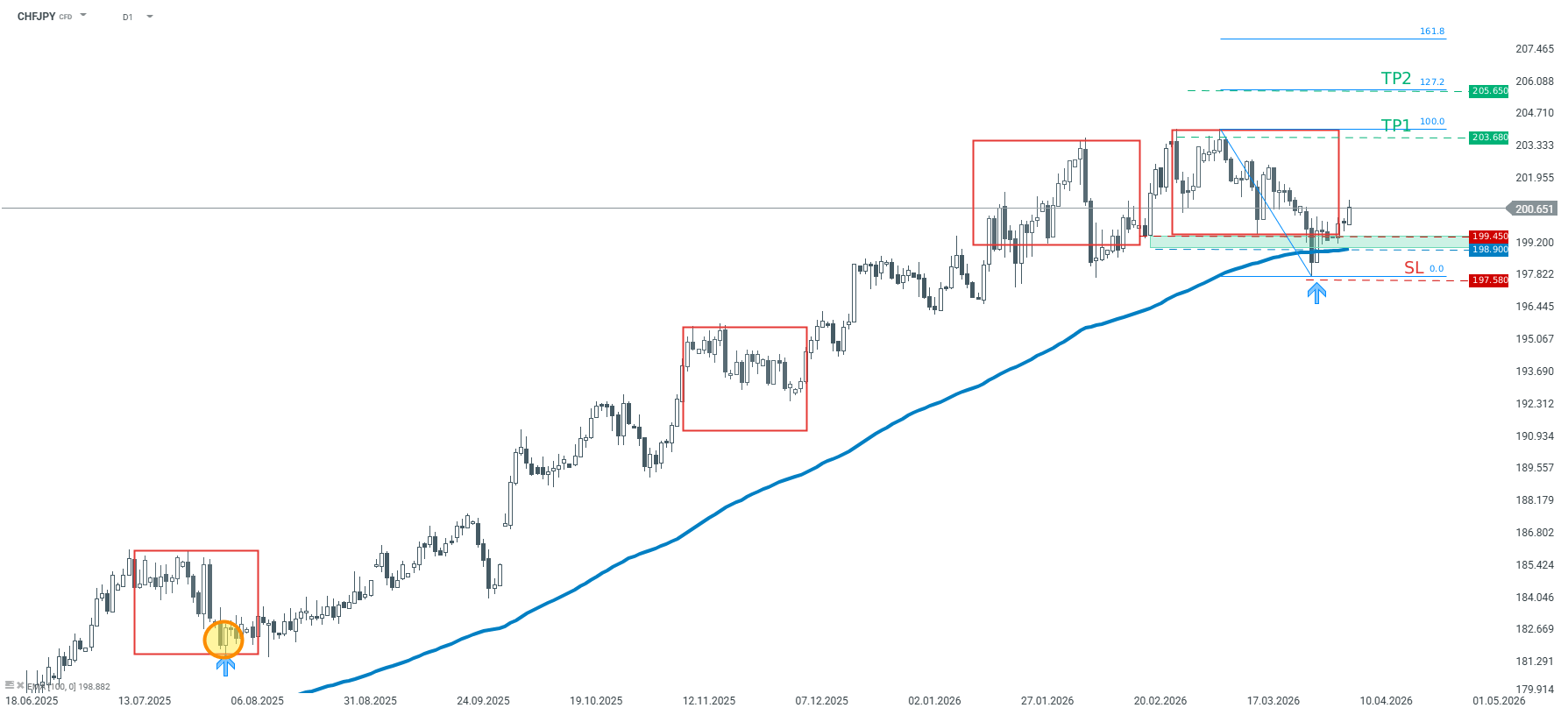
Facts: The pair reached the lower limit of 1:1 structure at 199.45 Main trend on the pair remains upward from March 2025
Recommendation: Trade: Long position on CHFJPY at market price Target: 203.68, 205.65 Stop: 197.58
Opinion: Looking at CHFJPY chart, one can observe that the price bounced off the key technical support today. This support is marked with the lower limit of 1:1 structure (red rectangles) as well as 100-period moving average from D1 interval. Should buyers manage to hold the price above the support at 199.45, another upward impulse may be on the cards. We recommend taking a long position on CHFJPY at market price with two targets: 203.68 and 205.65. We also recommend placing a stop loss order at 197.58 Source: xStation5
To provide the best experiences, we use technologies like cookies to store and/or access device information. Consenting to these technologies will allow us to process data such as browsing behavior or unique IDs on this site. Not consenting or withdrawing consent, may adversely affect certain features and functions.
Functional
Always active
The technical storage or access is strictly necessary for the legitimate purpose of enabling the use of a specific service explicitly requested by the subscriber or user, or for the sole purpose of carrying out the transmission of a communication over an electronic communications network.
Preferences
The technical storage or access is necessary for the legitimate purpose of storing preferences that are not requested by the subscriber or user.
Statistics
The technical storage or access that is used exclusively for statistical purposes.The technical storage or access that is used exclusively for anonymous statistical purposes. Without a subpoena, voluntary compliance on the part of your Internet Service Provider, or additional records from a third party, information stored or retrieved for this purpose alone cannot usually be used to identify you.
Marketing
The technical storage or access is required to create user profiles to send advertising, or to track the user on a website or across several websites for similar marketing purposes.