Australian Dollar outperforms on broader risk rally, hawkish RBA bets

April 17, 2026
  • AUD/USD rises to near 0.7175 as the Australian Dollar outperforms amid the risk-on mood.
  • Market sentiment remains favorable for riskier assets on Iran truce hopes.
  • Traders expected the RBA to hike interest rates further by 55 bps this year.

The Australian Dollar (AUD) outperforms its major currency peers, trading 0.16% higher to near 0.7175 ahead of the opening of United States (US) markets during the European trading session on Friday. The Aussie pair trades firmly as Iran optimism-based broader risk rally has strengthened the antipodean.

Australian Dollar Price Today

The table below shows the percentage change of Australian Dollar (AUD) against listed major currencies today. Australian Dollar was the strongest against the New Zealand Dollar.

USDEURGBPJPYCADAUDNZDCHF
USD-0.15%-0.02%0.00%-0.18%-0.14%0.09%-0.18%
EUR0.15%0.12%0.11%-0.05%0.00%0.22%-0.03%
GBP0.02%-0.12%-0.02%-0.18%-0.13%0.10%-0.15%
JPY0.00%-0.11%0.02%-0.15%-0.12%0.10%-0.14%
CAD0.18%0.05%0.18%0.15%0.04%0.25%0.03%
AUD0.14%-0.00%0.13%0.12%-0.04%0.22%-0.02%
NZD-0.09%-0.22%-0.10%-0.10%-0.25%-0.22%-0.24%
CHF0.18%0.03%0.15%0.14%-0.03%0.02%0.24%

The heat map shows percentage changes of major currencies against each other. The base currency is picked from the left column, while the quote currency is picked from the top row. For example, if you pick the Australian Dollar from the left column and move along the horizontal line to the US Dollar, the percentage change displayed in the box will represent AUD (base)/USD (quote).

During the press time, S&P 500 futures trades 0.2% higher to near 7,060, reflecting a strong demand for riskier assets. The US Dollar Index (DXY), which tracks the Greenback’s value against six major currencies, trades marginally lower to near 98.10. The DXY is all set to close negatively for the second straight week.

A broader risk rally suggests that market participants are confident of the announcement of a permanent ceasefire between the United States (US) and Iran, as President Donald Trump has expressed multiple times that Washington is close to reaching a deal with Tehran.

US President Trump said in a press briefing on Thursday, “We’re very close to a deal with Iran,” while warning that military actions against Tehran would resume if a deal is not closed. Trump also said that Iran is willing to give up its enriched uranium and surrender its nuclear ambitions.

On the domestic front, market participants expect the Reserve Bank of Australia (RBA) to deliver more interest rate hikes this year. In the March policy meeting, the RBA raised its Official Cash Rate (OCR) by 25 basis points (bps) to 4.1%, and warned that inflation was already high in Australia before the war in the Middle East started.

According to a Reuters report, the RBA is expected to raise its OCR further by 55 bps in the remaining year to 4.65%.
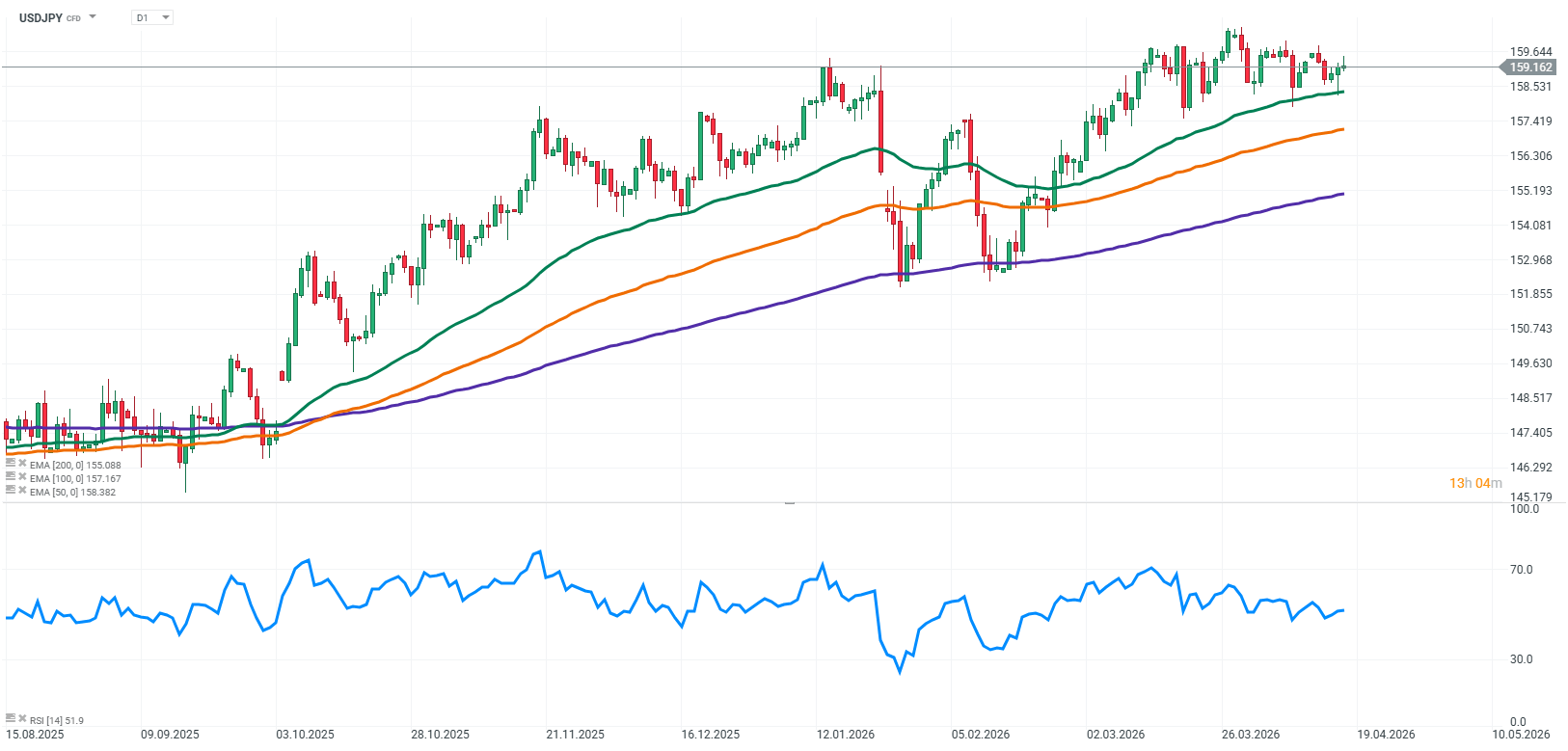
Chart of the Day – USD/JPY

April 17, 2026

USDJPY remains at the center of global currency market attention, with its price action increasingly driven not only by macroeconomic fundamentals but also by rising political risk. As the exchange rate approaches the psychological barrier at 160, the market is beginning to view this level as a potential tolerance threshold for Japanese authorities rather than just another point on the chart. As a result, the discussion around the next directional move is becoming less purely fundamental and increasingly focused on whether and when a response from Japan’s Ministry of Finance could materialize.

Source: xStation5

What Is Driving USDJPY today?

Rising Intervention Risk Around the 160 Area As USDJPY moves closer to the 160 zone, sensitivity to potential currency intervention is clearly increasing. This level is widely seen as a boundary where Japanese authorities may step in, either through direct market operations or via strong verbal warnings. Historical experience suggests that such environments can trigger sharp and asymmetric market reactions, as speculative positions built on yen weakness become vulnerable to rapid unwinding once intervention signals emerge.

Bank of Japan Between Inflation Pressures and Growth Risks

At the same time, the Bank of Japan remains a key piece of the puzzle. On one hand, persistent inflation supports the case for gradual policy normalization. On the other hand, growing concerns about slowing economic momentum and emerging stagflation-like risks continue to weigh on the policy outlook. As a result, the BoJ remains cautious and avoids committing to aggressive tightening, which limits yen strength and sustains uncertainty about the future path of monetary policy.

Interest Rate Differentials as the Core Trend Driver

Despite rising volatility around key levels, the primary structural driver remains the wide interest rate differential between the United States and Japan. This gap continues to support US dollar strength and keeps carry trade strategies attractive. However, market participants are increasingly aware that such an environment can persist for an extended period without being stable, especially as USDJPY approaches levels perceived as potentially sensitive to intervention risk.

The Role of Oil and the Gulf Region for Japan

An often underestimated factor in the broader USDJPY picture is the oil market and Japan’s dependence on energy imports from the Gulf region. As a highly import-dependent economy, Japan is particularly sensitive to fluctuations in oil prices, with higher energy costs directly worsening its terms of trade and adding inflationary pressure domestically. In this context, developments in the Middle East and OPEC production policy can have a meaningful impact not only on Japan’s external balance but also on expectations regarding Bank of Japan policy. Rising oil prices from the Gulf region act as an additional inflationary force for Japan. In such an environment, the FX market increasingly incorporates not only interest rate differentials but also external cost shocks that may influence the pace of monetary policy normalization and the broader outlook for the yen.

Key Takeways: A Market Defined by Boundaries and Event Risk

Overall, USDJPY is in a phase where traditional fundamental drivers still support higher levels, but their influence is increasingly counterbalanced by political risk and the possibility of intervention. As a result, the market is becoming less of a directional trend story and more of a range-bound, event-driven regime where asymmetry of risk and sudden volatility shifts play a dominant role.

EUR/USD Price Forecast – Needs breakout above 1.1825 for a fresh rally

April 17, 2026
  • EUR/USD turns sideways after rallying to near 1.1825, awaiting the resumption of US-Iran talks.
  • US President Trump says that Iran is ready to hand over its uranium enrichment.
  • ECB’s Villeroy pushes back prospects of an interest rate hike in policy announcement on April 30.

The EUR/USD pair trades subduedly near 1.1777 during the Asian trading session on Friday. The major currency pair has turned sideways after a two-week-long rally to near 1.1825 as investors await the announcement of another round of talks between the United States (US) and Iran.

S&P 500 futures are flat in the Asian trade after rising 0.26% to 7,041 on Thursday, reflecting a quiet but broadly upbeat market mood. The US Dollar Index (DXY), which tracks the Greenback’s value against six major currencies, trades marginally higher around 98.25, but looks set for a second weekly loss.

While neither the US nor Iran has announced any timeframe for the second round of talks, President Donald Trump expressed confidence, in a press briefing on Thursday, that Iran is willing to give up its uranium enrichment and surrender its nuclear ambitions. Trump also said, “We’re very close to a deal with Iran,” while warning that military actions against Tehran would resume if a deal is not closed.

On the domestic front, European Central Bank (ECB) policymaker and governor of the Bank of France François Villeroy de Galhau has pushed back hopes of an interest rate hike in the policy meeting later this month. “Focus on April hike is premature,” he said in an interview with CNBC on Thursday.

EUR/USD technical analysis

EUR/USD trades flat at around 1.1777 in the Asian trade. The pair holds a constructive near-term bullish bias as spot remains above the 20-day exponential moving average (EMA) at 1.1673, keeping recent upside progress intact after rebounding from the mid-1.15s. Momentum conditions are supportive, with the 14-day Relative Strength Index hovering around 62, suggesting persistent buying interest without yet signaling extreme overbought conditions.

On the downside, initial support is defined by the 20-day EMA at 1.1673, where a break would weaken the current advance and expose a deeper pullback toward the recent mid-1.15 consolidation area. As long as buyers defend this dynamic floor, the path of least resistance remains higher, leaving the pair biased to probe above the April 16 high of 1.1825 and extend the recovery toward the February high of 1.1929.

USD/CHF stays near 0.7850 amid increased market caution

April 17, 2026
  • USD/CHF steadies as traders remain cautious amid uncertainty surrounding ongoing US–Iran peace deal discussions.
  • SNB March Meeting Minutes flagged rising economic uncertainty, citing the Middle East conflict as a key inflation risk.
  • The US Dollar Index gains support from safe-haven demand after Israel–Lebanon ceasefire violations.

USD/CHF moves little after two days of gains, trading around 0.7830 during the Asian hours on Friday. The pair steadies as traders adopt caution on uncertainty over US–Iran peace deal discussions.

March Meeting Minutes from the Swiss National Bank (SNB) highlighted rising uncertainty surrounding Switzerland’s economic outlook, with global developments, particularly the Middle East conflict, identified as key inflation risks.

Policymakers also noted that, amid elevated geopolitical tensions and safe-haven inflows, the SNB is likely to stay ready to intervene in FX markets to prevent an abrupt and excessive appreciation of the Swiss Franc that could threaten price stability.

The USD/CHF pair may regain its ground as the US Dollar Index (DXY) receives support from increased safe-haven demand following a CNN report that the Lebanese army recorded multiple ceasefire violations by Israel after the truce came into effect. US President Donald Trump announced on Thursday that Israel and Lebanon agreed to a 10-day ceasefire that started at 5 PM ET.

Lebanon accused Israel of carrying out “several acts of aggression,” noting that intermittent shelling has affected several villages in southern Lebanon. The army also urged residents to delay returning to southern towns and villages amid the reported ceasefire breaches.

Moreover, Washington and Tehran are expected to resume discussions over the weekend, with President Trump maintaining an optimistic tone on the chances that both sides could secure a lasting ceasefire before its expiration next week.

NZD/USD remains subdued below 0.5900 as market caution lifts US Dollar

April 17, 2026
  • NZD/USD weakens as the US Dollar rises amid cautious sentiment ahead of weekend US–Iran talks.
  • Washington and Tehran are set to resume talks this weekend, with Trump expressing optimism about progress.
  • New Zealand’s annual food inflation eased to 3.4% in March, lowest since February 2025, after 4.5% previously.

NZD/USD remains subdued for the second successive day, trading around 0.5890 during the Asian hours on Friday. The pair weakens as the US Dollar (USD) edges higher, supported by cautious market sentiment ahead of the upcoming meeting between the United States (US) and Iran scheduled for the weekend.

However, discussions between Washington and Tehran are anticipated to resume over the weekend, with US President Donald Trump adopting an optimistic stance on the likelihood that both nations could secure a permanent ceasefire before its expiration next week.

President Trump said on Thursday that he had held conversations with Lebanese President Joseph Aoun and Israeli Prime Minister Benjamin Netanyahu. He added that Israel and Lebanon have agreed to implement a 10-day ceasefire, which took effect at 5 PM ET.

In New Zealand, annual Food Inflation moderated to 3.4% in March from 4.5% previously, marking the first decline in three months and the lowest reading since February 2025. On a monthly basis, the Food Price Index declined by 0.6%, following a prior 0.1% decrease.

Meanwhile, UOB economist Ho Woei Chen evaluated China’s stronger Q1 2026 Gross Domestic Product (GDP) data and its policy implications. Despite real GDP expanding by 5.0% YoY, the team maintains its 2026 growth projection at 4.7% amid external headwinds and subdued domestic demand. Robust economic activity alongside contained inflation diminishes the likelihood of near-term rate cuts, with only a modest 10-basis-point easing now expected in Q3 2026. Any shifts in China’s economic outlook could influence the New Zealand Dollar (NZD), given the close trade relationship between China and New Zealand.

CAD receives support from higher oil prices

April 17, 2026
  • USD/CAD slips as the commodity-linked Canadian Dollar strengthens amid a modest rise in oil prices.
  • Lebanon’s army recorded multiple Israeli ceasefire violations after the truce took effect.
  • The US Dollar Index gains support from safe-haven demand amid cautious sentiment ahead of weekend US–Iran talks.

USD/CAD remains subdued for the fifth consecutive day, trading around 1.3700 during the Asian hours on Friday. The pair inches lower as the commodity-linked Canadian Dollar (CAD) edges higher amid a slight increase in oil prices, given Canada’s status as the largest crude exporter to the United States (US).

West Texas Intermediate (WTI) Oil price holds gains near $90.00 per barrel at the time of writing. Crude oil prices receive support from supply concerns, which could be attributed to the market caution surrounding the United States (US)-Iran ceasefire talks.

CNN reported on Friday that the Lebanese army said that it recorded multiple ceasefire violations by Israel after the truce went into effect. Lebanon accused Israel of committing “several acts of aggression,” saying intermittent shelling has impacted several villages in southern Lebanon. The army urged citizens to delay returning to southern towns and villages in light of the alleged ceasefire violations.

US President Donald Trump said on Thursday that he had spoken with Lebanese President Joseph Aoun and Israeli Prime Minister Benjamin Netanyahu, adding that Israel and Lebanon agreed to a 10-day ceasefire that began at 5 PM ET.

However, the downside of the USD/CAD pair is restrained as the US Dollar Index (DXY) receives support from increased safe-haven demand amid market caution ahead of the upcoming meeting between the United States (US) and Iran scheduled for the weekend.

Washington and Tehran are expected to resume their discussions over the weekend, with President Trump expressing optimism that both nations could secure a permanent ceasefire before it expires next week.

AUD bulls retain control amid US-Iran diplomacy efforts, hawkish RBA

April 17, 2026
  • AUD/USD stalls the previous day’s modest pullback from the 0.7200 neighborhood.
  • The Israel-Lebanon ceasefire and Iran diplomacy hopes underpin the risk sentiment.
  • The hawkish RBA also supports the Aussie, albeit a modest USD uptick caps gains.

The AUD/USD pair holds steady above mid-0.7100s during the Asian session on Friday and for now, seems to have stalled the previous day’s modest pullback from its highest level since June 2022. Spot prices remain on track to register strong weekly gains amid a supportive fundamental backdrop.

The announcement of a ceasefire between Israel and Lebanon fuels hopes for a US-Iran peace deal and remains supportive of the upbeat market mood. This, along with the Reserve Bank of Australia’s (RBA) hawkish outlook, continues to act as a tailwind for the Aussie. In fact, RBA Deputy Governor Andrew Hauser said earlier this week that the central bank is focused on preventing any lift in medium-term inflation expectations, reaffirming bets for further policy tightening in 2026. The current market pricing suggests a 65% chance of a rate hike in May, which, in turn, is seen as a key factor supporting the AUD/USD pair.

Meanwhile, Finance Ministers from the Group of Seven (G7) emphasized the urgent need to limit the economic repercussions of an ongoing Middle East conflict. Furthermore, the instability in the Strait of Hormuz keeps a lid on the optimism led by potential US-Iran peace talks. This assists the safe-haven US Dollar (USD) in preserving the previous day’s modest recovery gains from its lowest level since late February and might cap the AUD/USD pair. Hence, it will be prudent to wait for some follow-through buying before positioning for the resumption of the pair’s uptrend witnessed over the past three weeks or so.

Any meaningful USD appreciation, however, seems elusive in the wake of diminishing odds for a rate hike by the US Federal Reserve (Fed). Traders might also refrain from placing aggressive directional bets and opt to wait for another round of talks between the US and Iran, possibly this weekend. Nevertheless, the aforementioned supportive fundamental backdrop suggests that the path of least resistance for the AUD/USD pair is to the upside, and any corrective pullback is more likely to be bought into. Traders now look forward to speeches from influential FOMC members, which will drive the USD and provide some impetus.

JPY softens on Middle East uncertainty; official warns of FX intervention

April 17, 2026
  • USD/JPY gains ground to near 159.35 in Friday’s Asian session. 
  • Trump said the next meeting between the US and Iran might take place over the weekend.
  • Japan’s Katayama hinted at the JPY intervention after talks with the US counterpart. 

The USD/JPY pair gathers strength around 159.35 during the Asian trading hours on Friday. The pair extends the rally for the third consecutive day amid uncertainty in the Middle East. However, heightening intervention warnings from Japanese officials might cap the upside for USD/JPY. 

US President Donald Trump said on Thursday that Israel and Lebanon agreed to a 10-day ceasefire. The uncertainty in the Middle East remains high as the Lebanese army stated on Friday that it recorded multiple ceasefire violations by Israel after the truce went into effect at midnight local time on Friday. Rising tensions in the Middle East could boost the US Dollar (USD) against the Japanese Yen (JPY).

Traders will closely monitor a second round of negotiations between the US and Iran that could take place this weekend. Earlier on Thursday, Trump expressed optimism about the possibility that the US and Iran could clinch a permanent ceasefire ahead of its expiration next week. 

Intervention fears from Japanese authorities could underpin the JPY and create a tailwind for the pair. Japan’s Finance Minister Satsuki Katayama said on Thursday that she’s held close discussions on foreign exchange issues with US Treasury Secretary Scott Bessent and that authorities are prepared for “bold” action if needed.

Earlier Friday, Bank of Japan (BoJ) Governor Kazuo Ueda said that a decision on how soon to raise interest rates must take into account the fact that the nation’s real interest rate is low. He added that Japan is facing rising inflation from a “negative supply shock,” which is more difficult to rein in with monetary policy than inflation driven by strong demand.