
Canadian Dollar remains stronger as risk-on mood weighs on US Dollar

April 14, 2026
  • USD/CAD struggles as reports suggest further US–Iran talks to secure a longer-term ceasefire.
  • President Trump said Tehran initiated contact, while Iranian President Masoud Pezeshkian signaled willingness for lawful dialogue.
  • Canadian Prime Minister Mark Carney secured a parliamentary majority for his Liberal government on Monday.

USD/CAD remains subdued for the second consecutive day, trading around 1.3790 during the Asian hours on Tuesday. The pair weakens as the US Dollar (USD) struggles amid eased risk aversion following reports that the United States (US) and Iran may hold further talks to secure a longer-term ceasefire before the current two-week truce ends.

US President Donald Trump said that Iran had made contact and is now looking to resume negotiations. Vice President JD Vance also indicated ongoing diplomatic efforts and a possible path toward US-Iran conflict de-escalation. Vance stated that recent discussions over the weekend were constructive, providing US officials with deeper insight into Iran’s negotiating stance.

The Greenback weakens as markets scale back hawkish Federal Reserve (Fed) bets, with easing inflation risks tied to a potential long-term US–Iran ceasefire and a possible reopening of the Strait of Hormuz, which has pressured oil prices.

Meanwhile, Fed Governor Stephen Miran said the Iran-related energy shock has not yet affected long-term inflation expectations, adding he expects price pressures to return to the central bank’s target within a year.

The downside of the USD/CAD pair could be restrained as the commodity-linked Canadian Dollar (CAD) could face challenges amid lower oil prices, given the fact that Canada is the largest crude exporter to the United States. Crude oil prices fall as supply concerns ease after reports of US-Iran further talks.

In Canada, CBC News reported that Prime Minister Mark Carney secured a parliamentary majority for his Liberal government on Monday, strengthening his ability to advance legislation aimed at navigating a more divided geopolitical landscape. The victory gives Carney’s Liberals 172 seats in the 343-seat House of Commons.
EUR/CAD caps near 1.6200 as Euro struggles due to risk-off mood

April 13, 2026
  • EUR/CAD stays silent as risk aversion rises following the failure of US–Iran peace talks.
  • Nordea analysts say resolving the US–Iran conflict wouldn’t remove the need for ECB tightening.
  • CAD may gain as oil prices rise amid renewed fears of a Strait of Hormuz blockade.

EUR/CAD holds position after paring its intraday losses, trading around 1.6200 during the Asian hours on Monday. However, the currency cross still remains in the negative territory as the Euro (EUR) struggles amid increased risk aversion after the failure of the United States (US)-Iran peace talks.

US Vice President JD Vance confirmed the US–Iran talks in Islamabad ended without a deal following 21 hours of negotiations. President Donald Trump confirmed on Truth Social that the blockade of ships entering and exiting Iranian ports will begin today, April 13, at 10:00 AM ET (14:00 GMT).

Eurozone annual inflation rose to 2.5% in March, the highest since January 2025, exceeding the European Central Bank’s (ECB) 2% target amid rising energy prices. ECB President Christine Lagarde emphasized that policy will remain restrictive until inflation sustainably returns to target.

Nordea’s Jan von Gerich and Tuuli Koivu, in their pre-ceasefire ECB outlook, projected four 25-basis-point rate hikes starting in June. They emphasize that broader price pressures persist and that even a resolution to the conflict would not eliminate the need for ECB tightening.

The EUR/CAD cross also struggles as the commodity-linked Canadian Dollar (CAD) may receive support from the rising oil prices, given Canada’s status as the largest crude exporter to the United States (US).

West Texas Intermediate (WTI) oil price trades over 7% higher near $96.90 per barrel at the time of writing. Crude oil prices rise as US–Iran tensions re-escalate and fears grow over a potential Strait of Hormuz blockade.

CAD pares losses vs USD as rallying oil prices counter hawkish Fed bets

April 13, 2026
  • USD/CAD struggles to build on its modest gains amid a combination of factors.
  • The door for further diplomacy remains open, capping the USD and the major.
  • Rallying Oil prices underpin the Loonie and act as a headwind for spot prices.

The USD/CAD pair retreats a few pips from the Asian session high and currently trades around the 1.3860-1.3855 region, up around 0.15% for the day. Meanwhile, the mixed fundamental backdrop warrants caution before positioning for an extension of a modest recovery from sub-1.3800 levels, or over a two-week low set on Friday.

The US Dollar (USD) struggles to capitalize on the weekly bullish gap opening amid reports that regional countries are racing to bring the US and Iran back to the negotiating table within days. This keeps the door open for further diplomacy and caps the safe-haven Greenback. Moreover, an intraday rally in Crude Oil prices underpins the commodity-linked Loonie and contributes to capping the USD/CAD pair.

West Texas Intermediate (WTI) – the benchmark US Crude Oil price – rallies back to the $105/barrel mark in reaction to failed US-Iran peace talks over the weekend. In fact, US Vice President JD Vance said that he placed a final and best offer on the table, but Iran declined to accept the terms, leading to a stalemate. Meanwhile, Iranian state media said that excessive demands sank the possibility of an agreement.

Furthermore, US President Donald Trump said that the US Navy would start blockading the Strait of Hormuz, jeopardizing a fragile two-week ceasefire. Adding to this, continued Israeli strikes in Lebanon raise the risk of a renewed escalation of tensions in the Middle East and support oil prices. However, hawkish US Federal Reserve (Fed) bets should limit deeper losses for the buck and the USD/CAD pair.

Data released on Friday showed that inflation in the US surged by the most in nearly four years during March. Apart from this, the war-driven surge in elevated energy prices led investors to abandon bets on Fed rate cuts and shift focus to potential interest rate hikes this year. The outlook triggers a fresh leg up in US Treasury bond yields, which favors the USD bulls and acts as a tailwind for the USD/CAD pair.

CAD declines as oil prices ease, US Dollar gains

April 10, 2026
  • USD/CAD rises as the commodity-linked Canadian Dollar weakens amid falling oil prices.
  • WTI drops over 11.5% this week after the US–Iran agreed to a two-week ceasefire, easing supply concerns.
  • US official confirms Lebanon–Israel talks will be held next week in Washington, DC.

USD/CAD gains ground after four days of losses, trading around 1.3820 during the Asian hours on Friday. The pair appreciates as the commodity-linked Canadian Dollar (CAD) struggles amid lower oil prices, given Canada’s status as the largest crude exporter to the United States (US).

West Texas Intermediate (WTI) oil price holds losses after experiencing volatility, trading around $91.80 per barrel at the time of writing. The WTI price is down by over 11.5% for the week, at the time of writing, after the US and Iran agreed to a two-week ceasefire.

However, crude oil prices may regain ground as Israeli strikes on Lebanon and the ongoing closure of the Strait of Hormuz strain diplomatic efforts. Israeli Prime Minister Benjamin Netanyahu said that there is “no ceasefire in Lebanon” and Israel would continue “to strike Hezbollah with full force” as the country’s military launched fresh strikes.

Reuters reported that a US State Department official confirmed that talks between Lebanon and Israel will take place next week in Washington, DC. “We can confirm that the Department will host a meeting next week to discuss ongoing ceasefire negotiations with Israel and Lebanon,” said a US official.

US Federal Reserve’s (Fed) March Meeting Minutes suggest the central bank remains in a wait-and-see stance, while acknowledging that inflationary risks linked to higher oil prices are becoming more balanced. Traders await the US Consumer Price Inflation (CPI) report due later in the North American session.

Currency Talk – EUR/CAD NZD/USD, USD/JPY

April 9, 2026

The Overbalance analysis aims to identify three financial instruments, analyzed primarily on the daily/four-hour (D1/H4) timeframe. The analysis uses only the Overbalance methodology, which helps determine where a trend may continue or where it may reverse.
Today’s analysis covers three instruments, evaluated solely in terms of 1:1 correction structures.

EURCAD
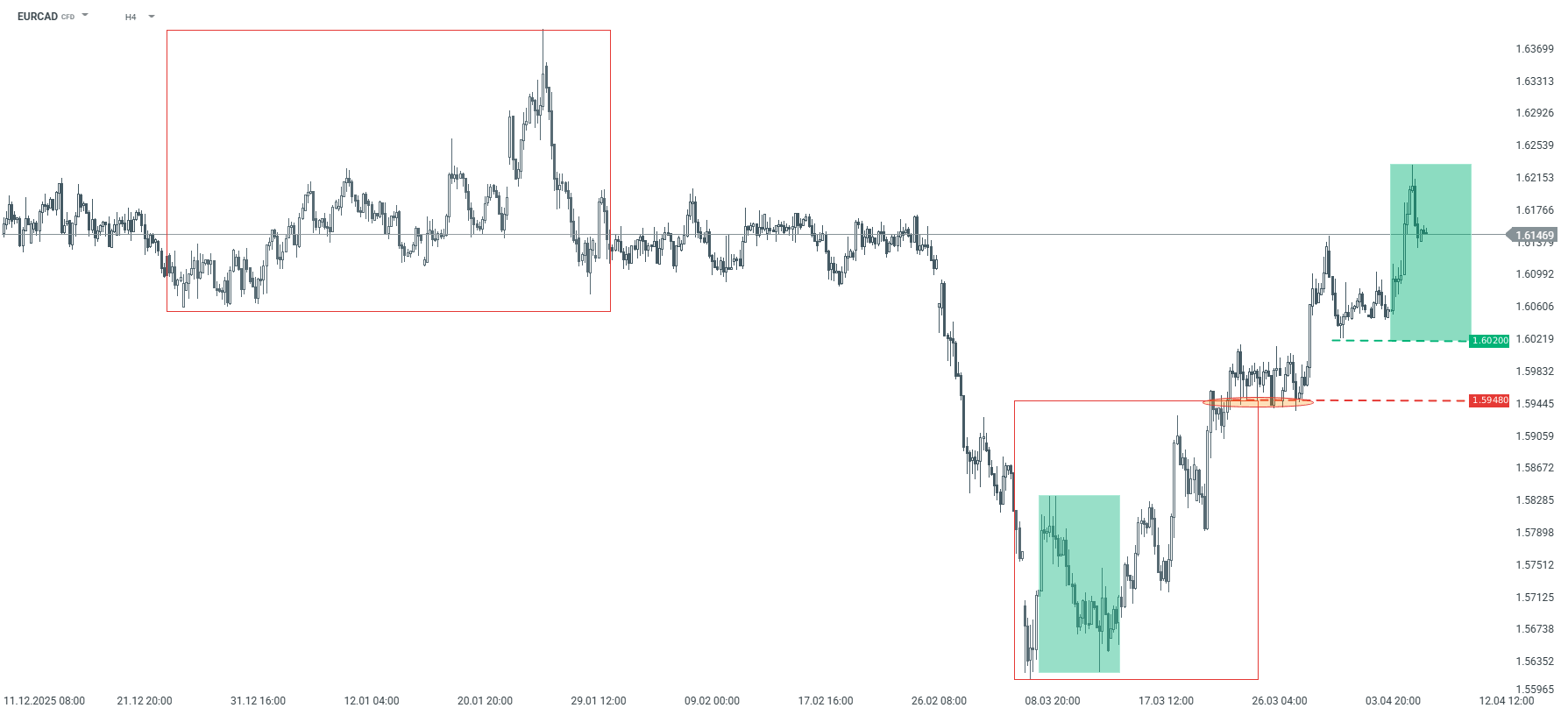
At the end of March, EURCAD prices broke out of a major 1:1 downtrend pattern at the 1.5948 level, paving the way for further gains. We are currently seeing a continuation of the uptrend, and counting from the March 9 low, we can identify a local 1:1 uptrend pattern. In the event of a correction, the key short-term support remains at the 1.6020 level, where the lower boundary of this pattern is located. Conversely, only a return of the price below 1.5948 could suggest a shift to a downtrend. For now, sentiment remains bullish.

EURCAD – H4 timeframe. Source: xStation

NZDUSD
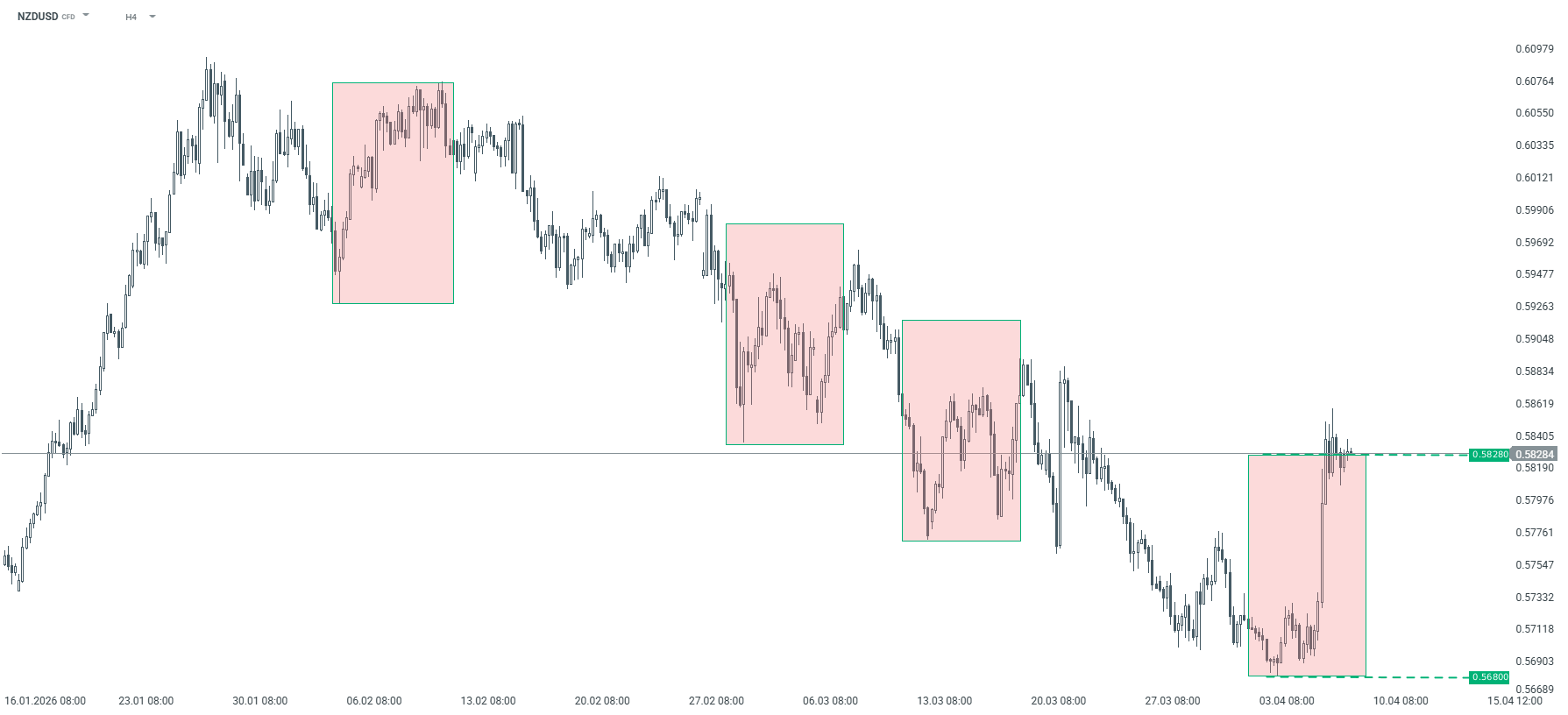
Since February of this year, NZDUSD has been trending downward, with the market repeatedly forming corrections of similar magnitude. We are currently observing a test of the key resistance level resulting from the 1:1 Fibonacci retracement at 0.5828. A sustained break below this level could lead to a shift in sentiment toward an uptrend. On the other hand, defending this level and keeping the price within the downtrend could result in a return to declines and a test of recent lows at 0.5680. The current zone is of critical importance in the short term.

NZDUSD – H4 chart. Source: xStation

USDJPY
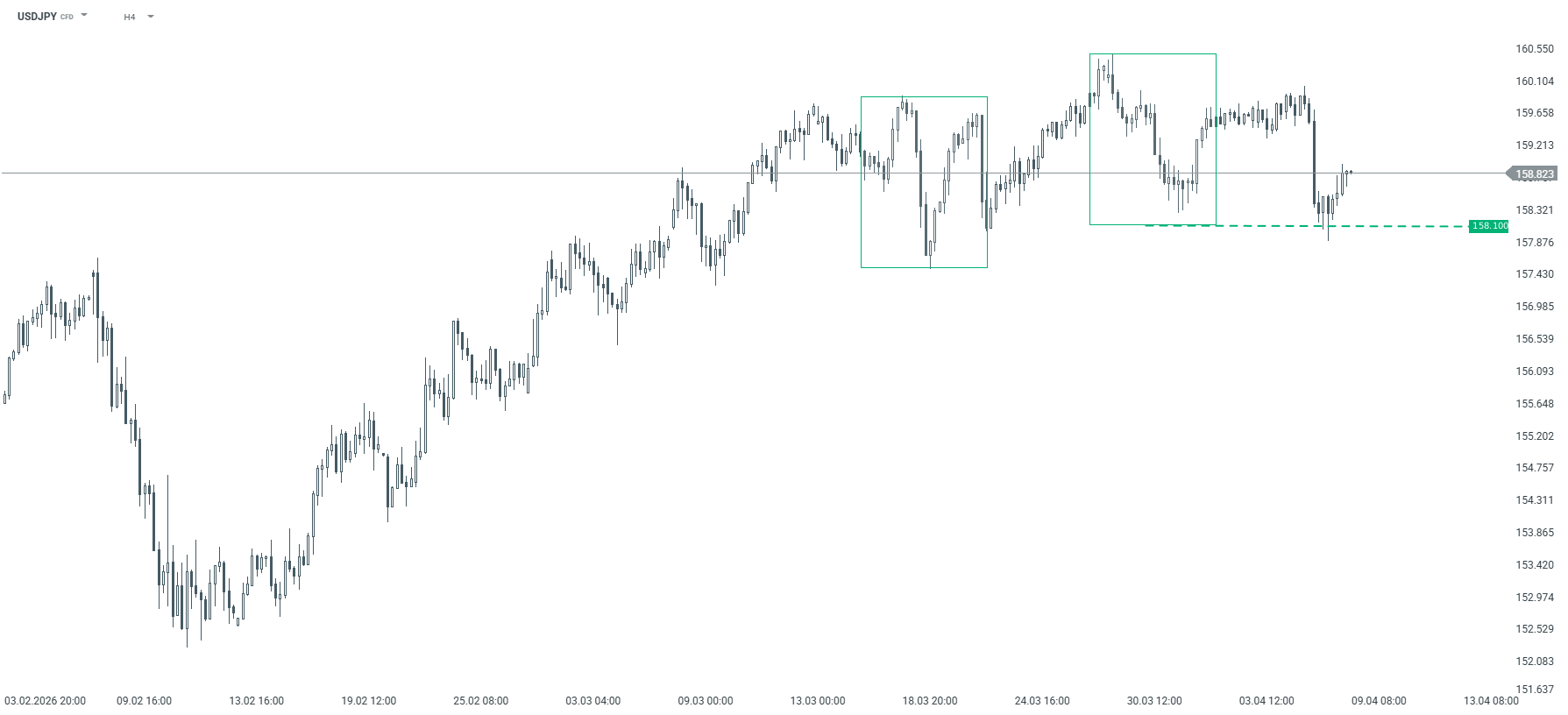
Since mid-February, USDJPY has been in a strong uptrend. Recently, one of the larger corrections occurred, covering a range of approximately 240 pips. The current correction has the same range as the previous one, marked in green, which allows us to identify key support at the 158.10 level, based on a 1:1 ratio. If this level holds, there is a chance for the uptrend to resume and for new highs to be tested. Conversely, a break below this level could lead to a trend reversal and a deepening of the decline.

USDJPY – H4 chart. Source: xStation

The material on this page does not constitute financial advice and does not take into account your level of understanding, investment objectives, financial situation or any other specific needs. All information provided, including opinions, market research, mathematical results and technical analyzes published on the Website or transmitted To you by other means, it is provided for information purposes only and should in no way be construed as an offer or solicitation for a transaction in any financial instrument, nor should the information provided be construed as advice of a legal or financial nature on which any investment decisions you make should be based exclusively To your level of understanding, investment objectives, financial situation, or other specific needs, any decision to act on the information published on the Website or sent to you by other means is entirely at your own risk if you In doubt or unsure about your understanding of a particular product, instrument, service or transaction, you should seek professional or legal advice before trading. Investing in CFDs carries a high level of risk, as they are leveraged products and have small movements Often the market can result in much larger movements in the value of your investment, and this can work against you or in your favor. Please ensure you fully understand the risks involved, taking into account investments objectives and level of experience, before trading and, if necessary, seek independent advice.

CAD slips as USD safe-haven bid offsets oil rebound

April 9, 2026
  • USD/CAD rises as the US Dollar gains ground on safe-haven demand amid fading US-Iran ceasefire optimism.
  • Fed March Meeting Minutes show a wait-and-see stance, while acknowledging risks are becoming more balanced.
  • The commodity-linked CAD may gain as oil rebounds after the tanker traffic halt in the Strait of Hormuz.

USD/CAD gains ground after three days of losses, trading around 1.3860 during the Asian hours on Thursday. The pair appreciates as the US Dollar (USD) receives support from renewed safe-haven demand amid uncertainty surrounding the ceasefire agreement between the United States (US) and Iran.

The Minutes from the Federal Reserve’s (Fed) March meeting, released on Wednesday, suggest the central bank remains in a wait-and-see stance, while acknowledging that risks are becoming more balanced. Policymakers broadly supported holding rates steady, with nearly all participants backing no change, and many viewing policy as already near a neutral range, implying a high bar for further tightening.

However, the upside of the USD/CAD pair could be restrained as the commodity-linked Canadian Dollar (CAD) may find support from a rebound in oil prices. West Texas Intermediate (WTI) is trading around $91.50 at the time of writing. Crude oil prices rise after Iranian media reported a halt in tanker traffic through the Strait of Hormuz following fresh Israeli strikes in Lebanon.

Iranian officials said recent developments breach the terms of the less-than-day-old ceasefire, calling it “unreasonable” to continue talks for a permanent deal with the United States. Iranian Parliament Speaker Mohammad Bagher Ghalibaf said the US breached three key clauses of Iran’s 10-point proposal, calling further talks “unreasonable.” Meanwhile, US Vice President JD Vance signaled that the strait could begin reopening as he leads a US delegation to Islamabad for direct talks with Iran this weekend.

USD/CAD edges lower as shifting US-Iran headlines keep markets cautious

April 6, 2026
  • USD/CAD softens as the US Dollar weakens, allowing the Canadian Dollar to snap a two-day losing streak.
  • Shifting geopolitical headlines around the US-Iran war keep sentiment fragile, limiting downside in the US Dollar.
  • Focus also on upcoming US inflation data and Canada employment figures later this week.

The Canadian Dollar (CAD) gains traction against the US Dollar (USD) on Monday as traders react to evolving geopolitical developments in the US-Iran war. At the time of writing, USD/CAD is trading around 1.1315, hovering near four-month highs.

Risk appetite improved earlier in the Asian session following reports of a potential 45-day ceasefire between the US and Iran, which is weighing modestly on the Greenback. However, the US Dollar pared some of its losses as conflicting headlines kept uncertainty elevated and limited expectations of a near-term resolution.

The US Dollar Index (DXY), which tracks the Greenback against a basket of six major currencies, is trading around 99.98 after rebounding from an intraday low near 99.76.

Iran has called for a permanent end to the war in response to the US proposal, according to IRNA, while also rejecting a ceasefire framework conveyed via Pakistan. Meanwhile, a US official cited by Axios said Iran submitted a 10-point response to the proposal, describing it as “maximalist” and noting that it remains unclear whether it would allow progress toward a diplomatic solution.

This suggests the conflict could escalate further, with a deal appearing unlikely ahead of the deadline set by US President Donald Trump, who has warned of potential strikes on power plants and other civilian infrastructure if the Strait of Hormuz is not reopened by Tuesday, 8:00 p.m. Eastern Time.

Beyond immediate geopolitical risks, the broader economic fallout from the war is also coming into focus. Rising Oil prices are adding to inflation pressure while raising concerns about global economic growth, a combination that is complicating the outlook for both the Federal Reserve (Fed) and the Bank of Canada (BoC).

On the data front, the ISM Services Purchasing Managers Index (PMI) for March came in at 54, down from 56.1 in February and below expectations of 55.

Looking ahead this week, market attention will turn to inflation data in the US, including the Consumer Price Index (CPI) for March and the Personal Consumption Expenditures (PCE) Price Index for February. In Canada, the March employment data will also be in focus.

US Dollar Price Today

The table below shows the percentage change of US Dollar (USD) against listed major currencies today. US Dollar was the strongest against the Japanese Yen.

USDEURGBPJPYCADAUDNZDCHF
USD-0.22%-0.26%0.02%-0.23%-0.31%-0.43%-0.24%
EUR0.22%-0.02%0.22%-0.01%-0.11%-0.23%-0.04%
GBP0.26%0.02%0.23%-0.01%-0.09%-0.25%-0.01%
JPY-0.02%-0.22%-0.23%-0.23%-0.34%-0.47%-0.28%
CAD0.23%0.01%0.01%0.23%-0.08%-0.21%-0.02%
AUD0.31%0.11%0.09%0.34%0.08%-0.14%0.07%
NZD0.43%0.23%0.25%0.47%0.21%0.14%0.22%
CHF0.24%0.04%0.00%0.28%0.02%-0.07%-0.22%

The heat map shows percentage changes of major currencies against each other. The base currency is picked from the left column, while the quote currency is picked from the top row. For example, if you pick the US Dollar from the left column and move along the horizontal line to the Japanese Yen, the percentage change displayed in the box will represent USD (base)/JPY (quote).

CAD remains depressed against a firmer USD; bullish Oil prices limit losses

April 6, 2026
  • USD/CAD trades with a positive bias for the third straight day, though it lacks bullish conviction.
  • Rising geopolitical tensions and Fed rate hike bets continue to support the USD and spot prices.
  • Elevated Crude Oil prices underpin the Loonie and hold back bulls from placing aggressive bets.

The USD/CAD pair attracts some buyers for the third consecutive day on Monday and trades just below mid-1.3900s during the Asian session, well within striking distance of a nearly four-month high set last week amid a firmer US Dollar (USD). The uptick, however, lacks bullish conviction as elevated Crude Oil prices could underpin the commodity-linked Loonie and cap gains for spot prices.

US President Donald Trump threatened to target Iran’s power plants and bridges if the Strait of Hormuz is not reopened by Tuesday, while Iran introduced new conditions for reopening the strategic waterway. This raises the risk of a further escalation of the ongoing conflict in the Middle East and continues to underpin the USD’s status as the global reserve currency. Adding to this, rising bets for an interest rate hike by the US Federal Reserve (Fed) turn out to be another factor supporting the USD and acting as a tailwind for the USD/CAD pair.

The closely-watched US Nonfarm Payrolls (NFP) report showed on Friday that the US economy added 178K new jobs in March, reversing the previous month’s revised net loss of 133K. Adding to this, the Unemployment Rate unexpectedly fell to 4.3% last month. This comes on top of inflation fears stemming from the war-driven surge in Crude Oil prices and removes any near-term pressure on the Fed to cut rates, which remains supportive of elevated US Treasury bond yields. The outlook, in turn, continues to support the USD and the USD/CAD pair.

Meanwhile, supply disruption worries lift Crude Oil prices to a nearly four-week top. This might hold back traders from placing aggressive bearish bets around the Canadian Dollar (CAD) and warrants some caution before positioning for any further move higher for the USD/CAD pair. Hence, it will be prudent to wait for a sustained strength and acceptance above the 1.3900 mark, or the year-to-date high, before positioning for an extension of a nearly one-month-old uptrend from the 1.3525 region, or the March monthly swing low.