

EUR/JPY Remains above 183.50 to test nine-day EMA barrier

April 1, 2026
  • EUR/JPY tests the immediate resistance at the nine-day EMA of 183.70.
  • The Relative Strength Index hovers near the 50 mid-line, indicating balanced momentum.
  • The initial support appears at the 50-day EMA at 183.36.

EUR/JPY extends its gains for the second consecutive day, trading around 183.60 during the Asian hours on Wednesday. The technical analysis of the daily chart suggests the currency cross moves sideways within the ascending triangle pattern, reflecting buying pressure.

The near-term bias is mildly bullish as the EUR/PY cross holds above the 50-day Exponential Moving Average (EMA), continuing to offer a rising trend base. The nine-day EMA remains above the 50-day EMA, keeping a short-term positive alignment despite the recent consolidation under the 184.00 area.

Momentum is balanced, with the Relative Strength Index (RSI) hovering close to the 50 mid-line after recovering from last week’s dip, which points to stabilizing demand rather than aggressive buying pressure.

The EUR/JPY cross is testing the immediate barrier at the nine-day EMA of 183.70, followed by the upper ascending triangle boundary around 184.60. Further advances above the triangle would reinforce the bullish bias and lead the currency cross to explore the region around the all-time high of 186.88, reached on January 23.

On the downside, the primary support lies at the 50-day EMA at 183.36, followed by the lower boundary of the ascending triangle around 182.70. A break below the channel would expose the three-month low of 180.81, recorded on February 12.

EUR/JPY: Daily Chart

(The technical analysis of this story was written with the help of an AI tool.)

Euro Price Today

The table below shows the percentage change of Euro (EUR) against listed major currencies today. Euro was the strongest against the New Zealand Dollar.

USDEURGBPJPYCADAUDNZDCHF
USD-0.09%-0.09%0.10%-0.03%-0.05%0.17%-0.21%
EUR0.09%-0.01%0.18%0.06%0.05%0.28%-0.11%
GBP0.09%0.00%0.19%0.06%0.06%0.29%-0.09%
JPY-0.10%-0.18%-0.19%-0.11%-0.10%0.09%-0.25%
CAD0.03%-0.06%-0.06%0.11%0.00%0.20%-0.18%
AUD0.05%-0.05%-0.06%0.10%-0.01%0.22%-0.15%
NZD-0.17%-0.28%-0.29%-0.09%-0.20%-0.22%-0.37%
CHF0.21%0.11%0.09%0.25%0.18%0.15%0.37%

The heat map shows percentage changes of major currencies against each other. The base currency is picked from the left column, while the quote currency is picked from the top row. For example, if you pick the Euro from the left column and move along the horizontal line to the US Dollar, the percentage change displayed in the box will represent EUR (base)/USD (quote).

USD/JPY Price – Bulls struggle below 160.00 amid intervention fears, softer USD

March 31, 2026
  • USD/JPY faces rejection ahead of the 160.00 psychological mark amid a modest USD downtick.
  • Intervention fears further benefit the JPY and contribute to capping the upside for spot prices.
  • The technical setup favors a bullish outlook amid reduced BoJ rate hike bets and geopolitical uncertainties.

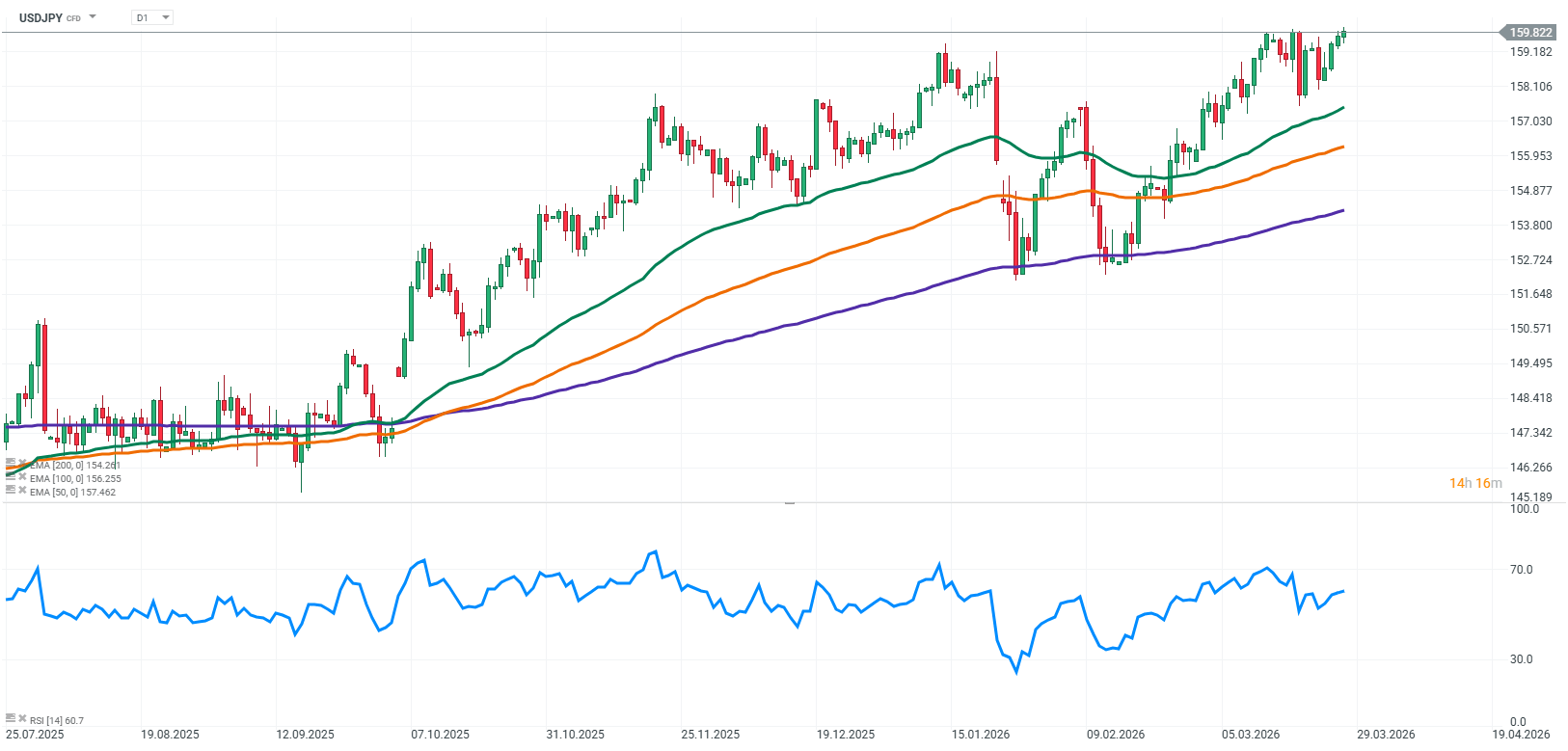
The USD/JPY pair attracts fresh sellers following a modest Asian session uptick to the 160.00 neighborhood on Tuesday, though it manages to hold above the previous day’s swing low. Spot prices currently trade around the 159.70-159.75 region, unchanged for the day, as traders seem reluctant amid mixed fundamental cues.

Against the backdrop of economic concerns stemming from the Iran war, softer Tokyo consumer inflation figures temper bets for an immediate policy tightening by the Bank of Japan (BoJ). This, in turn, undermines the Japanese Yen (JPY) and supports the USD/JPY pair. However, hopes for a de-escalation of tensions in the Middle East weigh on the US Dollar (USD) and cap spot prices amid JPY intervention fears.

From a technical perspective, the near-term tone stays mildly bullish as the USD/JPY pair holds well above the rising 200-day Exponential Moving Average (EMA), keeping the broader uptrend intact despite the recent hesitation above the 160.00 psychological mark. Furthermore, the lack of follow-through selling favors bulls and suggests that the path of least resistance for spot prices remains to the upside.

Meanwhile, the Moving Average Convergence Divergence (MACD) indicator has flattened around the zero line after losing upside traction, suggesting fading bullish momentum rather than a clear reversal. Adding to this, the Relative Strength Index (RSI) near 59 remains in positive territory without overbought signals, which validates the positive outlook and supports a bias for dip-buying while momentum consolidates.

The aforementioned structure favors renewed tests of 160.30, the recent swing high, followed by a higher barrier at 161.00, where a breakout would reopen the path toward fresh cycle highs. On the downside, immediate support aligns at 159.00, with a deeper floor at 158.40 that guarded prior pullbacks. A daily close below the latter would expose 157.70 as the next downside level for the USD/JPY pair.

(The technical analysis of this story was written with the help of an AI tool.)

USD/JPY daily chart

Chart Analysis USD/JPY

USD/JPY retreats from intervention red line as Japan warns on Yen weakness

March 30, 2026
  • USD/JPY retreats after briefly surpassing 160.00, a level widely seen as a red line for Japanese authorities
  • Japanese officials step up warnings over JPY weakness and do not rule out decisive action.
  • Middle East geopolitical tensions and Powell’s cautious tone help limit the US Dollar’s downside.

USD/JPY retreats on Monday and trades around 159.60 at the time of writing, down 0.44% on the day, after reaching a nearly 20-month high above 160.00 earlier in the day. The move lower follows renewed warnings from Japanese authorities about potential intervention in the foreign exchange market.

The main catalyst behind the Japanese Yen’s (JPY) rebound came from comments by Japan’s top currency diplomat, Atsushi Mimura, who pointed to increasing speculative activity in currency markets. He warned that Tokyo could take “decisive steps” if these trends persist, reviving concerns about direct intervention to support the Japanese currency.

These remarks come as some policymakers also raise the possibility of a rate hike by the Bank of Japan (BoJ) to curb the inflationary effects of JPY weakness and rising energy prices. According to analysts at MUFG, recent signals suggest that Japanese authorities could respond through both monetary tightening and foreign exchange intervention if pressure on the currency continues.

However, the downside in the US Dollar (USD) remains limited as risk aversion persists amid escalating geopolitical tensions in the Middle East. The involvement of Iran-backed Houthi militias and threats to disrupt key maritime routes for Oil transport have increased market uncertainty and helped sustain demand for safe-haven assets.

In this context, US President Donald Trump said that Washington is holding discussions with what he described as a “new regime” in Iran in an effort to end military operations. At the same time, he warned that the United States (US) could target Iranian energy infrastructure if no agreement is reached quickly or if the Strait of Hormuz remains closed to commercial traffic.

On the monetary policy front, Federal Reserve (Fed) Chair Jerome Powell said earlier that the current policy stance is in a “good place” and that the Fed will wait for more data before adjusting interest rates. The Fed chair also stressed that supply shocks, particularly those linked to energy prices and geopolitical tensions, must be monitored to prevent inflation expectations from becoming unanchored.

Investors will also keep a close eye on upcoming Japanese data releases, including the Tokyo Consumer Price Index (CPI), Industrial Production and Retail Sales figures, which could offer further clues about the country’s economic outlook and the future policy path of the Bank of Japan.

US Dollar Price Today

The table below shows the percentage change of US Dollar (USD) against listed major currencies today. US Dollar was the strongest against the New Zealand Dollar.

USDEURGBPJPYCADAUDNZDCHF
USD0.57%0.65%-0.43%0.22%0.43%0.67%0.21%
EUR-0.57%0.07%-0.95%-0.34%-0.10%0.13%-0.37%
GBP-0.65%-0.07%-1.05%-0.39%-0.18%0.07%-0.43%
JPY0.43%0.95%1.05%0.66%0.87%1.12%0.63%
CAD-0.22%0.34%0.39%-0.66%0.20%0.41%-0.05%
AUD-0.43%0.10%0.18%-0.87%-0.20%0.26%-0.23%
NZD-0.67%-0.13%-0.07%-1.12%-0.41%-0.26%-0.50%
CHF-0.21%0.37%0.43%-0.63%0.05%0.23%0.50%

The heat map shows percentage changes of major currencies against each other. The base currency is picked from the left column, while the quote currency is picked from the top row. For example, if you pick the US Dollar from the left column and move along the horizontal line to the Japanese Yen, the percentage change displayed in the box will represent USD (base)/JPY (quote).

Chart of The Day – USD/JPY

March 27, 2026

USDJPY remains under strong pressure, trading in the 159.50–159.80 range, close to the psychological barrier of 160.00. Current price movements are driven by a combination of dollar strength, concerns over potential Japanese government intervention, and macroeconomic and geopolitical factors.

Source: xStation5

What shapes USDJPY movements?

Dollar strength and global tensions
USDJPY is supported by the overall strength of the US dollar. Investors view the dollar as a safe-haven amid rising geopolitical tensions in the Middle East and uncertainty in commodity markets. Strong demand for the USD limits the potential for yen appreciation, especially in an environment of global unrest and increased risk aversion.

Risk of intervention by Japanese authorities
Japanese authorities have increasingly signaled their readiness to intervene if USDJPY exceeds the 160.00 level. The purpose of potential intervention is to protect Japanese exports and stabilize the economy. A strong dollar raises import costs and may increase inflationary pressure in Japan. Interventions serve as a tool for authorities to manage excessive currency fluctuations that could negatively impact the trade balance and financial market stability.

Monetary policy
The Bank of Japan continues its ultra-loose policy, maintaining low interest rates over the long term. At the same time, US rates remain elevated, widening the yield differential between the USD and JPY and supporting further dollar strength against the yen. This divergence in monetary policy makes the dollar more attractive to investors in the short and medium term, maintaining upward pressure on USDJPY.

Energy prices and Japan’s trade balance
Japan is heavily reliant on imported oil and gas. Rising energy prices increase import costs, weaken the trade balance, and limit growth potential. Higher commodity prices also add to inflationary pressure, increasing the risk of currency instability. In this context, a strong dollar combined with high commodity prices can further weaken the yen, keeping USD/JPY near record levels.

Conclusion

USDJPY remains sensitive to a combination of dollar strength, intervention signals from Japanese authorities, and external factors such as energy prices and geopolitical tensions. Strong dollar momentum and potential actions by the Japanese government limit the scope for stable gains above 160.00.

The material on this page does not constitute financial advice and does not take into account your level of understanding, investment objectives, financial situation or any other specific needs. All information provided, including opinions, market research, mathematical results and technical analyzes published on the Website or transmitted To you by other means, it is provided for information purposes only and should in no way be construed as an offer or solicitation for a transaction in any financial instrument, nor should the information provided be construed as advice of a legal or financial nature on which any investment decisions you make should be based exclusively To your level of understanding, investment objectives, financial situation, or other specific needs, any decision to act on the information published on the Website or sent to you by other means is entirely at your own risk if you In doubt or unsure about your understanding of a particular product, instrument, service or transaction, you should seek professional or legal advice before trading. Investing in CFDs carries a high level of risk, as they are leveraged products and have small movements Often the market can result in much larger movements in the value of your investment, and this can work against you or in your favor. Please ensure you fully understand the risks involved, taking into account investments objectives and level of experience, before trading and, if necessary, seek independent advice.

Japanese Yen hangs near YTD low vs. USD amid Middle East tensions, intervention fears

March 26, 2026
  • USD/JPY bulls pause for a breather amid fears of JPY intervention, though the downside appears limited.
  • War-driven economic concerns continue to undermine the JPY and lend support to the currency pair.
  • Inflation fears and hawkish Fed bets underpin the USD, further acting as a tailwind for the spot prices.

The USD/JPY pair consolidates around mid-159.00s during the Asian session on Thursday and remains within striking distance of its highest level since July 2024, touched earlier this month.

The Japanese Yen (JPY) continues with its relative underperformance amid concerns that the war-driven surge in energy prices would weigh on Japan’s trade balance and economic outlook. Furthermore, a sustained increase in Oil prices would drive up inflation and create a classic stagflationary environment, complicating the Bank of Japan’s (BoJ) normalization efforts. This, along with the underlying US Dollar (USD) bullish sentiment, acts as a tailwind for the USD/JPY pair.

Iran’s foreign minister said on Wednesday that Tehran is reviewing a US proposal to end the war but has no intention of holding talks to wind down the widening Middle East conflict. Furthermore, the deployment of additional US troops in the region points to the risk of a further escalation of the conflict and overshadows US President Donald Trump’s ceasefire rhetoric. Apart from this, hawkish US Federal Reserve (Fed) expectations benefit the USD and support the USD/JPY pair.

In fact, traders have nearly priced out the possibility of any further rate cuts by the Fed and are rapidly increasing bets for a hike by the end of this year. The hawkish outlook, along with persistent geopolitical uncertainties, continues to underpin the USD’s global reserve currency status and suggests that the path of least resistance for the USD/JPY pair is to the upside. However, intervention fears hold back the JPY bears from placing fresh bets and cap the upside for spot prices.

GBP/JPY holds above 213.00, eyes monthly high amid bearish JPY sentiment

March 26, 2026
  • GBP/JPY bulls move to the sidelines as intervention fears offer some support to the JPY.
  • Economic concerns stemming from the Iran war might cap any meaningful JPY move up.
  • The BoE’s hawkish outlook underpins the GBP and backs the case for some upside for the pair.

The GBP/JPY cross holds steady above the 213.00 mark during the Asian session on Thursday and remains close to a one-month peak, retested earlier this week. Moreover, the fundamental backdrop seems tilted in favor of bullish traders and suggests that the path of least resistance for spot prices is to the upside.

Investors remain worried that the war-driven surge in energy prices would weigh on Japan’s economic outlook and drive up inflationary pressures. This increases the risk of a “stagflationary” environment and might complicate the Bank of Japan’s (BoJ) normalization efforts. The outlook, in turn, has been a key factor behind the Japanese Yen’s (JPY) recent underperformance and continues to act as a tailwind for the GBP/JPY cross.

Meanwhile, BoJ Governor Kazuo Ueda said on Tuesday that he expects underlying inflation to accelerate moderately and added that he will guide monetary policy appropriately to stably achieve the inflation target, accompanied by wage gains. The JPY fails to gain any respite from Ueda’s hawkish comments amid economic concerns stemming from the Middle East conflict, though bears seem hesitant on the back of rising intervention fears.

In fact, Japan’s Vice Finance Minister for International Affairs and top foreign exchange official, Atsushi Mimura, said earlier this week that the government might consider taking measures on all fronts in foreign exchange (FX) volatility. Apart from this, the lack of any meaningful buying interest around the British Pound (GBP), amid a bullish US Dollar (USD), contributes to keeping a lid on any meaningful upside for the GBP/JPY cross.

That said, the UK Consumer Price Index (CPI) released on Wednesday reaffirmed the Bank of England’s (BoE) hawkish tilt and could act as a tailwind for the GBP. In fact, the BoE signaled last week a potential interest rate hike as early as April amid inflation fears. This, along with the underlying bearish sentiment surrounding the JPY, validates the near-term positive outlook and backs the case for an extension of over a one-month-old uptrend.

Japanese Yen Price This Month

The table below shows the percentage change of Japanese Yen (JPY) against listed major currencies this month. Japanese Yen was the strongest against the New Zealand Dollar.

USDEURGBPJPYCADAUDNZDCHF
USD2.00%0.94%2.09%1.02%2.29%3.09%2.29%
EUR-2.00%-1.04%0.07%-0.94%0.28%1.05%0.29%
GBP-0.94%1.04%1.15%0.09%1.34%2.12%1.33%
JPY-2.09%-0.07%-1.15%-1.05%0.19%0.97%0.19%
CAD-1.02%0.94%-0.09%1.05%1.25%2.04%1.25%
AUD-2.29%-0.28%-1.34%-0.19%-1.25%0.79%0.00%
NZD-3.09%-1.05%-2.12%-0.97%-2.04%-0.79%-0.78%
CHF-2.29%-0.29%-1.33%-0.19%-1.25%-0.01%0.78%

The heat map shows percentage changes of major currencies against each other. The base currency is picked from the left column, while the quote currency is picked from the top row. For example, if you pick the Japanese Yen from the left column and move along the horizontal line to the US Dollar, the percentage change displayed in the box will represent JPY (base)/USD (quote).

USD/JPY climbs as US Dollar strength outweighs hawkish BoJ, geopolitical risks

March 25, 2026
  • USD/JPY edges higher, supported by the resilience of the US Dollar amid geopolitical tensions.
  • The Japanese Yen remains under pressure despite a hawkish tone from the Bank of Japan.
  • Markets stay focused on Middle East tensions and their impact on energy prices and safe-haven flows.

USD/JPY trades around 159.00 on Wednesday at the time of writing, up 0.18% on the day. The pair continues to draw support from sustained demand for the US Dollar (USD) in an environment marked by persistent geopolitical uncertainty.

The Japanese Yen (JPY) struggles to attract buyers despite the release of the Bank of Japan (BoJ) meeting minutes, which indicate that policymakers see room for further rate hikes if the economic outlook evolves as expected. This relatively hawkish stance is offset by concerns over the impact of rising energy prices on Japan’s economy, which is heavily reliant on imports. The surge in Oil prices, driven by the Middle East war, is worsening Japan’s terms of trade and adding further pressure on the currency.

At the same time, the US Dollar remains firm, supported by its safe-haven status. Investors remain cautious as they monitor developments in discussions between Washington and Tehran, with ceasefire proposals circulating but no confirmed breakthrough. Recent military developments in the region continue to fuel risk aversion and reinforce flows into the Greenback.

On the monetary policy front, comments from Federal Reserve (Fed) officials, including Michael Barr, suggest that interest rates may need to remain steady for some time due to inflation still running above target. This outlook helps maintain yield differentials in favor of the US Dollar against the Japanese Yen.

Analysts at BNY also highlight that Japanese activity data show signs of improvement, with a rebound in industrial production and exports. However, these positive signals have not been sufficient to support the JPY, as markets remain focused on yield spreads and global risk dynamics.

Meanwhile, Societe Generale economists note that the pair is testing the upper bound of its multi-year range, with the risk of a bullish breakout if levels near 160 are cleared. They point to the potential for a move toward the highs seen in 2024, as the US Dollar continues to hold the upper hand.

Finally, OCBC Bank emphasizes the key role of energy prices in the JPY’s current weakness, while warning that Japanese authorities could intervene in the foreign exchange market if USD/JPY moves sustainably above the 160 threshold. This could limit further upside in the short term, without necessarily altering the broader bullish trend.

US Dollar Price Today

The table below shows the percentage change of US Dollar (USD) against listed major currencies today. US Dollar was the strongest against the Australian Dollar.

USDEURGBPJPYCADAUDNZDCHF
USD0.21%0.17%0.19%0.14%0.50%0.32%0.34%
EUR-0.21%-0.04%0.02%-0.08%0.29%0.10%0.12%
GBP-0.17%0.04%0.04%-0.02%0.33%0.14%0.17%
JPY-0.19%-0.02%-0.04%-0.06%0.30%0.10%0.13%
CAD-0.14%0.08%0.02%0.06%0.37%0.19%0.20%
AUD-0.50%-0.29%-0.33%-0.30%-0.37%-0.18%-0.17%
NZD-0.32%-0.10%-0.14%-0.10%-0.19%0.18%0.01%
CHF-0.34%-0.12%-0.17%-0.13%-0.20%0.17%-0.01%

The heat map shows percentage changes of major currencies against each other. The base currency is picked from the left column, while the quote currency is picked from the top row. For example, if you pick the US Dollar from the left column and move along the horizontal line to the Japanese Yen, the percentage change displayed in the box will represent USD (base)/JPY (quote).