USD/JPY retreats slightly from a two-week high as receding Fed hike bets undermine the USD.
Expectations of further BoJ tightening support the JPY and contribute to capping spot prices.
The technical setup warrants caution for bulls, though the US-Japan rate gap offers support.
The USD/JPY pair trades with a mild negative bias below mid-159.00s during the Asian session on Friday, though it remains close to a nearly two-week high touched the previous day.
Signs of cooling US inflation temper expectations for an immediate rate hike by the Federal Reserve (Fed), which keeps the US Dollar (USD) depressed. The Japanese Yen (JPY), on the other hand, draws some support from bets for further policy tightening by the Bank of Japan (BoJ), which contributes to capping the upside for the USD/JPY pair.
That said, borrowing costs in Japan remain significantly lower compared to other major economies, including the USD, which keeps the so-called JPY carry trade active. Furthermore, persistent geopolitical uncertainties should help limit deeper losses for the safe-haven Greenback and support the USD/JPY pair, warranting caution for bears.
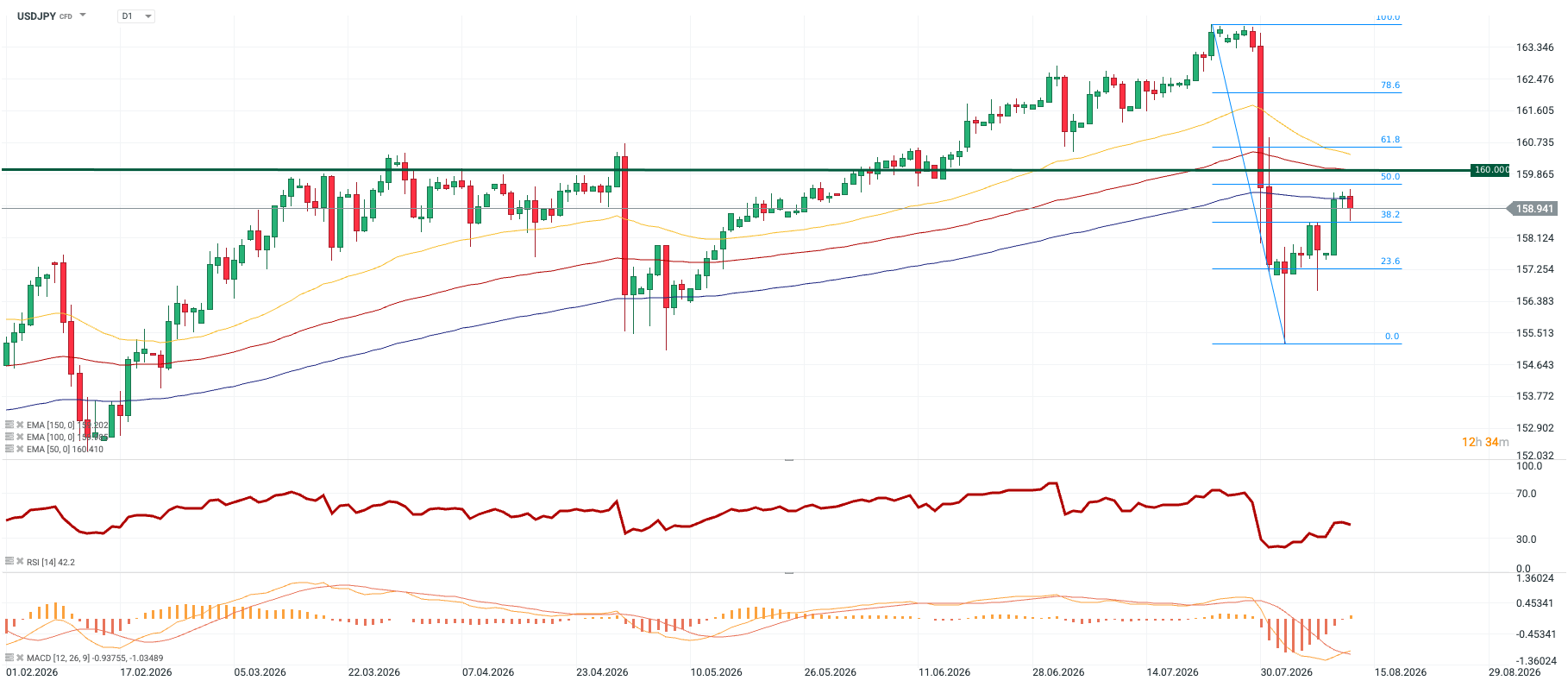
From a technical perspective, the recent strong recovery from the 155.25-155.20 area, or the lowest since early May, stalls near the 50% Fibonacci retracement level of the intervention-led slump from a four-decade peak. Meanwhile, momentum indicators hint at waning upside momentum as the USD/JPY pair consolidates under dense resistance.
The Relative Strength Index (RSI) around 56 is mildly positive, while the Moving Average Convergence Divergence (MACD) has slipped slightly below zero with a soft negative histogram. Hence, any subsequent move beyond the 50% retracement level at 159.61 might confront a hurdle near the 100-period Exponential Moving Average (EMA) at 159.85.
A move beyond these levels should pave the way for further gains to the 61.8% retracement at 160.65 and the higher Fibonacci resistances at 162.12 and 164.00. On the downside, initial support is seen at the 38.2% retracement at 158.58, ahead of the 23.6% retracement near 157.30, while a deeper slide would expose the structural floor around 155.23.
EUR/JPY finds immediate support at its nine-day EMA of 183.49.
The 14-day Relative Strength Index at 47.11 signals neutral-to-soft momentum.
The Primary resistance sits at the 50-day EMA at 184.51.
EUR/JPY extends its losses for the third successive day, trading around 183.60 during the Asian hours on Thursday. The 14-day Relative Strength Index (RSI) at 47.11 reinforces a neutral-to-soft momentum backdrop rather than a decisive directional push.
The EUR/JPY cross is retaining a mildly bearish near-term bias as it holds below the 50-day Exponential Moving Average (EMA) while trading just above the nine-day EMA. This split in moving averages suggests the currency cross is capped by medium-term trend resistance despite nearby short-term support.
The EUR/JPY cross faces immediate support at its nine-day Exponential Moving Average of 183.49. A decisive break below this short-term indicator would strengthen the prevailing bearish bias, potentially pressing the currency cross down toward its eight-month low of 179.37, recorded on August 3. If downward momentum continues, the next key technical target lies at the nine-month low of 175.70.
A turn to the upside would see EUR/JPY cross head toward primary resistance at its 50-day EMA near 184.51. Clearing this medium-term hurdle could signal a broader bullish resurgence, opening the path for the pair to retest the area surrounding its all-time peak of 187.95 set on April 17.
Analysts at Scotiabank note that, while “there have been no comments from FinMin Katayama or ViceMin Mimuri,” local media coverage is increasingly “highlighting the potential for tension between US officials and Japan’s government as the US pushes for BoJ tightening.”
The British Pound gains slightly against the Japanese Yen due to stronger-than-expected UK Q2 GDP data.
UK GDP growth remained steady at 0.6% in the second quarter this year.
Investors seek fresh cues regarding more US-Japan intervention to support the Yen.
The British Pound (GBP) attracts slight bids against the Japanese Yen (JPY) during the European trading session on Wednesday, following the release of the preliminary United Kingdom (UK) Q2 Gross Domestic Product (GDP) data.
The Office for National Statistics (ONS) has reported that the economy expanded at a steady pace of 0.6%, faster than estimates of 0.4%. On an annualized basis, the GDP growth also remained higher at 1.2% than the 1.1% estimates and the previous reading of 0.9%. In June, GDP growth was 0.3%, while it was expected to remain flat again.
Meanwhile, monthly Manufacturing and Industrial Production data also remained stronger than expectations. Manufacturing Production rose by 0.5%, while it was expected to decline by 0.2%. Industrial Production grew 0.2%, faster than 0.1% estimates.
Going forward, the British currency will be influenced by market expectations for the Bank of England’s (BoE) monetary policy outlook.
On the Tokyo front, the Japanese Yen trades broadly sideways as investors seek fresh cues from Japan’s Ministry of Finance (MoF) on whether there will be more United States (US)-Japan joint intervention to support the currency.
The US-Japan jointly intervened on the last day of July to counter “excessive volatility and disorderly movements in the Japanese yen in recent months”, Japan MoF reported.
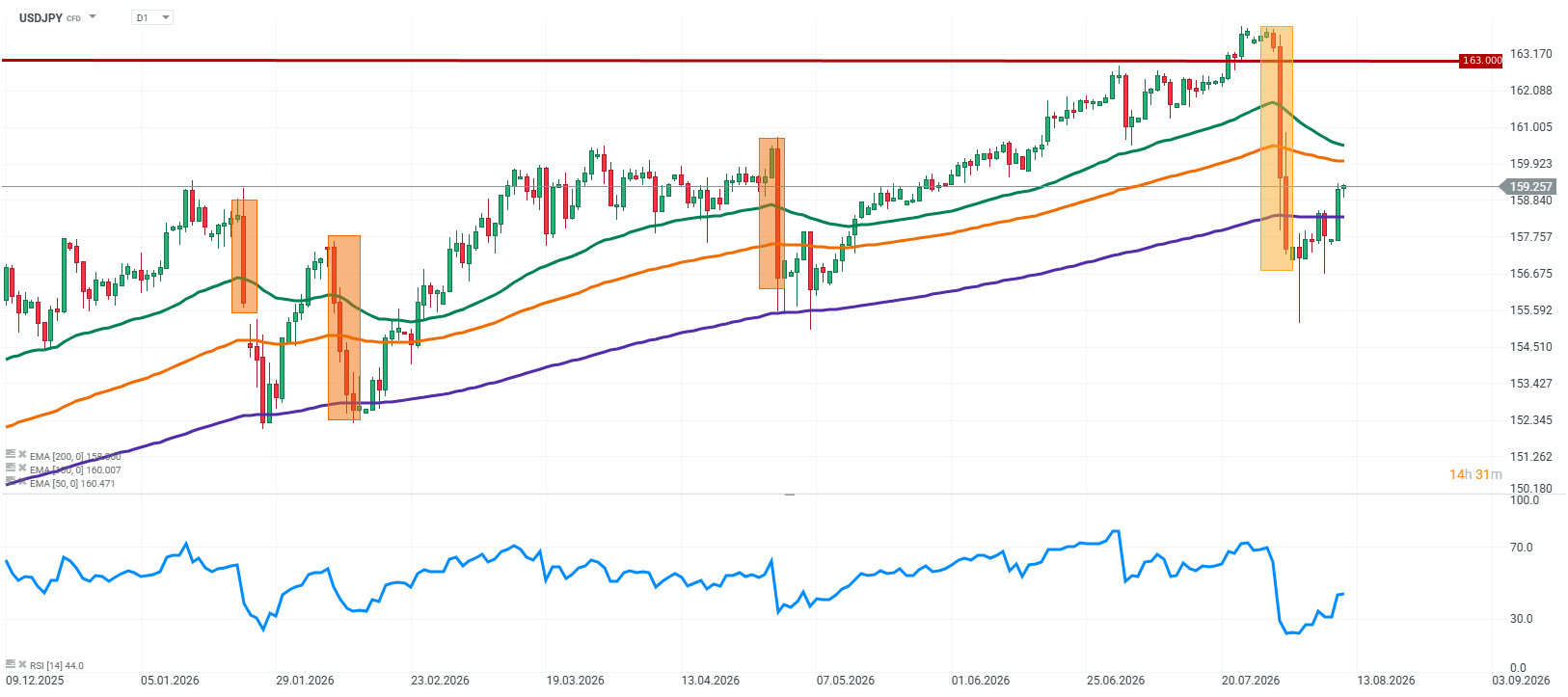
The Japanese Yen (JPY) continues to navigate complex market dynamics, consolidating near the 159.25 level against the US Dollar (USD) following a sharp upward push. While technical momentum keeps short-term upside risks alive for the currency pair, the fundamental backdrop has been reshaped by rare, coordinated foreign exchange intervention between Japanese authorities and the United States. As valuation gaps narrow from extreme lows, market participants are weighing technical range boundaries against the structural impact of joint official action.
USD/JPY daily chart
Institutional Analysis: UOB vs. DBS Group Research
To compare how leading institutions view the outlook for the Yen, we highlight the core takeaways from UOB and DBS Group Research:
Near-Term Technical Picture: UOB expects USD/JPY to consolidate in an intraday range of 158.95 to 159.60, with deeply overbought conditions limiting immediate upside beyond 159.60.
Multi-Week Trading Band: UOB maintains an upside-tilted bias over a 1–3 week horizon within a broader 157.00 to 160.20 range, noting that medium-term strength remains intact as long as spot holds above its 21-day EMA.
Official Sector Action: DBS Group Research highlights the significance of Japan’s second FX market intervention of the year, emphasizing that rare joint participation by the US adds massive credibility and reduces volatility risks in the US Treasury market.
Regional Currency Impact: DBS Group Research notes that limiting JPY weakness helps alleviate unwanted selling pressure on other undervalued Asian currencies, specifically the South Korean Won (KRW) and Chinese Renminbi (RMB).
Technical overbought conditions anchor USD/JPY in elevated range
According to Quek Ser Leang and Lee Sue Ann at UOB, Monday’s sharp USD rally has transitioned into a quiet consolidation phase near 159.25. While short-term technical indicators reflect strong underlying momentum, deeply overbought conditions make a decisive breakout above major resistance unlikely in the immediate term. Over a wider multi-week period, the pair is expected to remain contained within higher boundaries, anchored by key moving average support.
“While the bias for USD is tilted to the upside, any advance is likely part of a higher range of 157.00/160.20.”
Coordinated US-Japan intervention narrows Yen undervaluation and stabilizes regional FX
Taking a broader policy perspective, Chang Wei Liang at DBS Group Research stresses that the Yen’s historical undervaluation has begun to narrow following joint FX intervention by US and Japanese authorities. The involvement of the US Treasury — a rare occurrence last witnessed 15 years ago in 2011 — greatly enhances the credibility of official actions while mitigating the need for massive unilateral Treasury sales by Japan. Furthermore, by stemming excessive Yen weakness, policymakers are effectively insulating broader Asian FX markets from spillover depreciation.
“Co-ordinated FX intervention between the US and Japan is rare, with the last joint intervention occurring 15 years ago to weaken an excessively over-valued JPY in the aftermath of the 2011 Tohoku earthquake… Indeed, both the KRW and RMB are quite undervalued according to our DEER model, and so interventions to limit JPY weakness also help alleviate unwanted selling pressure on regional currencies.”
Banks expect elevated range-trading backed by strong intervention credibility
Based on the assessments from both institutions, the banks project an environment where USD/JPY remains technically supported at high levels but subject to firm official capping. UOB anticipates that short-term price action will remain bound between 157.00 and 160.20, with overbought momentum limiting aggressive gains past 159.60. Concurrently, DBS Group Research maintains that the unprecedented backdrop of joint US-Japan intervention provides a credible structural floor for the Yen, helping to stabilize both the domestic currency and broader regional Asian FX over the coming weeks.
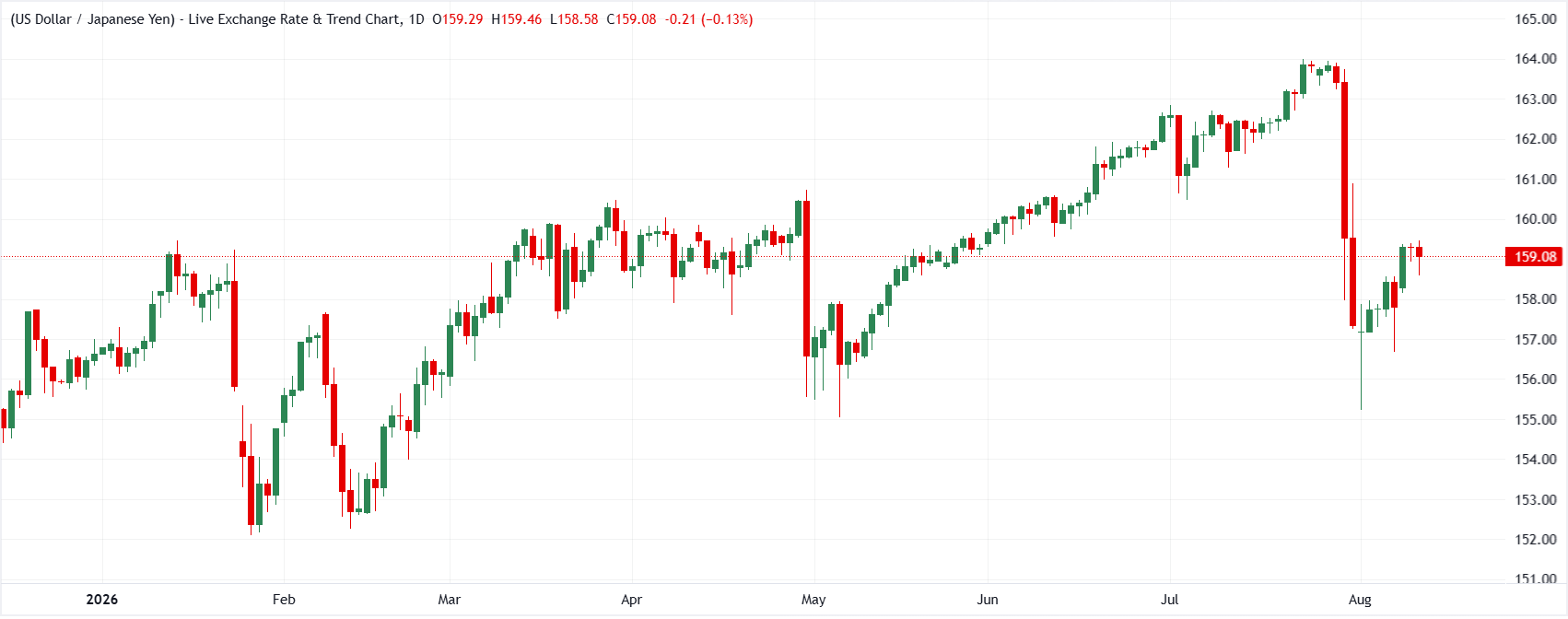
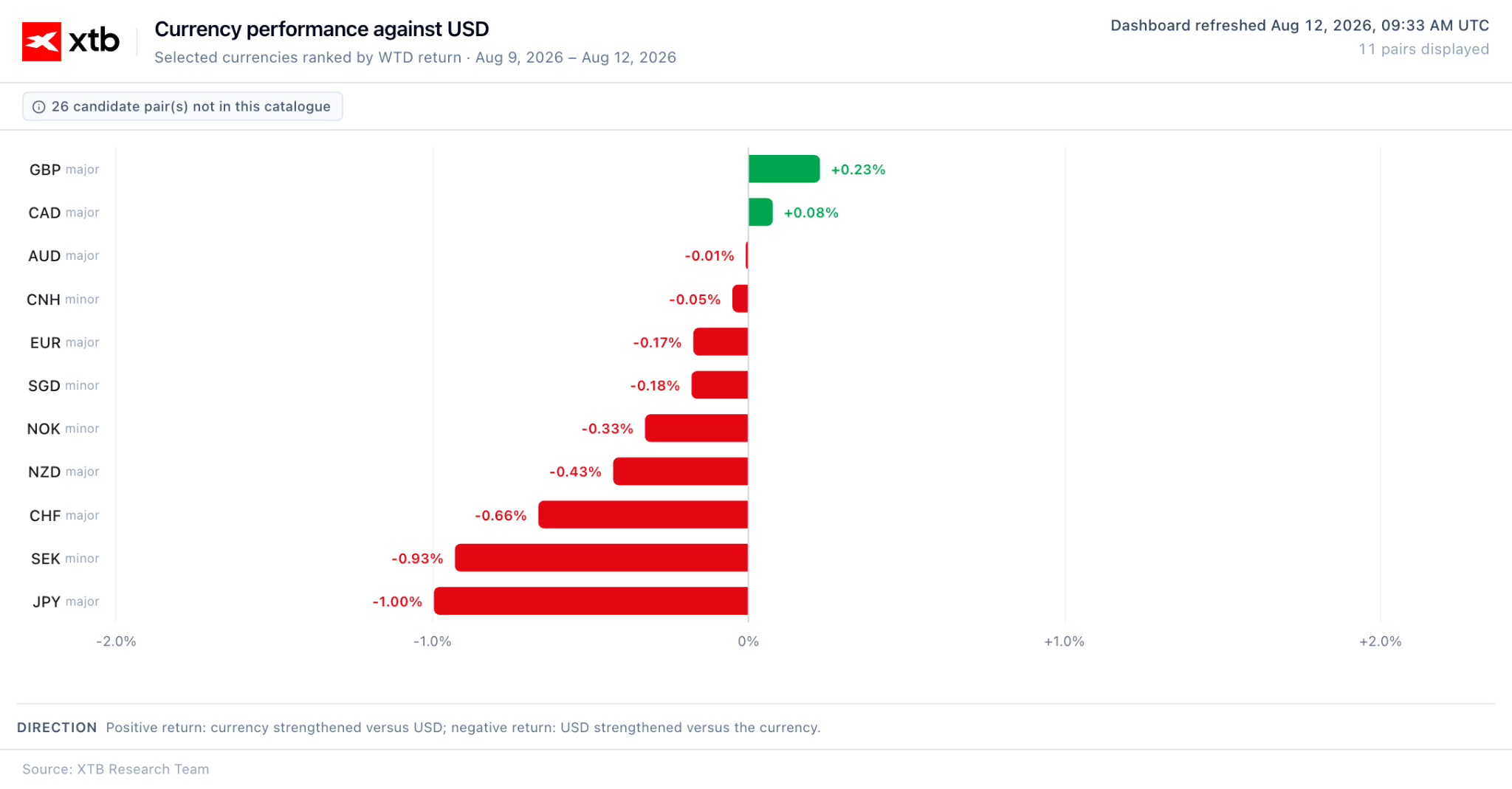
The Japanese currency has weakened by 1% against the dollar this week. It has been two weeks since the record intervention by the Japanese Ministry of Finance and the US Department of the Treasury. Following a decline to near 155, the USDJPY pair is beginning to recover, approaching the psychological barrier at 160. Figure 1: USDJPY (01.02.2026 – 12.08.2026)
Source: xStation, 12.08.2026
What stands behind the decline?
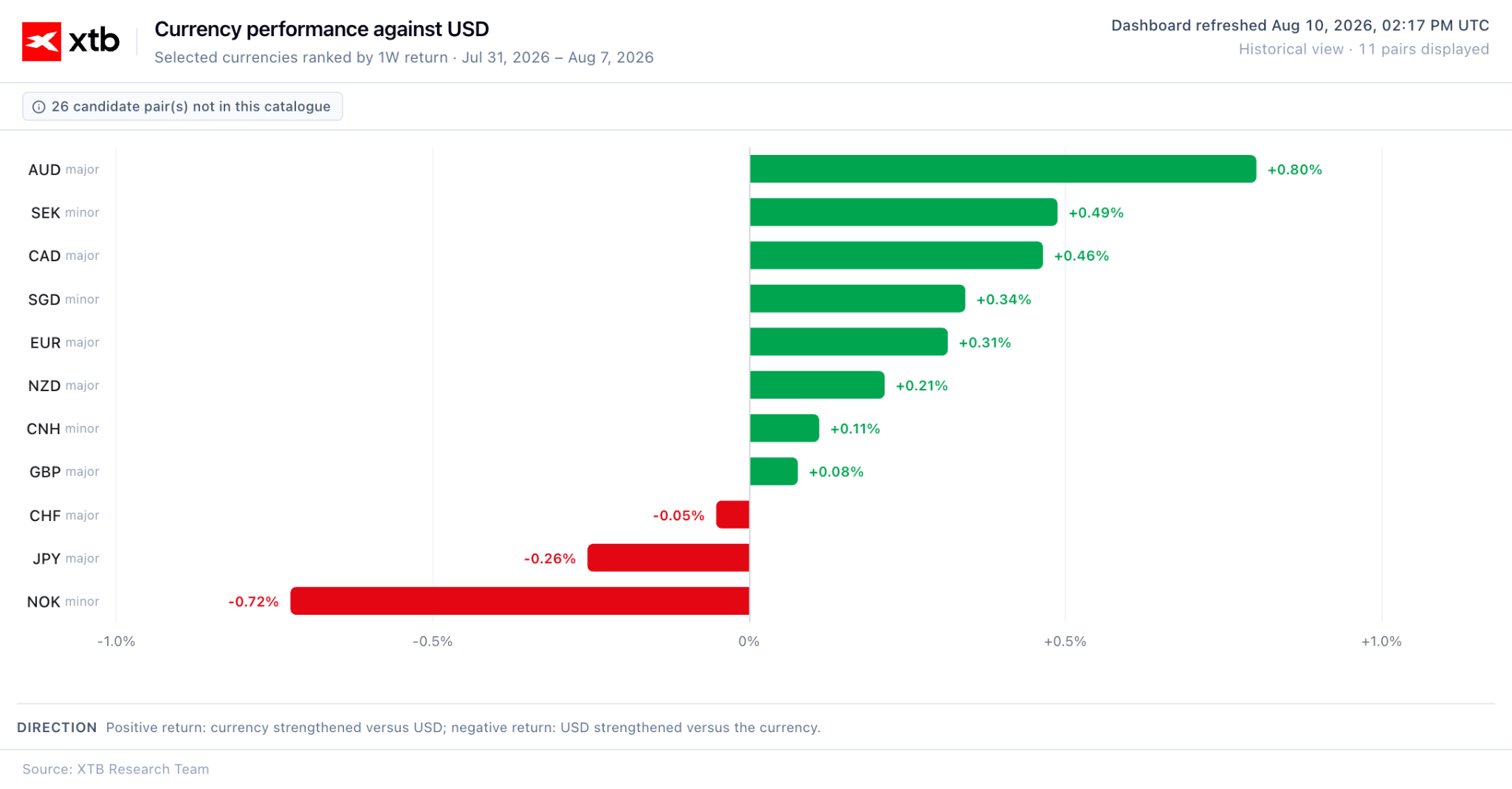
Fundamentals continue to put pressure on the Japanese currency. The key remains, of course, the carry trade issue, i.e., trading on interest rate differentials. Figure 2: Performance of Selected Currencies against the USD (09.08.2026 – 12.08.2026)
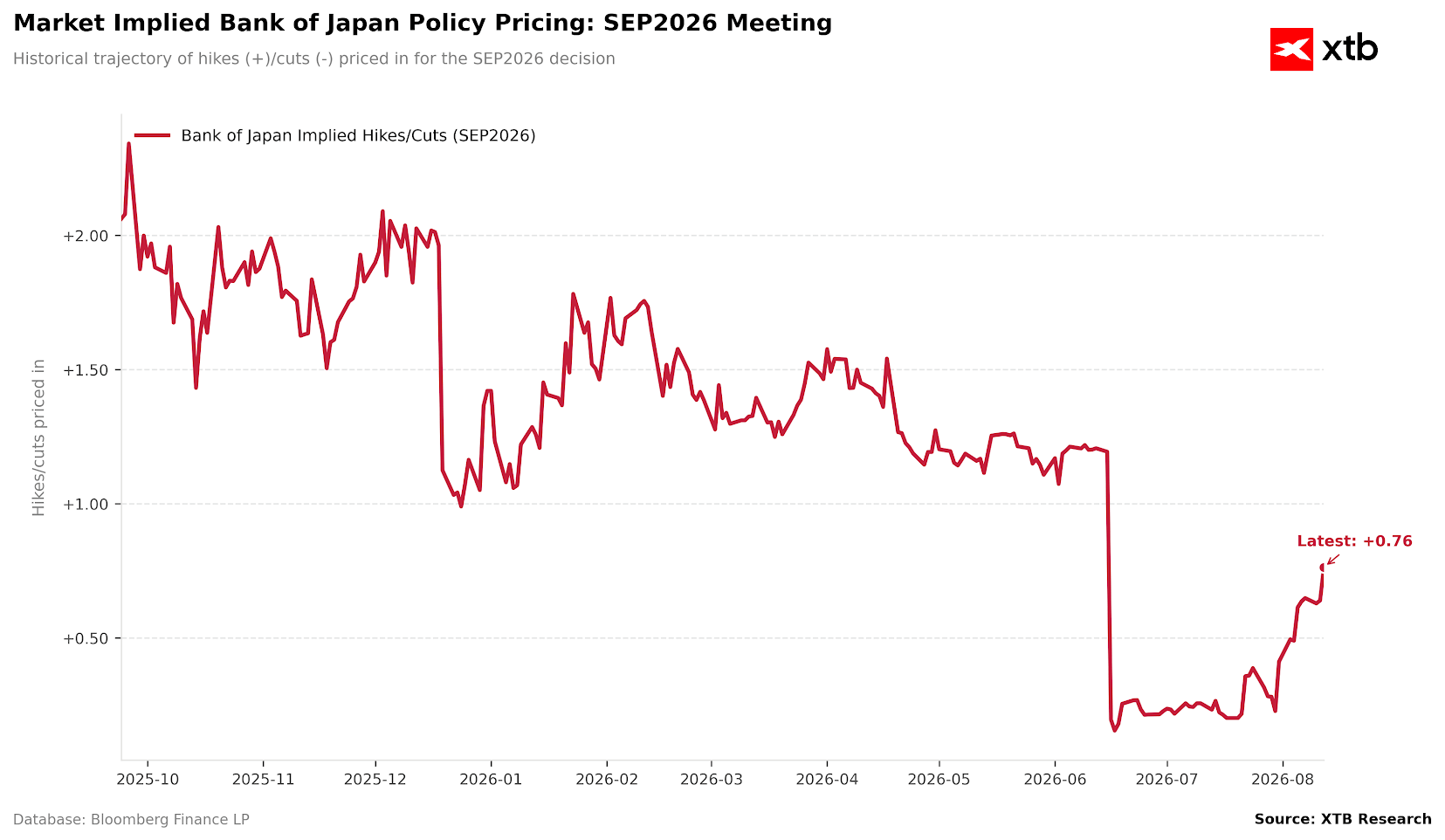
Source: xStation, 12.08.2026 As long as the divergence between the projected interest rate levels in the United States and Japan remains significant, even an intervention amounting to nearly 90 billion dollars may prove insufficient to permanently reverse the trend. Investors expect firm action from the Bank of Japan, though an opportunity for this will not arise until 18 September. The decision to raise interest rates then may constitute a significant declaration for the market, leading to an increase in bets on further hikes in subsequent months. Currently, such a move is priced in at approximately 75%.
Figure 3: Market-implied Probability of a Hike at the September BoJ Meeting (2025-2026)
Source: XTB Research, 12.08.2026 In the meantime, market attention will shift to the United States. Today at 1:30 PM, we await the publication of the July inflation data. What can we expect?
The headline inflation indicator is expected to be 3.4% y/y (a decline from 3.5%).
The core indicator is expected to fall to its lowest level since March 2021 (to 2.5%).
Ceny energii najprawdopodobniej spadną, głównie za sprawą spadku cen benzyny.
Energy prices are likely to fall, mainly due to the decline in petrol prices.
Core services inflation is expected to rebound to 0.2% m/m, driven by rising rental costs.
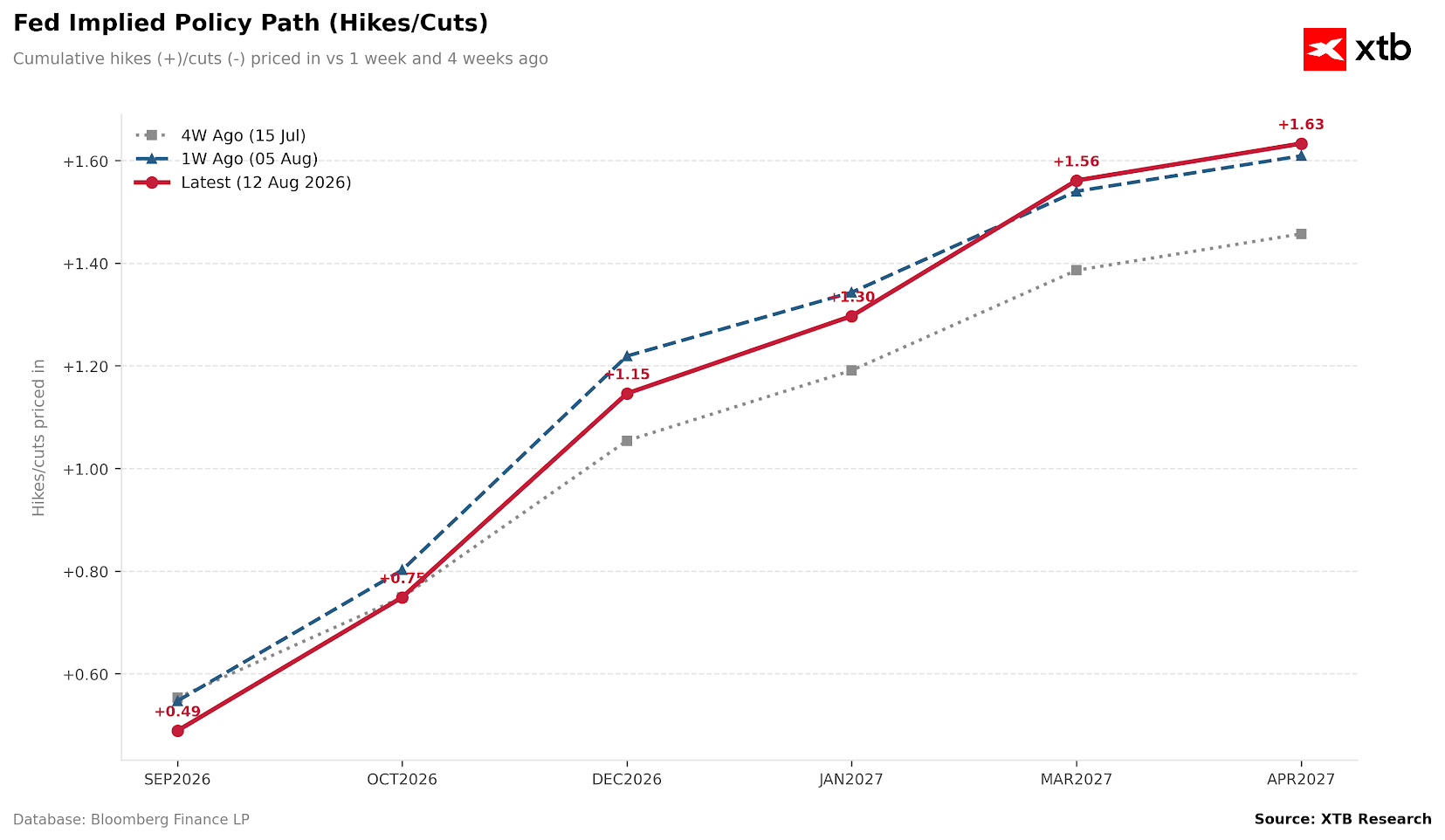
If the reading shows a stronger-than-expected decline, markets may continue their dovish repricing regarding the Fed’s interest rate path. It is worth noting that after the latest committee meeting and the exceptionally weak NFP data, the market-implied probability of a September hike has fallen to approximately 50%.
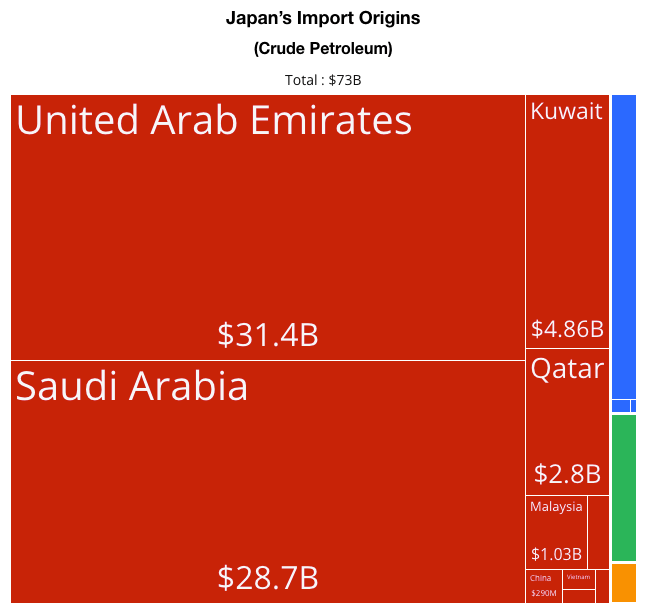
Source: XTB Research, 12.08.2026 In the context of the yen, attention is also drawn to developments in the Strait of Hormuz – Japan is almost entirely dependent on imports for its energy needs, and nearly 90% of its crude oil normally comes from the Middle East. Figure 5: Structure of Japan’s Crude Oil Imports (2024)
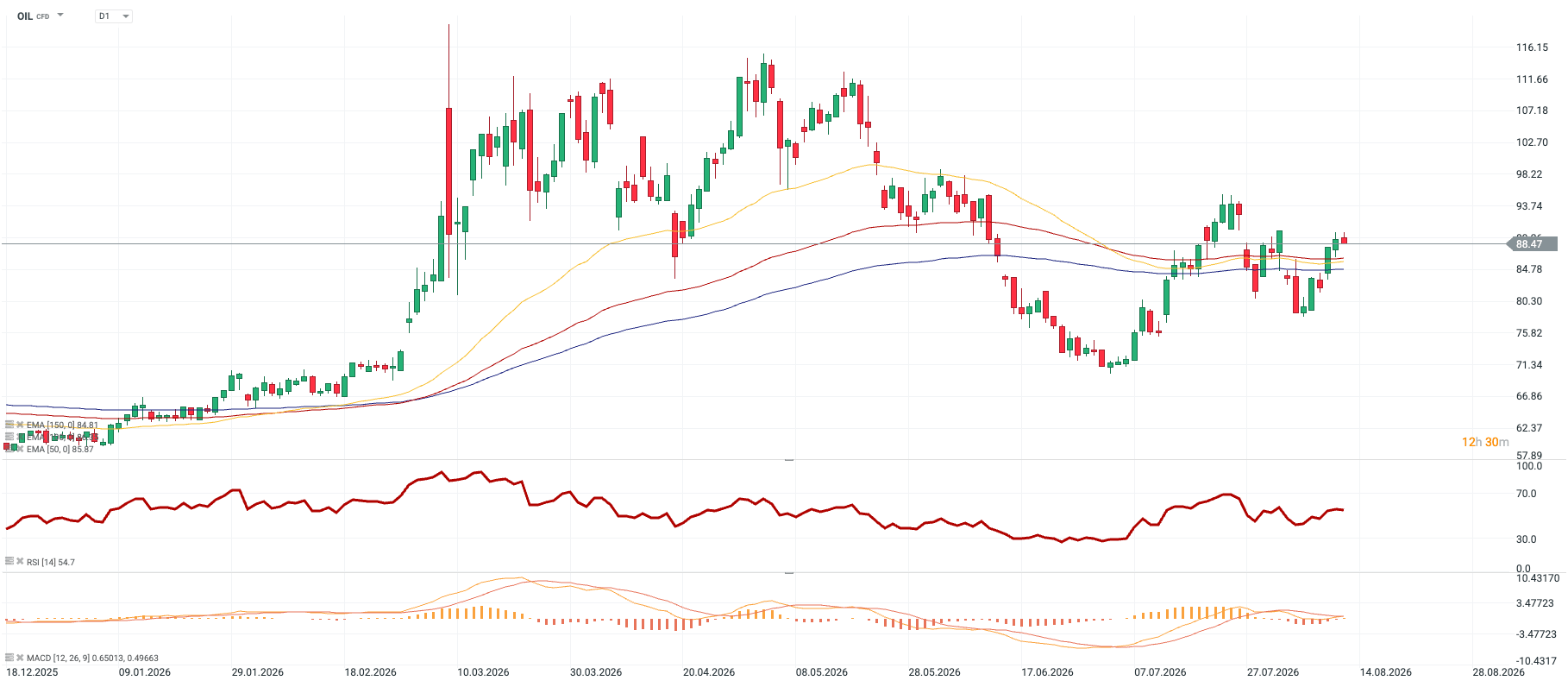
Source: OEC, 12.08.2026 In recent days, we have observed a rebound in oil prices. One must pay over 89 dollars for a barrel of Brent. Yesterday, key energy commodities continued to rise, despite optimistic declarations from the Pakistani Ministry of Foreign Affairs. Figure 6: OIL (18.12.2025 – 12.08.2026)
Source: xStation, 12.08.2026 Overnight, Donald Trump stated in media comments that the USA has “total control” over the Strait of Hormuz. The Iranian side, in turn, has set tough conditions for reopening the route, demanding the lifting of US sanctions, an end to the naval blockade, and the payment of reparations for war damages by the USA. Ship traffic in the Strait of Hormuz has fallen to its lowest level in a week (approx. 10 ships per day).
GBP/JPY attracts some dip-buyers on Tuesday amid the underlying JPY bearish sentiment.
Japan’s fiscal concerns and the wide UK-Japan rate gap continue to undermine the JPY.
GBP bulls seem hesitant ahead of key UK macro data on Thursday, including the Q2 GDP.
The GBP/JPY cross recovers a modest intraday dip and climbs above the 215.00 psychological mark during the first half of the European session on Tuesday. Spot prices currently trade near an over one-week high, touched on Monday, and seem poised to appreciate further amid a broadly weaker Japanese Yen (JPY).
The brutal market reaction to a joint US-Japan intervention in late July turned out to be short-lived amid growing concerns about Japan’s worsening fiscal conditions, aggravated by Prime Minister Sanae Takaichi’s aggressive economic stimulus and tax cuts. Adding to this, the persistently wide interest rate gap between Japan and other major economies, including the UK, which has been fueling the so-called carry trade, contributes to the JPY’s underperformance and acts as a tailwind for the GBP/JPY cross.
The Bank of Japan (BoJ) lifted the short-term policy rate in June to 1.00%, or the highest since 1995, while the Bank of England’s (BoE) base rate is at 3.75%. This leaves a gap of around 275 basis points (bps). Furthermore, investors remain worried that Japan’s economy will remain under strain amid energy supply disruptions due to the Middle East conflict. Japan depends on the Middle East for roughly 95% of its crude oil, suggesting that the path of least resistance for the GBP/JPY cross remains to the upside.
Meanwhile, the British Pound (GBP) struggles to attract buyers amid a modest US Dollar (USD) strength. Traders also seem reluctant ahead of the UK data dump, including the Q2 GDP report, on Thursday, which might keep a lid on any further appreciation move for the GBP/JPY cross. Nevertheless, the fundamental backdrop validates the near-term positive outlook. This, in turn, suggests that any corrective pullback could be seen as a buying opportunity and is more likely to remain limited.
USDJPY is once again moving higher, while the yen is beginning to give back some of the gains it made following the joint intervention by Japan and the United States at the end of July. It was an exceptionally strong response from the authorities, which helped push USDJPY sharply lower in a short period of time and gave the yen some much-needed relief. The problem is that just a few days later, the market is once again testing the weakness of the Japanese currency. This shows that FX intervention can be an effective tool for stopping a sharp move, but it may not be enough to produce a lasting change in the trend. In the case of the yen, the underlying problem is much deeper. The gap between interest rates in the United States and Japan remains very wide, and this has been one of the key reasons behind the persistent pressure on the Japanese currency. The market is therefore paying increasing attention to what could happen at the Bank of Japan’s September meeting. There are growing signals that the BoJ could decide to raise interest rates again on September 17–18. Such a move would be far more important for the yen than intervention alone, as it would represent a genuine change in the interest-rate differential between Japan and the United States.
Source: xStation5
Factors Currently Driving USDJPY
Intervention Gave the Yen Some Relief, but the Effect Is Quickly Fading
At the end of July, USDJPY approached levels that were difficult for Japanese authorities to accept. The response was particularly decisive, as the United States also joined Japan in taking action this time. The joint operation quickly reversed part of the previous move and led to a strong appreciation of the yen. Initially, the effect was very clear. USDJPY fell toward 157, and the market once again began to consider the possibility of a lasting trend reversal. Today, the situation looks different. The pair is rising again, while support for the yen is starting to look increasingly fragile. The market is paying attention to the fact that Tokyo did not follow up the intervention with further aggressive action, which could indicate that policymakers primarily want to limit excessive market moves rather than permanently target a specific exchange-rate level. This is precisely why intervention alone does not solve the problem. It can stop the market for several days or weeks, but if the underlying conditions remain unchanged, pressure on the yen can quickly return.
The BoJ Needs to Do More Than Just Intervene
The most important piece of the puzzle remains the Bank of Japan’s monetary policy. The BoJ has begun the process of normalizing monetary policy and has already raised interest rates. The market is increasingly expecting that this was not the final move. Recent reports suggest that the central bank could decide to raise rates again at its September 17–18 meeting. For the yen, this would be a much more important signal than another round of FX intervention. A rate hike would narrow the interest-rate differential between US and Japanese assets, reducing the attractiveness of strategies that involve funding investments in higher-yielding currencies with the yen. For now, however, the market still needs to see whether the BoJ will actually be willing to act. The possibility of a September rate hike provides some support for the yen, but only an actual decision — combined with guidance on future moves — could change the market outlook in a more lasting way.
The Interest-Rate Differential Remains a Problem for the Yen
Even if the BoJ raises rates in September, the gap between US and Japanese interest rates will remain significant. This is where the main problem for the Japanese currency lies. The market may buy the yen for some time in anticipation of a BoJ move, but if the central bank signals a prolonged pause after the hike, the dollar’s advantage could quickly return. For this reason, a rate hike alone may not be enough. What will matter much more is whether the BoJ can convince the market that it is beginning a longer-term process of monetary policy normalization. If that happens, USDJPY could enter a more sustained downtrend. If, on the other hand, the BoJ remains cautious while the Fed keeps rates elevated for an extended period, pressure on the yen could return despite another rate hike.
The Market Is Testing Tokyo’s Credibility Again
The latest intervention was also exceptional because both Japan and the United States participated. Such a move strengthened the signal sent to the market and showed that authorities were prepared to act against excessive yen weakness. The problem, however, is that the market is already beginning to test how long that signal will remain effective. If USDJPY once again approaches the levels that previously triggered intervention, Tokyo will face a difficult choice. Another intervention would send a very strong signal, but it would become increasingly difficult to convince the market that government action can permanently reverse the trend without support from monetary policy. That is why the BoJ’s September meeting could be more important than the intervention itself. The market will want to see whether the central bank is genuinely prepared to use interest-rate policy as the second pillar in its efforts to combat yen weakness.
USDJPY Is Rising Again, but September Could Change the Picture
The current rise in USDJPY shows that the effect of the joint Japan-US intervention is gradually fading. The yen received several weeks of relief, but the fundamentals of the FX market have not changed enough to suggest that a lasting trend reversal is underway. Attention is now shifting toward the Bank of Japan. If the BoJ does indeed raise rates in September and its communication signals the possibility of further moves, the yen could receive much stronger and more durable support. If, however, the Japanese central bank raises rates but leaves the market with the impression that further hikes will be difficult to achieve, USDJPY could resume its upward move. For now, the market is showing that intervention alone has not been enough. Japan needs not only to sell dollars and buy yen, but above all to narrow the interest-rate differential. This is precisely why the BoJ’s September meeting could be one of the most important events for USDJPY during the entire third quarter.
Key Takeaways
USDJPY is rising again, showing that the effect of the latest joint Japan-US intervention is beginning to fade.
The intervention helped strengthen the yen sharply, but it did not change the underlying fundamentals of the market.
The key factor for the yen remains the large interest-rate differential between the United States and Japan.
The market is increasingly pricing in the possibility of another BoJ rate hike at the September 17–18 meeting.
If the BoJ signals further monetary policy normalization, the yen could receive significantly more durable support than it did from intervention alone.
If the Japanese central bank remains cautious, USDJPY could come under renewed upward pressure.
For the yen, the key question is therefore not whether Tokyo can intervene again, but whether the BoJ is prepared to raise rates quickly enough to actually change the fundamentals behind the Japanese currency’s weakness.
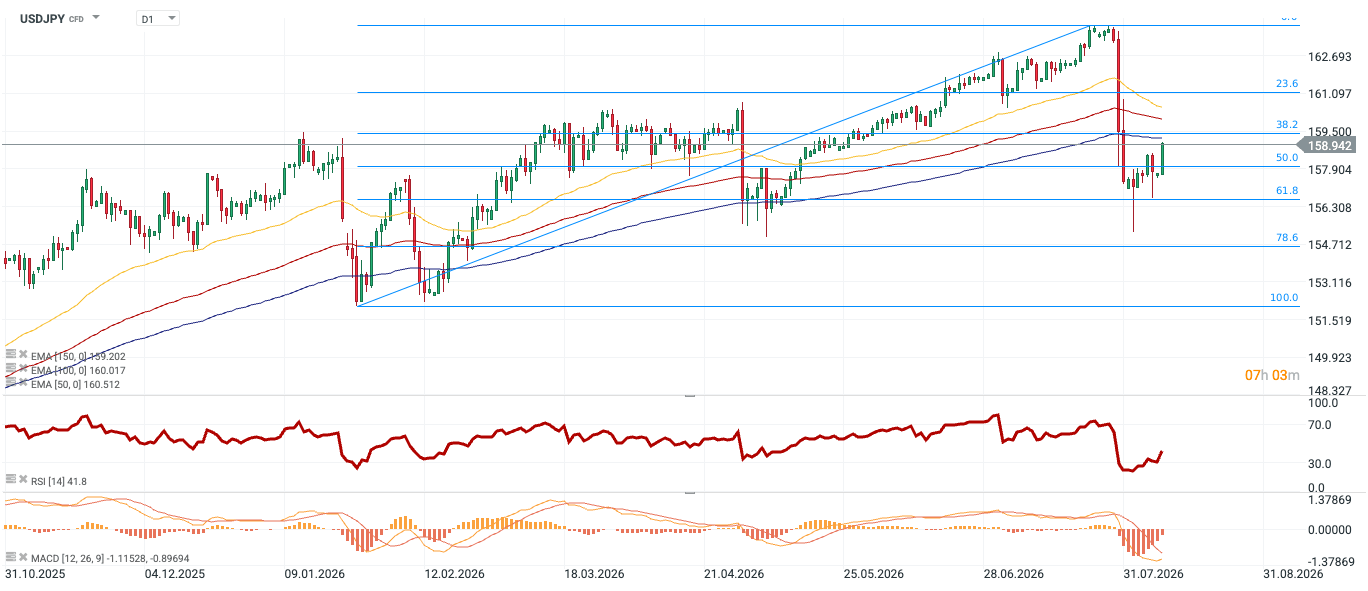
Following a record intervention by the Japanese Ministry of Finance and the US Department of the Treasury, the yen strengthened by over 5%, recovering losses incurred over the last 5 months, since the outbreak of the war in Iran. After reaching a local low below the 156 level, the USDJPY pair has returned to growth.
The fundamentals have not changed significantly and continue to exert pressure on the Japanese currency. The key issue remains the carry trade, or trading on the interest rate differential. As long as the discrepancy between the projected interest rate levels in the United States and Japan remains significant, even interventions amounting to nearly 90 billion dollars may prove insufficient to permanently reverse the trend. Figure 2: USDJPY (31.10.2025 – 10.08.2026)
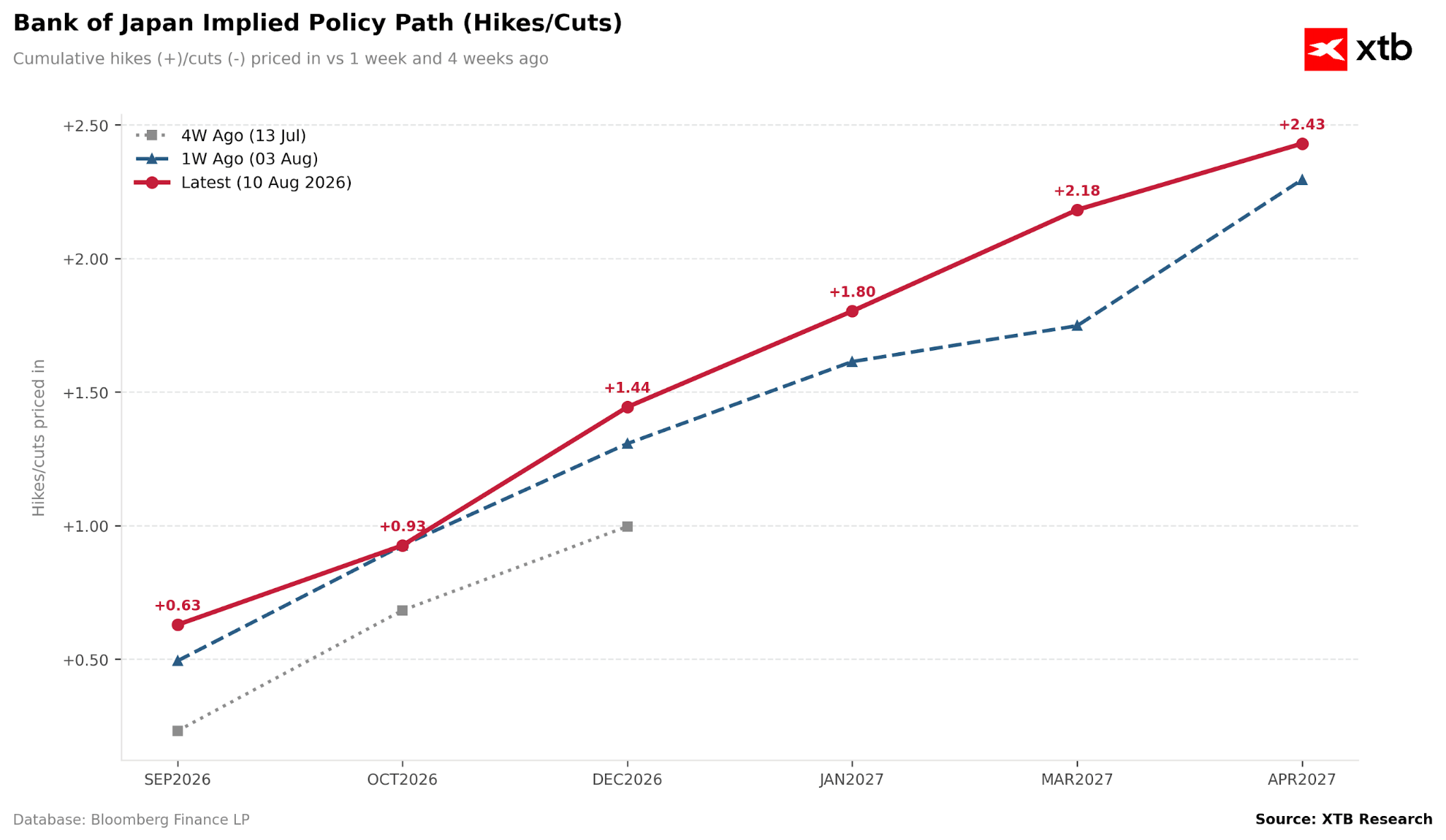
Source: xStation, 10.08.2026 Currently, the interest rate differential between both sides of the ocean stands at 2.675%. Market valuations suggest that it will narrow slightly in the coming months, reaching approximately 2.35% in July 2027. However, it seems that investors expect more decisive action from the Bank of Japan, with the next opportunity appearing only on 18 September. A decision to raise interest rates then could serve as a significant declaration for the market, leading to increased bets on subsequent hikes in the following months. Currently, such a move is priced at approximately 60%.
Figure 3: Bank of Japan Implied Policy Path (Hikes/Cuts) (2026-2027)
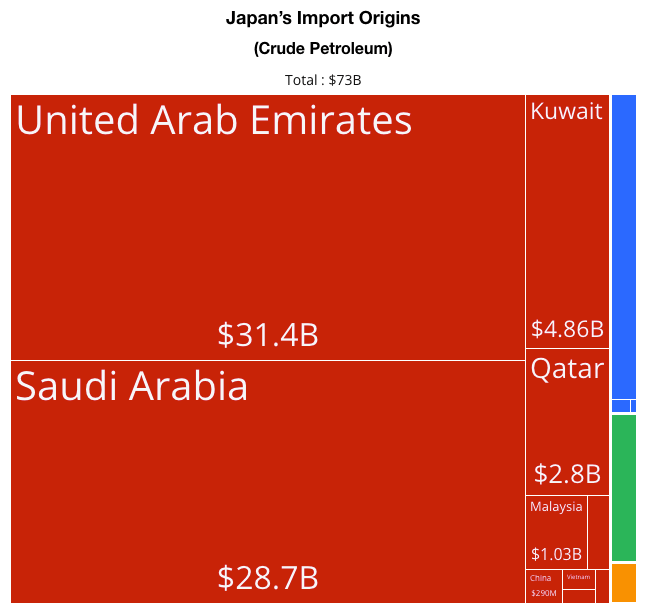
Source: XTB Research, 10.08.2026 In the meantime, the market’s attention will focus on the United States and the developing situation in the Middle East. Japan is almost entirely dependent on imports for its energy needs, and under standard conditions, nearly 90% of its crude oil comes from the Middle East. Figure 4: Japan’s Crude Oil Import Structure (2024)
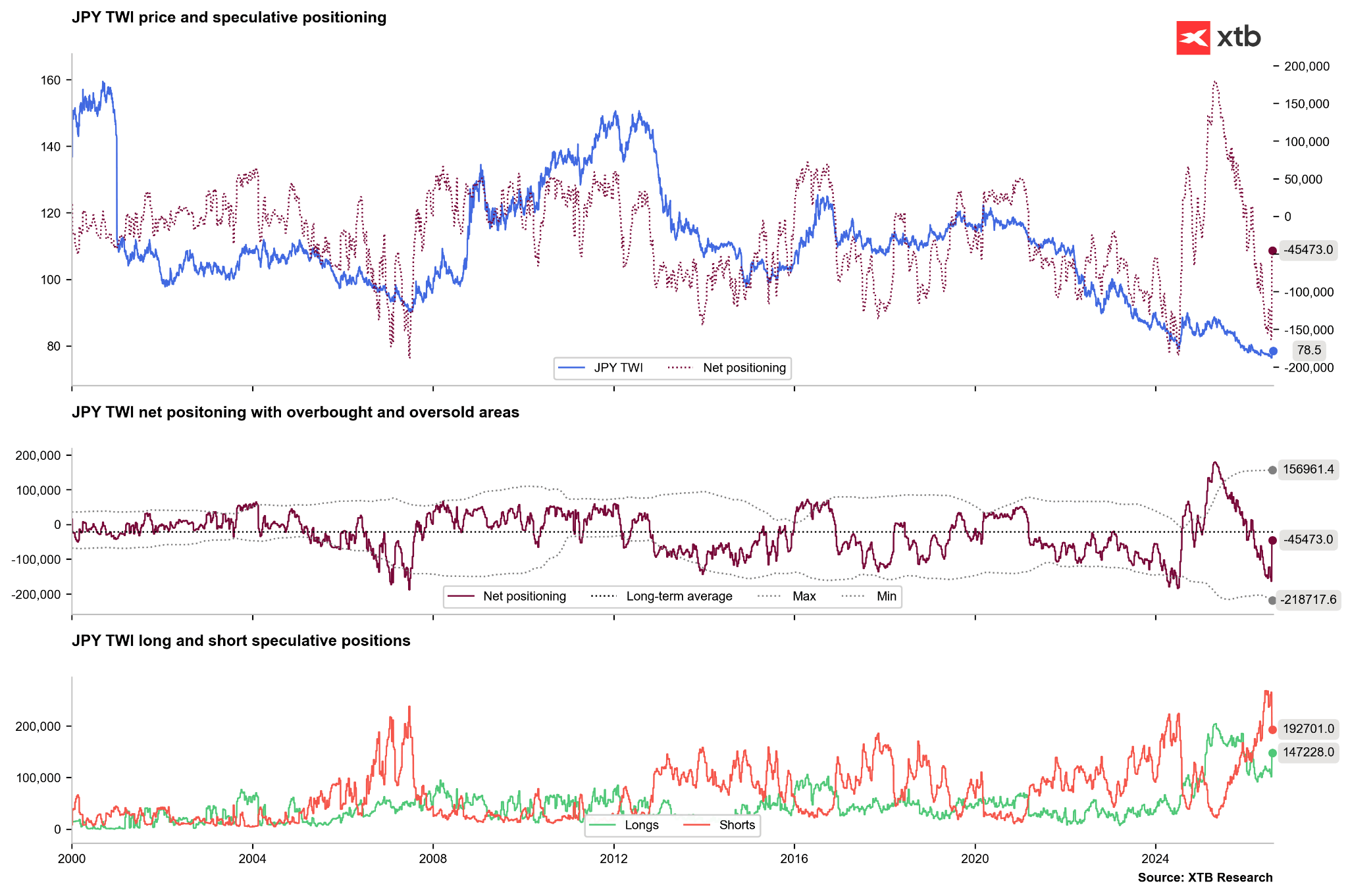
Source: OEC, 10.08.2026 However, further interventions cannot be ruled out, which the markets seem to fear. Positioning on the yen has changed significantly after many investors withdrew speculative short positions for fear of further actions aimed at defending the exchange rate. Figure 5: Yen Positioning (2000 – 2026)
Source: XTB Research, 10.08.2026
US Dollar (USD)
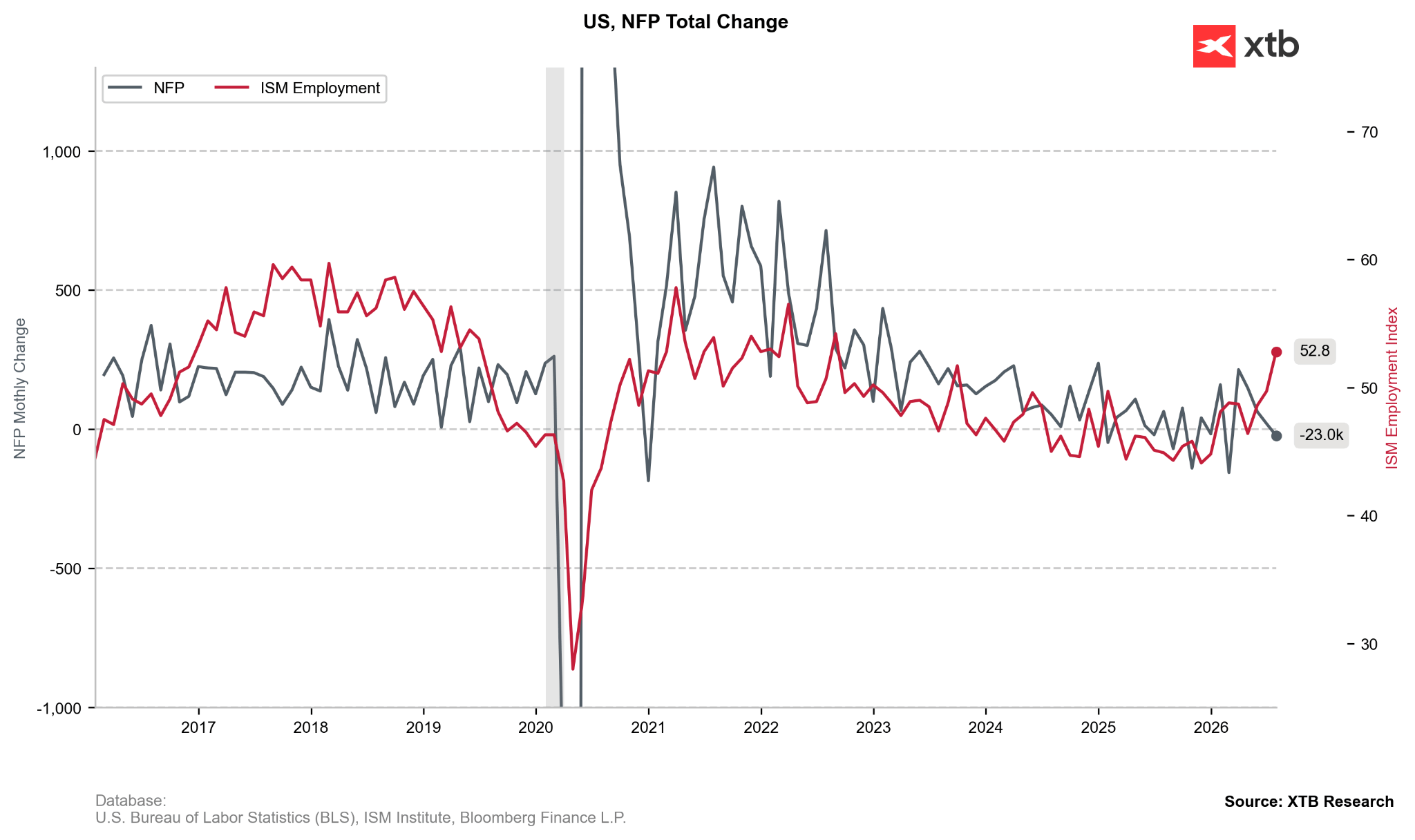
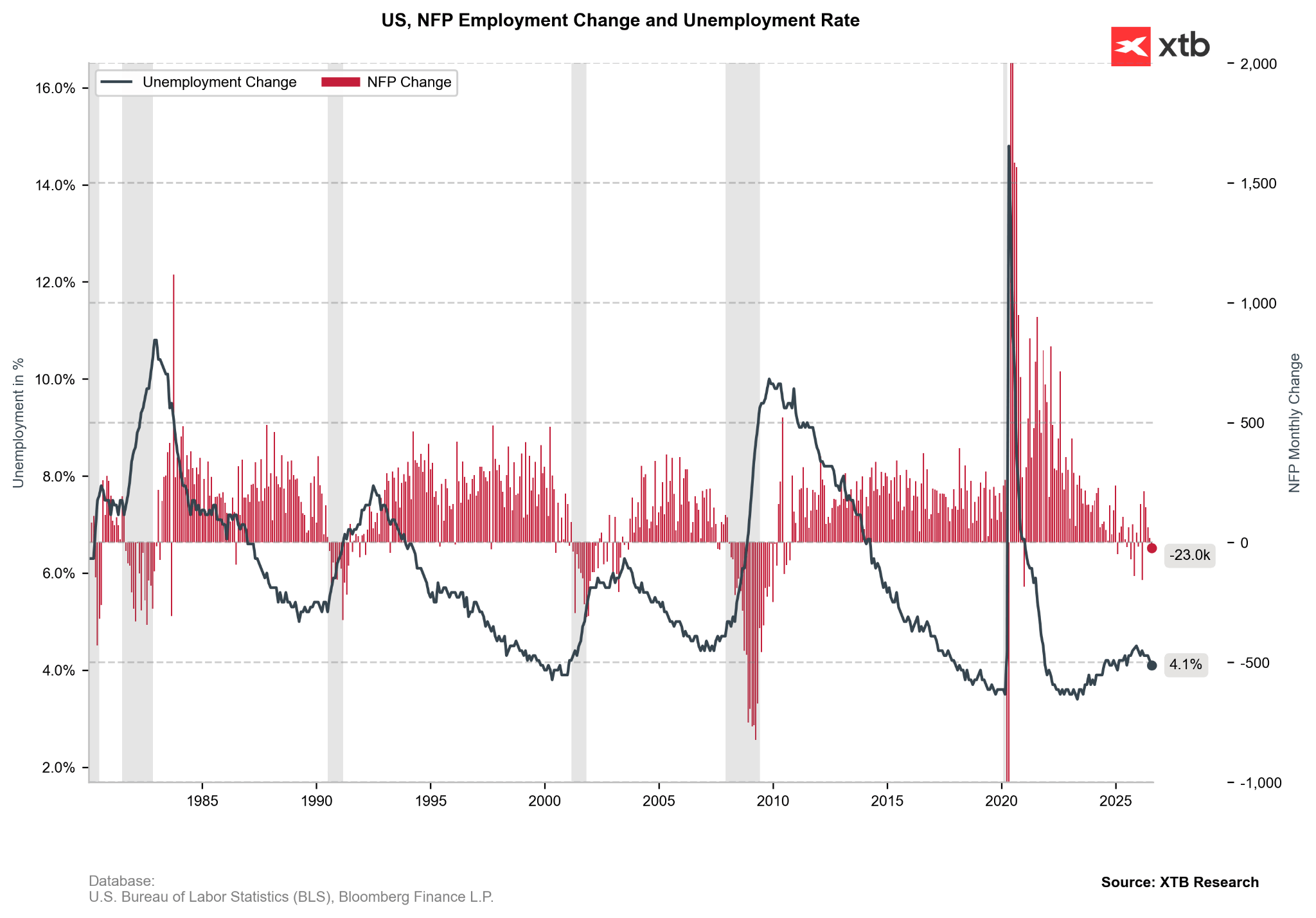
The July NFP report has been published. The number of new jobs in the US economy fell by 23 thousand, missing expectations by 5 standard deviations. Although extreme phenomena occur much more frequently in the world of macroeconomics (the so-called fat tails), assuming the data follows a normal distribution, we would have to wait 290,000 years for another such reading. Figure 6: NFP and Employment Component in ISM PMI (2016 – 2026)
Source: XTB Research, 10.08.2026 The market reaction was certainly noticeable, though not as strong as many might have expected. The dollar’s losses were limited by, among other things, a decline in the unemployment rate (to 4.1%) and problems with seasonal adjustment of the data (the decline resulted mainly from a lower number of jobs in the public education sector). Figure 7: NFP and Unemployment Rate (1980 – 2026)
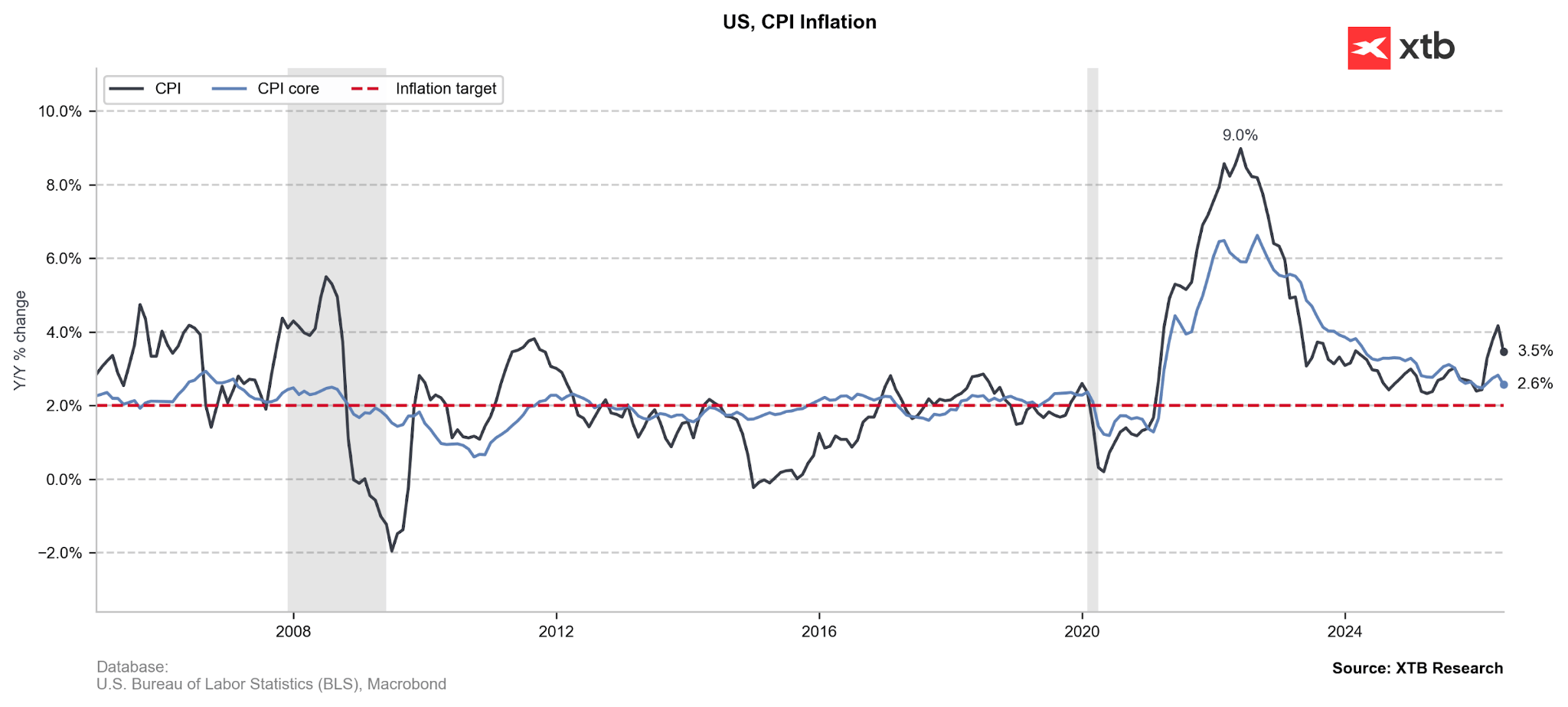
Source: XTB Research, 10.08.2026 It is worth noting, however, that higher energy prices have affected companies in the retail, leisure, and hospitality sectors (this despite the World Cup ending in July). Investors are currently unsure which direction the Fed will take in September; looking at market valuations, the chances of a hike can be compared to a coin toss. All eyes are on the July inflation reading scheduled for Wednesday. If, despite rising oil and gas prices, it shows similar values to June, we expect the committee led by Kevin Warsh to refrain from a hike until the next meeting. Figure 8: US CPI Inflation (2004 – 2026)
Source: XTB Research, 10.08.2026 For Warsh himself, this would be an exceptionally comfortable situation. In the event of intensifying inflation concerns, the committee would be almost forced to raise rates, especially in the face of revived discussions regarding the Fed’s independence. The topic returned to the table after further threats from Donald Trump directed at Lisa Cook, one of the FOMC decision-makers. These appeared more than a month after the Supreme Court deemed the president’s recent actions in this area unlawful.
To provide the best experiences, we use technologies like cookies to store and/or access device information. Consenting to these technologies will allow us to process data such as browsing behavior or unique IDs on this site. Not consenting or withdrawing consent, may adversely affect certain features and functions.
Functional
Always active
The technical storage or access is strictly necessary for the legitimate purpose of enabling the use of a specific service explicitly requested by the subscriber or user, or for the sole purpose of carrying out the transmission of a communication over an electronic communications network.
Preferences
The technical storage or access is necessary for the legitimate purpose of storing preferences that are not requested by the subscriber or user.
Statistics
The technical storage or access that is used exclusively for statistical purposes.The technical storage or access that is used exclusively for anonymous statistical purposes. Without a subpoena, voluntary compliance on the part of your Internet Service Provider, or additional records from a third party, information stored or retrieved for this purpose alone cannot usually be used to identify you.
Marketing
The technical storage or access is required to create user profiles to send advertising, or to track the user on a website or across several websites for similar marketing purposes.