

AUD/USD Rally pauses as RSI (14) struggles to extend above 60.00

April 10, 2026
  • AUD/USD corrects to near 0.7065 after a four-day winning streak.
  • Investors await the outcome of US-Iran ceasefire talks in Pakistan.
  • The US headline CPI is expected to have risen at a faster pace of 3.3% YoY in March.

The AUD/USD pair is down 0.23% to near 0.7065 in the late Asian trading session, struggling to extend its winning streak for the fifth trading day on Friday. The Aussie pair comes under pressure as the Australian Dollar (AUD) underperforms amid uncertainty surrounding the first round of talks between the United States (US) and Iran in Pakistan over the weekend regarding the permanent ceasefire.

Australian Dollar Price Today

The table below shows the percentage change of Australian Dollar (AUD) against listed major currencies today. Australian Dollar was the weakest against the US Dollar.

USDEURGBPJPYCADAUDNZDCHF
USD0.09%0.15%0.16%0.08%0.23%0.25%0.02%
EUR-0.09%0.05%0.09%-0.03%0.12%0.16%-0.08%
GBP-0.15%-0.05%0.04%-0.06%0.09%0.11%-0.14%
JPY-0.16%-0.09%-0.04%-0.09%0.07%0.04%-0.18%
CAD-0.08%0.03%0.06%0.09%0.13%0.16%-0.07%
AUD-0.23%-0.12%-0.09%-0.07%-0.13%0.02%-0.22%
NZD-0.25%-0.16%-0.11%-0.04%-0.16%-0.02%-0.24%
CHF-0.02%0.08%0.14%0.18%0.07%0.22%0.24%

The heat map shows percentage changes of major currencies against each other. The base currency is picked from the left column, while the quote currency is picked from the top row. For example, if you pick the Australian Dollar from the left column and move along the horizontal line to the US Dollar, the percentage change displayed in the box will represent AUD (base)/USD (quote).

Market participants doubt that US-Iran talks will go on smoothly amid continued military attacks in Lebanon between Iran-backed Houthis and the Israeli army.

Israeli Prime Minister (PM) Benjamin Netanyahu has pushed back hopes of a ceasefire in Lebanon, stating that Tel Aviv would continue “to strike Hezbollah with full force” as the country’s military launched fresh strikes.

On Thursday, Israeli PM Netanyahu stated, through a tweet on X, that he is open to direct negotiations with Lebanon after repeated requests from the nation.

On the macro front, investors await the US Consumer Price Index (CPI) data for March, which will be published at 12:30 GMT. The US headline inflation is expected to arrive significantly higher at 3.3% from 2.4% in February.

AUD/USD technical analysis

AUD/USD trades lower at around 0.7065 as of writing. However, the pair maintains a constructive bullish bias as spot holds above the 20-day exponential moving average (EMA) at 0.6989. The pair has rebounded from last month’s lows and is stabilizing near recent highs.

However, the price needs a fresh trigger to extend its upside, with the Relative Strength Index (RSI) struggling to break into the 60.00s zone.

On the downside, initial support is provided by the 20-day EMA at 0.6989, which reinforces the short-term bullish structure as long as it holds on closing bases. A daily close below this dynamic floor would signal fading upward momentum and expose a deeper correction towards the April 7 low around 0.6900.

Looking up, the April 9 high around 0.7100 is the immediate resistance; a decisive break above the same would allow the price to extend its rebound towards the March high at 0.7187.

Offshore Yuan Weakens, Still Set for Weekly Gain

April 10, 2026

The offshore yuan edged lower to around 6.83 per dollar, ending a five-session winning streak, after the People’s Bank of China reaffirmed its cautious monetary easing stance, even as consumer inflation slowed and producer prices rebounded. Annual consumer inflation slowed more than expected to 1% in March 2026 from 1.3% in February, as the seasonal boost from holiday spending faded.

The PBoC maintained its cautious stance at a quarterly meeting last month, signaling limited appetite for aggressive easing after a modest rate cut in 2025. Meanwhile, producer prices rose 0.5%, beating forecasts and marking the first increase since September 2022, driven partly by higher global energy costs amid Middle East tensions. While China’s strategic reserves and diversified energy supply have cushioned the impact, signs of domestic pass-through are emerging, as authorities raised retail fuel prices for the third time since late February. Over the week, the yuan is set for its second weekly gain.

Currency Talk – EUR/CAD NZD/USD, USD/JPY

April 9, 2026

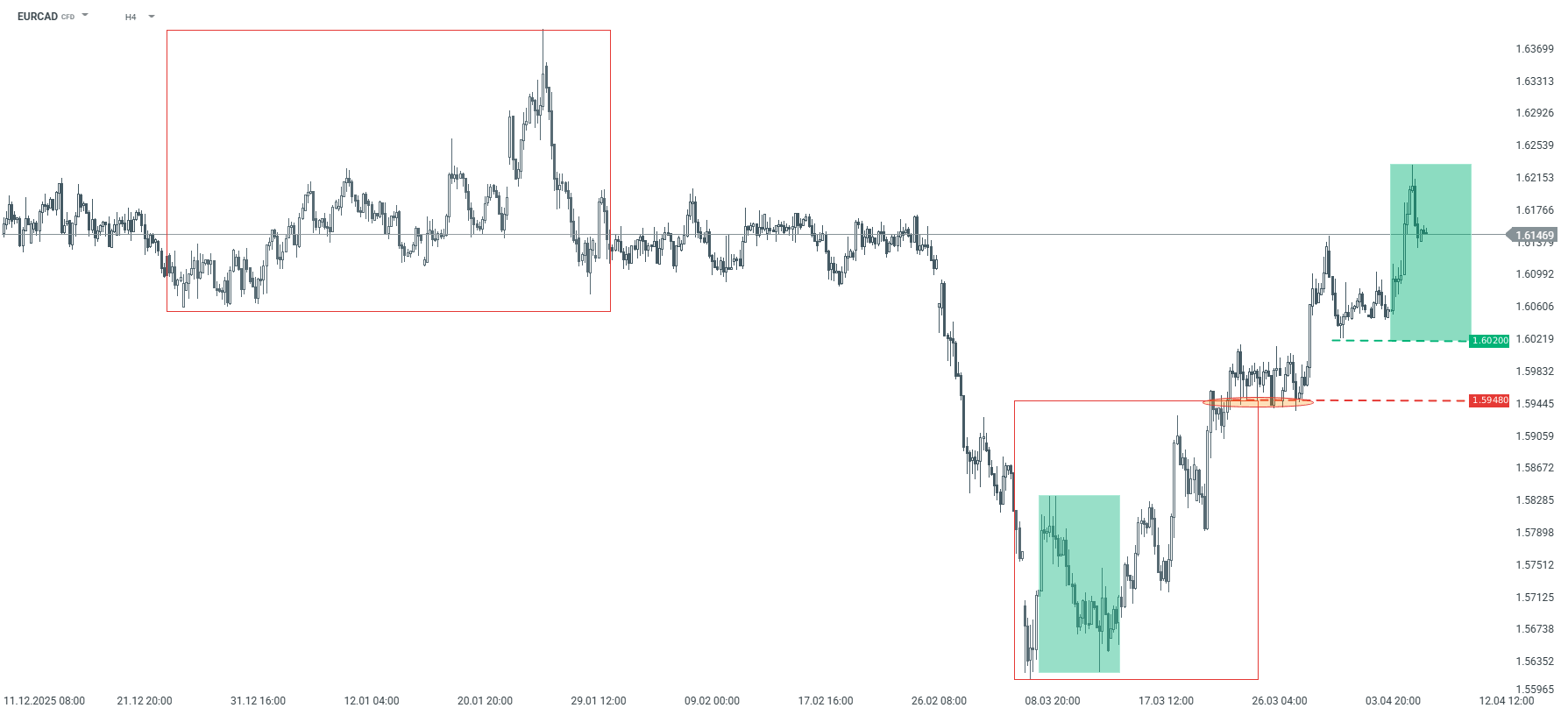
The Overbalance analysis aims to identify three financial instruments, analyzed primarily on the daily/four-hour (D1/H4) timeframe. The analysis uses only the Overbalance methodology, which helps determine where a trend may continue or where it may reverse.
Today’s analysis covers three instruments, evaluated solely in terms of 1:1 correction structures.

EURCAD
At the end of March, EURCAD prices broke out of a major 1:1 downtrend pattern at the 1.5948 level, paving the way for further gains. We are currently seeing a continuation of the uptrend, and counting from the March 9 low, we can identify a local 1:1 uptrend pattern. In the event of a correction, the key short-term support remains at the 1.6020 level, where the lower boundary of this pattern is located. Conversely, only a return of the price below 1.5948 could suggest a shift to a downtrend. For now, sentiment remains bullish.

EURCAD – H4 timeframe. Source: xStation

NZDUSD
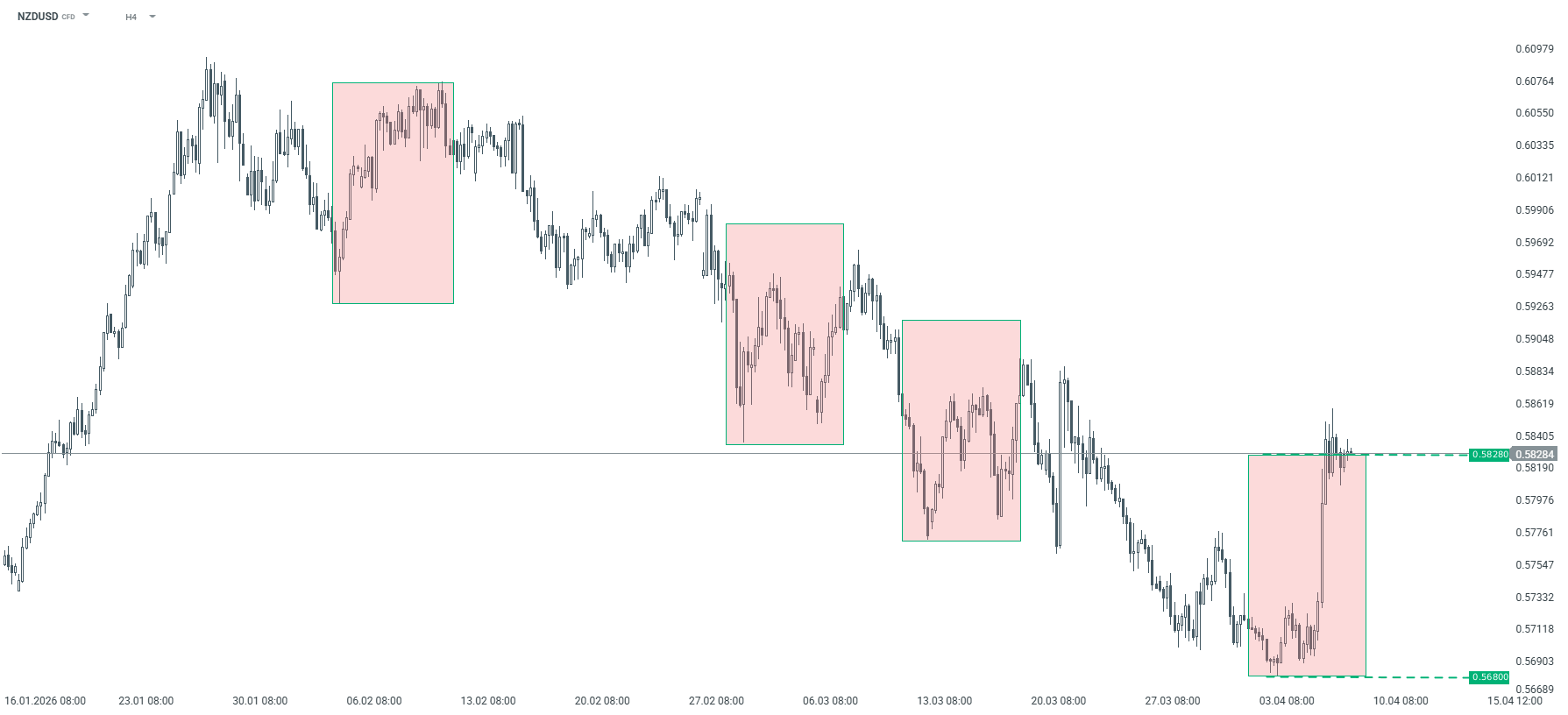
Since February of this year, NZDUSD has been trending downward, with the market repeatedly forming corrections of similar magnitude. We are currently observing a test of the key resistance level resulting from the 1:1 Fibonacci retracement at 0.5828. A sustained break below this level could lead to a shift in sentiment toward an uptrend. On the other hand, defending this level and keeping the price within the downtrend could result in a return to declines and a test of recent lows at 0.5680. The current zone is of critical importance in the short term.

NZDUSD – H4 chart. Source: xStation

USDJPY
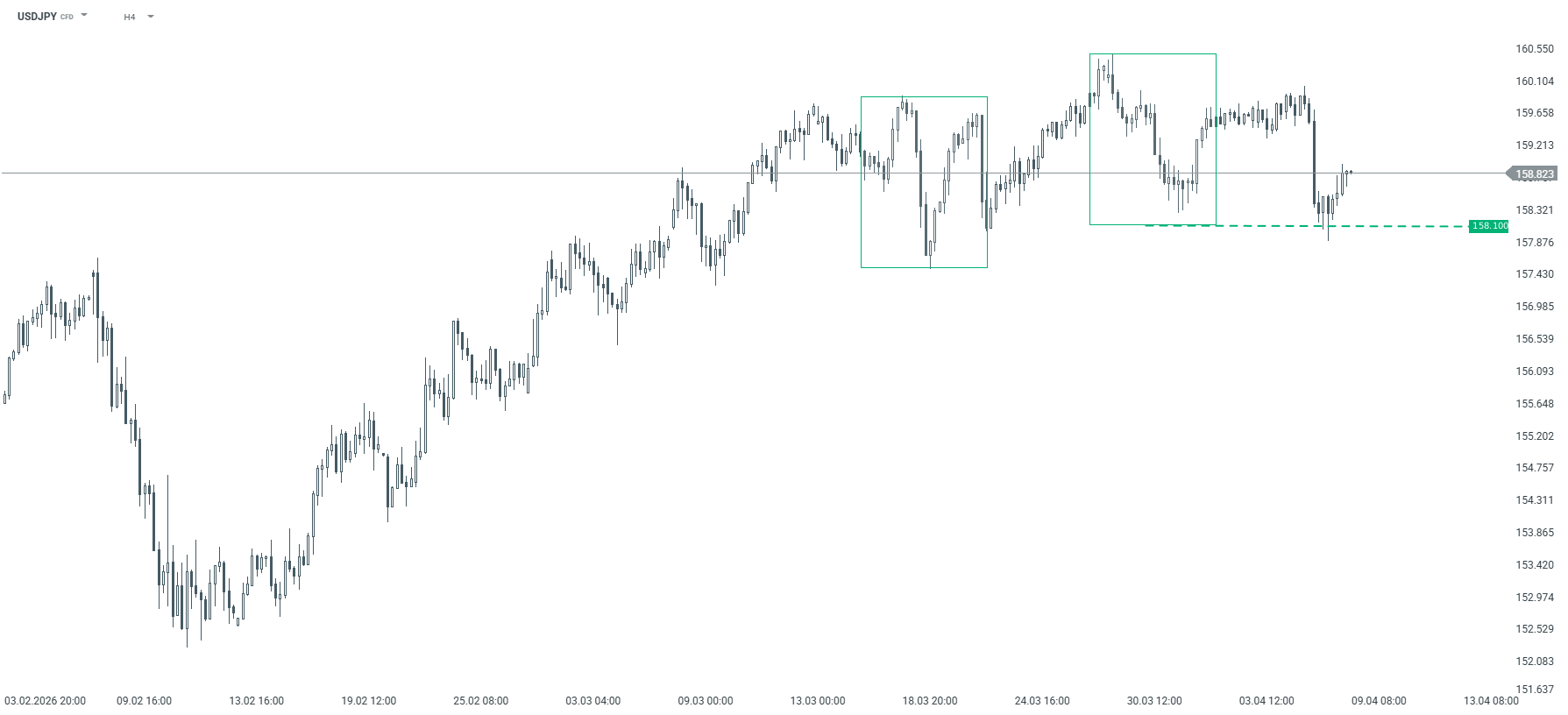
Since mid-February, USDJPY has been in a strong uptrend. Recently, one of the larger corrections occurred, covering a range of approximately 240 pips. The current correction has the same range as the previous one, marked in green, which allows us to identify key support at the 158.10 level, based on a 1:1 ratio. If this level holds, there is a chance for the uptrend to resume and for new highs to be tested. Conversely, a break below this level could lead to a trend reversal and a deepening of the decline.

USDJPY – H4 chart. Source: xStation

The material on this page does not constitute financial advice and does not take into account your level of understanding, investment objectives, financial situation or any other specific needs. All information provided, including opinions, market research, mathematical results and technical analyzes published on the Website or transmitted To you by other means, it is provided for information purposes only and should in no way be construed as an offer or solicitation for a transaction in any financial instrument, nor should the information provided be construed as advice of a legal or financial nature on which any investment decisions you make should be based exclusively To your level of understanding, investment objectives, financial situation, or other specific needs, any decision to act on the information published on the Website or sent to you by other means is entirely at your own risk if you In doubt or unsure about your understanding of a particular product, instrument, service or transaction, you should seek professional or legal advice before trading. Investing in CFDs carries a high level of risk, as they are leveraged products and have small movements Often the market can result in much larger movements in the value of your investment, and this can work against you or in your favor. Please ensure you fully understand the risks involved, taking into account investments objectives and level of experience, before trading and, if necessary, seek independent advice.

Yuan Holds Firm at 3-Year Peak

April 9, 2026

The offshore yuan held above 6.83 per USD, pausing near an over three-year high as investors weighed a fragile US–Iran ceasefire. The agreement, tied to a 10-point proposal and contingent on reopening the Strait of Hormuz, initially boosted risk appetite and weakened the dollar. However, sentiment turned cautious after fresh accusations from Iran of violations, citing disputes over uranium enrichment, continued Israeli strikes in Lebanon, and alleged airspace breaches.

Meanwhile, China remains relatively better positioned among Asian peers, with the yuan up about 1.0% against the dollar this month and 2.4% firmer year-to-date, as markets price in reduced geopolitical risk. The currency’s resilience has been supported by China’s large oil stockpiles and comparatively stable energy supply chains. Focus now turns to upcoming inflation numbers due Friday, expected to show a modest rise in annual consumer prices and a return to yearly growth in producer prices for the first time since 2022.

EUR/USD – Bulls await break above 200-SMA/38.2% Fibo. confluence near 1.1670

April 9, 2026
  • EUR/USD struggles to gain any meaningful traction during the Asian session amid mixed cues.
  • The Fed’s dovish outlook keeps the USD bulls on the defensive and lends support to the pair.
  • The fragile US-Iran ceasefire limits the USD downside and acts as a headwind for spot prices.

The EUR/USD pair finds some support near the 1.1650 region during the Asian session on Thursday, and for now, seems to have stalled the previous day’s late pullback from over a one-month high.

The US Federal Reserve’s (Fed) dovish outlook, signaling that it still sees one interest rate cut this year if inflation declines in line with expectations, caps the attempted US Dollar (USD) recovery move and acts as a tailwind for spot prices. Meanwhile, experts seem skeptical about the sustainability of the US-Iran ceasefire. This, in turn, benefits the Greenback’s safe-haven status and caps the upside for the EUR/USD pair.

The overnight failure to build on the momentum beyond the 1.1670 confluence hurdle – comprising the 200-day Simple Moving Average (SMA) and the 38.2% Fibonacci retracement level of the January-March downfall – warrants caution for bulls. That said, the Relative Strength Index (RSI) hovers around 56, and the Moving Average Convergence Divergence (MACD) holds in positive territory and edges higher, hinting that downside pressure is easing rather than a clear bullish reversal.

This makes it prudent to wait for a sustained strength above the said confluence barrier and the 1.1700 mark before positioning for further gains toward the 50% retracement at 1.1747 and the 61.8% Fibo. level at 1.1827, ahead of 1.1941 and 1.2086. On the downside, first support emerges at the 23.6% Fibo. retracement at 1.1568, with a deeper pullback exposing the cycle low region around 1.1409.

(The technical analysis of this story was written with the help of an AI tool.)

EUR/USD daily chart

Chart Analysis EUR/USD

JPY moves away from three-week top as tenuous US-Iran ceasefire benefits USD

April 9, 2026
  • USD/JPY regains positive traction following the overnight fall to a nearly three-week low.
  • The fragile US-Iran ceasefire helps revive the USD demand and lend support to spot prices.
  • Economic concerns stemming from Middle East conflicts weigh on the JPY and favor bulls.

The USD/JPY pair builds on the previous day’s modest bounce from sub-158.00 levels, or a nearly three-week low, and gains some positive traction during the Asian session on Thursday. Spot prices climb back closer to the 159.00 mark in the last hour and draw support from a combination of factors.

Investors turned skeptical about the durability of a fragile US-Iran ceasefire after Israel launched its largest assault on Lebanon. Adding to this, Iran reportedly is considering the possibility of withdrawing from the ceasefire agreement following what it said was an Israeli ceasefire violation in Lebanon. This keeps a lid on the optimism and benefits the US Dollar’s (USD) global reserve currency status, which, in turn, acts as a tailwind for the USD/JPY pair.

Meanwhile, Iran’s Islamic Revolutionary Guard Corps (IRGC) claimed that shipping through the critical Strait of Hormuz was halted minutes after Israel’s large-scale attack on Lebanon. Given Japan’s dependence on oil imports from the Middle East, the latest developments revive concerns that the economy will come under substantial strain in the foreseeable future. This further undermines the Japanese Yen (JPY) and lends additional support to the USD/JPY pair.

The USD bulls, however, seem hesitant on the back of the US Federal Reserve’s (Fed) dovish outlook. In fact, Minutes of the March FOMC meeting released on Wednesday showed that the central bank still sees interest rate cuts in the future if inflation were to decline in line with expectations. This, in turn, could limit any further appreciation for the USD/JPY pair as traders now look forward to the crucial US inflation data for some meaningful impetus.

The US Personal Consumption Expenditures (PCE) Price Index is due later during the North American session. The focus will then shift to the US Consumer Price Index (CPI) report on Friday, which will play a key role in influencing market expectations about the Fed’s policy outlook and drive the USD demand. Apart from this, geopolitical headlines should contribute to infusing volatility in the global financial markets and around the USD/JPY pair.

AUD declines due to fading optimism surrounding US-Iran ceasefire

April 9, 2026
  • AUD/USD weakens as the Australian Dollar struggles amid fading optimism, with the Iran 10-point deal lacking full commitment.
  • Markets now expect an RBA rate hike in May, with rates projected to reach 4.61% by year-end.
  • Iran says recent actions violate the ceasefire, calling further talks with the US unreasonable.

AUD/USD snaps a three-day winning streak, trading near 0.7030 during the Asian hours on Thursday. The risk-sensitive pair weakens as the Australian Dollar (AUD) comes under pressure amid fading optimism, with reports suggesting the 10-point framework lacks full commitment from both sides, leaving the deal fragile and incomplete.

However, the Middle East conflict, now in its second month, has lifted energy prices and heightened inflation risks, reinforcing expectations that global central banks may keep policy tighter for longer.

The Reserve Bank of Australia (RBA) has already raised rates by 50 basis points to 4.10% amid persistently high inflation. Markets now anticipate another hike in May, with rates seen reaching 4.61% by year-end.

According to Reuters, Iranian officials said recent developments violate the terms of the less-than-day-old ceasefire, calling it “unreasonable” to proceed with talks for a permanent agreement with the United States (US).

The warning from Iran’s lead negotiator and parliament speaker, Mohammed Bager Qalibaf, underscores ongoing regional volatility. Iran’s Islamic Revolutionary Guard Corps (IRGC) also claimed that shipping through the Strait of Hormuz had halted after Israel expanded strikes in Lebanon.

Traders await the US Consumer Price Index (CPI) report for March, due Friday. Headline inflation is expected to rise 3.3% year-over-year (YoY), up from 2.4%, driven by higher oil prices amid the Middle East conflict.

CAD slips as USD safe-haven bid offsets oil rebound

April 9, 2026
  • USD/CAD rises as the US Dollar gains ground on safe-haven demand amid fading US-Iran ceasefire optimism.
  • Fed March Meeting Minutes show a wait-and-see stance, while acknowledging risks are becoming more balanced.
  • The commodity-linked CAD may gain as oil rebounds after the tanker traffic halt in the Strait of Hormuz.

USD/CAD gains ground after three days of losses, trading around 1.3860 during the Asian hours on Thursday. The pair appreciates as the US Dollar (USD) receives support from renewed safe-haven demand amid uncertainty surrounding the ceasefire agreement between the United States (US) and Iran.

The Minutes from the Federal Reserve’s (Fed) March meeting, released on Wednesday, suggest the central bank remains in a wait-and-see stance, while acknowledging that risks are becoming more balanced. Policymakers broadly supported holding rates steady, with nearly all participants backing no change, and many viewing policy as already near a neutral range, implying a high bar for further tightening.

However, the upside of the USD/CAD pair could be restrained as the commodity-linked Canadian Dollar (CAD) may find support from a rebound in oil prices. West Texas Intermediate (WTI) is trading around $91.50 at the time of writing. Crude oil prices rise after Iranian media reported a halt in tanker traffic through the Strait of Hormuz following fresh Israeli strikes in Lebanon.

Iranian officials said recent developments breach the terms of the less-than-day-old ceasefire, calling it “unreasonable” to continue talks for a permanent deal with the United States. Iranian Parliament Speaker Mohammad Bagher Ghalibaf said the US breached three key clauses of Iran’s 10-point proposal, calling further talks “unreasonable.” Meanwhile, US Vice President JD Vance signaled that the strait could begin reopening as he leads a US delegation to Islamabad for direct talks with Iran this weekend.