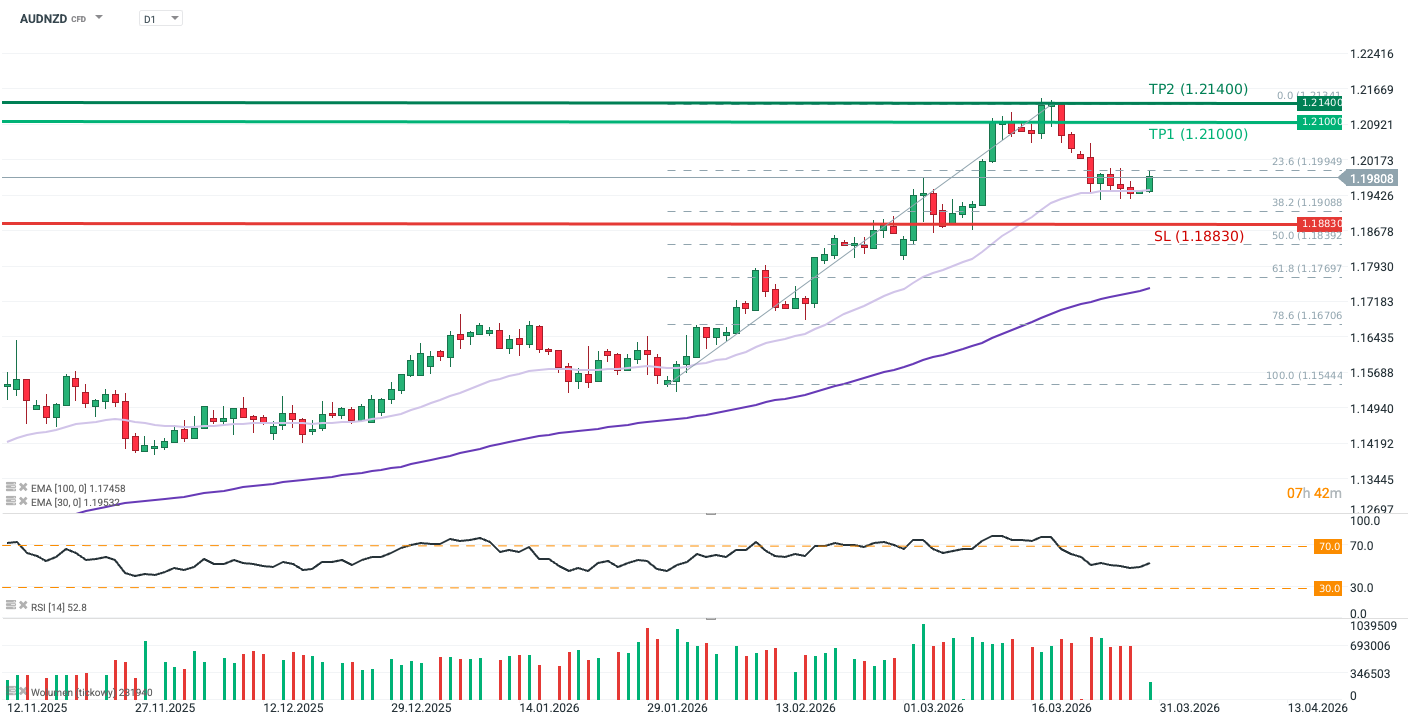


Trade of The Day – AUD/NZD

March 30, 2026

Facts

  • AUDNZD rebounded from the 30-day exponential moving average (EMA30; light purple) during today’s session.
  • The swap market (OIS curve) currently prices an approximately 60% probability of an interest rate hike in Australia for May, compared to approximately 8% in New Zealand.
  • The RSI stands at approximately 52, remaining well below the overbought threshold (i.e., below 70).

Recommendation

  • Long Position (BUY) at market price
  • Target Prices (Take Profit): 1.21000 (TP1), 1.21400 (TP2)
  • Stop Loss (SL): 1.18830

Source: xStation5

Opinion

AUDNZD recently underwent a correction triggered by a global decline in risk appetite and concerns regarding an economic slowdown in China. As China is highly dependent on Iranian oil, its trade ties with the Australian mining industry significantly influence the Australian dollar’s valuation. However, the downward move stalled at the EMA30; after several days of sideways trading, the pair rebounded, signaling a likely continuation of the broader uptrend.

While global inflation concerns driven by energy prices remain prevalent, the Reserve Bank of Australia (RBA) continues to position itself as the most hawkish central bank among G10 nations, with rates currently at 4.10%. This creates a favorable carry trade opportunity against the significantly more dovish Reserve Bank of New Zealand (RBNZ), where rates stand at 2.25%.

The 10-year bond yield spread between the two economies has remained stable since early March (at approximately 30 bps). Therefore, in the short term, Australia’s active hiking cycle should continue to support the AUDNZD trend. A primary risk factor would be a decisive pivot from the RBNZ; according to the OIS curve, markets expect the RBNZ to resume hikes in the autumn, potentially ending the year with rates at 3%.

Methodology

This recommendation was prepared based on a technical analysis of the AUDNZD chart and a fundamental analysis of both economies (focusing on Australian and New Zealand monetary policy). The directional bias was determined using moving averages, price action, and market expectations regarding central bank responses to the ongoing conflict in Iran. Take Profit and Stop Loss levels were set using Price Action methodology (TP1 at the nearest resistance, TP2 at the recent peak, and SL at the nearest swing low).


AUD/USD weakens on Middle East tensions as markets await RBA minutes

March 30, 2026
  • AUD/USD weakens as rising geopolitical tensions in the Middle East weigh on investor sentiment.
  • Threats to key Oil shipping routes and the involvement of the Houthis increase fears of a broader escalation.
  • Markets continue to assess the outlook for Australian interest rates ahead of the RBAโ€™s minutes release.

AUD/USD trades around 0.6860 on Monday at the time of writing, down 0.21% on the day, as investors adopt a cautious stance amid escalating geopolitical tensions in the Middle East.

Market sentiment remains fragile after Iran-backed Houthi forces in Yemen joined the conflict between Israel and Iran. Over the weekend, the militants launched missiles toward Israel and threatened to close the Bab el-Mandeb Strait, a strategic shipping route for Middle Eastern Oil supplies. This new source of uncertainty has increased fears of a broader regional escalation and added volatility to financial markets.

In this environment ofย risk aversion, growth-sensitive currencies such as the Australian Dollar (AUD) tend to come under pressure, while investors shift toward assets perceived as safer. The conflict is also complicating theย outlookย for energy markets, with some analysts warning that Oil prices could rise further if maritime routes are disrupted.

On the political front, US President Donald Trump said on Monday that Washington is holding โ€œserious discussionsโ€ with what he described as a new regime in Iran in an effort to end military operations. However, he also warned that the US could launch massive strikes against Iranian energy infrastructure if a deal is not reached quickly or if the Strait of Hormuz remains closed to commercial traffic.

Markets have reacted cautiously to these remarks. Iranian officials have expressed skepticism about the negotiations, accusing Washington of speaking about diplomacy while preparing the ground for a possible military invasion.

On the Australian side, investors are focusing on the upcoming release of the minutes from the latest Reserve Bank of Australia (RBA) meeting, scheduled for Tuesday. The central bank raised its key interest rate by 25 basis points at that meeting, bringing the cash rate to 4.1%. Traders will look for clues in the minutes about the policy outlook in the coming months.

According to the ASXโ€™s RBA Rate Tracker, markets currently price in about a 69% chance of another rate hike at the May 5 meeting. Confirmation of this outlook could provide support to the Aussie, although geopolitical risks and shifts in global risk appetite remain key drivers forย AUD/USDย in the near term.

Australian Dollar Price Today

The table below shows the percentage change of Australian Dollar (AUD) against listed major currencies today. Australian Dollar was the strongest against the New Zealand Dollar.

USDEURGBPJPYCADAUDNZDCHF
USD0.20%0.24%-0.59%0.20%0.19%0.46%0.09%
EUR-0.20%0.03%-0.77%0.00%0.04%0.26%-0.12%
GBP-0.24%-0.03%-0.82%-0.02%-0.01%0.23%-0.15%
JPY0.59%0.77%0.82%0.79%0.78%1.03%0.66%
CAD-0.20%-0.00%0.02%-0.79%-0.01%0.19%-0.13%
AUD-0.19%-0.04%0.01%-0.78%0.01%0.24%-0.11%
NZD-0.46%-0.26%-0.23%-1.03%-0.19%-0.24%-0.38%
CHF-0.09%0.12%0.15%-0.66%0.13%0.11%0.38%

The heat map shows percentage changes of major currencies against each other. The base currency is picked from the left column, while the quote currency is picked from the top row. For example, if you pick the Australian Dollar from the left column and move along the horizontal line to the US Dollar, the percentage change displayed in the box will represent AUD (base)/USD (quote).

Currency Talk – EUR/NZD, EUR/CAD, AUD/USD

March 30, 2026

The Overbalance analysis aims to identify three financial instruments, analyzed primarily on the daily/four-hour (D1/H4) timeframe. The analysis uses only the Overbalance methodology, which helps determine where a trend may continue or where it may reverse.
Todayโ€™s analysis covers three instruments, evaluated solely in terms of 1:1 correction structures.

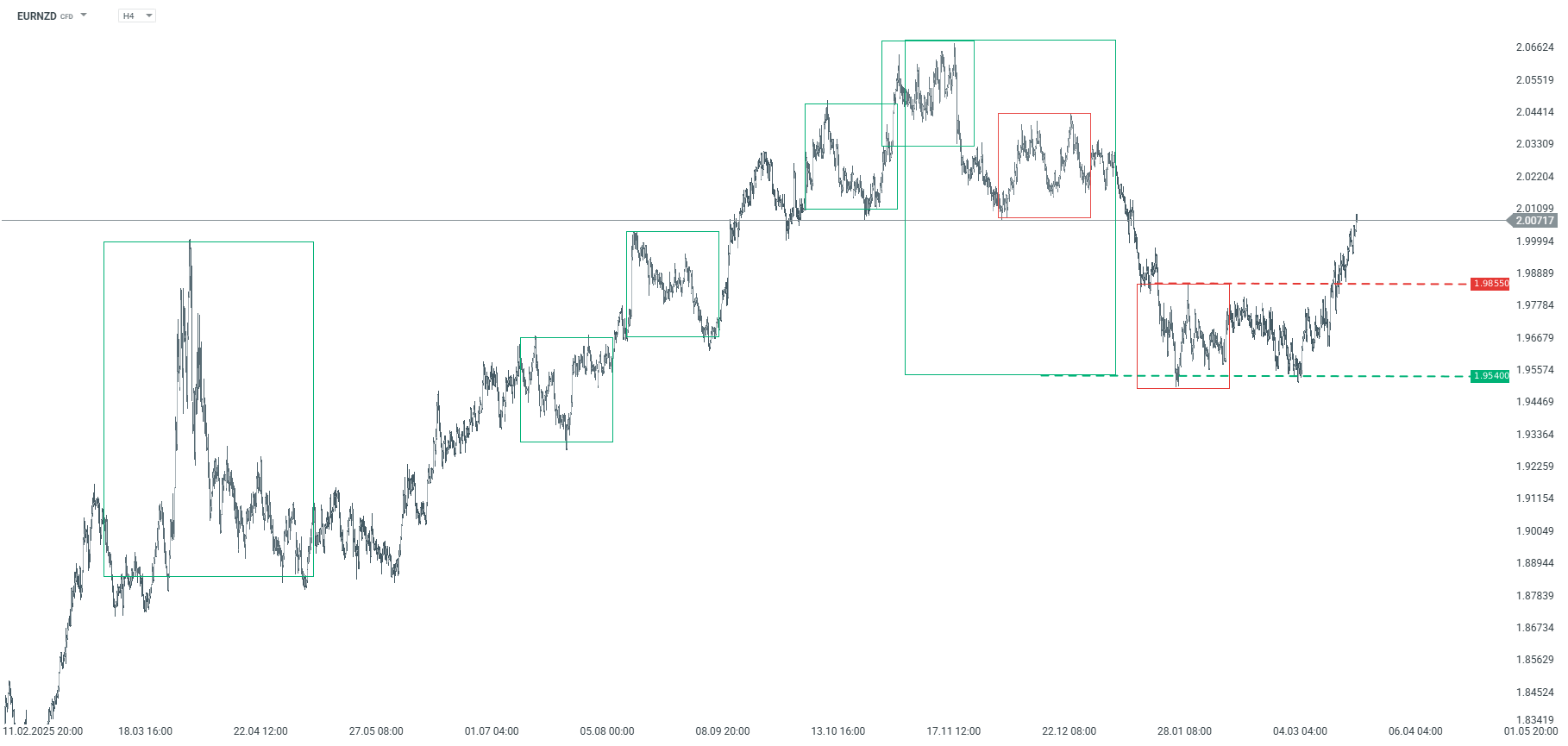
EURNZD
Last week, the EURNZD broke through key resistance at 1.9855, which corresponded to the upper boundary of the 1:1 geometric pattern. According to the Overbalance methodology, this breakout suggests potential for a move toward last Novemberโ€™s highs, around 2.0680. An additional argument in favor of the bullish scenario is the earlier double bounce off support at 1.9540. In the event of a correction, the 1.9855 level should act as short-term support.

EURNZD – H4 timeframe. Source: xStation

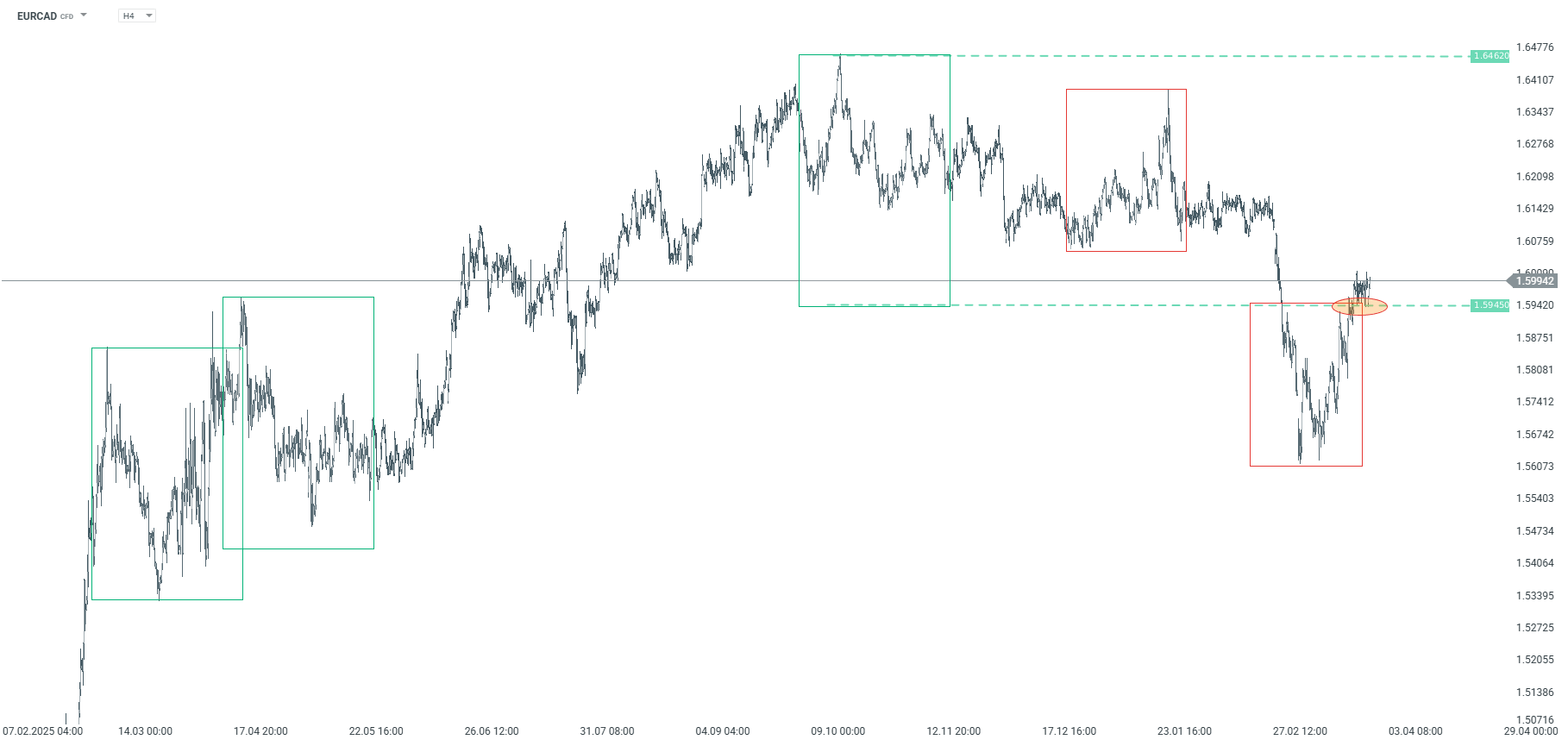
EURCAD
The EURCAD pair is attempting to resume its upward trend. The price has broken above the upper boundary of the 1:1 bearish pattern at the 1.5945 level and has also broken above the polarity of the previous bullish pattern, which falls exactly at the same point. According to the Overbalance methodology, as long as the price remains above the 1.5945 level, the bullish scenario remains in effect.

EURCAD – H4 timeframe. Source: xStation

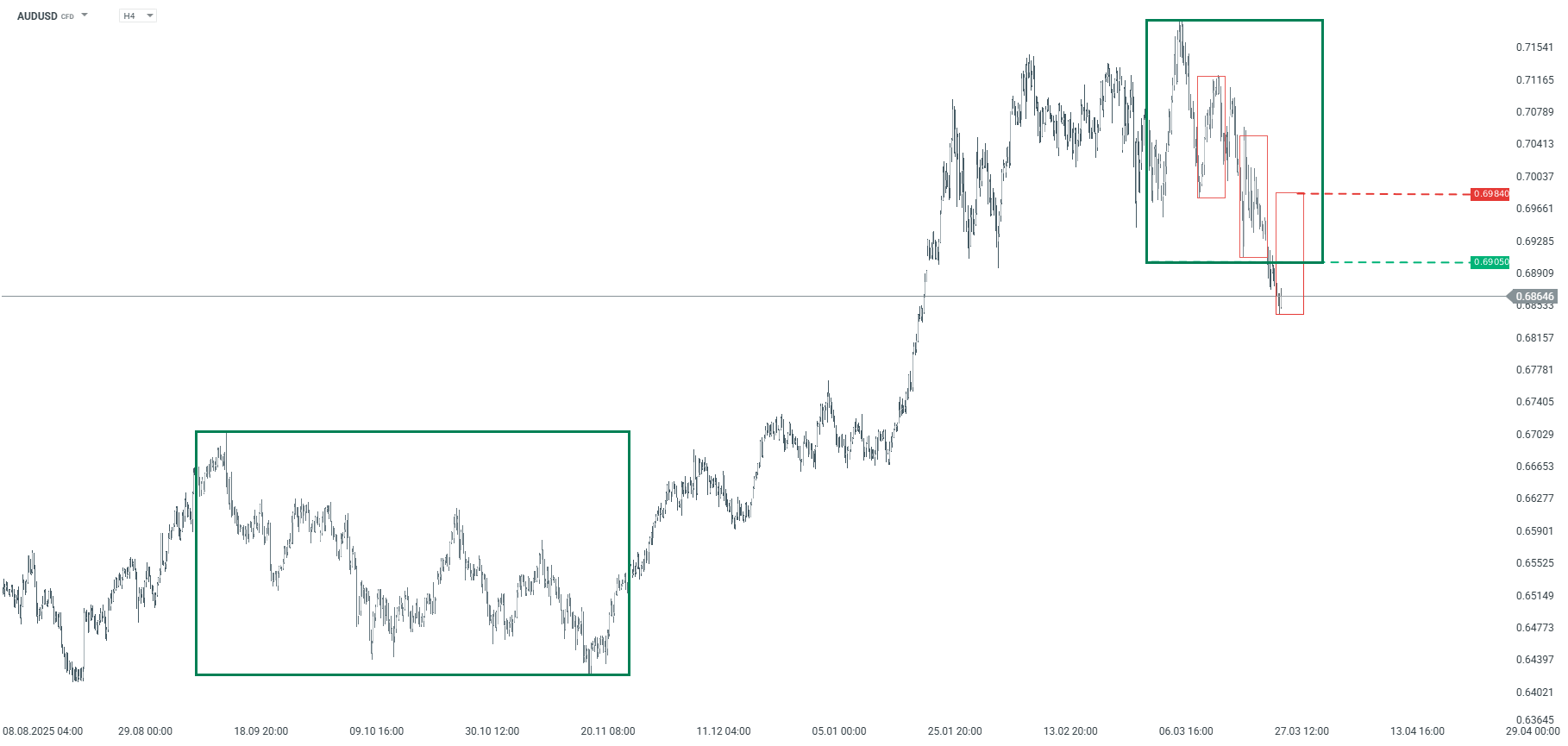
AUDUSD
The AUDUSD price has broken below the key support level at 0.6905, which corresponded to the lower boundary of a broad 1:1 pattern. A break below this level could support a scenario involving a deeper correction or even a trend reversal. Currently, the 0.6905 level acts as key resistance. To signal a return to an uptrend, the price would need to additionally break above the 0.6984 level, where the upper boundary of the local 1:1 downtrend pattern is located.

AUDUSD – H4 chart. Source: xStation

The material on this page does not constitute financial advice and does not take into account your level of understanding, investment objectives, financial situation or any other specific needs. All information provided, including opinions, market research, mathematical results and technical analyzes published on the Website or transmitted To you by other means, it is provided for information purposes only and should in no way be construed as an offer or solicitation for a transaction in any financial instrument, nor should the information provided be construed as advice of a legal or financial nature on which any investment decisions you make should be based exclusively To your level of understanding, investment objectives, financial situation, or other specific needs, any decision to act on the information published on the Website or sent to you by other means is entirely at your own risk if you In doubt or unsure about your understanding of a particular product, instrument, service or transaction, you should seek professional or legal advice before trading. Investing in CFDs carries a high level of risk, as they are leveraged products and have small movements Often the market can result in much larger movements in the value of your investment, and this can work against you or in your favor. Please ensure you fully understand the risks involved, taking into account investments objectives and level of experience, before trading and, if necessary, seek independent advice.

Euro Heads for Over 2% Monthly Loss as Middle East Risks Weigh

March 30, 2026

The euro held steady at $1.15 by the end of March, poised for a monthly decline of over 2% against the US dollar. Traders offloaded riskier assets as concerns mounted over the economic fallout from the escalating Middle East conflict, with reports suggesting thousands of US troops were preparing for a potential ground operation, despite Washingtonโ€™s insistence that diplomatic talks with Iran were progressing. Investors also turned their attention to a wave of key economic data due this week, including March inflation flash estimates from Europeโ€™s major economies. Market sentiment has shifted sharply on ECB policy, with traders now pricing in at least two interest rate hikes this year and a growing possibility of a third, abandoning earlier expectations of a 40% chance of a rate cut in 2026.

Sterling Nears 1% Monthly Drop on Middle East Jitters

March 30, 2026

The British pound drifted toward $1.32, lingering near its lowest since early December and on track for a monthly decline of over 1% against the US dollar. Risk aversion dominated markets as traders assessed the economic risks from the protracted Middle East conflict, with reports of US troop preparations for a potential ground operation overshadowing Washingtonโ€™s claims of progress in Iran negotiations. Meanwhile, Bank of England policy expectations underwent a dramatic shift: markets now anticipate at least two rate hikes in 2026, with a possible third, reversing earlier bets on two cuts.

NZD/USD Price Forecast: Attracts bids near 0.5725 as risk-on revives

March 30, 2026
  • NZD/USD recovers early losses and turns flat around 0.5745 as investorsโ€™ risk appetite improves.
  • Middle East conflicts have intensified following the Iran-backed Houthis’ entry.
  • The US Dollar ticks down ahead of Fed Powellโ€™s speech.

The NZD/USD pair claws back its early losses and flattens around 0.5745 during the early European trading session on Monday. The Kiwi pair bounces back from its over two-month low of 0.5725, the lowest low seen in over two months. The pair attracts bids as the New Zealand Dollar (NZD) bounces back due to the revival of the risk-on impulse.

During the European trading session, S&P 500 futures have recovered their opening losses and turned slightly positive around 6,375.

Investorsโ€™ risk appetite has improved despite the war in the Middle East intensifying. Conflicts between the United States (US), Israel, and Iran have escalated due to a report from the Wall Street Journal (WSJ) claiming that the Pentagon is preparing to send 10,000 additional military troops for the ground invasion on Iran.

In addition to potential US ground military action, the entry of Iran-backed Houthis in the ongoing war has also widened geopolitical tensions.

Meanwhile, the US Dollar (USD) trades marginally lower ahead of the Federal Reserveโ€™s (Fed) Chair Jerome Powellโ€™s speech at 14:30 GMT. As of writing, the US Dollar Index (DXY), which tracks the Greenbackโ€™s value against six major currencies, ticks down to near 100.10.

NZD/USD technical analysis

In the daily chart,ย the NZD/USD pairย maintains a bearish near-term bias as price holds below the 20-day Exponential Moving Average (EMA), which is bending lower and tracking the recent sequence of lower highs.

Momentum confirms selling pressure, with the RSI slipping toward the mid-30s and extending its decline from neutral territory, indicating sellers keep control while avoiding oversold conditions for now.

Initial resistance emerges at the 20-day EMA near 0.5840, and a daily close above this area would be needed to ease immediate downside pressure and open 0.5920 as the next upside level. On the downside, minor support sits at 0.5700, followed by a lower band around 0.5650, where a break would extend the current downtrend and expose the 0.5600 area as the next bearish target.

USD/CHF rebounds toward two-month highs near 0.8000 as KOF index weakens

March 30, 2026
  • USD/CHF appreciated after the Swiss KOF Leading Indicator fell to 96.1 in February.
  • SNB may intervene in FX markets to curb excessive CHF strength and maintain price stability.
  • The US Dollar may strengthen on rising safe-haven demand amid fears of a potential US ground invasion in Iran.

USD/CHF continues its winning streak for the fifth successive day, trading around a two-month high of 0.8000 during the early European hours on Monday. The pair recovers its daily losses following the release of the Swiss KOF Leading Indicator, which fell to 96.1 in February, from 103.8 (revised from 104.2) in January.

However, the downside ofย the USD/CHF pairย could be restrained as the Swiss Franc (CHF) may face challenges as Swiss National Bank (SNB) Chair Martin Schlegel expressed the SNBโ€™s readiness to intervene in FX markets to curb sharp and excessive currency swings and safeguard price stability. Additionally, SNB board member Petra Tschudin also emphasized the central bankโ€™s increased willingness to step in and limit further strength in the Swiss Franc.

Moreover, the US Dollar (USD) may regain its ground against the major peers amid increased safe-haven demand, which could be attributed to fears of a potential United States (US) ground invasion in Iran.

A Wall Street Journal (WSJ) report suggested last week that the US Pentagon could deploy 10,000 additional troops to Iran. In response, Ebrahim Zolfaqari issued a stark warning on Iranian state TV, stating that โ€œUS troops will be good food for sharks of the Persian Gulf.โ€

Iran-backed Houthi forces in Yemen launched their first strikes on Israel over the weekend, widening the regional conflict and warning that attacks will continue until operations against Iran and its allies cease. The group also threatens Red Sea shipping routes and key Saudi energy infrastructure, heightening risks to global supply.

US economic data releasesย this week, including various labor market-linked indicators, particularly the Nonfarm Payrolls (NFP), as well as the ISM Purchasing Managersโ€™ Index (PMI), are expected to influence market expectations for theย Federal Reserveย (Fed) monetary policyย outlook.

AUD/USD edges up from from 0.6840 low but risk aversion limits rallies

March 30, 2026
  • AUD/USD rebound from 0.6842 lows fails to find acceptance above 0.6870.
  • The risk-averse mood weighs on the Aussie as the Iran war complicates.
  • Analysts at UOB contemplate a further decline towards 0.6765.

Theย Aussie Dollarย (AUD) is trimming losses against the US Dollar (USD) on Monday. The pair bounced from two-month lows around 0.6840 but is struggling to rise above 0.6870, as negative market sentiment keeps weighing on any significant Aussie recovery.

Investors’ mood remains sour on Monday, as the Middle East War gets messier by the day. The irruption of the Iran-backed Houthis in Yemen this weekend has added a new variable to an already complicated scenario, blurring any swift end to the conflict. The Houthis have launched missiles at Israel from Yemen, and threatened to close the Strait of Bab el Mandab, another bottleneck for Saudi Oil supply, which might trigger a further escalation in Crude prices.

Scepticism about Trump’s “negotiations”

Meanwhile, US President Donald Trump has reiterated that there are direct and indirect talks with the Iranian leaders, praising their โ€œvery reasonable” attitude, and Pakistan offered to hold talks between the US and Iran.

Investors, however, have taken these comments in stride, as Tehran remains sceptical. Iranโ€™s Parliament Speaker, Mohammed Baqer Qalibat, accused the US of sending messages about negotiations while preparing a ground invasion, and other Iranian leaders threatened with a bloodbath if that invasion finally takes place.

Bearing this in mind, rallies in the risk-sensitive Aussie are likely to find sellers.ย Technical analysts at UOBย see the pair in a bearish trend with 0.6765 as a potential target: โ€œWhile the weekly MACD remains in positive territory, it has been heading steadily lower over the past few weeks (…) The overall technical picture suggests that AUD/USD could continue to head lower. A clear break below the 0.6850/0.6870 support zone could potentially trigger a sharp decline toward 0.6765.”