

NZD/USD Price Forecast: Attracts bids near 0.5725 as risk-on revives

March 30, 2026
  • NZD/USD recovers early losses and turns flat around 0.5745 as investors’ risk appetite improves.
  • Middle East conflicts have intensified following the Iran-backed Houthis’ entry.
  • The US Dollar ticks down ahead of Fed Powell’s speech.

The NZD/USD pair claws back its early losses and flattens around 0.5745 during the early European trading session on Monday. The Kiwi pair bounces back from its over two-month low of 0.5725, the lowest low seen in over two months. The pair attracts bids as the New Zealand Dollar (NZD) bounces back due to the revival of the risk-on impulse.

During the European trading session, S&P 500 futures have recovered their opening losses and turned slightly positive around 6,375.

Investors’ risk appetite has improved despite the war in the Middle East intensifying. Conflicts between the United States (US), Israel, and Iran have escalated due to a report from the Wall Street Journal (WSJ) claiming that the Pentagon is preparing to send 10,000 additional military troops for the ground invasion on Iran.

In addition to potential US ground military action, the entry of Iran-backed Houthis in the ongoing war has also widened geopolitical tensions.

Meanwhile, the US Dollar (USD) trades marginally lower ahead of the Federal Reserve’s (Fed) Chair Jerome Powell’s speech at 14:30 GMT. As of writing, the US Dollar Index (DXY), which tracks the Greenback’s value against six major currencies, ticks down to near 100.10.

NZD/USD technical analysis

In the daily chart, the NZD/USD pair maintains a bearish near-term bias as price holds below the 20-day Exponential Moving Average (EMA), which is bending lower and tracking the recent sequence of lower highs.

Momentum confirms selling pressure, with the RSI slipping toward the mid-30s and extending its decline from neutral territory, indicating sellers keep control while avoiding oversold conditions for now.

Initial resistance emerges at the 20-day EMA near 0.5840, and a daily close above this area would be needed to ease immediate downside pressure and open 0.5920 as the next upside level. On the downside, minor support sits at 0.5700, followed by a lower band around 0.5650, where a break would extend the current downtrend and expose the 0.5600 area as the next bearish target.

NZD/USD trades with caution near 0.5800 as Iran rejects US ceasefire proposal

March 26, 2026
  • NZD/USD remains on the edge around 0.5800 as Iran wants the US to fulfil its demands before ceasefire talks.
  • Major demands from Iran include the guarantee of a total end to the war, and the closure of US bases in the Middle East.
  • RBNZ’s Breman said that monetary policy adjustments could be done on either side.

The NZD/USD pair trades cautiously near 0.5800 during the Asian trading session on Thursday. The Kiwi is under pressure as Iran’s rejection to ceasefire proposal and 15-point settlement plan by United States (US) President Donald Trump has raised concerns over hopes of de-escalation in Middle East conflicts.

On Wednesday, Iran’s Fars news agency reported that Tehran doesn’t see the truce and talks as viable in current conditions. Also, Iran demands completion of its key demand before involving in direct talks with Washington, Wall Street Journal (WSJ) reported, which includes the closure of all US bases in the Gulf, reparations for attacks, lifting all sanctions, allowing Iran to retain its missile program without restrictions, and the recognition of Iran’s authority over the Strait of Hormuz.

Uncertainty surrounding the outlook of the war in the Middle East has improved the demand for safe-haven assets, such as the US Dollar (USD). As of writing, the US Dollar Index (DXY), which tracks the Greenback’s value against six major currencies, clings to Wednesday’s gains around 99.65.

In addition to heightened geopolitical tensions, firm expectations that the Federal Reserve (Fed) will not commit any dovish monetary policy adjustment this year are also keeping the US Dollar on the front foot.

In New Zealand (NZ), the central bank has warned of high inflation and has kept the likelihood of monetary policy adjustment on either side. “We don’t want to react too soon to inflationary pressures that we can do little about, but we don’t want to wait too long in case we see those inflationary pressures becoming more-long lasting, Reserve Bank of New Zealand Governor Anna Breman said earlier this week, Reuters reports, and added, “I will not rule out either rate hikes or rate cuts because of the uncertainty in the global environment.”

Currency Talk – GBP/AUD AUD/NZD EUR/AUD

March 25, 2026

The Overbalance analysis aims to identify three financial instruments, analyzed primarily on the daily/four-hour (D1/H4) timeframe. The analysis uses only the Overbalance methodology, which helps determine where a trend may continue or where it may reverse.
Today’s analysis covers three instruments, evaluated solely in terms of 1:1 correction structures.

GBPAUD
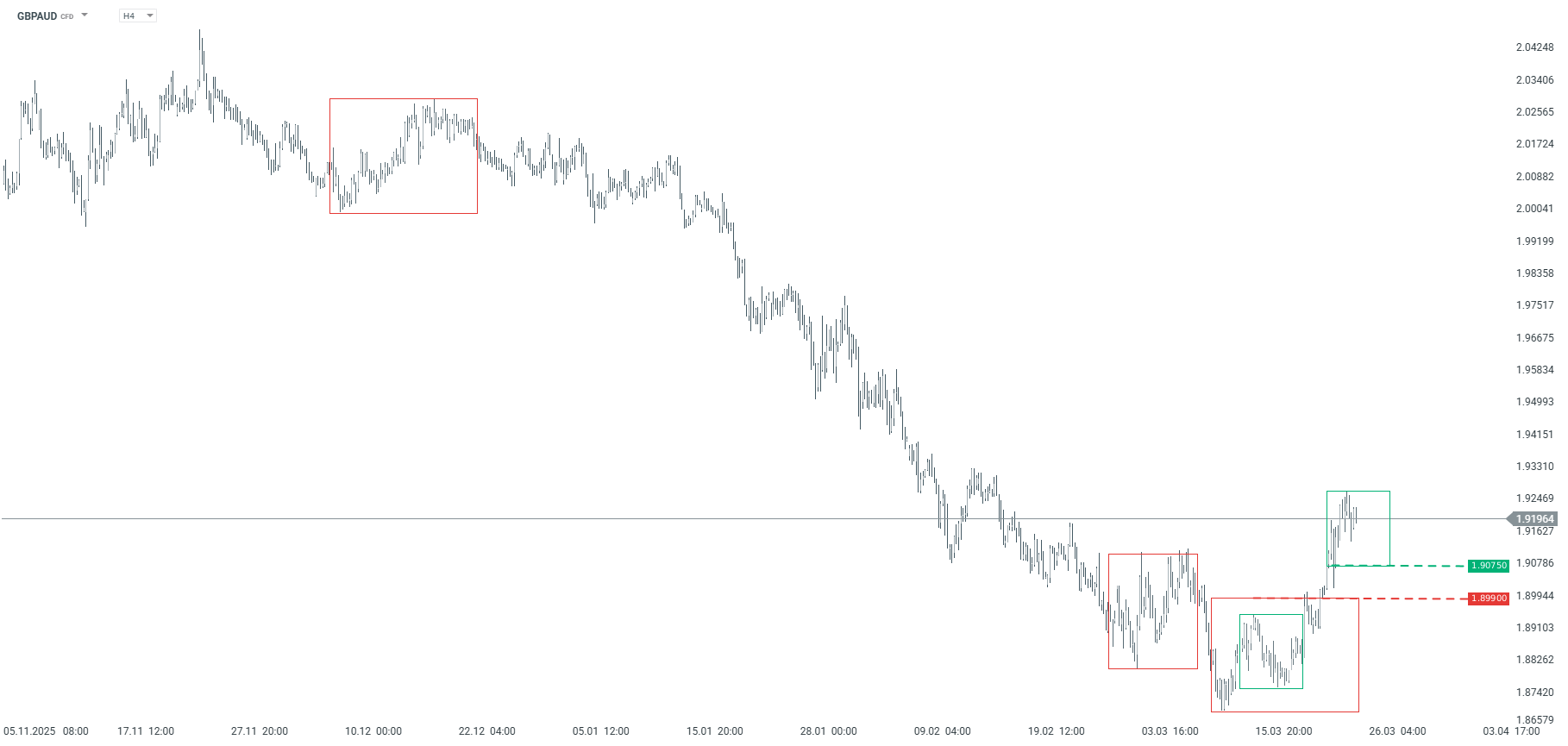
Since last November, the GBPAUD currency pair has been trading in a downtrend; however, in mid-March, the upper boundary of the broad 1:1 pattern was broken at the 1.8990 level, which may indicate a shift in sentiment toward an uptrend. Currently, the 1.8975 level should be considered key short-term support, as it marks the lower boundary of the local 1:1 bullish pattern. According to the Overbalance methodology, as long as this level holds, further expansion of the upward movement is possible. Conversely, a drop back below 1.8990 could signal a resumption of the downward trend.

GBPAUD – H4 timeframe. Source: xStation

AUDNZD
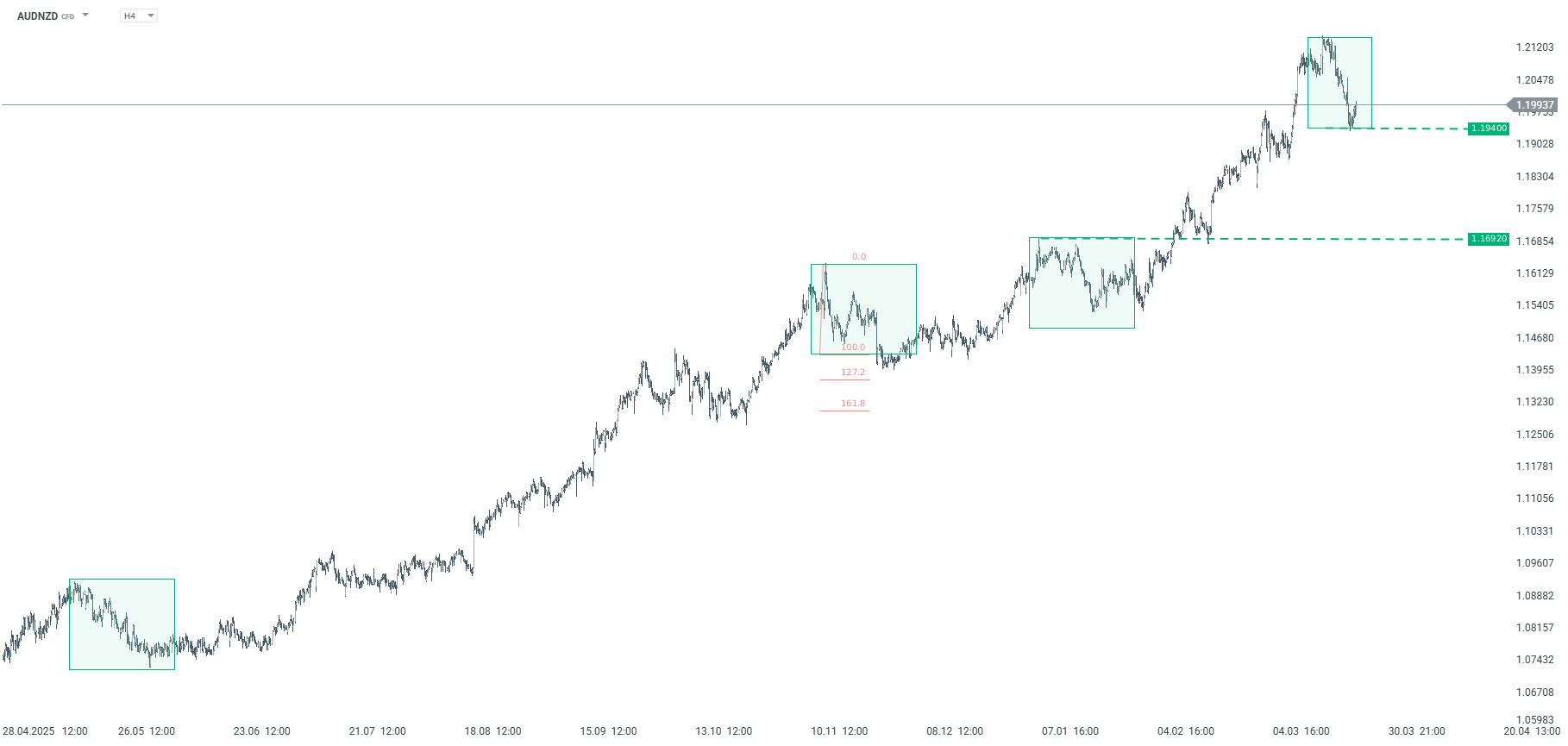
The AUDNZD exchange rate has been in an uptrend since April of last year. Due to the prolonged period without a major correction, the recent downward move is similar in magnitude to previous corrections, allowing us to identify support at the 1.1730 level, where the lower boundary of the 1:1 pattern is located. According to the Overbalance methodology, as long as this level holds, the uptrend remains in effect.

AUDNZD – H4 timeframe. Source: xStation

EURAUD
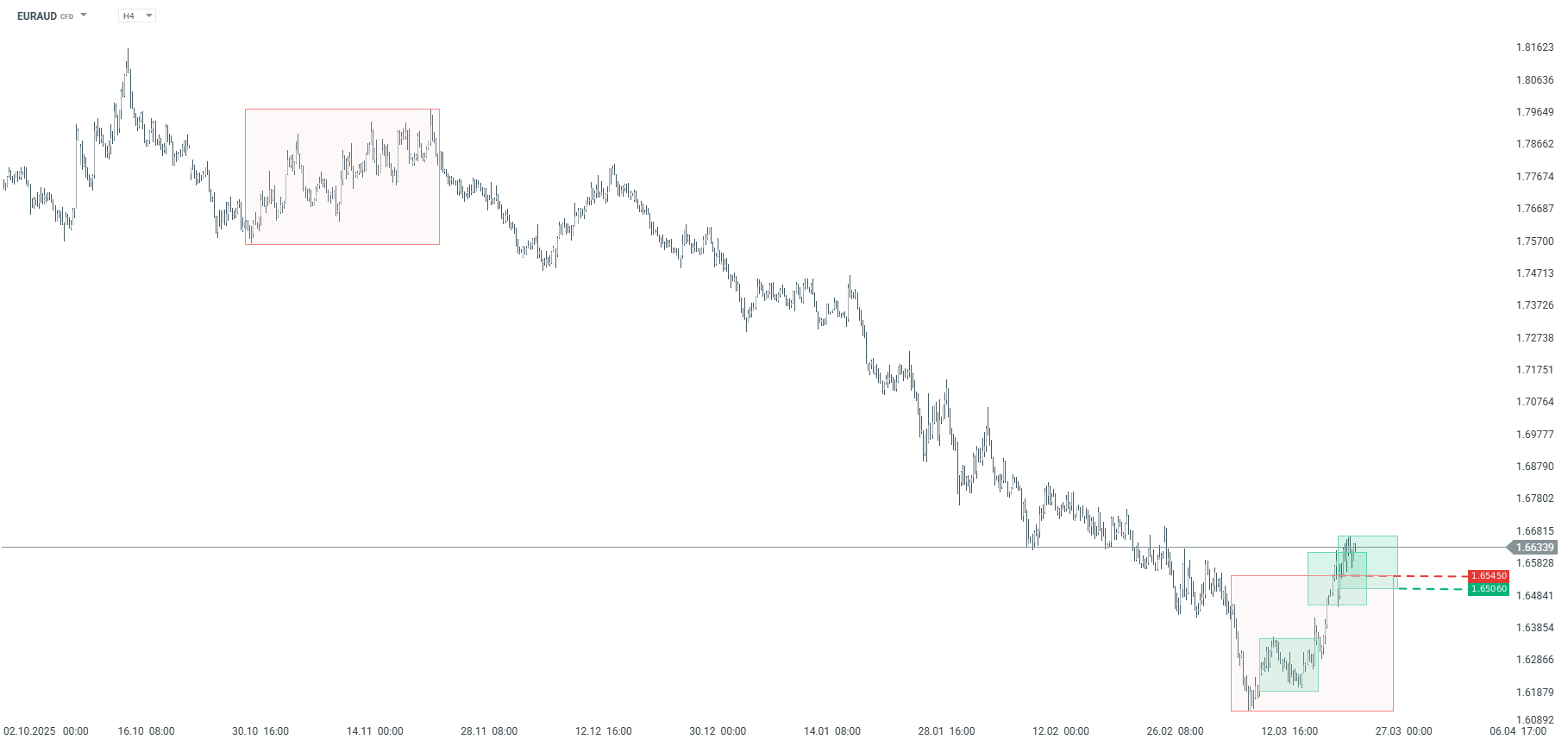
Since last October, the EURAUD pair has been trading in a downtrend; however, in recent days, the 1.6545 level has been broken, which may suggest the start of an upward correction or even a trend reversal. According to the Overbalance methodology, as long as the price remains above this level, the base case scenario remains a continuation of the uptrend. Conversely, a return below 1.6545, as well as a break below the 1.6506 level—where the lower boundary of the local 1:1 uptrend pattern lies—could signal a return to the downtrend. For now, the base case remains an upward correction.

EURAUD – H4 timeframe. Source: xStation

The material on this page does not constitute financial advice and does not take into account your level of understanding, investment objectives, financial situation or any other specific needs. All information provided, including opinions, market research, mathematical results and technical analyzes published on the Website or transmitted To you by other means, it is provided for information purposes only and should in no way be construed as an offer or solicitation for a transaction in any financial instrument, nor should the information provided be construed as advice of a legal or financial nature on which any investment decisions you make should be based exclusively To your level of understanding, investment objectives, financial situation, or other specific needs, any decision to act on the information published on the Website or sent to you by other means is entirely at your own risk if you In doubt or unsure about your understanding of a particular product, instrument, service or transaction, you should seek professional or legal advice before trading. Investing in CFDs carries a high level of risk, as they are leveraged products and have small movements Often the market can result in much larger movements in the value of your investment, and this can work against you or in your favor. Please ensure you fully understand the risks involved, taking into account investments objectives and level of experience, before trading and, if necessary, seek independent advice.