

NZD/USD – Hawkish RBNZ Decision And TACO Trade Support The NZD

April 8, 2026

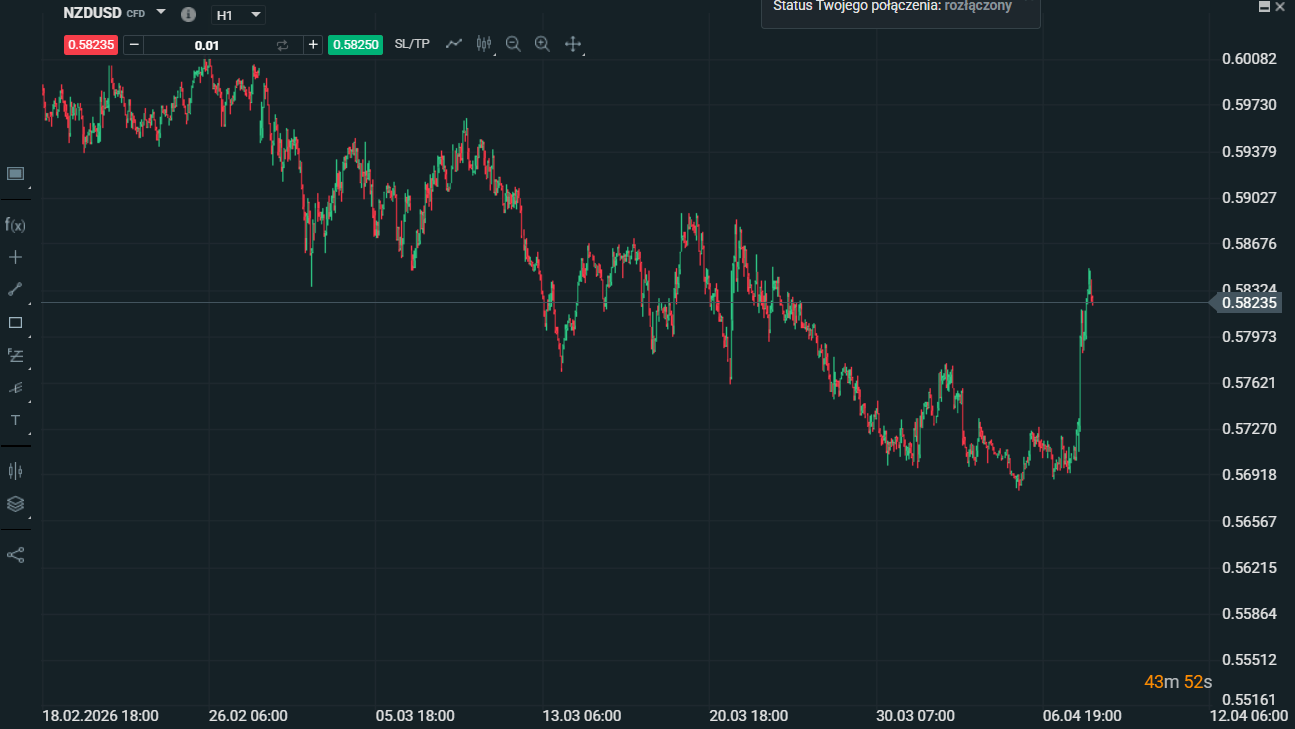
NZDUSD gained as much as 2.00% following the RBNZ decisionsupported both by the more hawkish tone of the central bank and the global move after the de-escalation of US–Iran tensions. The kiwi reached around 0.5844 (currently 0.5824). Investors interpreted the decision as a hawkish pause. The RBNZ emphasized that if inflationary pressure spreads beyond energy and begins to affect wages, pricing behavior, or inflation expectations, decisive and rapid rate hikes may be necessary.

The core message from the RBNZ is that the inflation outlook has worsened, even if growth conditions have not improved. The bank indicated that the conflict in the Middle East has significantly altered the outlook through supply chain disruptions and rising oil and fuel prices, which will translate into higher inflation in the short term. Official forecasts point to inflation at 3.0% in March and 4.2% in June, above the 1–3% target range, with key transmission channels including transport, airfares, and food.

At the same time, the RBNZ does not want to overreact to what may be a temporary supply shock. The bank stressed that the situation differs from 2022, as demand in the economy is currently much weaker and spare capacity should limit second-round inflation effects. This is important because domestic activity remains weak: GDP growth is minimal, financial conditions have tightened, and mortgage rates have increased. In other words, the RBNZ faces a difficult trade-off between rising inflation and a still fragile recovery.

Therefore, the decision was perceived as hawkish despite no rate hike. The committee considered more preemptive action to prevent inflation expectations from becoming unanchored but ultimately chose to wait for more data. There are also growing expectations that July could be the first possible timing for rate hikes if inflation pressures persist.

The market backdrop further strengthened the NZD move. The two-week US–Iran ceasefire triggered a strong risk-on move — US500 futures rose around 2.5%, oil prices declined, and the dollar weakened. This supported cyclical currencies, with the NZD standing out thanks to an additional domestic catalyst. At the time of writing, NZDUSD is gaining 1.67%.
The material on this page does not constitute financial advice and does not take into account your level of understanding, investment objectives, financial situation or any other specific needs. All information provided, including opinions, market research, mathematical results and technical analyzes published on the Website or transmitted To you by other means, it is provided for information purposes only and should in no way be construed as an offer or solicitation for a transaction in any financial instrument, nor should the information provided be construed as advice of a legal or financial nature on which any investment decisions you make should be based exclusively To your level of understanding, investment objectives, financial situation, or other specific needs, any decision to act on the information published on the Website or sent to you by other means is entirely at your own risk if you In doubt or unsure about your understanding of a particular product, instrument, service or transaction, you should seek professional or legal advice before trading. Investing in CFDs carries a high level of risk, as they are leveraged products and have small movements Often the market can result in much larger movements in the value of your investment, and this can work against you or in your favor. Please ensure you fully understand the risks involved, taking into account investments objectives and level of experience, before trading and, if necessary, seek independent advice.


JPY surges against US Dollar as Trump confirms two-week ceasefire

April 8, 2026
  • The Japanese Yen outperforms the US Dollar on the US-Iran temporary ceasefire.
  • Iran said that negotiations on the 10-point proposal with the US will begin on April 10.
  • A sharp decline in the oil price has improved the appeal of the Japanese Yen.

The Japanese Yen (JPY) trades significantly higher against the US Dollar (USD) on Wednesday, with the USD/JPY pair sliding 0.75% to near 158.40 during the Asian trading session. The pair faces intense selling pressure as demand for safe-haven assets has diminished, following the announcement of a two-week ceasefire between the United States (US) and Iran.

Japanese Yen Price Today

The table below shows the percentage change of Japanese Yen (JPY) against listed major currencies today. Japanese Yen was the strongest against the US Dollar.

USDEURGBPJPYCADAUDNZDCHF
USD-0.68%-0.82%-0.76%-0.34%-1.15%-1.62%-0.95%
EUR0.68%-0.15%-0.09%0.32%-0.47%-0.98%-0.29%
GBP0.82%0.15%0.04%0.49%-0.30%-0.80%-0.14%
JPY0.76%0.09%-0.04%0.42%-0.37%-0.85%-0.19%
CAD0.34%-0.32%-0.49%-0.42%-0.79%-1.26%-0.62%
AUD1.15%0.47%0.30%0.37%0.79%-0.49%0.17%
NZD1.62%0.98%0.80%0.85%1.26%0.49%0.66%
CHF0.95%0.29%0.14%0.19%0.62%-0.17%-0.66%

The heat map shows percentage changes of major currencies against each other. The base currency is picked from the left column, while the quote currency is picked from the top row. For example, if you pick the Japanese Yen from the left column and move along the horizontal line to the US Dollar, the percentage change displayed in the box will represent JPY (base)/USD (quote).

During the press time, the US Dollar Index (DXY), which gauges the Greenback’s value against six major currencies, is down 0.54% to near 99.00. S&P 500 futures rally almost 2.5% to near 6,777, signifying upbeat market sentiment.

Earlier in the day, US President Donald Trump announced a suspension of planned attacks on Iranian civilian infrastructure for two weeks, through a post on Truth.Social, as Tehran agreed to reopen the Strait of Hormuz, a critical gateway to almost 20% of global oil supply. Trump added, “We received a 10-point proposal from Iran, and believe it is a workable basis on which to negotiate.”

Meanwhile, Iranian officials have also acknowledged the Hormuz reopening and have stated that negotiations on the 10-point proposal with the US will begin on April 10 in Islamabad. Tehran clarified that the 10-point proposal includes controlled transit through the Hormuz coordinated with Iranian armed forces, ending the war against Iran and allied groups, and withdrawal of US combat forces from all regional bases.

The temporary ceasefire announcement between the US and Iran has resulted in a sharp decline in the WTI Oil price, which is down over 10% around $90.00. Lower oil prices bode well for currencies from economies like Japan, which rely heavily on oil imports to meet their energy needs.

Going forward, investors will focus on the US Federal Open Market Committee (FOMC) minutes of the March policy meeting, which will be published later in the day.

GBP advances as US-Iran ceasefire improves market sentiment

April 8, 2026
  • GBP/USD rises as the US Dollar weakens on reduced safe-haven demand after a US-Iran two-week ceasefire.
  • Trump agreed to a two-week ceasefire with Iran, conditional on reopening the Strait of Hormuz.
  • US-Iran ceasefire lowers oil prices, easing inflation pressures and giving the BoE room to resume policy easing.

GBP/USD extends its winning streak for the third consecutive day, trading around 1.3400 during the Asian hours on Wednesday. The pair appreciates as the US Dollar (USD) declines on decreased safe-haven demand after the United States (US) and Iran agreed on a two-week ceasefire.

However, the GBP/USD pair’s upside may be limited as the Pound Sterling (GBP) could struggle after the US-Iran ceasefire eased oil prices, dampening inflation pressures and giving the Bank of England (BoE) room to resume easing. Prior to the conflict, markets had priced in two to three rate cuts for 2026, expectations that were later erased by the energy-driven inflation shock.

US President Donald Trump shared in a post on Truth Social late Tuesday that he’d agreed to a two-week ceasefire with Iran on the condition that Iran agree to reopen the critical Strait of Hormuz. A White House official said that Israel has also agreed to the ceasefire.

Moreover, an Iranian official said that negotiations with the US will be held in Islamabad, Pakistan, to finalize details, aiming to confirm Iran’s battlefield achievements politically within a maximum of 15 days. Iran added that the meeting will begin on Friday and may be extended if both sides agree.

However, Iranian attacks continue in the Middle East and Israel as missile alerts keep sounding. The Israeli military said it has identified missiles launched from Iran towards Israel. The Qatar Defence Ministry also confirmed that armed forces intercepted the missile attack targeting Qatar.

Offshore Yuan Rallies to Over 3-Year High

April 8, 2026

The offshore yuan strengthened to around 6.82 per dollar on Wednesday, continuing its upward momentum for a fourth consecutive session and reaching its highest level since February 2023, primarily driven by a pressured greenback following a ceasefire announcement.

President Donald Trump revealed that the US and Iran had reached a two-week ceasefire agreement, narrowly averting what the president had previously warned could escalate into an attack with catastrophic consequences for the region. Shortly after the announcement, Iranian Foreign Minister Seyed Abbas Araghchi stated that access to the Strait of Hormuz would be possible through coordination with Iran’s Armed Forces. Domestically, investors are turning their attention to China’s upcoming inflation data, due later this week. Analysts expect a slight uptick in annual consumer prices, while producer prices are projected to see its first annual rise since September 2022.

EUR/USD – Rises above 1.1650, moving averages amid bullish reversal

April 8, 2026
  • EUR/USD may rise toward the six-week high of 1.1795.
  • The 14-day Relative Strength Index at 56 indicates positive momentum above the midline.
  • The immediate support lies at the 50-day EMA of 1.1632.

EUR/USD extends its winning streak for the third successive day, trading around 1.1670 during Asian hours on Wednesday. The daily chart technical analysis indicates a bullish reversal as the pair is rising above the descending channel pattern.

The EUR/USD pair has rebounded above the nine-day and 50-day Exponential Moving Averages (EMAs), framing a tentative bullish bias after an earlier downside phase.

The 14-day Relative Strength Index (RSI) momentum indicator at 56 shows positive momentum above the midline, backing the recovery and reducing immediate downside pressure. This configuration points to buyers regaining control as long as the EUR/USD pair holds above recent breakout levels, with scope for an extension higher if it can sustain above the shorter moving average cluster.

On the upside, the EUR/USD pair may target the six-week high of 1.1795, reached on March 2. Further advances would support the pair in exploring the region around 1.2082, the highest since June 2021, reached on January 27.

The EUR/USD pair may find the immediate support at the 50-day EMA of 1.1632, followed by the nine-day EMA of 1.1575. A return to the descending channel would put downward pressure on the pair to test the eight-month low of 1.1411, recorded on March 13. Further declines would put downward pressure on the pair to test the descending channel around 1.1220.

EUR/USD: Daily Chart

(The technical analysis of this story was written with the help of an AI tool.)

Euro Price Today

The table below shows the percentage change of Euro (EUR) against listed major currencies today. Euro was the strongest against the US Dollar.

USDEURGBPJPYCADAUDNZDCHF
USD-0.64%-0.77%-0.74%-0.32%-1.04%-1.49%-0.93%
EUR0.64%-0.14%-0.13%0.32%-0.40%-0.89%-0.30%
GBP0.77%0.14%0.00%0.46%-0.24%-0.72%-0.16%
JPY0.74%0.13%0.00%0.44%-0.26%-0.74%-0.17%
CAD0.32%-0.32%-0.46%-0.44%-0.70%-1.16%-0.61%
AUD1.04%0.40%0.24%0.26%0.70%-0.48%0.08%
NZD1.49%0.89%0.72%0.74%1.16%0.48%0.57%
CHF0.93%0.30%0.16%0.17%0.61%-0.08%-0.57%

The heat map shows percentage changes of major currencies against each other. The base currency is picked from the left column, while the quote currency is picked from the top row. For example, if you pick the Euro from the left column and move along the horizontal line to the US Dollar, the percentage change displayed in the box will represent EUR (base)/USD (quote).

NZD/USD sticks to gains near two-week top, around 0.5800 after RBNZ leaves rates unchanged

April 8, 2026
  • NZD/USD catches aggressive bids as the US-Iran ceasefire news weighs heavily on the USD.
  • The RBNZ leaves interest rates unchanged, doing little to influence the NZD or spot prices.
  • Traders now look to the RBNZ’s post-meeting press conference for short-term impetuses.

The NZD/USD pair turns positive for the third straight day following a modest Asian session dip to the 0.5700 mark and rallies to a nearly two-week top on Wednesday in reaction to the US-Iran ceasefire news. Spot prices stick to strong intraday gains above the 0.5800 mark and move little following the Reserve Bank of New Zealand (RBNZ) policy decision.

As was widely anticipated, the RBNZ decided to leave the Official Cash Rate (OCR) unadjusted at 2.25% for the second meeting in a row amid uncertainties over the economic and inflation outlook due to the Iran war. The announcement, however, does little to influence the New Zealand Dollar (NZD) or the NZD/USD pair as traders now look to RBNZ Governor Dr. Anna Breman’s comments during the post-meeting press conference for some meaningful impetus.

In the meantime, positive geopolitical developments remain supportive of the upbeat market mood, which undermines the US Dollar’s (USD) reserve currency status and acts as a tailwind for the NZD/USD pair. US President Donald Trump announced that he will suspend planned military strikes against Iran for two weeks, provided Tehran agrees to an immediate and safe opening of the Strait of Hormuz. Moreover, Iran’s Foreign Minister, Seyed Abbas Araghchi, said in a statement that Tehran will cease its defensive operations if attacks against the country are halted.

Iran’s foreign minister further added that safe passage through the key waterway will be possible for a period of two weeks, triggering a steep decline in Crude Oil prices and easing inflationary concerns. This tempers market bets for a rate hike by the US Federal Reserve (Fed), which, along with the risk-on impulse, continues to weigh on the safe-haven US Dollar (USD) and offers support to the NZD/USD pair.

AUD/JPY Gains momentum, bullish bias prevails above 100-day EMA

April 8, 2026
  • AUD/JPY strengthens to near 111.80 in Wednesday’s Asian session. 
  • The cross maintains the constructive outlook above the 100-day EMA, with bullish RSI momentum. 
  • The initial support level is located at 111.00; the first upside barrier emerges at 112.50.  

The AUD/JPY cross gathers strength to around 111.80 during the Asian trading hours on Wednesday. The Australian Dollar (AUD) edges higher against the Japanese Yen (JPY) amid improved risk sentiment. US President Donald Trump said late Tuesday that he had agreed “to suspend the bombing and attack of Iran for a period of two weeks” on the condition that Iran reopens the Strait of Hormuz.

Iranian Foreign Minister Seyed Abbas Araghchi stated that during the two weeks, safe passage through the Strait of Hormuz “will be possible via coordination with Iran’s Armed Forces and with due consideration of technical limitations.” Easing tensions in the Middle East undermines a safe-haven currency such as the JPY and acts as a tailwind for the cross in the near term. 

On the other hand, fears that Japanese authorities would step in to support the domestic currency might cap the downside for the JPY. Japan’s top currency diplomat Atsushi Mimura said last week that officials may need to take “decisive” steps if speculative moves persist in the currency market.

Chart Analysis AUD/JPY

Technical Analysis:

In the daily chart, the near-term bias of AUD/JPY is bullish as price extends its advance well above the 100-day exponential moving average around 107.50, confirming a dominant uptrend and resilient dip demand. The latest candles hold in the upper half of the Bollinger Band envelope, while the bands remain relatively wide, signalling sustained upside momentum rather than a volatility blow-off. RSI has rebounded toward the high-50s, recovering from mid-range readings and aligning with renewed buying pressure after the recent consolidation above the 111.00 handle.

Initial support emerges at 111.00, where recent lows converge with the mid-Bollinger zone, and a break below would expose deeper pullback risk toward the 110.00 area. Stronger downside protection aligns near the 109.00 region, close to the Bollinger lower band cluster and prior congestion, and a loss of this floor would weaken the broader bullish structure. On the topside, immediate resistance stands at the March 19 high of 112.61, followed by the upper boundary of the Bollinger Band of 113.15. 

Trade of The Day – GBP/AUD

April 7, 2026

Facts:
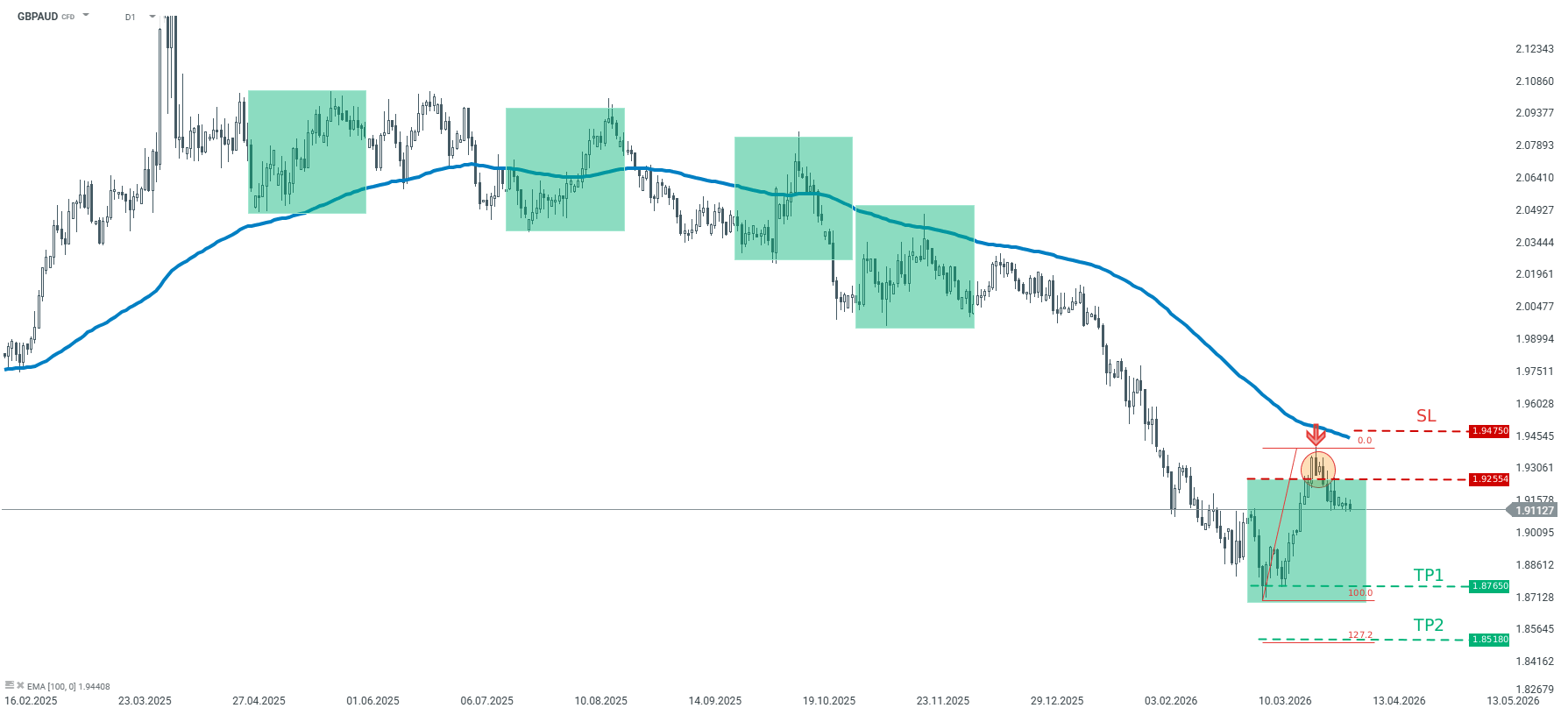
The price bounced off the upper limit of 1:1 structure at 1.9255
GBPAUD sits below the 100-period moving average form H4 interval

Recommendation: 
Trade: Short position on GBPAUD at market price
Target: 1.8765, 1.8518
Stop: 1.9475

Opinion: Looking at the GBPAUD chart at the H4 interval, one can see that the price bounced off the key resistance today. The price bounced off the resistance marked with the upper limit of 1:1 structure at 1.9255. According to the Overbalance strategy, as long as the price sits below the aforementioned resistance, the main trend remains downward. In addition the price sits below the 100-period moving average from the H4 interval which also confirms the bearish scenario.  We recommend going short GBPAUD at market price with two targets: 1.8765 and 1.8518. We also recommend placing a stop loss order at 1.9475 Source: xStation5