

Currency Hedger No Comments

Japanese Yen steadies on Middle East tensions, intervention caution

  • USD/JPY trades on a flat note near 157.25 in Tuesdayโ€™s early Asian session.
  • Rising tensions in the Middle East could boost the US Dollar.
  • Markets remain on high alert following suspected interventions by Japanese authorities.

The USD/JPY pair holds steady around 157.25 during the Asian trading hours on Tuesday. The latest developments in the Middle East send oil prices higher, sparking further fears of instability in the region. The US April ISM Services Purchasing Managers Index (PMI) report will be published due later on Tuesday. 

The United Arab Emirates said on Monday that it had intercepted a number of missiles fired from Iran. Thatโ€™s the first time the UAEโ€™s missile alert system was activated since the US-Iran ceasefire began last month. US President Donald Trump on Monday warned Iran that it will be โ€œblown off the face of the earthโ€ if it targets US ships that are protecting commercial vessels transiting the strait.

Meanwhile, Iran’s Foreign Minister Abbas Araghchi stated the current situation in the Strait of Hormuz makes it โ€œclear that thereโ€™s no military solution to a political crisis.โ€ Any signs of rising tensions in the Middle East could support the US Dollar (USD) against the Japanese Yen (JPY).

Traders remain on edge over the potential for Japanese authorities to step back into the market after last weekโ€™s intervention to curb weakness. Japanese Finance Minister Satsuki Katayama said Japan can take action against speculative foreign-exchange movements.


Currency Hedger No Comments

GBP/JPY stabilizes below 213.00 after suspected JPY intervention-led intraday volatility

  • GBP/JPY attracts heavy intraday selling on Monday amid suspected Yen intervention.
  • Economic concerns stemming from Middle East tensions cap the upside for the JPY.
  • The BoEโ€™s hawkish outlook lends support to the GBP and also limits losses for the cross.

The GBP/JPY cross seems to have stabilized following good two-way price swings earlier this Monday and trades just below the 213.00 mark during the first half of the European session.

The Japanese Yen (JPY) gets a strong boost at the start of a new week amid speculations that authorities again intervened in the FX market to prop up the weak domestic currency. This, in turn, was seen as a key factor behind the GBP/JPY pair’s intraday decline of nearly 200 pips from levels just above mid-216.00s. However, economic concerns stemming from the Middle East crisis and the continued disruption of energy supplies through the Strait of Hormuz hold back the JPY bulls from placing aggressive bets.

Meanwhile, US President Donald Trump announced a new initiative to guide ships stranded in the Gulf under a program called “Project Freedom”. The immediate market reaction, however, remains muted as top Iranian lawmaker Ebrahim Azizi said that any US interference in the strategic waterway will be considered a violation of the ceasefire. This, along with the lack of progress in US-Iran peace talks, keeps geopolitical risks in play and remains supportive of elevated Crude Oil prices, capping gains for the JPY.

Theย British Poundย (GBP), on the other hand, draws support from the Bank of England’s (BoE) hawkishย outlook, suggesting that rate hikes could be appropriate if inflation remains persistent. This turns out to be another factor that contributes to limiting the downside for the GBP/JPY cross. From a technical perspective, the intraday fall stalled near the 100-day Simple Moving Average (SMA), further warranting caution before positioning for an extension of last week’s sharp pullback from the highest level since January 2008.

Japanese Yen Price Today

The table below shows the percentage change of Japanese Yen (JPY) against listed major currencies today. Japanese Yen was the strongest against the British Pound.

USDEURGBPJPYCADAUDNZDCHF
USD-0.01%0.11%-0.08%0.10%0.08%-0.01%0.13%
EUR0.00%0.08%-0.07%0.10%0.10%-0.00%0.12%
GBP-0.11%-0.08%-0.17%0.01%0.02%-0.09%0.06%
JPY0.08%0.07%0.17%0.14%0.10%0.01%0.14%
CAD-0.10%-0.10%-0.01%-0.14%-0.04%-0.14%0.03%
AUD-0.08%-0.10%-0.02%-0.10%0.04%-0.13%0.04%
NZD0.00%0.00%0.09%-0.01%0.14%0.13%0.15%
CHF-0.13%-0.12%-0.06%-0.14%-0.03%-0.04%-0.15%

The heat map shows percentage changes of major currencies against each other. The base currency is picked from the left column, while the quote currency is picked from the top row. For example, if you pick the Japanese Yen from the left column and move along the horizontal line to the US Dollar, the percentage change displayed in the box will represent JPY (base)/USD (quote).

Currency Hedger No Comments

Chart of The Day – EUR/USD

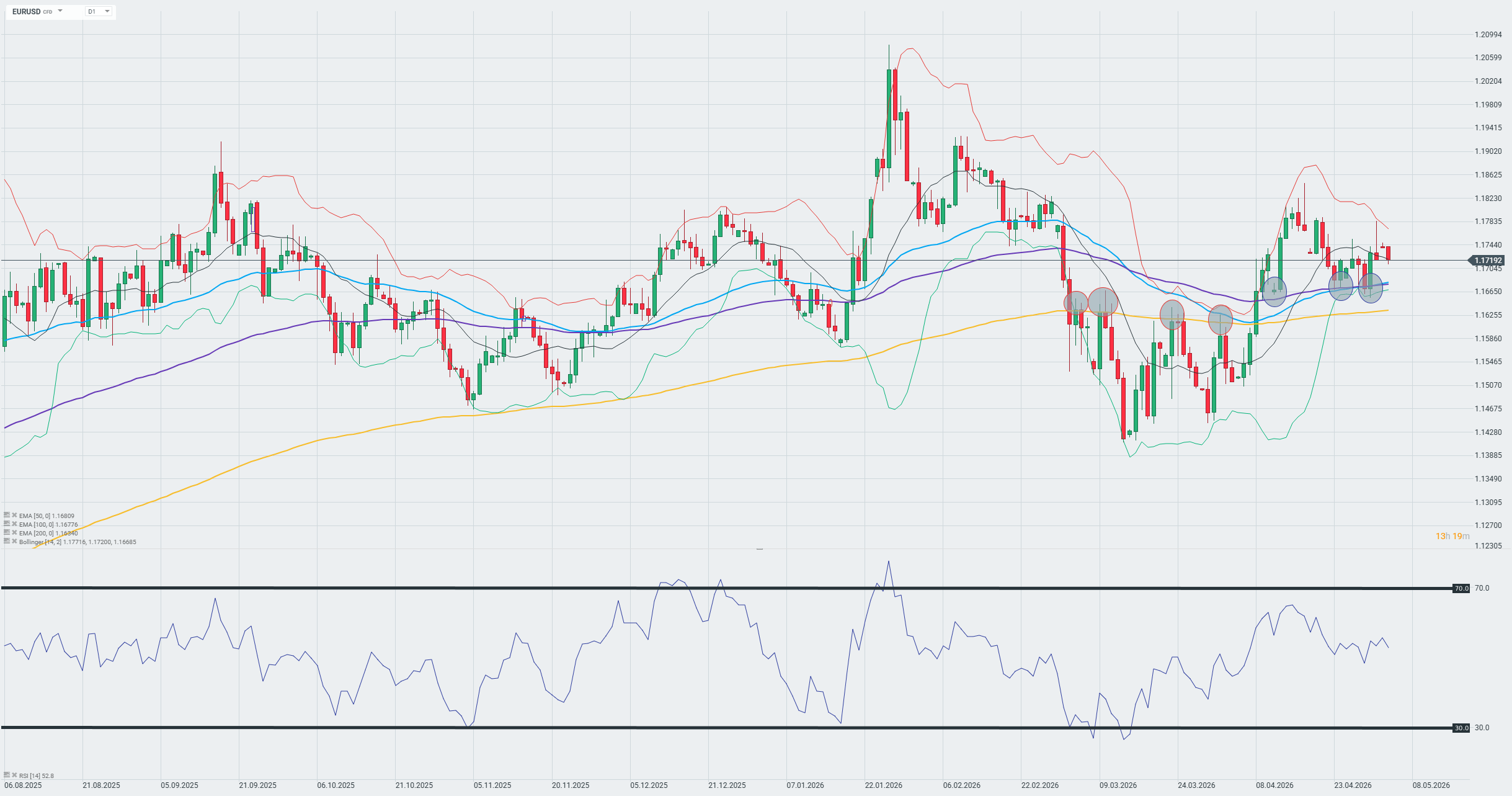
The EUR/USD exchange rate is trading around 1.1719 on Monday, and despite seemingly positive industrial data, the eurozone is sending out worrying signals. The final reading of the PMI index for the manufacturing sector stood at 52.2 points in April, up from 51.6 a month earlier, which at first glance looks like a solid improvement. In reality, however, the rise in manufacturing activity is not driven by real demand, but by increased stockpiling by firms seeking to secure goods against further shortages and price rises resulting from the escalation of tensions in the Middle East. This is a seemingly positive result, which in fact says more about the fear of supply chain disruptions than about the actual strength of the European economy. The devil is in the details, and it is these details that are shaping the outlook for both growth and inflation in the eurozone.

Delivery delays have reached their worst level since July 2022, input cost inflation has risen to a 46-month high, and price pressures are increasingly being passed on to selling prices, marking the largest monthly jump since records began in 1997. As a result, the ECB faces a real dilemma: the data suggest a recovery, but leading indicators of producer sentiment and expectations merely confirm the growing risk of stagflation. For EUR/USD, this implies an environment of heightened uncertainty, in which the exchange rate may be prone to sharp movements depending on further signals from the Fed and the ECB, and any stronger US inflation data could push the pair back towards the support level at 1.1650.

On the EUR/USD daily chart, following a sharp rally to around 1.2060 at the start of the year, the exchange rate underwent a significant correction that brought prices down to lows around 1.1380, from where a rebound occurred.

Currently, the pair is trading at 1.1719, oscillating near the 50-day EMA (1.1681) and the 100-day EMA (1.1678), which together form a dynamic support zone, while the 200-day EMA at 1.1634 serves as another line of defense for the bulls. Bollinger Bands indicate narrowing volatility, with the upper band at 1.1771 and the lower band at 1.1669, signaling a potential breakout in the coming sessions. The RSI is hovering around the neutral level of 52, which does not provide a clear directional signal and suggests that the market is still looking for momentum for a decisive move above the resistance at 1.1800 or a deeper correction toward the aforementioned 200-day EMA support.

Currency Hedger No Comments

Offshore Yuan Hits 2-Week High

The offshore yuan strengthened to around 6.81 per dollar on Monday, reaching a two-week high amid the extended Labour Day holiday, as rising demand for yuan settlements supported the currency. Yuan-denominated settlements via the Cross-Border Interbank Payment System (CIPS) reached CNY 1.46 trillion in March, roughly triple the level five years ago. The surge has been driven in part by greater use of the yuan in energy trade amid the Middle East war, as Iran began accepting yuan for transit fees through the Strait of Hormuz. Russia has also shifted toward yuan-based settlements for energy exports, particularly in trade with China. Similar trends are emerging in the Middle East, where the yuanโ€™s share of Saudi oil transactions exceeded 40% in March. Earlier this year, Chinese President Xi Jinping pledged to rein in financial risks while promoting the yuan as a global reserve currency, fueling expectations of faster internationalization and a wider global role for Chinaโ€™s currency.

Currency Hedger No Comments

EUR/GBP Price Forecasts: Euro remains vulnerable below 0.8640

  • EUR/GBP recovery attempt from 0.8620 lows remains limited below 0.8640.
  • The Pound is outperforming the Euro, with risk appetite subdued.
  • Euro bears remain in control, with the 2026 low near 0.8610 at a short distance.

The Euroย (EUR) opens the week on a soft note against theย British Poundย (GBP). The pair shows moderate losses, as Fridayโ€™s upside attempt from the 0.8620 lows failed to find acceptance above a previous support area at 0.8640, which leaves the year-to-date low, at 0.8611, exposed

The Pound shows a slightly better performance than the Euro on a cautious start to the week, with all eyes on the Strait of Hormuz, after US President Donald Trump flagged a military operation to free vessels of neutral nations stranded in the critical waterway, but without providing further details.

The UKย economic calendarย is thin on Monday. In Europe, Aprilโ€™s final HCOB Manufacturing Purchasing Managers Index (PMI) is expected to confirm a moderate expansion in the sector’s activity, while the Sentix Index will provide details about investorsโ€™ confidence ahead of speeches by some European Central Bank (ECB) policymakers.

Technical Analysis: Previous support at 0.8640 is holding bulls

Chart Analysis EUR/GBP

EUR/GBPย remains stalled below the confluence of a reverse trendline from late March highs and the area between 0.8630 and 0.8640, which supported bears on March 23, 24, and 26.

Technical indicators in 4-hour charts are in bearish territory. The Relative Strength Index (RSI) around 38 signals weak demand rather than oversold stress, while the Moving Average Convergence Divergence (MACD) histogram fluctuates around the zero line, hinting at sluggish momentum.

Failure to extend recovery past 0.8640 leaves the 2026 low, at 0.8611 (March 19 low), on the bears’ focus. Further down, the next target is the August 2025 low, at 0.8596. On the upside, a confirmation above 0.8640 would shift the focus towards the April 27 and 28 lows, around 0.8655, and the April 24 high, near 0.8685.

Euro Price Today

The table below shows the percentage change of Euro (EUR) against listed major currencies today. Euro was the strongest against the Australian Dollar.

USDEURGBPJPYCADAUDNZDCHF
USD-0.06%-0.01%-0.09%0.06%0.07%-0.13%-0.05%
EUR0.06%0.01%-0.04%0.12%0.14%-0.06%-0.01%
GBP0.00%-0.01%-0.06%0.11%0.12%-0.11%-0.01%
JPY0.09%0.04%0.06%0.12%0.11%-0.10%-0.02%
CAD-0.06%-0.12%-0.11%-0.12%-0.01%-0.22%-0.12%
AUD-0.07%-0.14%-0.12%-0.11%0.00%-0.24%-0.14%
NZD0.13%0.06%0.11%0.10%0.22%0.24%0.09%
CHF0.05%0.00%0.00%0.02%0.12%0.14%-0.09%

The heat map shows percentage changes of major currencies against each other. The base currency is picked from the left column, while the quote currency is picked from the top row. For example, if you pick the Euro from the left column and move along the horizontal line to the US Dollar, the percentage change displayed in the box will represent EUR (base)/USD (quote).

Currency Hedger No Comments

USD/JPY approaches 157.00 after falling to 155.70 on likely Yen intervention

  • USD/JPY regains lost ground after a sudden drop to 155.70 earlier on Monday.
  • Yen crosses dropped sharply on Monday on another suspected intervention.
  • A Reuters report suggests that Tokyo would have spent 5.48 trillion Yen ($35 billion) last week to support the JPY.

The US Dollar (USD) pares previous losses against the Japanese Yen (JPY) ahead of the European session opening on Monday. The pair is trading at the 156.80 area at the time of writing after dropping about 150 pips in a matter of minutes during the Asian session, hitting session lows near 155.70.

The Japanese Ministry of Finance (MOF) did not make any comment, as usual, but the nature of the decline, without any clear fundamental reason behind, and with all Yen crosses acting in the same way, suggests that Japanese authorities intervened in markets again.

Beyond that, Reuters reported on Friday that the Bank of Japan (BoJ) might have spent 5.48 trillion Yen ($35 billion) to support the JPY last week. Japanese Finance Minister Satsuki Katayama warned that Tokyo authorities were ready to take decisive action against currency speculators after the USD/JPY crossed the 160.00 level, considered a line in the sand for the MOF. The Yen has seen several jumps since then.

Markets, otherwise, remain calm on Monday with the focus in the Middle East, after US President Donald Trump pledged to free vessels blocked in the Strait of Hormuz, yet without giving further details on the operation. Iranian authorities affirmed that the critical waterway will remain closed.

In the economic docket, the Japaneseย calendarย is void, amid the Golden Week holidays. In the US, Factory Orders data will open the week on Monday and lay the ground for ISM Services PMI on Tuesday and a slew of employment reports throughout the week, including the key Nonfarm Payrolls release on Friday. Apart from that, a string ofย Federal Reserveย policymakers will provide further insight into the central bankโ€™s monetary policy stance.ย 

Currency Hedger No Comments

Pound Sterling advances on BoE hawkish hold while Hormuz tensions cap gains

  • GBP/USD gains ground to near 1.3600 in Mondayโ€™s early European session.ย 
  • The BoE maintained the interest rate at 3.75% last week but delivered a hawkish hold.
  • An Iranian official warned that Trumpโ€™s Hormuz mission will violate the ceasefire.ย 

The GBP/USD pairย gathers strength around 1.3600 during the early European session on Monday. Signals from the Bank of England (BoE) that suggest a potential shift toward higher interestย ratesย later this year underpin the Pound Sterling (GBP) against the US Dollar (USD). The US employment report for April will be in the spotlight later on Friday.ย 

The UK central bank held the bank rate steady at 3.75% as widely expected, presenting a scenario framework that suggests rate hikes could be appropriate but avoiding any pre-commitment. BoE Governor Andrew Bailey warned of “forceful tightening” if energy price shocks from the Middle East conflict continue to drive inflation. 

Nonetheless, uncertainty in the Middle East and the Strait of Hormuz could support the Greenback and act as a headwind for the major pair. US President Donald Trump said the US will begin guiding some neutral ships trapped in the Persian Gulf out through the Strait of Hormuz beginning Monday. Top Iranian lawmaker Ebrahim Azizi said that any US interference in the Strait will be considered a violation of the ceasefire.

Traders brace for the US employment report for April later on Friday. The US economy is estimated to see 73K job additions in April, while the Unemployment Rate is expected to remain steady at 4.3% during the same period. Any signs of weakening in the US labor market could weigh on the USD against the GBP.