


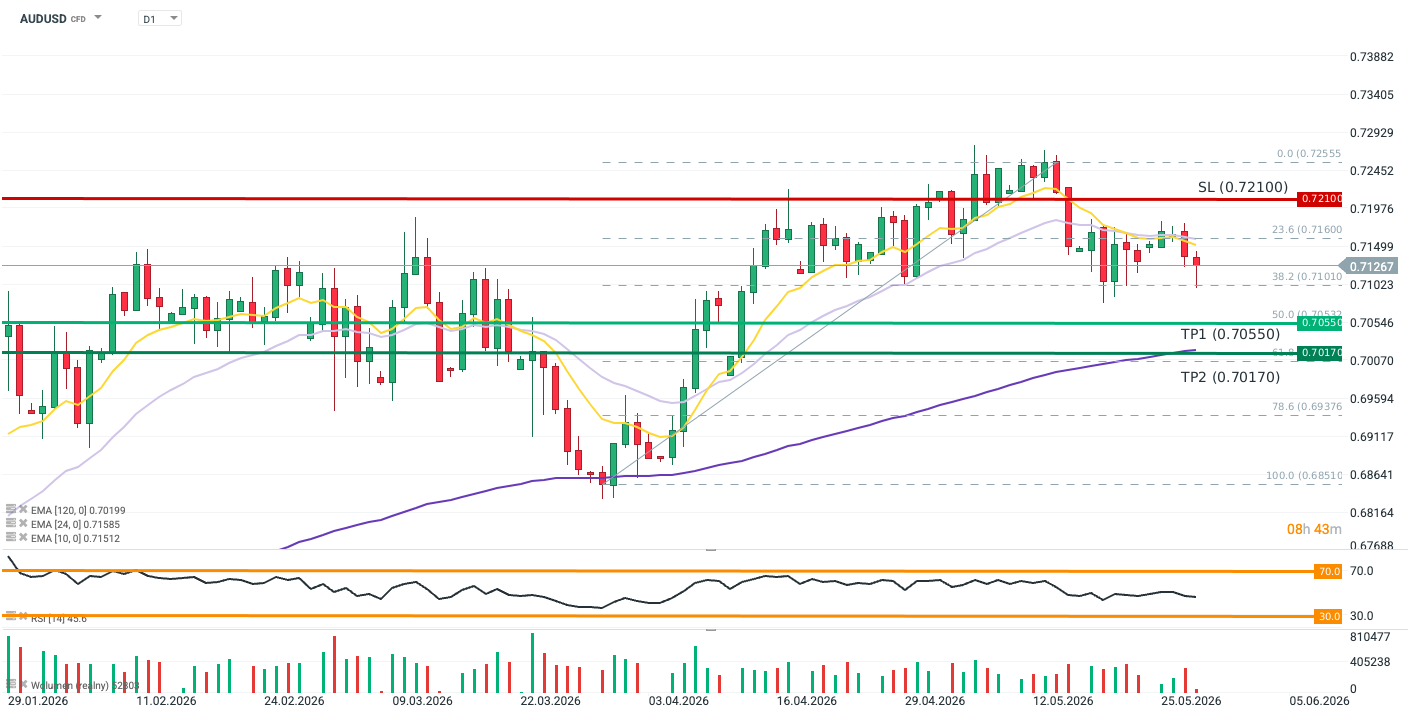
- The AUDUSD exchange rate opened today below the 10- and 30-day exponential moving averages (EMA10 – yellow, EMA30 – light purple).
- Core PCE inflation in the US rose to 3.3% YoY in April (previously 3.2% YoY).
- The swap market-implied probability of a US interest rate hike in 2026 increased from 82% to 86% over the course of the week.
Recommendation:
- Position: Short (SELL) on AUDUSD at market price
- Target Price (Take Profit; TP): 0.70550 (TP1), 0.70170 (TP2)
- Stop Loss (SL): 0.72100
Source: xStation5
Opinion
The AUDUSD pair erased some of its losses from today’s session following the release of the latest US inflation data, which turned out slightly softer than expected. Core PCE increased in line with expectations to 3.3% year-on-year, while on a month-on-month basis, prices rose by 0.2% (against a 0.3% forecast). However, the lack of a negative inflation surprise is not exactly “good news” for monetary policy, especially since inflation remains in an upward trend and is proving to be stickier than assumed. The Fed’s narrative is also becoming increasingly hawkish. Recent remarks from Cook, Goolsbee, Kashkari, and Jefferson unanimously emphasize the growing and materializing upside risks to inflation, along with a clear readiness to hike interest rates should this trend continue.
Furthermore, the AUDUSD’s reaction to the optimism generated by hopes of a truce between Iran and the US last week was quite moderate, and the gains were insufficient to push the price above the 10- and 30-day exponential moving averages. Therefore, risk-sensitive currencies (including the AUD) can be expected to remain under heavy pressure until real progress is made in the Middle East, and a potential rebound in reaction to the end of the war is unlikely to trigger a rapid return to an upward trend for the pair. The options market is also pointing to further declines for AUDUSD. The 1-week and 1-month risk reversal indicators sit below zero, showing that options betting on the depreciation of the AUD dominate the market. In other words, the market is systematically hedging against further declines in AUDUSD consistently across various time horizons.
Methodology
The recommendation was prepared based on the technical analysis of the AUDUSD chart and the fundamental analysis of the discussed economies (monetary policy in Australia and the US). The direction of the recommendation was determined using moving averages and market expectations regarding central bank policies. Take Profit and Stop Loss levels were set using the Fibonacci retracement of the last upward wave and price action (TP1 at the 50.0 Fibo level, TP2 between the D1 interval EMA100 and the 61.8 Fibo level, and SL at the support from which the price rebounded before breaking the last peak).