
- The Indian Rupee faces intense selling pressure against the US Dollar due to a strong recovery in oil prices.
- FIIs continue to squeeze their stake in the Indian stock market.
- India’s CPI in May is seen higher at 4% YoY from 3.48% in April.
The Indian Rupee (INR) tumbles at open against the US Dollar (USD) on Thursday, with the USD/INR pair rising to near 95.65. The pair gains as a sharp recovery in oil prices due to fears surrounding the collapse of the ceasefire between the United States (US) and Iran has weakened the Indian Rupee.
In India’s morning session, the MCX Crude Oil contract expiring on June 18 is up 0.7% to near 8,787. The contract surged 3.6% on Wednesday even after recovering significant losses.
The appeal of currencies from economies, such as India, which rely heavily on oil imports to meet their energy needs, diminishes in a high oil price environment.
US launches strikes against Iran’s unwarranted aggression
On late Wednesday, the US Central Command (CENTCOM) confirmed that it launched additional “self-defense strikes” on multiple targets in Iran as retaliation against Tehran’s “unwarranted and continued aggression”. This came after the US CENTCOM launched a series of attacks on Iran’s air defense, ground control stations, and surveillance radar sites near the Strait of Hormuz on Tuesday in response to Iran shooting down the US Apache helicopter.
Additional military operations from Washington were already anticipated as US President Donald Trump said in an interview with Fox News that he is close to ordering new strikes against Iran for taking too long in finalizing a deal.
Before remarks pointing to ordering fresh strikes against Iran, US President Trump also said in a post on Truth Social that Iran has to pay the price for taking too much time in reaching a deal.
However, the ceasefire between the US and Iran announced in April appears not to have collapsed yet as US President Trump has told aides to deliver a message to Iran via Qatar that the attacks did not mean a “restart of all-out war,” and were only in response to the helicopter downing, The Wall Street Journal (WSJ) reported.
FIIs keep squeezing stake in Indian stock market
Overseas investors continue to pare their stake in the Indian stock market as higher oil prices keep weighing on India Inc.’s earnings projections. So far in June, Foreign Institutional Investors (FIIs) have remained net sellers on all trading days and have offloaded their stake worth Rs. 62,654.34 crore.
India’s CPI data awaited
On the domestic front, the major trigger for the Indian Rupee will be the Consumer Price Index (CPI) data for May, which will be published on Friday. Investors will closely monitor the data to get fresh cues regarding the Reserve Bank of India’s (RBI) monetary policy outlook.
In the policy meeting last week, the RBI kept the Repo Rate unchanged at 5.25%, as expected, and warned that the central bank would need to act “if inflation gets generalized”.
India’s CPI data is expected to arrive higher at 4% Year-on-Year from 3.48% in April.
Technical Analysis: USD/INR stays in Symmetrical Triangle formation
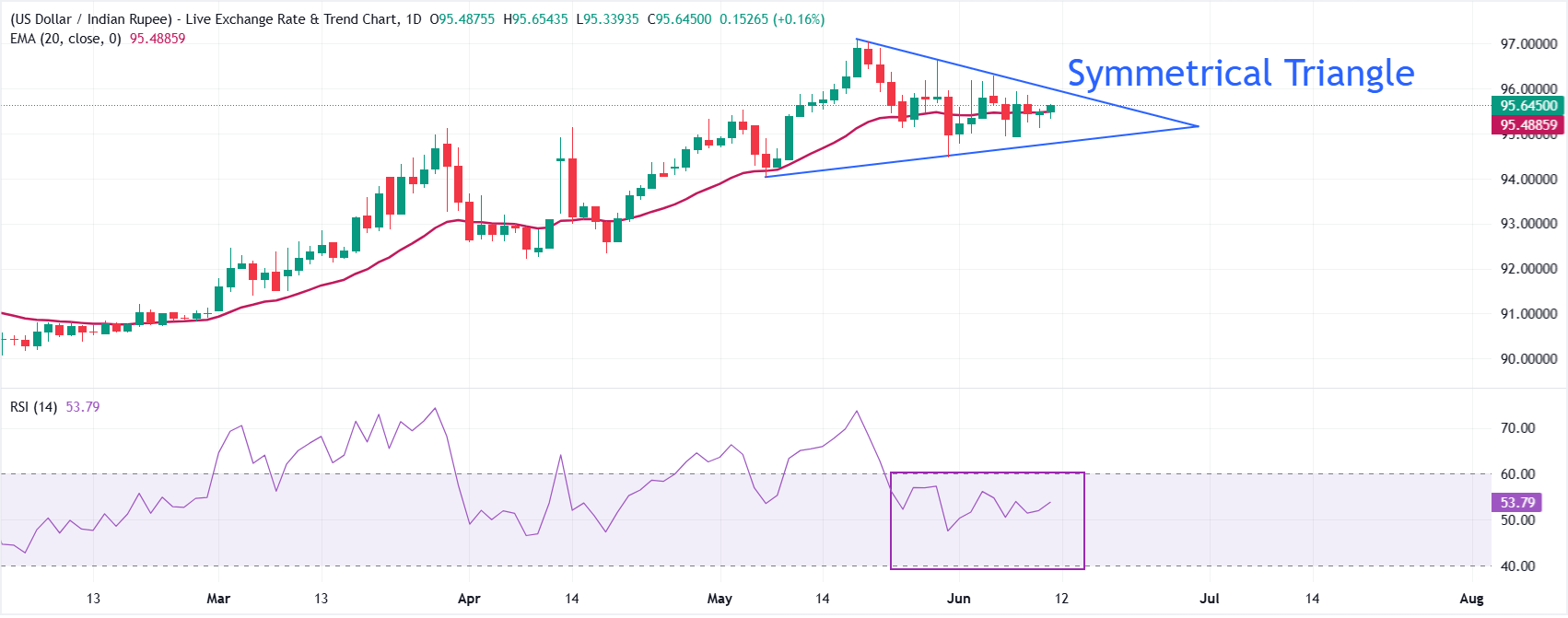
USD/INR trades higher at around 95.65 at press time. The near-term trend of the pair appears to be sideways in an overall bullish structure amid the Symmetrical Triangle formation. The pair remains close to the 20-day exponential moving average (EMA), which is at 95.4886, indicating a sideways trend.
The Relative Strength Index (RSI) at 53.79 is near neutral but slightly positive, hinting that upside pressure persists, even as the pair consolidates beneath the descending resistance trend structure derived from prior highs.
On the topside, initial resistance is seen at the bearish trend-line break area near 96.03, where a clear daily close above would open the way for a more sustained recovery towards the all-time high at 97.08. On the downside, immediate support sits at the 20-day EMA at 95.49, with the next, more structural, floor at the rising trend-line region around 94.77; a break below this latter level would weaken the current constructive tone and expose deeper retracements.