


Market Situation
Bearish sentiment dominates the commodity market today, reflected by a negative average daily change of -0.41% with only six assets rising. The energy sector is seeing the sharpest decline—Brent crude is down 2.24% today (over 8.4% weekly), and WTI has fallen by 1.96%, driven by increasing hopes for a US-Iran diplomatic agreement. On the opposite pole are agricultural commodities, where coffee is the leader of growth, appreciating by 5.73%, which pushes its valuation to an extreme level of +2.18 standard deviations (Z-score) above the 5-year average. Despite current corrections, industrial and precious metals still maintain historically high valuations, indicated by extreme deviations for copper (+3.06σ), gold (+2.76σ), and aluminum (+2.12σ). In the global context, it is worth noting reports of an expected economic slowdown in India due to the oil shock and stock market turmoil in Asia, which may affect future industrial demand. In the coming days, investor attention should focus on the upcoming Fed meeting and central bank decisions, which will define the further direction of the market. Commodity Price Changes in the Last Month
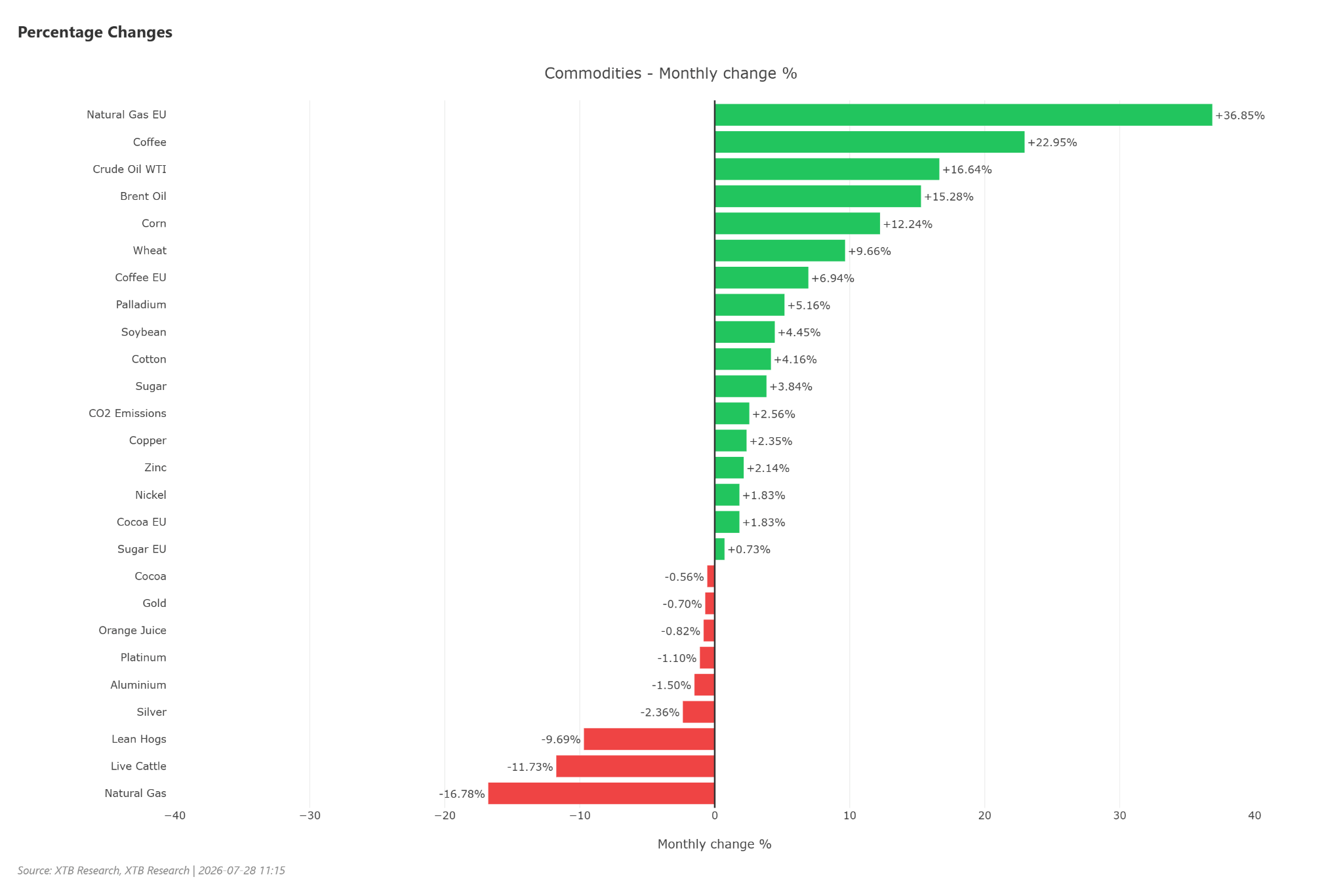
Over the last month, TTF natural gas, coffee, and crude oil gained the most. On the other hand, we have American natural gas and livestock. Source: XTB Oversold and Overbought Commodities
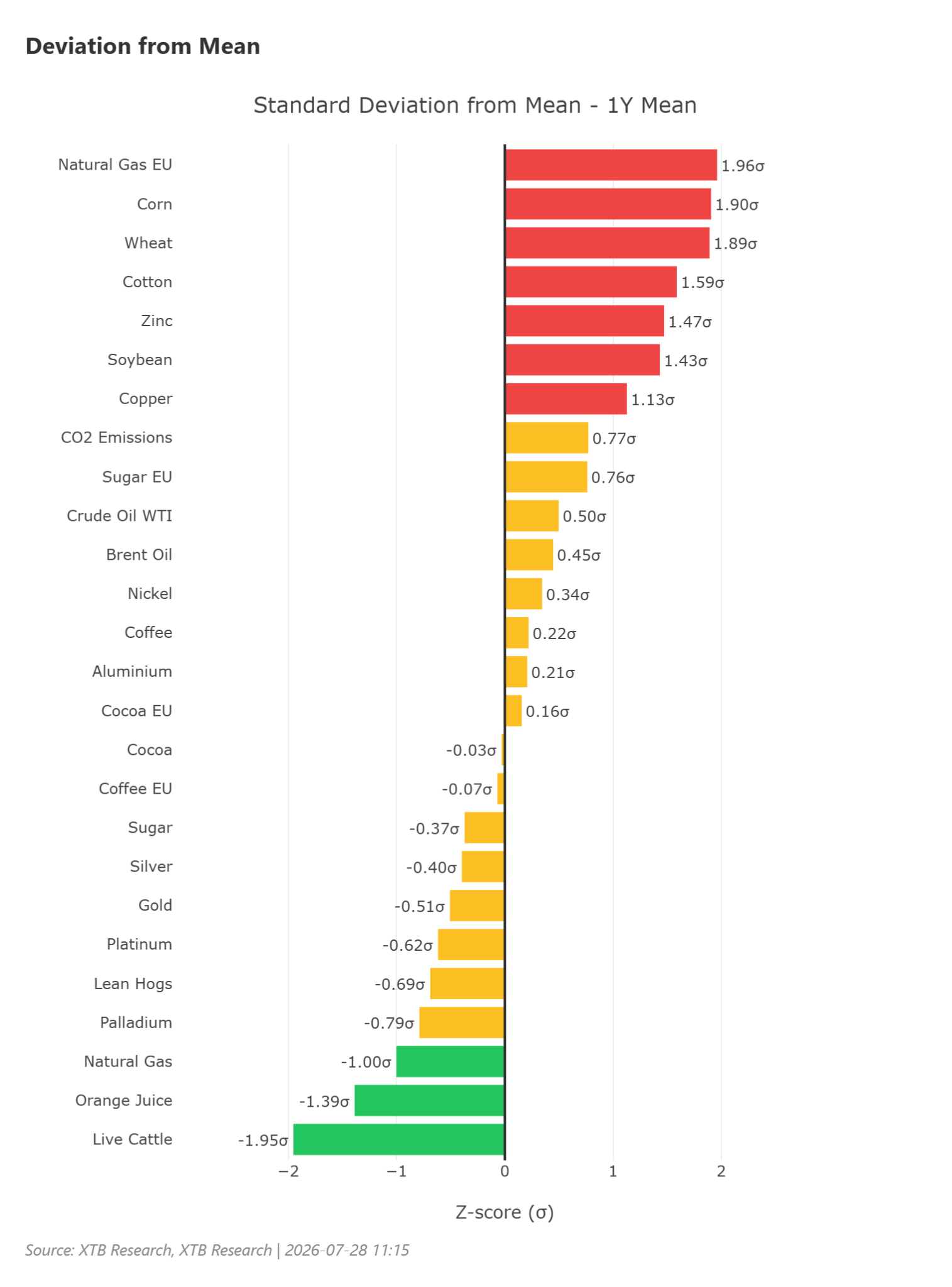
From a short-term perspective, cattle is very strongly oversold, reaching nearly 2 standard deviations from the 1-year average. In contrast, TTF natural gas, corn, wheat, and cotton can be treated as slightly overbought. Source: XTB
🛢️ Crude Oil
- Crude oil prices continue strong declines in response to reports of a halt in mutual attacks and attempts to engage in diplomatic talks between the US and Iran.
- Iran is set to discuss with Oman the resumption of ship traffic in the Strait of Hormuz. During the last session, only one tanker passed through Hormuz, while through Bab el-Mandab, there is a rebound to 7 tankers (compared to an average of 10 tankers in recent months).
- The price of Brent crude fell to around $87 for the September contract, while the October contract is trading below $84. WTI crude, in turn, dropped below $81 per barrel.
- If an agreement with Iran is reached, a significant oversupply, estimated at up to 2 million barrels per day in Q4 2026, will quickly appear on the oil market. Nevertheless, it is worth remembering that earlier IEA forecasts changed virtually from report to report, so everything will depend on the navigability of key straits in the Middle East.
- Reloading is resuming at the CPC terminal in Kazakhstan after disruptions caused by drone attacks. It is worth noting that the oil and fuel market is also disrupted by Ukrainian attacks on Russian oil infrastructure. It is estimated that up to 50% of fuel production capacity in Russia is shut down due to the attacks, leading to domestic supply problems.
- Global stocks of crude oil and petroleum products increased by 2.5% (by 37.9 million barrels) in the week ended July 17, narrowing the deficit relative to the 5-year average.
- US crude oil stocks also rose, although the latest reports indicate a further decline in reserves, close to 300 million barrels.
- According to Citi, the IEA may coordinate further releases of reserves and stocks if the situation does not normalize in the near future. The previous program of releasing 400 million barrels is expected to be completed within 1-2 months.
- A noticeable acceleration in fuel processing in China is observed, which may be related to the normalization of the situation or the desire to sell fuels (e.g., to Russia) due to high margins. Utilized processing capacities at state refineries increased from approx. 67% at the beginning of July to 75% currently. In private refineries, the increase is from approx. 43% to 48%.
Maritime Routes via Iran and JMIC

Proposed maritime routes via Iran and JMIC. It is worth remembering that using the Iranian route carries the probability of Iran collecting fees. Source: Bloomberg Finance LP Global Oil and Products Stocks
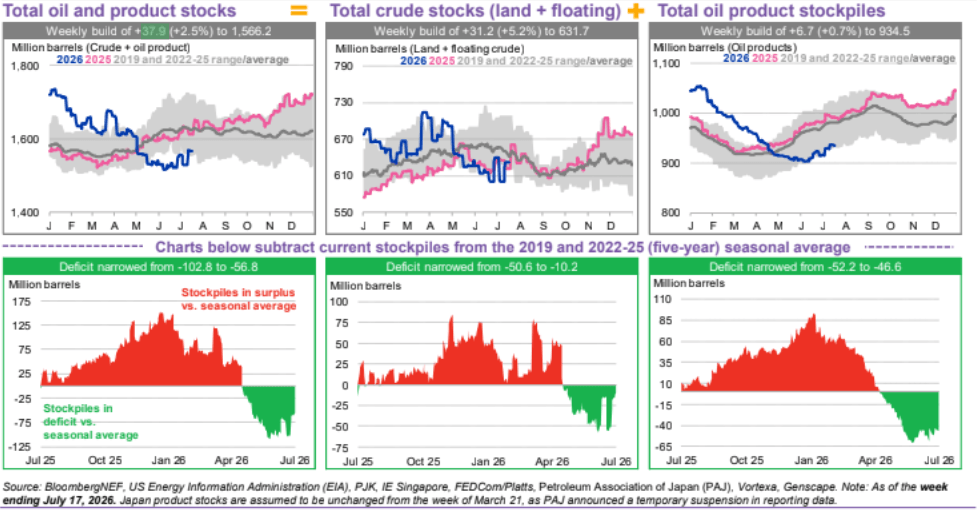
Global oil and products stocks have increased recently. Source: BloombergNEF Oil Production and Export in Iran
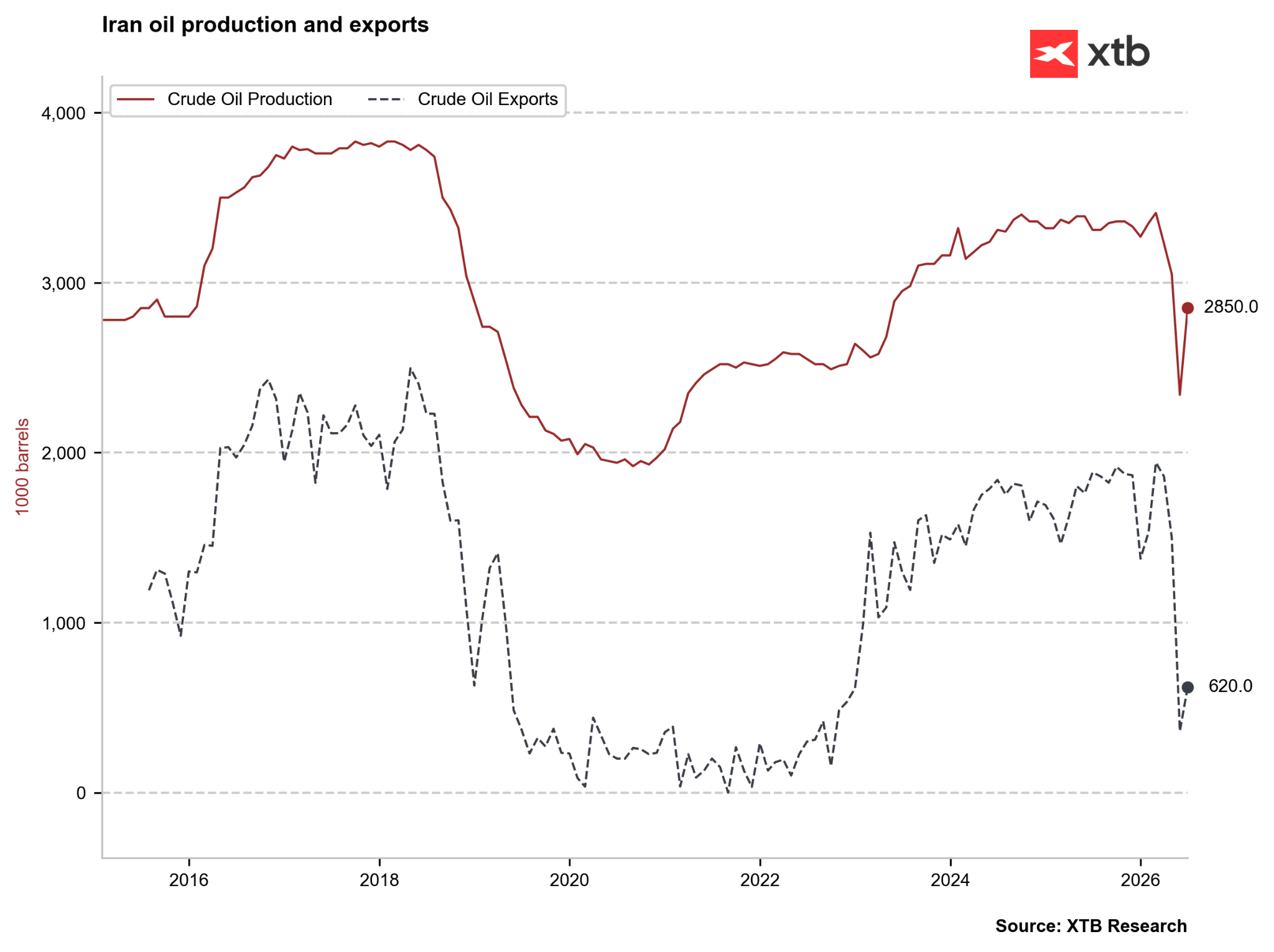
Iran’s production has clearly rebounded, but exports remain approximately 3 times lower than pre-war levels. Source: Bloomberg Finance LP, XTB Oil Price vs. Crack Spread
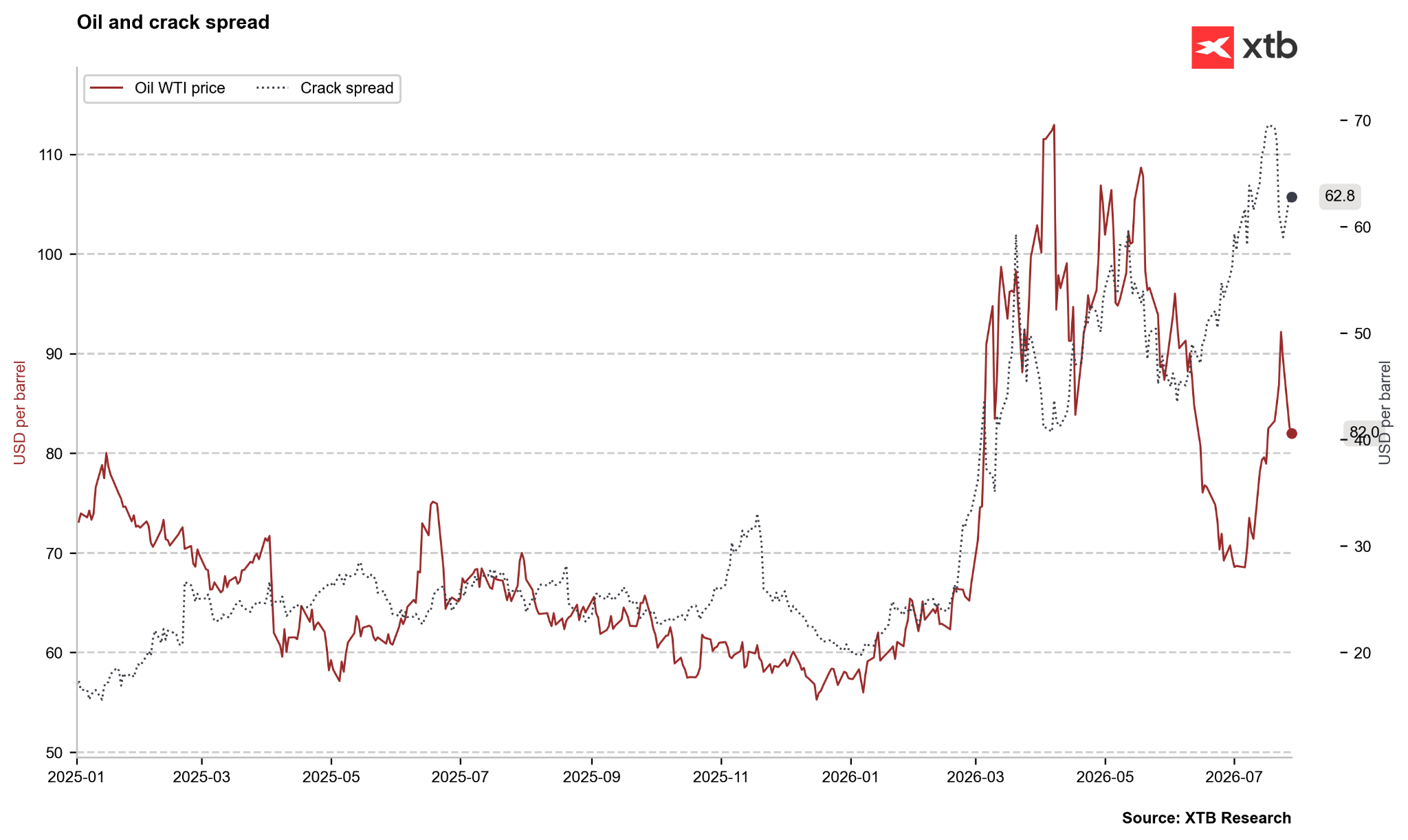
Crude oil is falling, while the crack spread is showing a small rebound and remains near historical highs. Source: Bloomberg Finance LP, XTB US Crude Oil Inventories
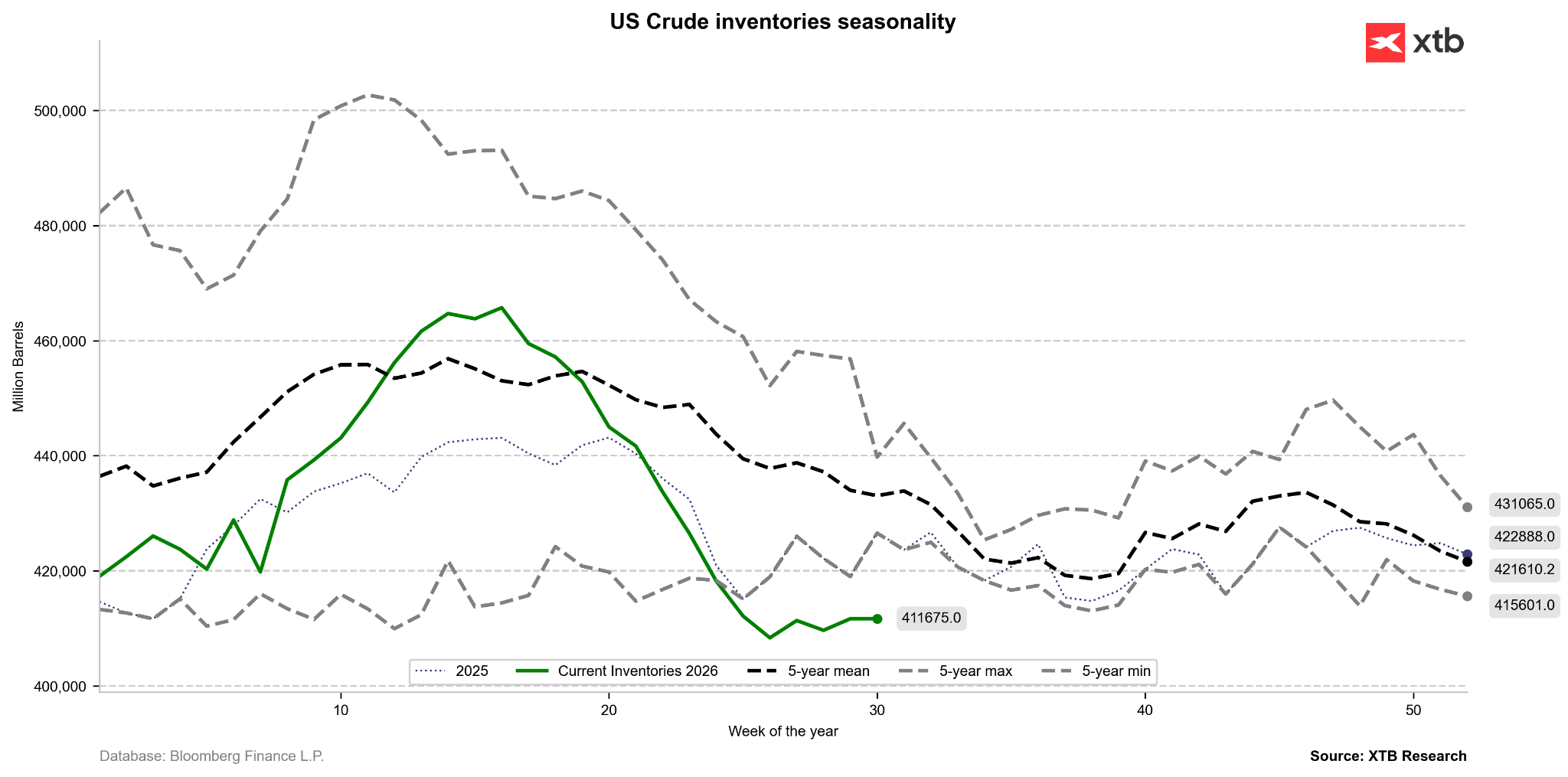
US crude oil inventories are stabilizing. Source: Bloomberg Finance LP, XTB
💨 Natural Gas (TTF + Henry Hub)
- Prices for gas contracts in Europe (TTF) continue to fall, declining by another 3.1% to 56.46 EUR/MWh (64.21 USD/MWh) after an earlier drop at the beginning of the week reaching up to 10% due to optimism surrounding de-escalation in the Middle East.
- Although gas prices in Europe are falling, an increase in demand in Asia is observed, which may divert supplies from the US to the eastern market, potentially leading to issues with replenishing storage before the winter season.
- Currently, storage fill is about 55%, compared to a 5-year average of 71%, with a goal of 90% before November 1.
- Natural gas prices in the US are also falling sharply, which may be a symptom of sentiment regarding the potential opening of the Strait of Hormuz. However, it is worth remembering that Qatar will not resume LNG supplies at a normal level until at least mid-September, which is why LNG exports from the US will remain high for many weeks to come.
- A slight cooling in the Midwest region has caused US gas consumption forecasts to decrease.
- Additionally, strong El Niño suggests that gas consumption during the winter may be lower, indicating that current inventories will be sufficient.
- Gas production on Monday was 113.1 bcfd, an increase of 3.7% y/y, while demand was 81.4 bcfd, an increase of 2.7%. LNG exports were 18.1 bcfd.
- EIA raised the forecast for average gas production to 111.2 bcfd at the beginning of July.
Natural Gas Demand
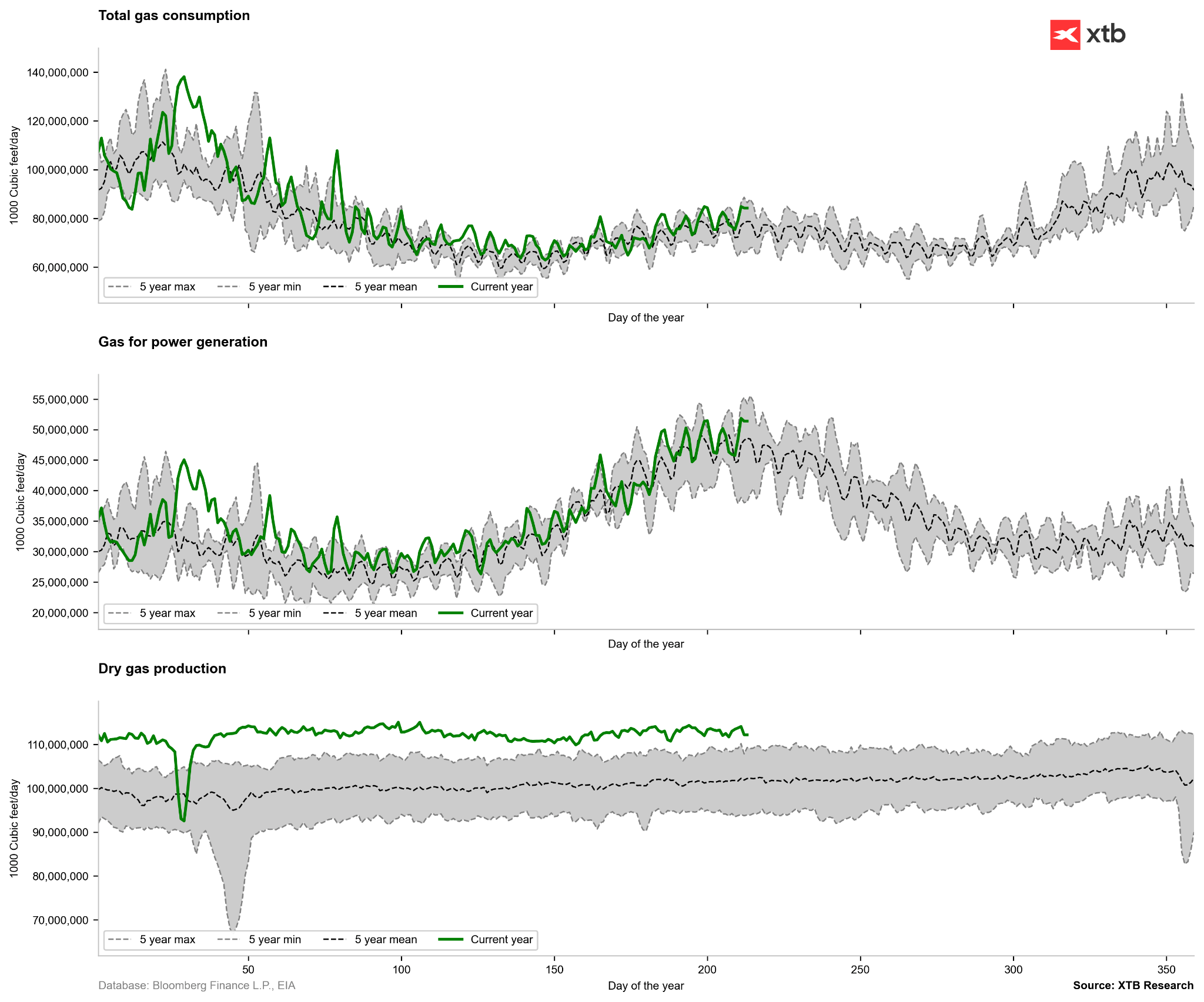
Gas demand remains above the 5-year average during the seasonal peak consumption period. Gas consumption for electricity production should fall in the coming weeks. Source: Bloomberg Finance LP, XTB Comparative Gas Stocks
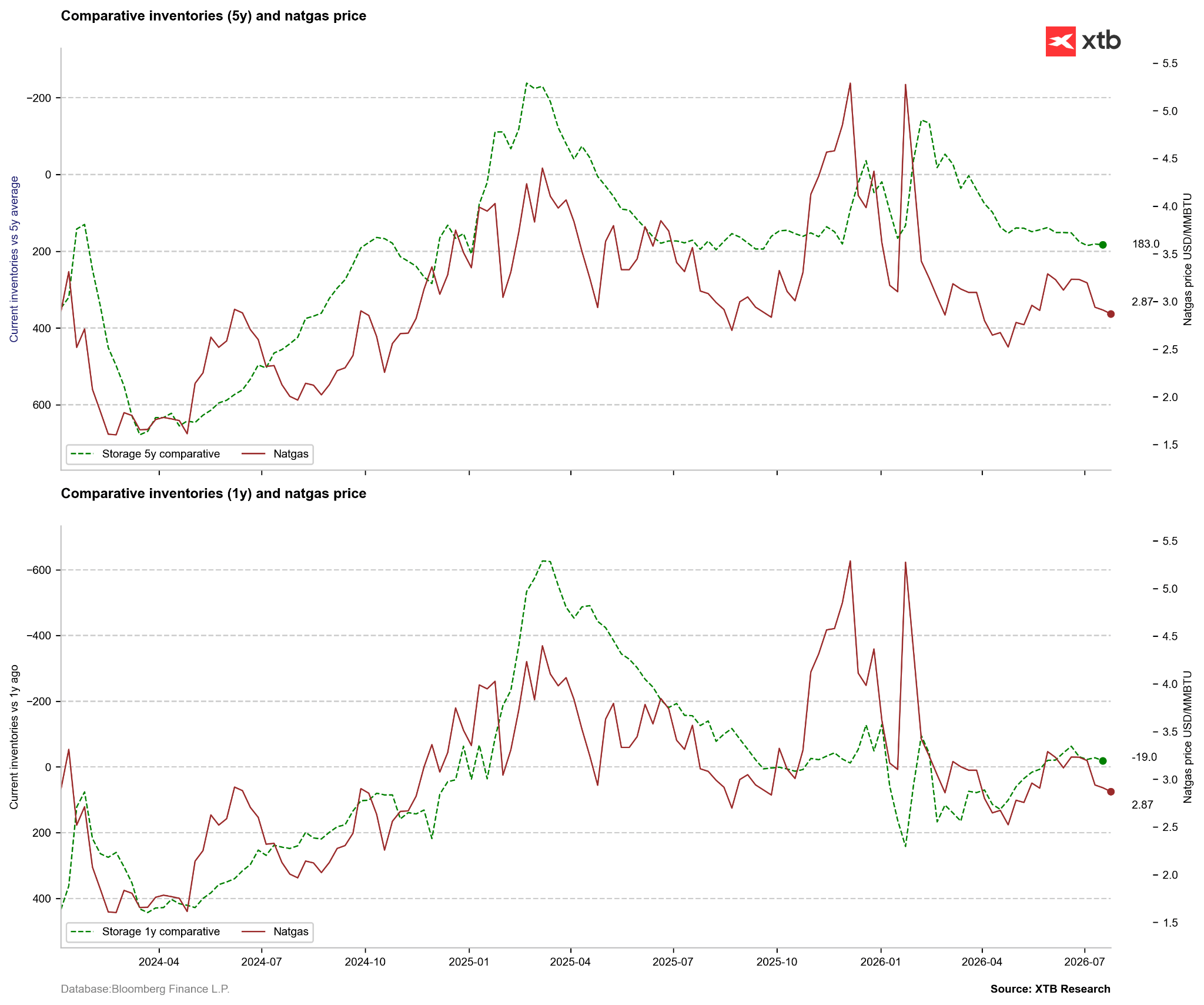
Comparative stocks have stopped increasing but remain at relatively high levels. Nevertheless, this potentially indicates an undervaluation of gas prices. Source: Bloomberg Finance LP, XTB Natural Gas Price Seasonality
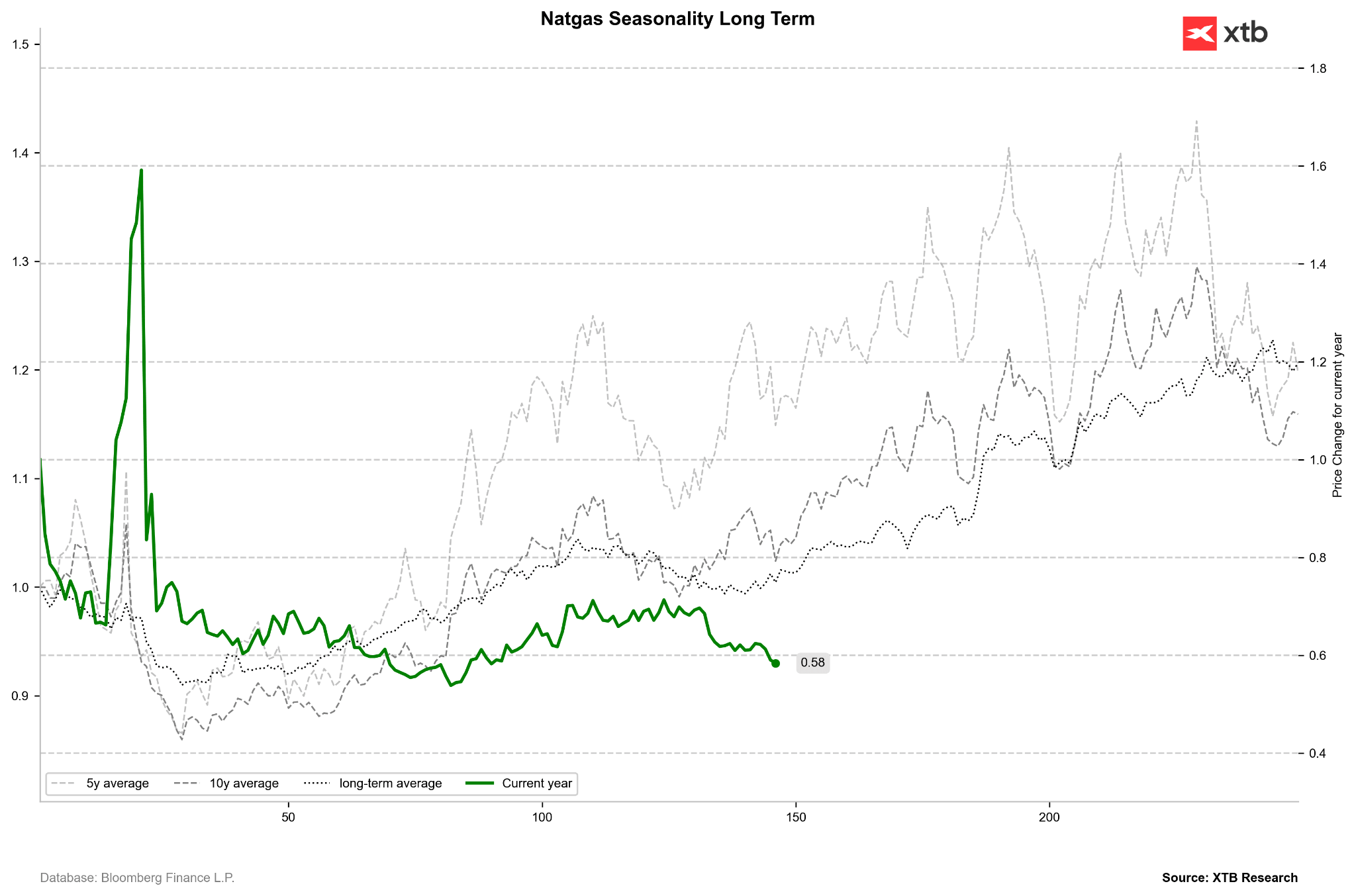
The current price behavior is completely contrary to short-term and long-term seasonality. It is worth remembering that the next two roll-overs will be relatively flat. Source: Bloomberg Finance LP, XTB Temperature Forecasts
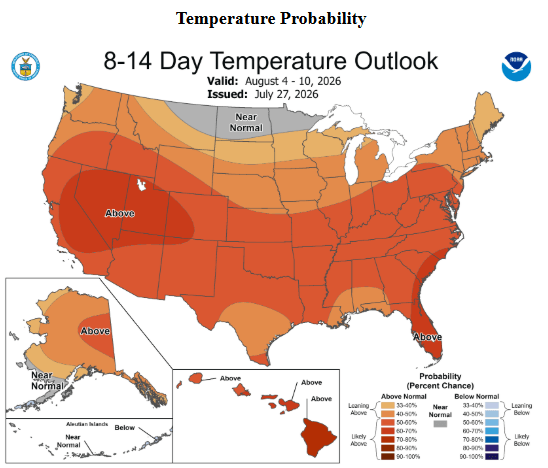
Although temperatures have been slightly lower than previously forecasted recently, a return to higher temperatures is expected at the beginning of August. Source: NOAA Technical Analysis of Gas Prices
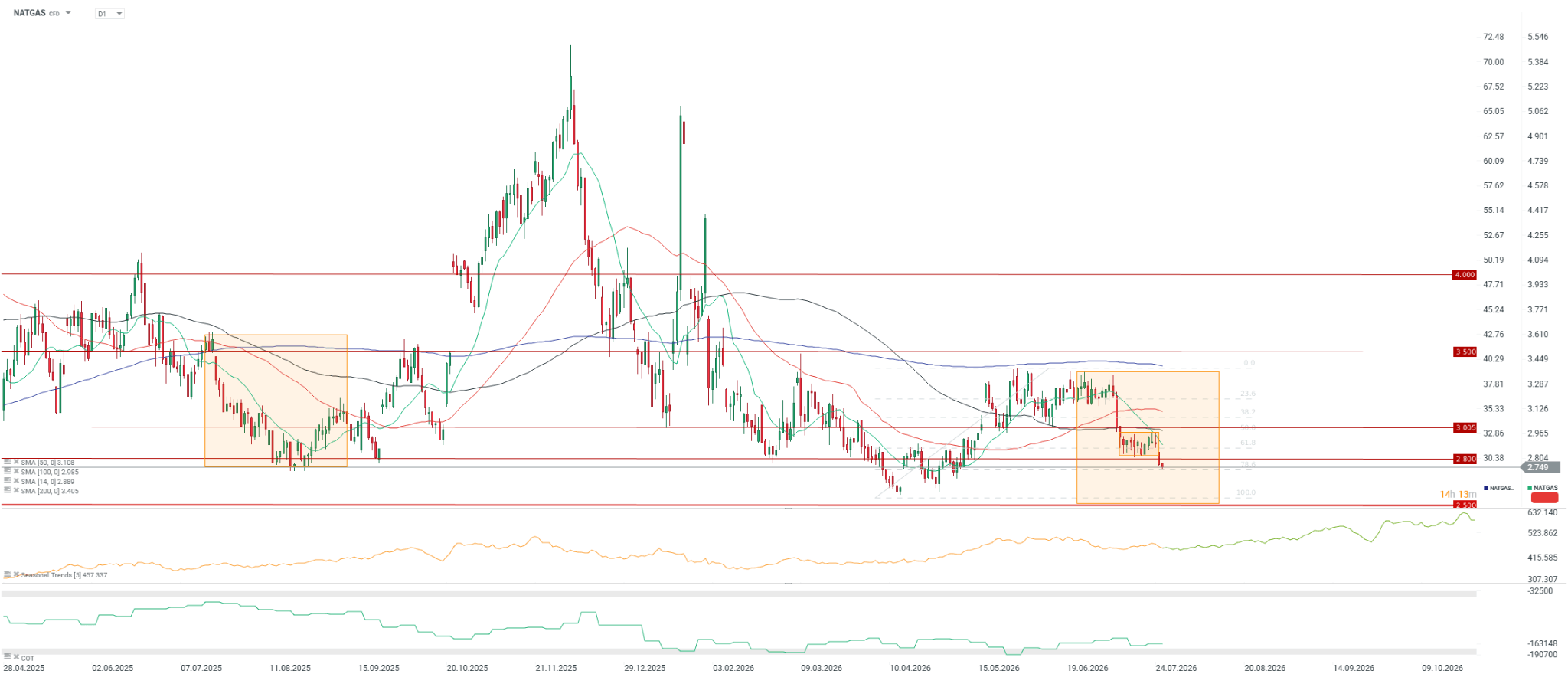
The price finally breaks out of the consolidation downwards and tests the last support at the 78.6 retracement. Last year, the downward wave in the summer period ended only in the second half of August. A similar range would currently indicate 2.5 USD/MMBTU. Source: xStation5
🟡 Gold
- Gold prices fell below $4050 per ounce ahead of the upcoming Federal Reserve meeting.
- Markets are pricing in slightly over 33% chance of a 25 basis point Fed rate hike. At the same time, a full rate hike is priced in for September.
- A potential rate increase or hawkish rhetoric from the Fed could strengthen bond yields and the dollar’s exchange rate, posing a risk of breaking the support at $4,000 per ounce and capital outflow from ETF funds.
- Gold has remained above $4,000 per ounce since the end of June thanks to dip buying and steady demand from central banks.
- A temporary pause in the fighting in the Middle East has eased concerns about further inflation growth.
Gold Seasonality
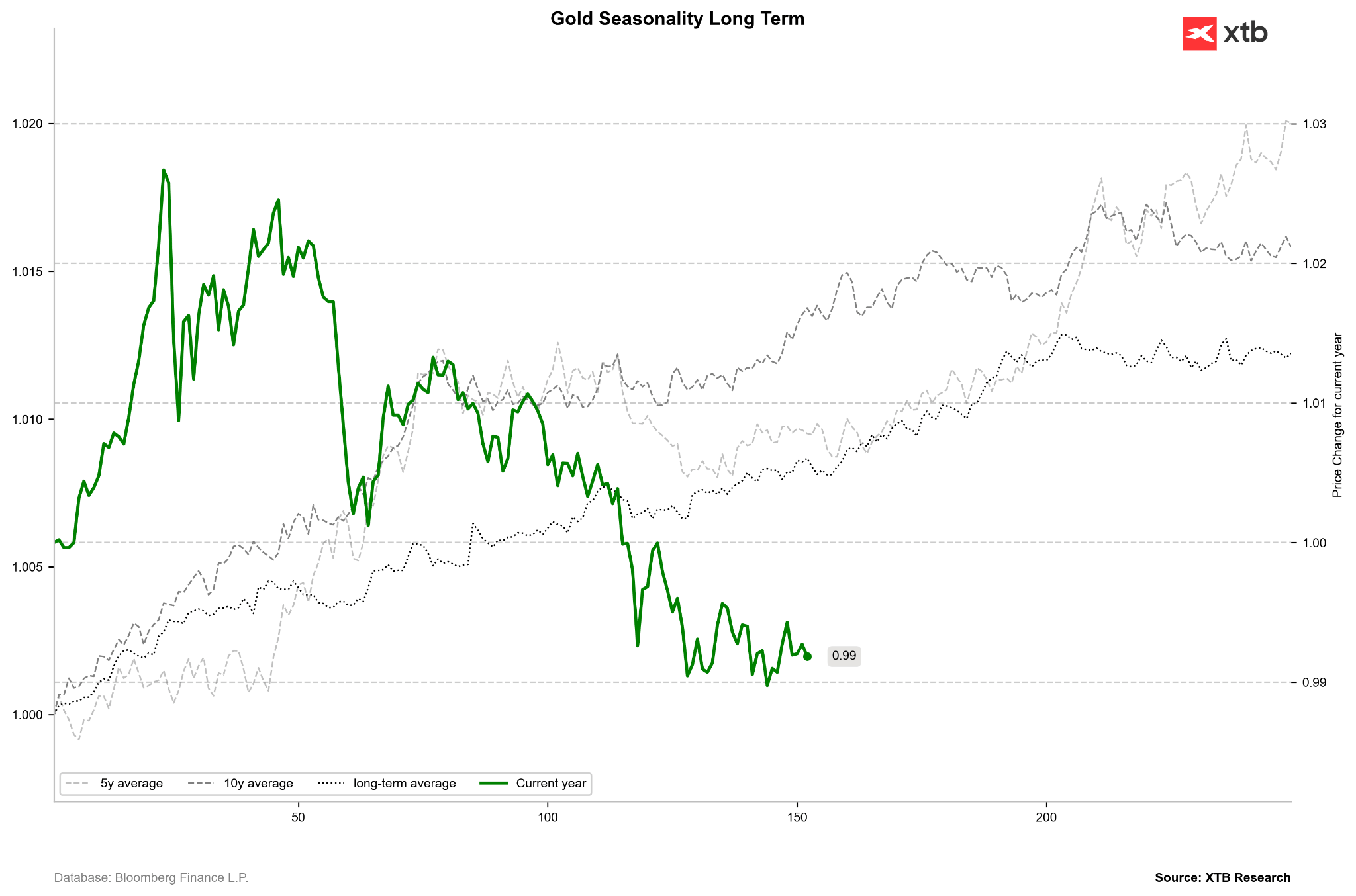
Gold should currently be in the phase of a seasonal rebound start. Nevertheless, we have been observing consolidation for about a month after sharp declines. Source: Bloomberg Finance LP, XTB Fed Interest Rate Expectations
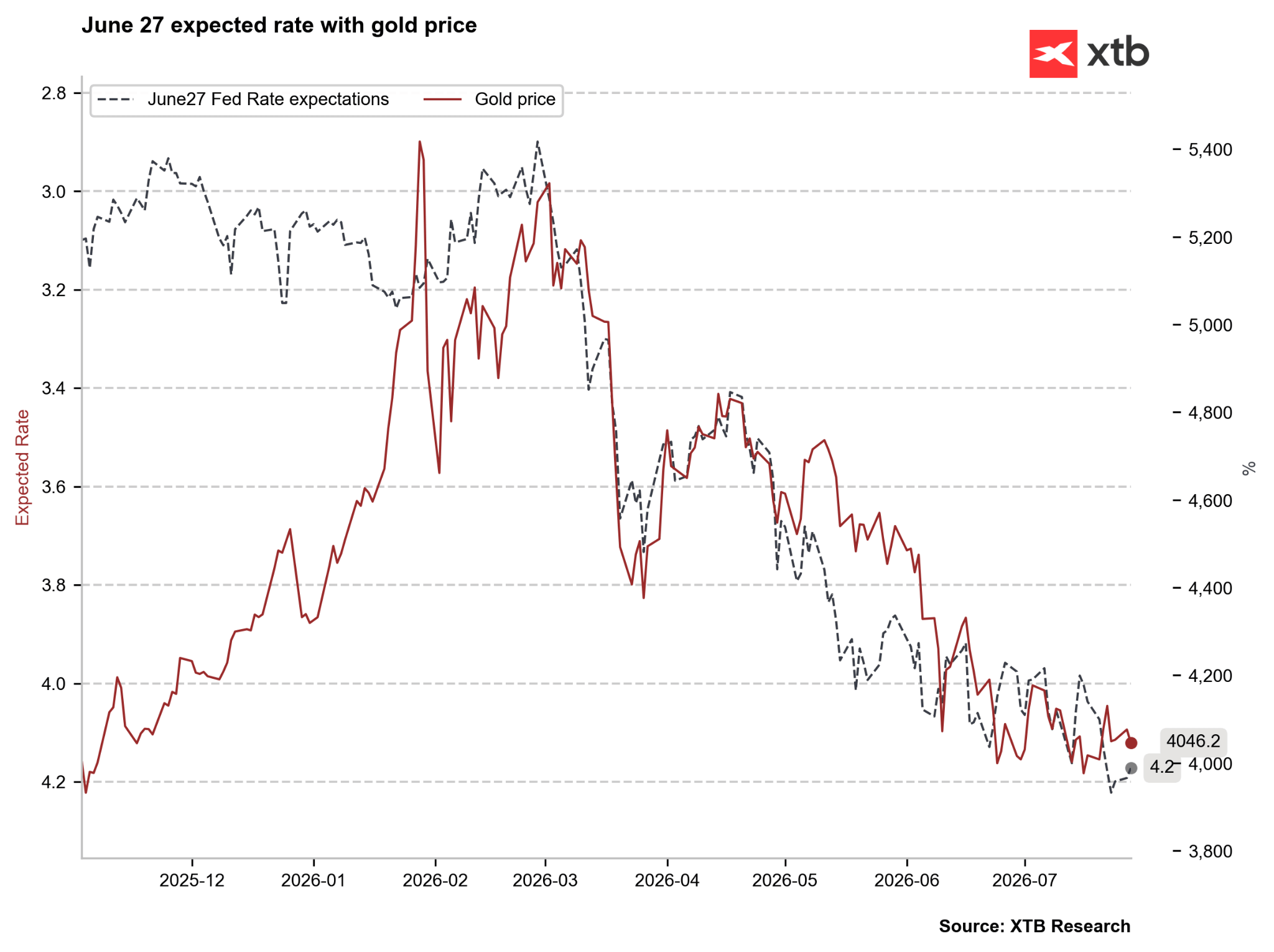
The effective rate is expected to be 4.2% by June next year, which would mean two full rate hikes from the current level. Gold is well priced relative to these expectations. Source: Bloomberg Finance LP, XTB Gold Purchases by ETFs
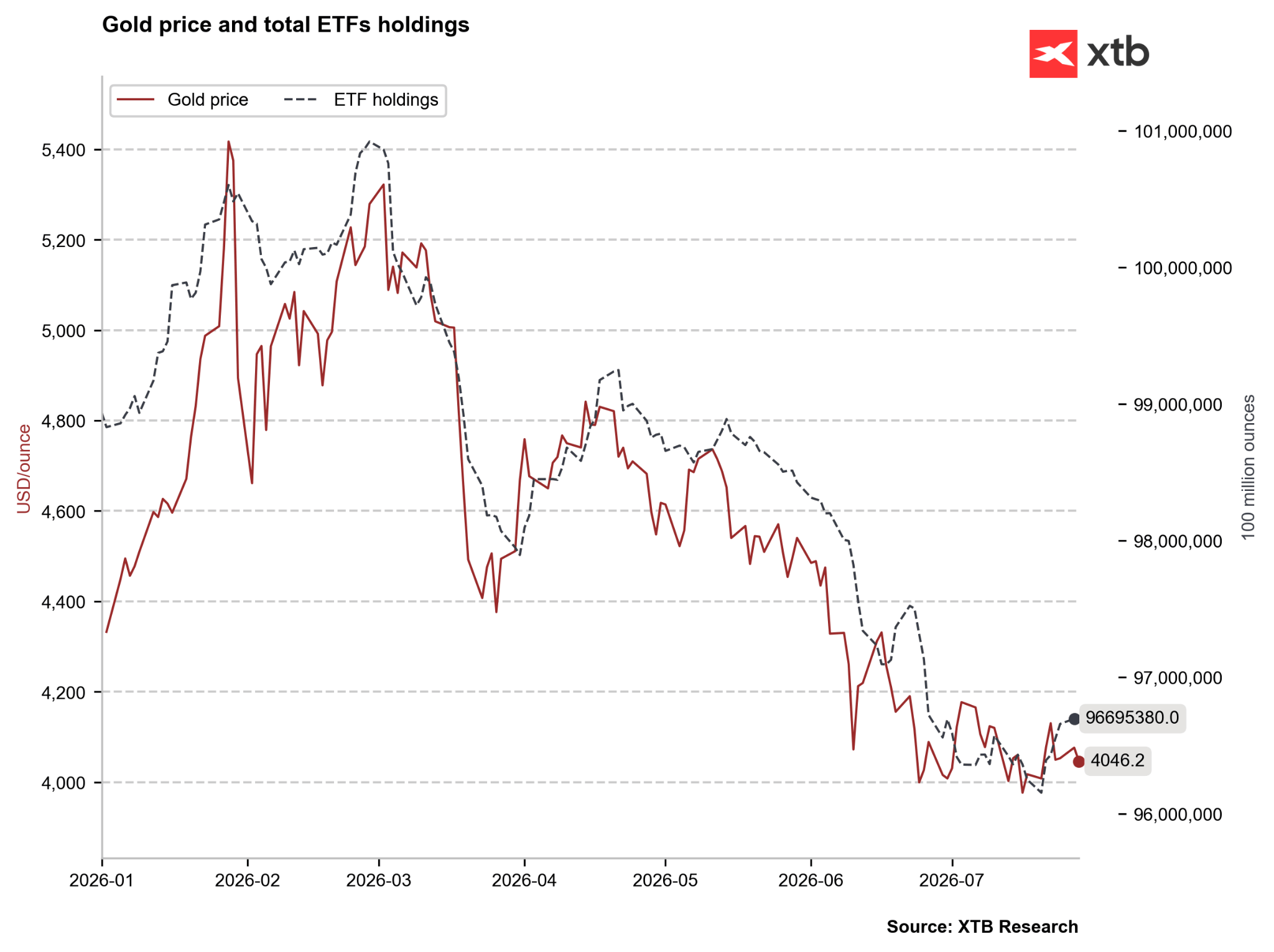
Despite mixed sentiment recently, ETFs are buying gold, and the rebound is already larger than in June. A dovish message from Warsh could push gold back towards $4200 per ounce. Source: Bloomberg Finance LP, XTB Gold Technical Analysis
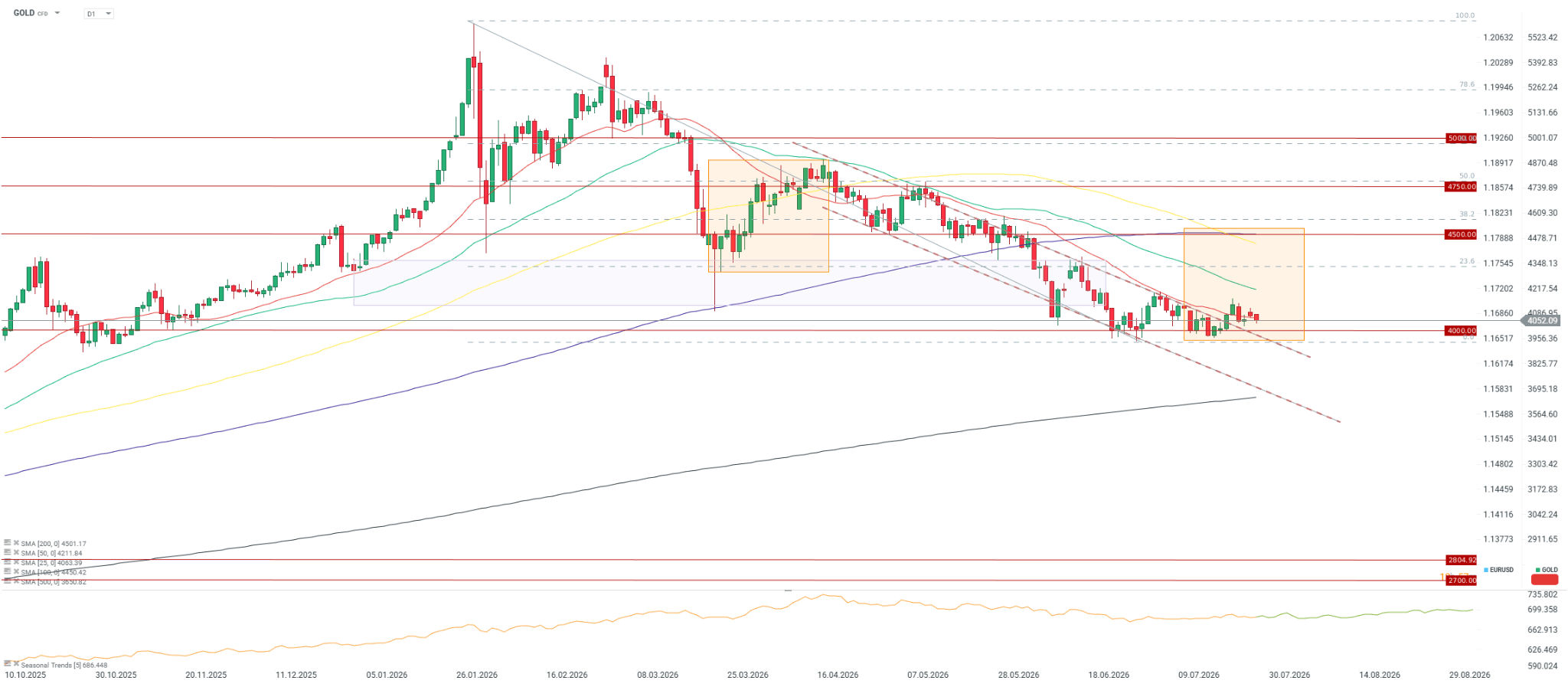
The price of gold is trying to stay above the 25-period average, following the recent attempt to break out of the descending trend channel. Source: xStation5
🍫 Cocoa
- Cocoa futures prices have fallen significantly to levels below $5200 per tonne and below £4000 per tonne, representing a decline of 1/3 compared to the previous year.
- Giants like Lindt, Barry Callebaut, and Nestlé have reported a drop in chocolate sales volume (e.g., Lindt down 7.5% in H1) due to high prices of finished products.
- Sales in traditional markets continue to look weak, but a clear improvement is observed in Asia.
- Corporations are focusing on innovation and social media trends (e.g., Dubai-style chocolate) to regain customers. However, it is worth noting that the amount of cocoa itself in finished products is simultaneously decreasing.
- Favorable weather conditions in Côte d’Ivoire, Ghana, and Nigeria are supporting preparations for the main harvests beginning at the turn of August and September.
- Cocoa deliveries to ports in Côte d’Ivoire since the start of the season reached 2.11 million tonnes compared to 1.75 million tonnes a year earlier.
- The CCC regulator in Côte d’Ivoire has begun a campaign to deliver fertilizers and seedlings to farmers across an area of 1.5 million hectares.
- Preliminary expectations for the 26/27 season indicate cocoa production in Côte d’Ivoire at 1.8 million tonnes, which would be a decrease of nearly 20% compared to the current production level.
- Transgraph Consulting indicates that the cocoa market surplus in 26/27 will shrink to just 80 thousand tonnes from over 400 thousand tonnes in the current season, which is mainly related to falling production.
Cocoa Stocks on Exchanges
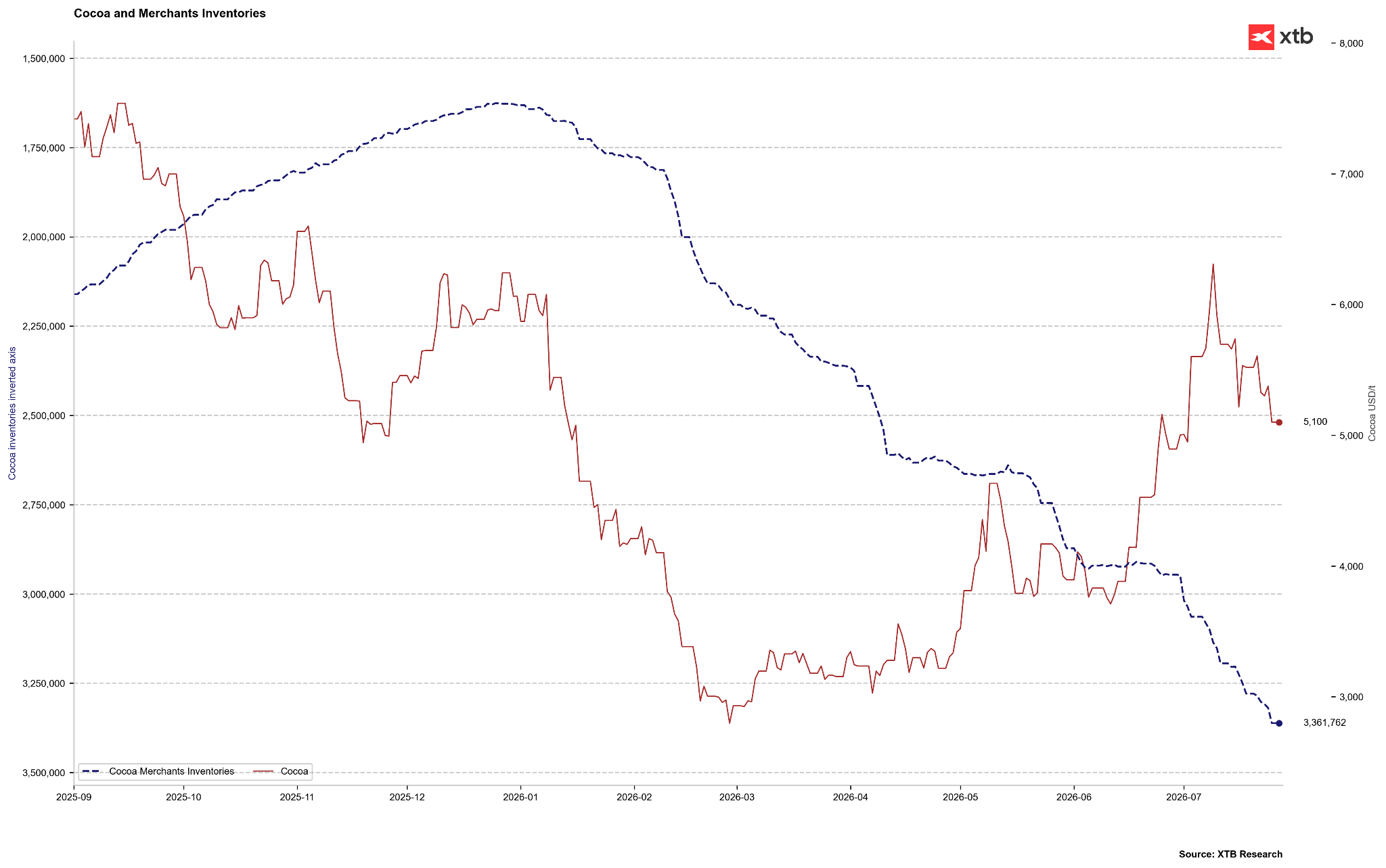
The real picture of the market is currently shown by the strong increase in cocoa stocks on exchanges, despite the fact that seasonally we should already be observing a slight decrease, as we are 2 months before the start of the next harvest season. Source: Bloomberg Finance LP, XTB Speculator Positions in the Cocoa Market
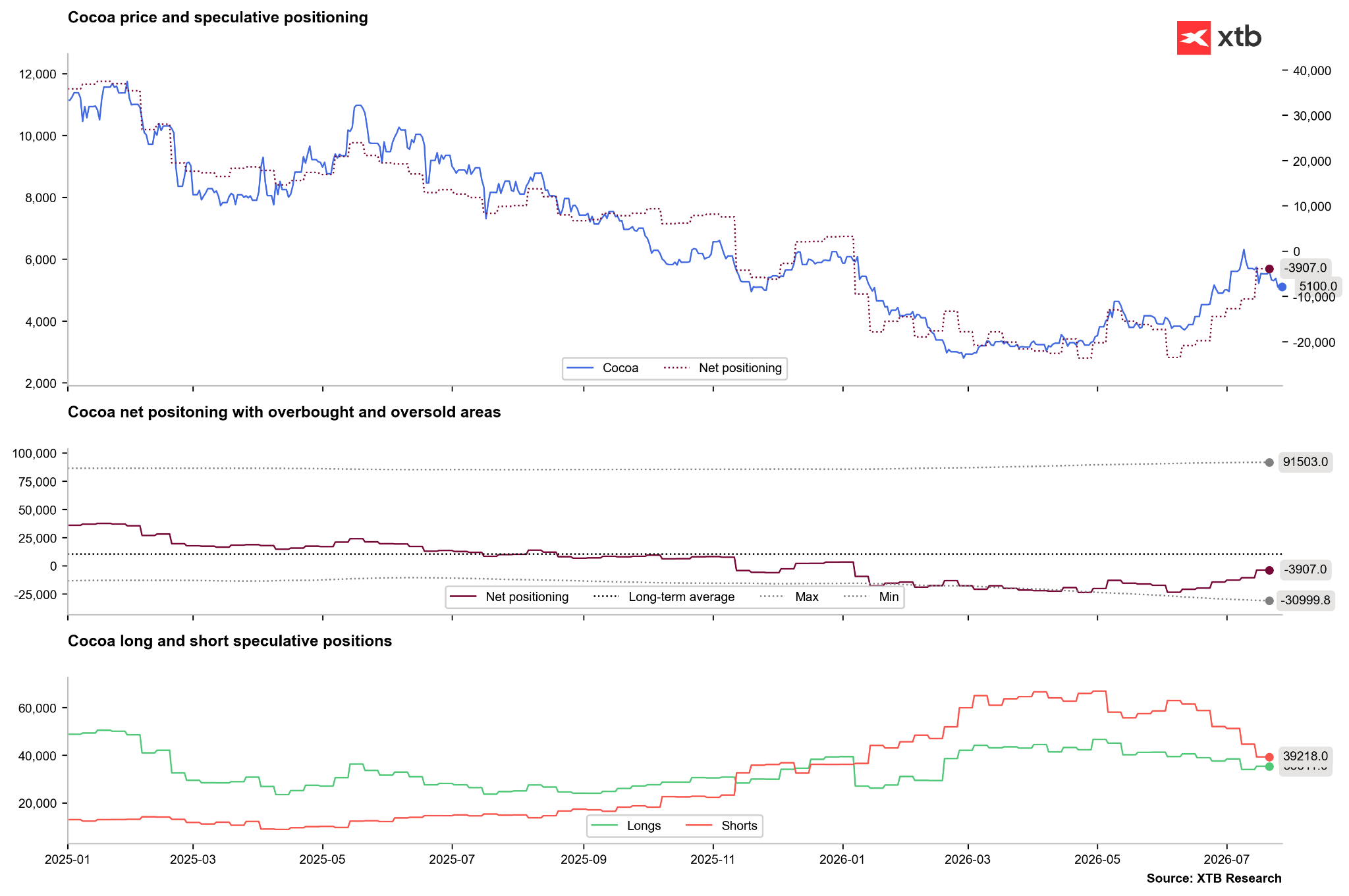
In recent weeks, speculators have reduced a lot of short positions. Source: Bloomberg Finance LP, XTB Cocoa Price Technical Analysis
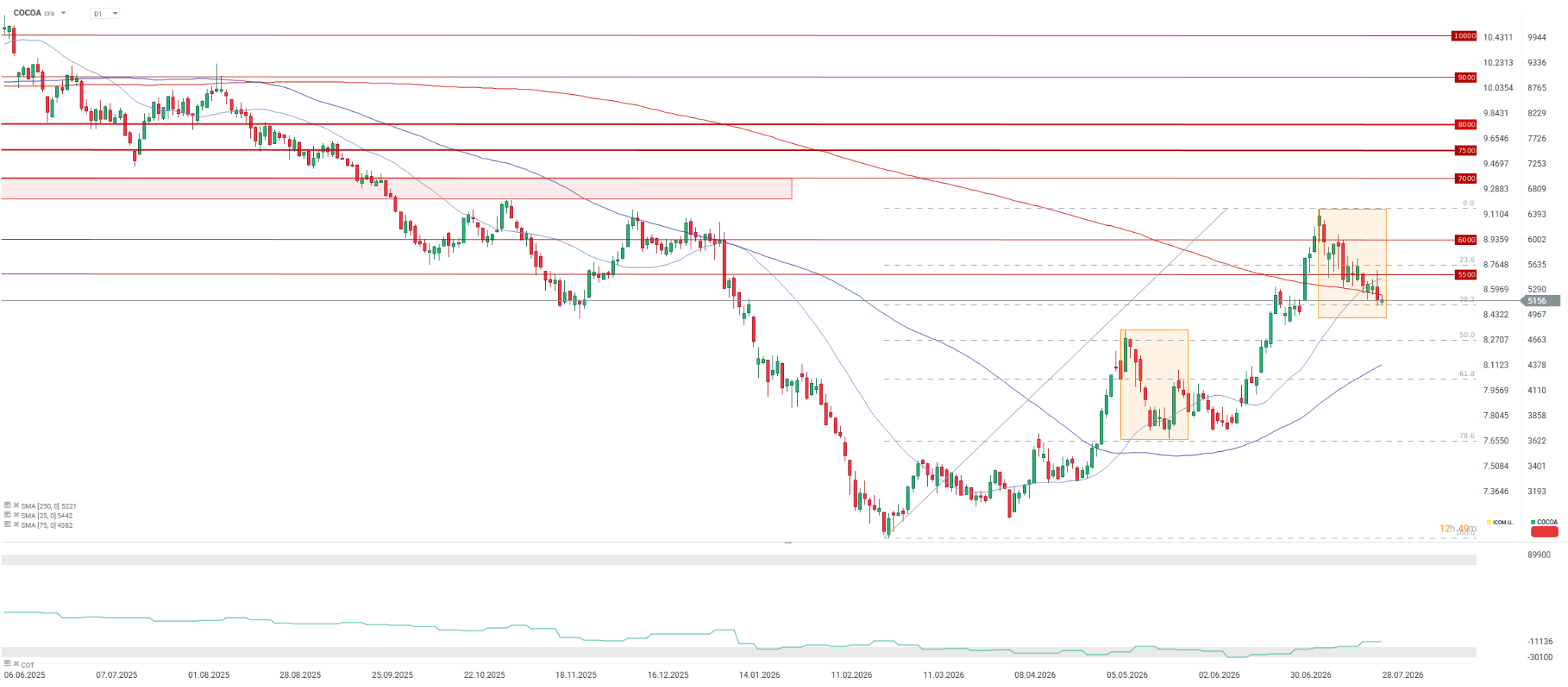
The price of cocoa has experienced a sharp drop to $5150 per tonne and is holding at the support related to the 38.2 retracement of the last upward wave and at the range of the largest correction in the current upward trend. However, the price is below the 25-period average and below the 250-period average. The key support is the area around 4700 at the 50.0 retracement. Source: xStation5