

Currency Hedger No Comments

Currency Talk – GBP/USD, AUD/NZD, USD/CHF

This analysis from the Overbalance series aims to identify three financial instruments, analyzed primarily on the daily/four-hour (D1/H4) timeframe. The analysis relies solely on the Overbalance methodology, which helps determine points where a trend may continue or where a reversal might occur.
Todayโ€™s analysis covers three instruments, evaluated solely in terms of 1:1 correction structures.

GBPUSD
The GBPUSD price has broken its downward trend by rising above the 1.3360 level, which, according to the Overbalance methodology, paves the way for a larger upward correction or even a trend reversal. Currently, the 1.3360 levelโ€”the upper boundary of the negated 1:1 geometryโ€”serves as key support. Conversely, for a return to the downtrend, the price would also need to fall below the 1.3315 level, where the lower boundary of the local 1:1 uptrend pattern is located.

GBPUSD – H4 chart. Source: xStation

AUDNZD
The AUDNZD pair has been in an uptrend for quite some time. The latest correction was exactly the same size as the previous ones, marked by the green rectangle. We are currently observing a local corrective move. If the correction continues, key support based on the Overbalance methodology is at the 0.6992 level, where the lower boundary of the 1:1 pattern is located. As long as the price remains above this level, the uptrend remains in effect.

AUDNZD – H4 timeframe. Source: xStation

USDCHF
USDCHF prices have been trending downward for quite some time, but since late January we have seen a dynamic upward correction. Currently, the price has rebounded from a key resistance level at 0.8042, where the upper boundary of the largest 1:1 pattern is located, which, according to the Overbalance methodology, may signal a return to the downtrend. For this scenario to be confirmed, the price should sustainably fall below the 0.7902 level, where the lower boundary of the smaller pattern is located. In that case, a acceleration of the decline toward recent lows would be possible. Conversely, a break above the 0.8042 level would open the way for further gains.

USDCHF – H4 timeframe. Source: xStation

The material on this page does not constitute financial advice and does not take into account your level of understanding, investment objectives, financial situation or any other specific needs. All information provided, including opinions, market research, mathematical results and technical analyzes published on the Website or transmitted To you by other means, it is provided for information purposes only and should in no way be construed as an offer or solicitation for a transaction in any financial instrument, nor should the information provided be construed as advice of a legal or financial nature on which any investment decisions you make should be based exclusively To your level of understanding, investment objectives, financial situation, or other specific needs, any decision to act on the information published on the Website or sent to you by other means is entirely at your own risk if you In doubt or unsure about your understanding of a particular product, instrument, service or transaction, you should seek professional or legal advice before trading. Investing in CFDs carries a high level of risk, as they are leveraged products and have small movements Often the market can result in much larger movements in the value of your investment, and this can work against you or in your favor. Please ensure you fully understand the risks involved, taking into account investments objectives and level of experience, before trading and, if necessary, seek independent advice.

Currency Hedger No Comments

USD/CHF Softens to near 0.7900 with rangebound tone ahead of US CPI release

  • USD/CHF weakens to around 0.7905 in Fridayโ€™s early European session.ย 
  • Further consolidation cannot be ruled out as the pair remains capped below the Bollinger Bandsโ€™ 20-day SMA, with neutral RSI.ย 
  • The immediate resistance level emerges at 0.7930; the initial support level is seen at 0.7895.ย 
  • The US March CPI inflation report is due later on Friday.ย 

The USD/CHF pairย loses ground to near 0.7905 during the early European session on Friday. A fragile two-week ceasefire between theย United States (US)ย andย Iran provides some support to a safe-haven currency such as the Swiss Franc (CHF) against the US Dollar (USD).ย 

Ahead of the US and Iran talks in Pakistan, Israel continues to bombard Lebanon after killing more than 300 people and injuring at least 1,150 in a single day of strikes across the country on Wednesday. Earlier Friday, Israeli Prime Minister Benjamin Netanyahu said that there is โ€œno ceasefire in Lebanonโ€ and Israel would continue โ€œto strike Hezbollah with full forceโ€ as the countryโ€™s military launched fresh strikes.

Traders will closely monitor the US Marchย Consumer Price Indexย (CPI) inflation report later on Friday. The headline CPI is projected to see a rise of 3.3% YoY in March, compared to 2.4% in February, driven by soaring oil prices due to the Middle East war. Any signs of hotter inflation in the US could boost the Greenback against the CHF in the near term.ย 

Chart Analysis USD/CHF

Technical Analysis:

In the daily chart, USD/CHF is hovering just above the 100-day exponential moving average (EMA) at 0.7893, which lends nearby support, but it remains capped by the Bollinger Bandsโ€™ 20-day simple moving average around 0.7932, keeping the broader tone neutral and range-bound. The Relative Strength Index (RSI) at 49 is essentially flat, hinting that directional conviction is lacking after the recent pullback from higher levels.

On the topside, initial resistance is located at the Bollinger midline/20-day SMA near 0.7930, with a break there exposing the upper Bollinger band at roughly 0.8032 as the next hurdle. On the downside, immediate support is seen at the 100-day EMA at 0.7895; a clear break below this level would open the way toward the lower Bollinger band support around 0.7832, where buyers could look to defend the broader range.

Currency Hedger No Comments

Trade of The Day – CHF/JPY

Facts:
The pair reached the lower limit of 1:1 structure at 199.45
Main trend on the pair remains upward from March 2025

Recommendation: 
Trade: Long position on CHFJPY at market price
Target: 203.68, 205.65
Stop: 197.58 

Opinion: Looking at CHFJPY chart, one can observe that the price bounced off the key technical support today. This support is marked with the lower limit of 1:1 structure (red rectangles) as well as 100-period moving average from D1 interval. Should buyers manage to hold the price above the support at 199.45, another upward impulse may be on the cards. We recommend taking a long position on CHFJPY at market price with two targets: 203.68 and 205.65. We also recommend placing a stop loss order at 197.58 Source: xStation5

Currency Hedger No Comments

War-Related Shifts in The Forex Market – USD Plumets, AUD, NDZ and CHF Rebound

The two-week suspension of U.S. military operations against Iran triggered a sharp shake-up in the FX market today, reversing much of the movement seen in recent weeks. Across a broad range of currencies, cyclical currencies are the most actively bought, with the NZD, SEK, and ZAR leading the way, while the USD and CAD are at the very bottom of the strength rankings. Pairs such as NZDUSD, AUDUSD, and GBPUSD are rebounding sharply, benefiting from the simultaneous rise in U.S. index futures and the steep sell-off in oil following the largest one-day drop in crude prices in years. The dollar index is sliding by about 0.9%, which, amid a sharp rebound in risk appetite on the stock markets, is weakening demand for safe-haven assets and pushing defensive positions in the USDโ€”and to some extent in the JPYโ€”to the sidelines.

Todayโ€™s reaction follows the pattern seen in recent weeks, in which shifts in the intensity of the conflict with Iran quickly translate into movements among the dollar, the yen, oil, and gold, increasing volatility in major currency pairs. Above is a heatmap of volatility in the FX market. Source: xStation

However, the biggest beneficiary of todayโ€™s combination of a hawkish central bank and global de-escalation remains the kiwi: following the RBNZโ€™s decision, NZD/USD rose temporarily by as much as 2% to around 0.5844, and is currently holding gains of around 1.7% at an exchange rate of approximately 0.5824. Investors interpreted the bankโ€™s statement as a โ€œhawkish pauseโ€โ€”the RBNZ clearly signaled its readiness for rapid rate hikes if inflation spreads beyond the energy sector and begins to affect wages and price expectations. At the same time, the bank emphasized that the supply shock linked to the earlier rise in oil prices is temporary, and that weaker domestic demand and rising spare capacity limit the risk of a second round of inflation. In this environment, the NZD benefits in two waysโ€”as a currency with a relatively high interest rate premium and as a classic representative of the risk-on basket, which is now returning to favor following the suspension of U.S.-Iran hostilities. If the window for peace talks in Islamabad does not close too abruptly, the NZDโ€™s current edge over the USD may hold, though ongoing instability in the region and the risk of a sudden escalation still call for caution when extending positions. 

The NZDUSD pair tested an important long-term control point marked by the 200-day EMA today. The retest has so far proved unsuccessful.

Source: xStation

The material on this page does not constitute financial advice and does not take into account your level of understanding, investment objectives, financial situation or any other specific needs. All information provided, including opinions, market research, mathematical results and technical analyzes published on the Website or transmitted To you by other means, it is provided for information purposes only and should in no way be construed as an offer or solicitation for a transaction in any financial instrument, nor should the information provided be construed as advice of a legal or financial nature on which any investment decisions you make should be based exclusively To your level of understanding, investment objectives, financial situation, or other specific needs, any decision to act on the information published on the Website or sent to you by other means is entirely at your own risk if you In doubt or unsure about your understanding of a particular product, instrument, service or transaction, you should seek professional or legal advice before trading. Investing in CFDs carries a high level of risk, as they are leveraged products and have small movements Often the market can result in much larger movements in the value of your investment, and this can work against you or in your favor. Please ensure you fully understand the risks involved, taking into account investments objectives and level of experience, before trading and, if necessary, seek independent advice.

Currency Hedger No Comments

USD/CHF holds gains above 0.8000 despite reports of US-Iran ceasefire talks

  • USD/CHF rose as the US Dollar gained on increased safe-haven demand driven by escalating Middle East tensions.
  • Greenbackโ€™s upside may be limited amid reports of the US, Iran, and mediators discussing a potential 45-day ceasefire.
  • Swiss annual inflation remained close to the SNBโ€™s lower target bound, reducing pressure for policy adjustments.

USD/CHF extends its winning streak for the third consecutive day, trading around 0.8010 during the Asian hours on Monday. The pair appreciated as the US Dollar (USD) gained ground amid increased safe-haven demand on heightened uncertainty in the Middle East.

However, the Greenbackโ€™s upside may be limited after reports that the United States (US), Iran, and regional mediators are discussing terms for a potential 45-day ceasefire. Unnamed sources see low chances of a deal being reached within the next 48 hours, a report from Axios cited by Bloomberg.

Earlier, President Trump set a new Tuesday deadline for Iran to reopen the Strait of Hormuz, while escalating threats against its power plants and other civilian infrastructure. Iranian officials warned of reciprocal retaliation, targeting US-linked infrastructure, and stated the strait would remain closed until compensation for war-related damages is secured.

Surging energy prices heighten speculation that theย Federal Reserveย (Fed) may postpone rate cuts and could even raise borrowing costs later this year if inflationary pressures persist. Market participants are now looking ahead to the latest Federal Open Market Committee (FOMC) Meeting Minutes for clearer guidance on the central bankโ€™s policy trajectory.

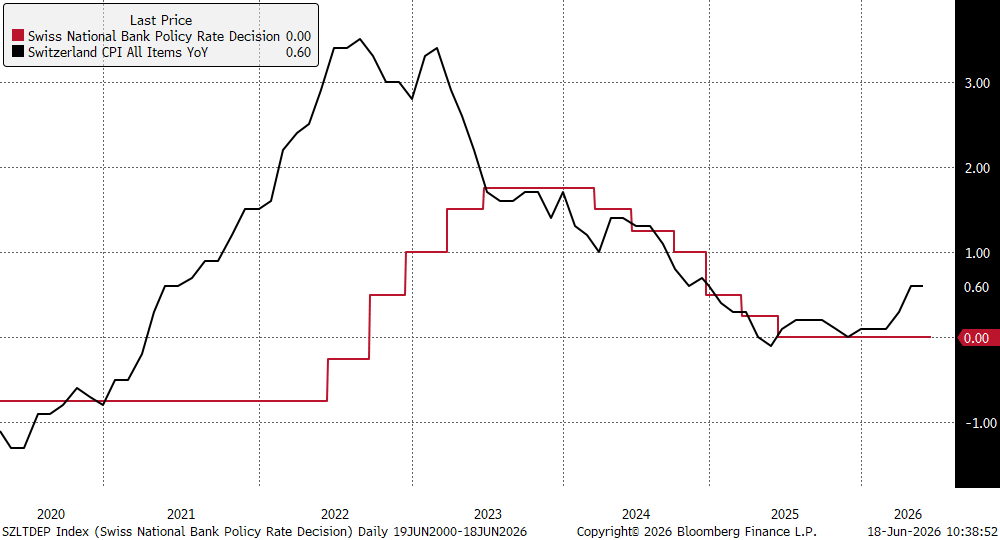
The latest domestic inflation figures eased pressure on the Swiss National Bank to adjust policy. Annual inflation rose to 0.3% year-over-year (YoY) in March, the highest in a year, but remains near the lower bound of the SNBโ€™s 0โ€“2% target.

Currency Hedger No Comments

USD/CHF stays near 0.8000 due thin trading on Good Friday

  • USD/CHF trades sideways as activity stays muted amid subdued market participation due to the Good Friday holiday.
  • The US Dollar holds ground on safe-haven demand following recent Iran threats from President Trump.
  • Swiss inflation rose to 0.3% YoY in March, staying near the SNBโ€™s lower target bound, easing pressure for policy changes.

USD/CHF remains steady after registering over 0.5% gains in the previous day, trading around 0.7980 during the Asian hours. The pair moves little as trading activity may remain subdued due to the Good Friday holiday.

The US Dollar (USD) holds firm against is major peers amid rising safe-haven demand following the recent Iran threats from the US President Donald Trump. US President Donald Trump offered no clarity on steps toward reopening the Strait of Hormuz, warning of intensified military action over the next two to three weeks and issuing strong threats against Iran. Iranโ€™s Foreign Minister Abbas Araghchi responded that recent US strikes on civilian infrastructure would not force a retreat, describing them instead as evidence of an opponent in disarray and moral decline.

Chicago Fed President Austan Goolsbee shared his concern on Thursday over rising oil prices, noting they could complicate efforts to curb inflation, particularly if gasoline costs surge and lift inflation expectations.

Meanwhile, the Dallas Fed president supported theย Federal Reserveย holdingย ratesย steady at the latest FOMC meeting, noting the labor market has stabilized since late 2025, though payroll growth remains weak and โ€œuncomfortable.โ€

Swiss inflation rose to 0.3% year-over-year (YoY) in March from 0.1%, below the 0.5% forecast but the highest in a year, reflecting rising energy costs linked to Middle East tensions. Price growth remains near the lower bound of the Swiss National Bankโ€™s 0โ€“2% target, reducing pressure for policy changes.

Currency Hedger No Comments

Currency Talk – USDJPY, NZDUSD, USDCHF

The Overbalance analysis aims to identify three financial instruments, analyzed primarily on the daily/four-hour (D1/H4) timeframe. The analysis uses only the Overbalance methodology, which helps determine where a trend may continue or where it may reverse. Todayโ€™s analysis covers three instruments, evaluated solely in terms of 1:1 correction structures.

USDJPY
Since February 12, the USDJPY has been trading in a strong uptrend. Initially, the movement was controlled by a 1:1 corrective pattern with a range of approximately 140 pips; however, in mid-March, a deeper correction occurred, after which the market established a new high. As a result, the current largest corrective pattern has a range of approximately 240 pips. At this point, the key support level is 158.10, derived from the lower boundary of this pattern. As long as this level holds, the uptrend remains in place. A break below it, however, could open the way for a larger correction or even a trend reversal.

USDJPY – H4 chart. Source: xStation

NZDUSD
The NZDUSD pair has been trending downward since late January. We are currently seeing an upward corrective move. If the correction continues, the key resistance level remains at 0.5845, where the upper boundary of the 1:1 correction pattern is located. According to the Overbalance methodology, the downtrend remains in effect until this level is negated.

NZDUSD – H4 chart. Source: xStation

USDCHF
Since early January, USDCHF has been in a downtrend. However, an upward correction has been developing since late January, and its range has already exceeded smaller geometric patterns, including the 0.7902 level. Nevertheless, the price has failed to break through the key resistance at 0.8042, where the upper boundary of the largest corrective pattern is located. According to the Overbalance methodology, the downtrend remains in effect until this level is broken. The decline could accelerate after falling below the 0.7902 level, which is the lower boundary of the smaller geometric pattern. Conversely, a break above 0.8042 could lead to a shift to an uptrend.

USDCHF – H4 timeframe. Source: xStation

The material on this page does not constitute financial advice and does not take into account your level of understanding, investment objectives, financial situation or any other specific needs. All information provided, including opinions, market research, mathematical results and technical analyzes published on the Website or transmitted To you by other means, it is provided for information purposes only and should in no way be construed as an offer or solicitation for a transaction in any financial instrument, nor should the information provided be construed as advice of a legal or financial nature on which any investment decisions you make should be based exclusively To your level of understanding, investment objectives, financial situation, or other specific needs, any decision to act on the information published on the Website or sent to you by other means is entirely at your own risk if you In doubt or unsure about your understanding of a particular product, instrument, service or transaction, you should seek professional or legal advice before trading. Investing in CFDs carries a high level of risk, as they are leveraged products and have small movements Often the market can result in much larger movements in the value of your investment, and this can work against you or in your favor. Please ensure you fully understand the risks involved, taking into account investments objectives and level of experience, before trading and, if necessary, seek independent advice.

Currency Hedger No Comments

USD/CHF rises above 0.7950 ahead of Swiss CPI inflation data

  • USD/CHF climbs to near 0.7985 in Thursdayโ€™s early European session. 
  • Trump said the USโ€™s war objectives are nearing completion and threatening to hit Iran hard over the next two to three weeks.
  • The Swiss March CPI inflation data will be released on Thursday.  

The USD/CHF pair jumps to around 0.7985 during the early European session on Thursday. The Greenback strengthens against the Swiss Franc (CHF) following an address to the nation by US President Donald Trump. Traders will keep an eye on the Swiss March Consumer Price Index (CPI) data, which is due later on Thursday. 

Trump said during a primetime televised speech from the White House on Thursday that his core “objectives are nearing completion” in Iran and expected another two or three weeks of involvement. Nonetheless, he signaled that the US is prepared to intensify its military response in the remaining time period and threatened to bring Iran โ€œback to the stone ages.โ€ Persistent tensions between the US and Iran could underpin the US Dollar (USD) in the near term.

The Swiss Federal Statistical Office will publish its inflation data on Thursday. The monthly and annual CPI are expected to show a rise of 0.5% for March. The persistent low inflation has led the Swiss National Bank (SNB) to maintain a cautious stance. 

Traders will shift their attention to the US jobs data on Friday. Markets expect the Nonfarm Payrolls (NFP) to show 60,000 in March, while the Unemployment Rate is projected to hold steady at 4.4% during the same period. If the reports show weaker-than-expected outcomes, this could undermine the USD against the CHF.