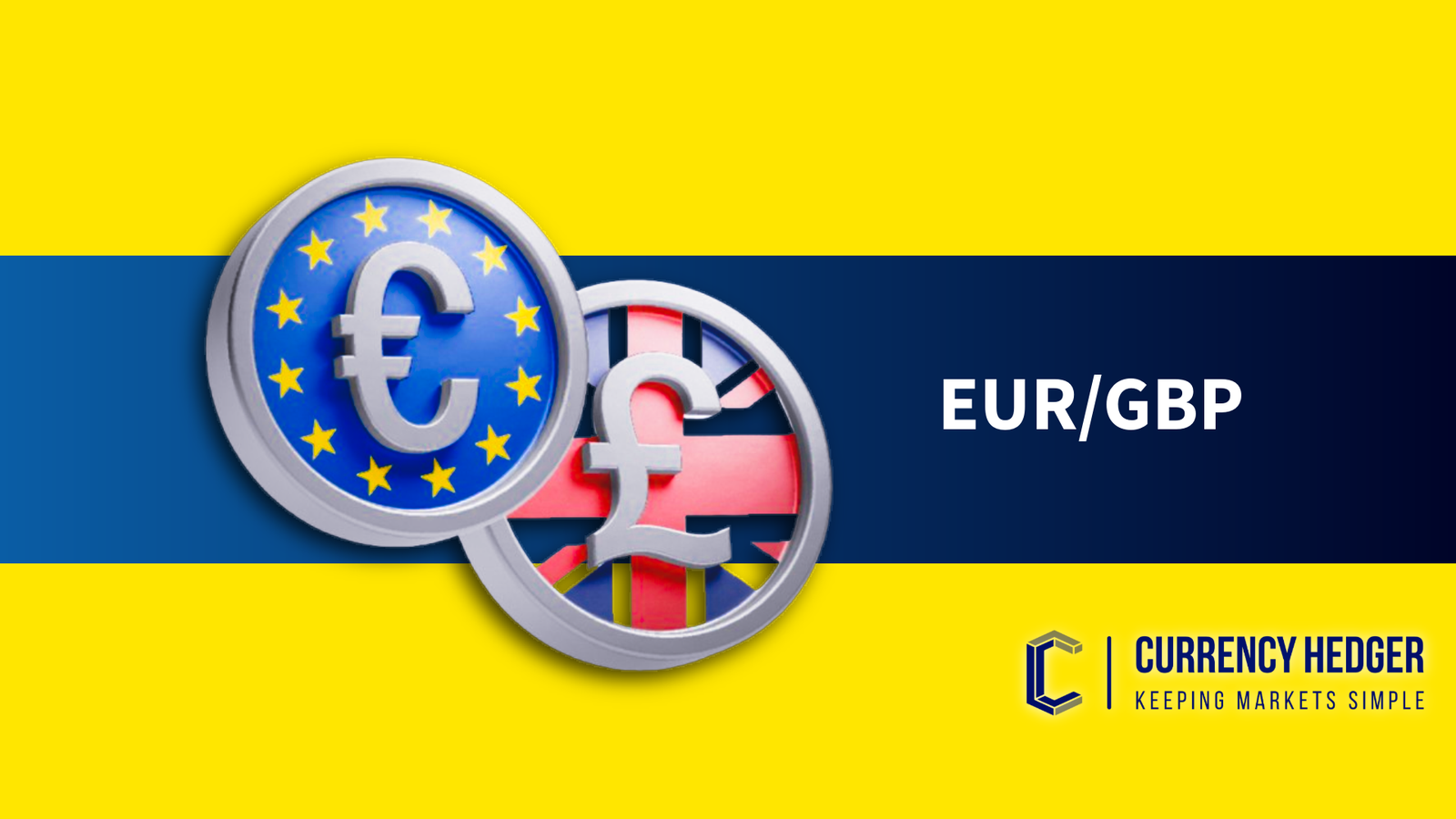
EUR/GBP keeps hovering around 0.8650, unfazed by UK consumption data

March 27, 2026
  • The Euro remains practically flat around 0.8650, following UK Retail Sales data.
  • Markets pay little attention to February’s UK consumption figures, as they predate Iran’s war.
  • Inflation in Spain accelerated in March to its highest level since 2024.

The Euro (EUR) keeps trading sideways against the British Pound (GBP) on Friday, oscillating within a tight range around the 0.8650 level for the fourth consecutive day, on track for a 0.25% weekly decline. The stronger-than-expected UK  Retail Sales figures released earlier on the day have failed to provide any significant support to the Sterling.

Data released by National Statistics earlier on Friday revealed that retail consumption fell for the first time in the last three months in February, by 0.4%, following a 2% increase in January. The market consensus had anticipated a sharper, 0.8% decline.

Excluding fuel, sales of all other items have shown a similar pattern, falling 0.4% on the month after a 2.2% gain in January, yet remaining above the -0.8% market consensus. Year on year, Retail Sales growth eased to 2.5%, from an upwardly revised 4.8% growth in the previous month, while the Core Retail Sales slowed down to 3.4% from 5.9% in January.

These figures have had a limited impact on the market as they predate the start of the war in Iran. Data from March, which will show the impact of a sharp decline in consumer confidence and a sharp uptick in prices due to the surge in Oil prices, is likely to have more relevance.

The Euro, on the other hand, remains on its back foot, also weighed by the pressure of higher Oil prices in the Eurozone economy. Spain’s Consumer Price Index (CPI) accelerated to 3.3% year-on-year in March, its highest level in 14 months, adding pressure on the European Central Bank (ECB) to hike interest rates in April.

EUR/USD Price Forecast: Resumes downside after failing to hold above 200-day EMA

March 27, 2026
  • EUR/USD trades marginally lower around 1.1520 as the US Dollar remains firm amid Middle East conflicts.
  • Peace mediators dismiss Trump’s claim that the 10-day halt to attacks on Iranian energy plants was ordered as per Tehran’s request.
  • ECB’s Lagarde warns of persistent energy supply risks due to significant damage to Gulf energy infrastructure.

The EUR/USD pair trades subduedly around 1.1520 during the European trading session on Friday. The major currency pair faces slight selling pressure as the US Dollar (USD) trades firmly with hopes of a de-escalation in the Middle East war easing, which involves the United States (US), Israel, and Iran.

During the press time, the US Dollar Index (DXY), which tracks the Greenback’s value against six major currencies, trades 0.1% higher to near 100.00.

Investors turn doubtful over Mideast optimism amid the conflicting statements from peace mediators on US President Donald Trump’s claim that he ordered a pause on planned military strikes on Iran’s power plans as per Tehran’s request.

According to the Wall Street Journal (WSJ), peace talks mediators dismissed claims that Iran had requested a 10-day pause on strikes on its energy plants.

On the Euro (EUR) front, the major currency is expected to remain under pressure amid fears of persistent energy supply disruption in the wake of damage to Gulf energy infrastructure amid the war.

European Central Bank (ECB) President Christine Lagarde said in an interview with the Economist that the negative energy shock to the world economy from the Mideast war would be larger than current projections, as too much energy infrastructure has been damaged.

EUR/USD technical analysis

EUR/USD trades lower at around 1.1520 as of writing. The pair holds just above the 200-day EMA near 1.1540 while extending a sequence of lower highs below the 20-day EMA around 1.1590, keeping the near-term bias modestly bearish within a broader sideways context.

The 14-day Relative Strength Index (RSI) struggles to hold its recovery move into the 40.00-60.00 zone, signifying heavy selling pressure at higher levels.

Immediate resistance emerges at the 20-day EMA around 1.1590, with a daily close above this barrier needed to ease bearish pressure and open a move toward 1.1690. A stronger recovery would then target the 1.1810/1.1850 area, where prior highs cluster and the recent breakdown began. On the downside, initial support is located at 1.1500, guarding the late pullback low at 1.1415. A decisive break below 1.1415 would confirm a continuation of the downswing and expose the next support zone closer to 1.1350, where longer-term buyers would be expected to re-emerge.

EUR/USD inches up after Trump’s Hormuz deadline extension; remains below mid-1.1500s

March 27, 2026
  • EUR/USD attracts some buyers during the Asian session amid a modest USD downtick.
  • Trump extends the deadline to reopen the Strait of Hormuz, undermining the buck.
  • Persistent geopolitical uncertainty and hawkish Fed bets could limit the USD downside.

The EUR/USD pair edges higher during the Asian session on Friday, though it lacks bullish conviction and risks attracting fresh sellers amid a bullish US Dollar (USD). Nevertheless, spot prices, for now, seem to have snapped a three-day losing streak and currently trade around the 1.1535-1.1540 area, up nearly 0.10% for the day.

US President Donald Trump delayed a threatened strike on Iran’s energy infrastructure and extended his deadline for Tehran to reopen the Strait of Hormuz until April 6. This helps ease concerns about a further escalation of tensions in the Middle East and dents the USD’s safe-haven demand, which turns out to be a key factor offering some support to the EUR/USD pair.

Meanwhile, Iran has threatened to retaliate against regional infrastructure, including desalination facilities, if Trump follows through with his threat. Moreover, the deployment of additional US troops has been fueling speculation of a potential ground operation. This keeps geopolitical risks in play and should underpin the USD’s status as the global reserve currency.

Apart from this, hawkish US Federal Reserve (Fed) expectations might continue to act as a tailwind for the buck and cap the upside for the EUR/USD pair. Investors remain worried that the war-driven surge in energy prices would revive inflationary pressures and now seem to have fully priced out the possibility of any further interest rate cuts by the Fed this year.

Moreover, traders are rapidly increasing bets for a hike by the end of this year. The outlook remains supportive of elevated US Treasury bond yields and validates the USD bullish bias. This, in turn, warrants some caution for the EUR/USD bulls and makes it prudent to wait for some follow-through buying before positioning for any further intraday appreciating move.

US Dollar Price Today

The table below shows the percentage change of US Dollar (USD) against listed major currencies today. US Dollar was the strongest against the Swiss Franc.

USDEURGBPJPYCADAUDNZDCHF
USD-0.10%-0.08%-0.14%-0.09%-0.07%-0.10%-0.04%
EUR0.10%0.02%-0.06%0.00%0.02%-0.00%0.06%
GBP0.08%-0.02%-0.09%-0.02%0.01%-0.03%0.04%
JPY0.14%0.06%0.09%0.07%0.06%0.04%0.12%
CAD0.09%-0.01%0.02%-0.07%0.00%-0.00%0.05%
AUD0.07%-0.02%-0.01%-0.06%-0.00%-0.02%0.04%
NZD0.10%0.00%0.03%-0.04%0.00%0.02%0.06%
CHF0.04%-0.06%-0.04%-0.12%-0.05%-0.04%-0.06%

The heat map shows percentage changes of major currencies against each other. The base currency is picked from the left column, while the quote currency is picked from the top row. For example, if you pick the US Dollar from the left column and move along the horizontal line to the Japanese Yen, the percentage change displayed in the box will represent USD (base)/JPY (quote).

Trade of The Day – EUR/USD

March 26, 2026

Facts:

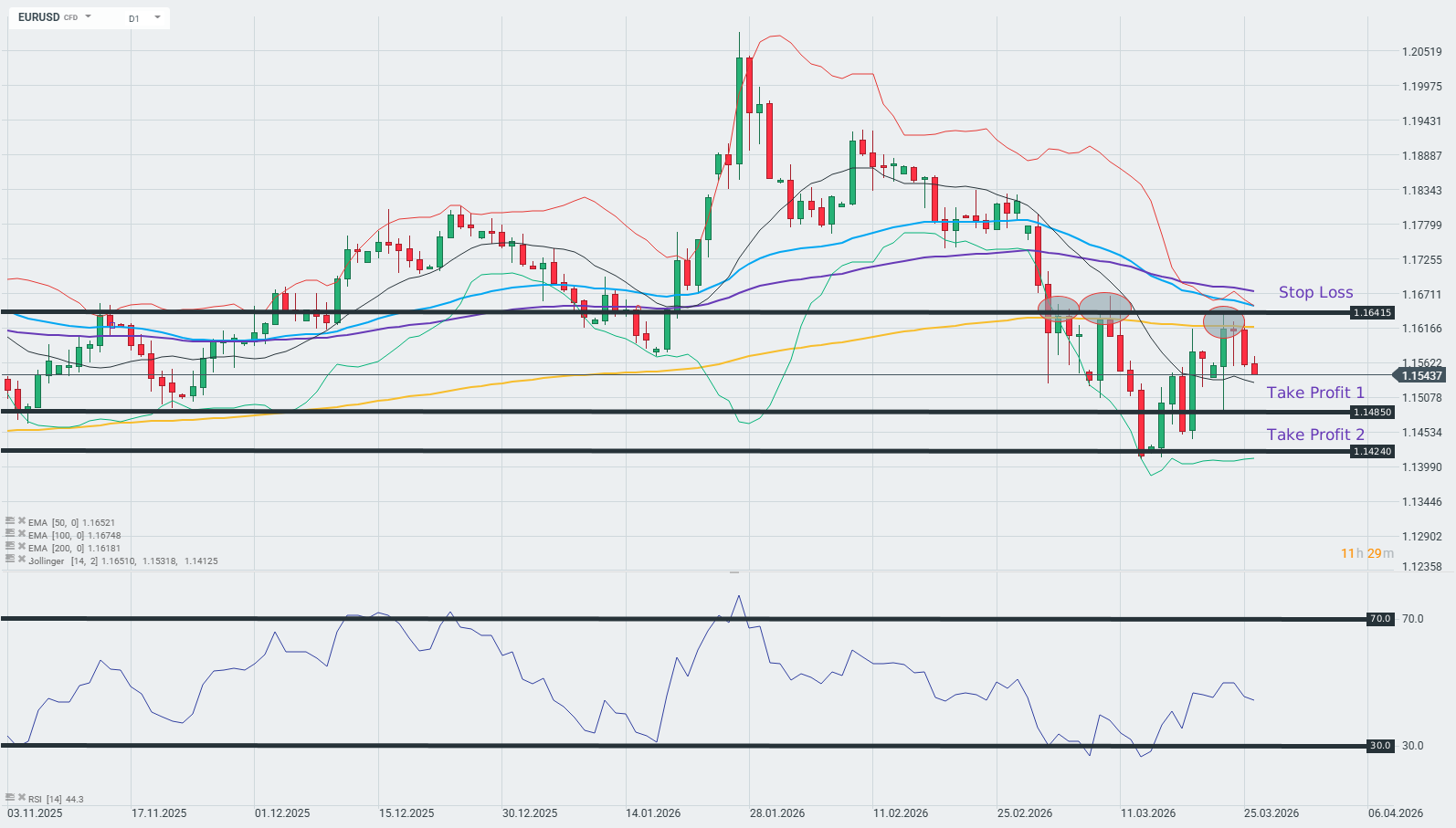
  • The EUR/USD exchange rate failed to break above the 200-day EMA
  • The price remains below the 50-, 100-, and 200-day exponential moving averages (EMA)

Recommendation: 

Trade: Short position on the EUR/USD pair at market price

Take Profit 1: 1,14850

Take Profit 2: 1,14240

Stop: 1.16415
 

Opinion:

The EUR/USD pair failed to break above the 200-day exponential moving average (EMA), which is a key technical signal confirming the euro’s continued weakness against the dollar. The price remains below the 50-, 100-, and 200-day EMAs, creating a classic bearish pattern—each of these moving averages currently acts as dynamic resistance, pushing the price back down on subsequent attempts to rebound. A stop-loss set at 1.16415 marks the zone where this pattern would be negated and would force a revision of the scenario.

Fundamental and geopolitical context

Iran’s rejection of the U.S. peace plan signals that tensions in the Middle East may persist for much longer than the market had originally anticipated. Such a scenario favors a steady inflow of capital into the dollar, a traditional safe-haven currency, and growing geopolitical uncertainty, combined with expectations of a return of inflationary pressure, creates solid foundations for a medium-term appreciation of the USD. Although the scale of the recent USD strengthening remains relatively moderate, historical analogies suggest that in similar, multi-vector crises, the dollar has tended to strengthen further.

Methodology and assumptions:


This recommendation is based on a technical analysis of the EURUSD chart. Classical technical analysis was used to assess the situation and analyze the trend. The target level—take profit 1—was set at the level of previous price reactions, using price action methodology. Take profit 2, on the other hand, is based on the location of this month’s local low. The protective stop-loss order was set above the most recent local high using price action methodology.

EUR/GBP holds above 0.8650 as hawkish ECB comments support the Euro

March 26, 2026
  • The Euro regains ground against the Pound Sterling on Thursday, with the cross returning to the upper range of the 0.8600s.
  • EUR/GBP edges up following hawkish comments from ECB’s Nagel.
  • From a wider perspective, the cross remains sideways, with both currencies weighed by risk aversion.

The Euro (EUR) edges up slightly against the British Pound (GBP) on Thursday, yet moving within previous ranges, following downbeat German consumer confidence figures and hawkish comments by European Central Bank (ECB) member and Bundesbank President Joachim Nagel.

Nagel said earlier on Thursday that an interest rate hike in April will be an option at next month’s ECB meeting “if the war in the Middle East raises the spectre of an inflation surge in the Eurozone”.

These comments follow Wednesday’s remarks by ECB President Christine Lagarde, who affirmed that the central bank will have to respond “in a forceful pr persistent way” if consumer inflation looks set to be well above the bank’s 2% target. 

Higher borrowing costs might derail recovery

The prospect of higher interest rates amid sluggish economic growth in the region’s leading economies is keeping investors wary, weighing on demand for the common currency.

On Thursday, the German GfK Index showed that consumer confidence is expected to plunge to -28 in April from -24.8 in March. Data from Wednesday showed that the German IFO Business Climate deteriorated too, albeit less than expected, while the PMI survey underscored that the rise in energy prices could easily derail a tame economic recovery.

The Pound Sterling (GBP), however, is not faring much better, which keeps the cross in a choppy, sideways trading cycle. UK inflation data revealed that consumer prices remained at 3%, even before the start of the war, which has boosted market expectations that the Bank of England will be forced to hike rates more than once this year.

EUR/USD under pressure as Iran pushes back against US ceasefire proposal

March 25, 2026
  • EUR/USD remains on the defensive as the US Dollar stays firm amid mixed US-Iran ceasefire signals.
  • Iran pushes back against US peace proposals, limiting ceasefire hopes
  • Oil-driven inflation concerns boost ECB rate hike bets while the Fed is seen holding rates.

The Euro (EUR) trades under pressure against the US Dollar (USD) on Wednesday, as the Greenback remains well supported amid conflicting headlines surrounding US-Iran ceasefire efforts. While Washington is pushing for a diplomatic breakthrough, uncertainty over Tehran’s response continues to underpin demand for the safe-haven Greenback.

At the time of writing, EUR/USD is trading around 1.1585, down about 0.20% on the day. Meanwhile, the US Dollar Index (DXY), which tracks the Greenback’s value against a basket of six major currencies, is 99.40 after marking an intraday low of 99.07.

Iran signaled little willingness to align with US-led proposals, with state-linked media Press TV reporting that Tehran will end the conflict strictly on its own terms. A senior political-security official said Iran “will not allow Trump to dictate the timing of the war’s end,” adding that any resolution would only come when Iran’s conditions are met.

Iran has set clear conditions for any deal. These include a full stop to attacks and assassinations, guarantees the war will not restart, payment for war damages, an end to fighting across all regional fronts, and recognition of its control over the Strait of Hormuz.

This comes after the United States reportedly proposed a 15-point plan, including a one-month ceasefire to kick-start negotiations. The proposal is said to involve curbs on Iran’s nuclear program and guarantees to keep the Strait of Hormuz open in exchange for potential sanctions relief.

The mixed signals from both sides suggest that a meaningful breakthrough remains unlikely in the near term, raising the risk of a prolonged conflict. This is keeping Oil-driven inflation concerns alive and complicating the policy outlook for major central banks.

Traders are now fully pricing in two rate hikes from the European Central Bank (ECB), while expectations for Federal Reserve (Fed) rate cuts this year have largely been priced out, with markets increasingly anticipating that the Fed will hold rates through 2026.

However, a Reuters poll published on Wednesday showed that 60 economists showed that 38 expect the ECB to keep its deposit rate at 2.00% this year, although 21 now see at least one rate hike in 2026.

Earlier in the day, ECB President Christine Lagarde said, “the ECB won’t act before it has sufficient information,” adding that “if the shock gives rise to a large though not-too-persistent overshoot of our target, some measured adjustment of policy could be warranted.” She also noted, “We must identify when higher energy costs risk spilling over into broad-based inflation.”

Currency Talk – GBP/AUD AUD/NZD EUR/AUD

March 25, 2026

The Overbalance analysis aims to identify three financial instruments, analyzed primarily on the daily/four-hour (D1/H4) timeframe. The analysis uses only the Overbalance methodology, which helps determine where a trend may continue or where it may reverse.
Today’s analysis covers three instruments, evaluated solely in terms of 1:1 correction structures.

GBPAUD
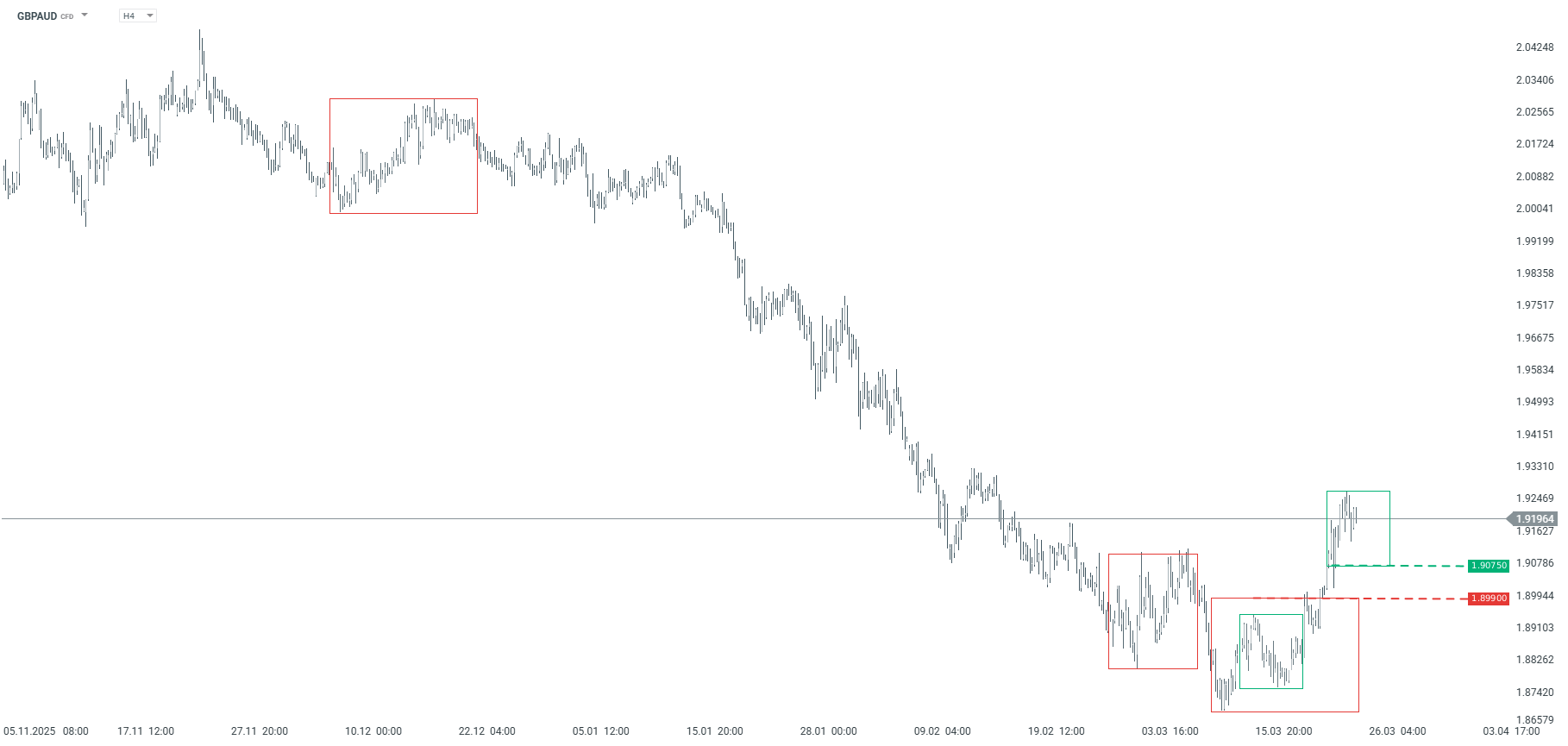
Since last November, the GBPAUD currency pair has been trading in a downtrend; however, in mid-March, the upper boundary of the broad 1:1 pattern was broken at the 1.8990 level, which may indicate a shift in sentiment toward an uptrend. Currently, the 1.8975 level should be considered key short-term support, as it marks the lower boundary of the local 1:1 bullish pattern. According to the Overbalance methodology, as long as this level holds, further expansion of the upward movement is possible. Conversely, a drop back below 1.8990 could signal a resumption of the downward trend.

GBPAUD – H4 timeframe. Source: xStation

AUDNZD
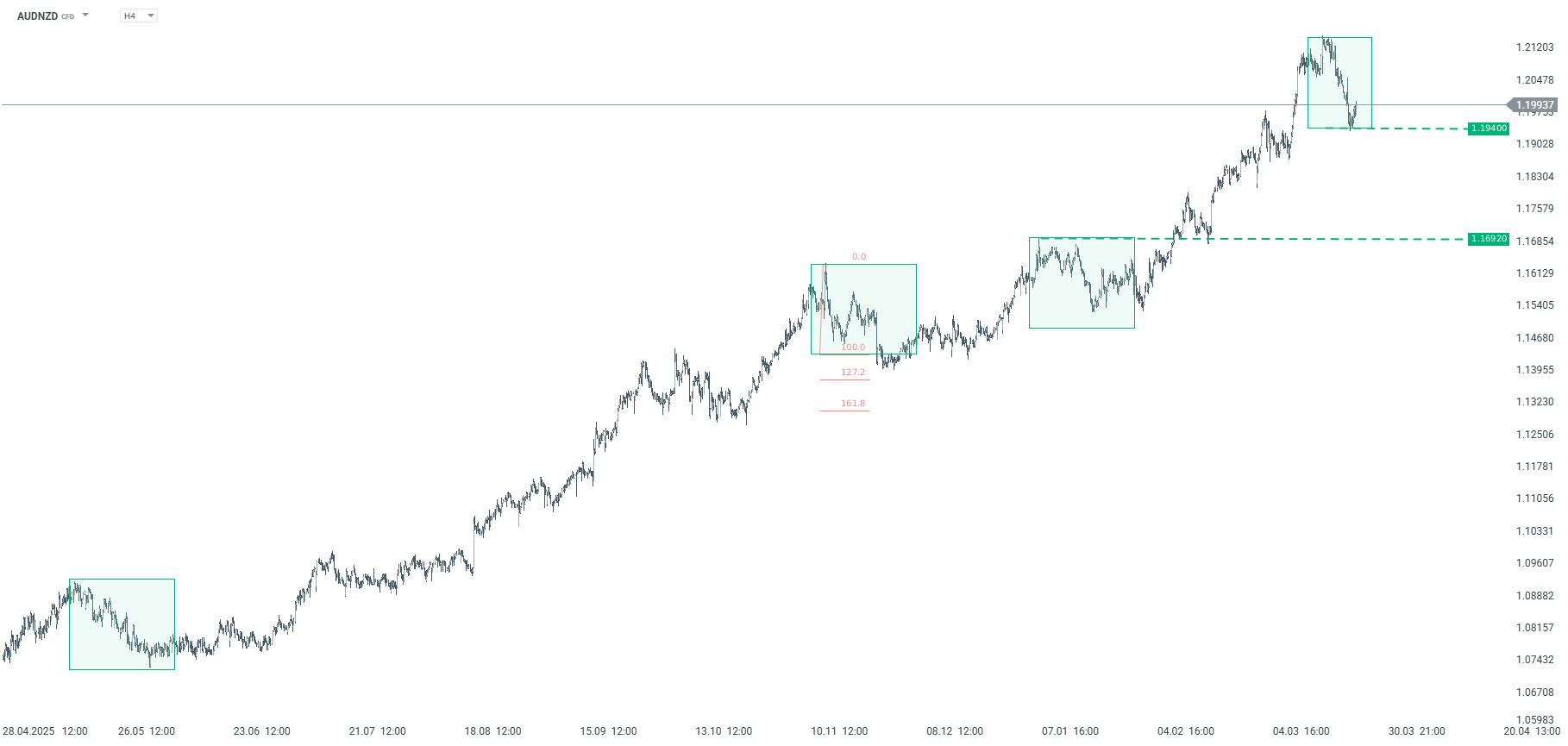
The AUDNZD exchange rate has been in an uptrend since April of last year. Due to the prolonged period without a major correction, the recent downward move is similar in magnitude to previous corrections, allowing us to identify support at the 1.1730 level, where the lower boundary of the 1:1 pattern is located. According to the Overbalance methodology, as long as this level holds, the uptrend remains in effect.

AUDNZD – H4 timeframe. Source: xStation

EURAUD
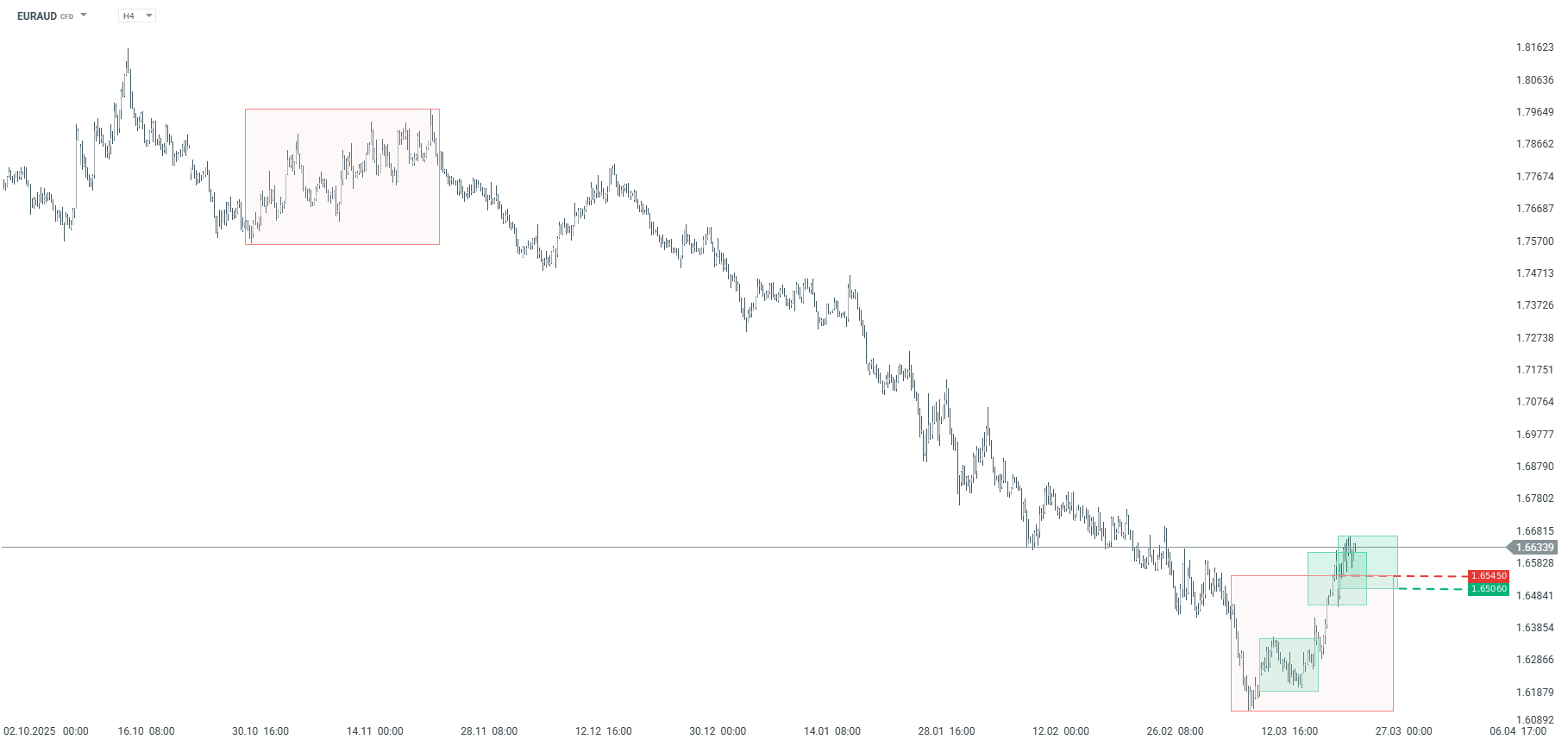
Since last October, the EURAUD pair has been trading in a downtrend; however, in recent days, the 1.6545 level has been broken, which may suggest the start of an upward correction or even a trend reversal. According to the Overbalance methodology, as long as the price remains above this level, the base case scenario remains a continuation of the uptrend. Conversely, a return below 1.6545, as well as a break below the 1.6506 level—where the lower boundary of the local 1:1 uptrend pattern lies—could signal a return to the downtrend. For now, the base case remains an upward correction.

EURAUD – H4 timeframe. Source: xStation

The material on this page does not constitute financial advice and does not take into account your level of understanding, investment objectives, financial situation or any other specific needs. All information provided, including opinions, market research, mathematical results and technical analyzes published on the Website or transmitted To you by other means, it is provided for information purposes only and should in no way be construed as an offer or solicitation for a transaction in any financial instrument, nor should the information provided be construed as advice of a legal or financial nature on which any investment decisions you make should be based exclusively To your level of understanding, investment objectives, financial situation, or other specific needs, any decision to act on the information published on the Website or sent to you by other means is entirely at your own risk if you In doubt or unsure about your understanding of a particular product, instrument, service or transaction, you should seek professional or legal advice before trading. Investing in CFDs carries a high level of risk, as they are leveraged products and have small movements Often the market can result in much larger movements in the value of your investment, and this can work against you or in your favor. Please ensure you fully understand the risks involved, taking into account investments objectives and level of experience, before trading and, if necessary, seek independent advice.

EUR/USD slips below 1.1600 as Middle East tensions escalate

March 24, 2026
  • EUR/USD weakens after fresh Israeli strikes hit Tehran.
  • President Trump announced a five-day truce following productive talks with Iran.
  • Iran’s Foreign Minister Abbas Araghchi denied any direct talks with Washington.

EUR/USD loses ground after registering modest gains in the previous session, trading around 1.1590 during the Asian hours on Tuesday. The pair depreciates as the US Dollar (USD) gains on increased risk aversion amid escalating Middle East conflict.

The Guardian reported on Tuesday that the Israeli military noted that it had launched a fresh wave of strikes on Tehran. This action came after US President Donald Trump signalled a pause in US attacks against energy infrastructure after what he said were productive talks with Iran. The Israeli Defense Forces (IDF) stated that it would continue operations in line with Israeli government directives until told otherwise.

Iran’s Foreign Minister, Abbas Araghchi, stated that there was “no dialogue” between Tehran and Washington. Meanwhile, Iranian Parliament Speaker Mohammad Bagher Ghalibaf said in a social media post on Monday that “no negotiations have been held with the US.” Mohsen Rezaei, the senior military adviser to Iranian Supreme Leader Mojtaba Khamenei, said that the war will continue until Iran receives full compensation for the damage it has sustained.

Reuters reported on Monday that San Francisco Federal Reserve Bank President Mary Daly said that unless the Iran conflict resolves quickly and the central bank can simply “look through” a temporary increase in oil prices, it is not clear what the next move on interest rates will need to be.

Rising oil prices are fueling inflation concerns and strengthening the European Central Bank’s (ECB) hawkish stance. The ECB left rates unchanged at last week’s meeting, citing the Iran conflict as a source of “significantly more uncertain” outlook.

Officials pointed to increasing inflation risks alongside weaker growth prospects, leading markets to boost expectations of potential rate hikes later this year. Policymakers are scheduled to speak on Monday, and any hawkish signals could provide support to the Euro.