

The Indian rupee climbed to around 95.1 per dollar, extending last week’s gains to a near four-week high as lower oil prices reinforced optimism from the Reserve Bank of India’s sustained market intervention. Brent crude prices fell 4.7% to below $84 a barrel after US President Donald Trump said plans for an attack on Iran had been shelved to allow negotiations on a nuclear deal, easing concerns over India’s import bill and inflation outlook. The rupee rallied 1.2% last week, its strongest weekly gain since March, as the RBI’s near-daily dollar sales eased fears of a slide beyond 97 per dollar. Additional support came after RBI data showed measures to attract capital inflows had brought in about $41 billion, including $36.7 billion through foreign currency non-resident deposits, bolstering the central bank’s capacity to defend the rupee. Meanwhile, the RBI’s net foreign exchange forward book narrowed slightly to $103.3 billion in June, reflecting lower near-term dollar liabilities.

Indian Rupee gains further as oil prices extend losses
- The Indian Rupee adds more gains due to further weakness in oil prices.
- US President Trump confirms that strikes on Iran have halted to open the door to diplomacy.
- India’s GDP growth will likely slow down to 6.6% YoY this year.
The Indian Rupee (INR) extends its winning streak against the US Dollar (USD) for the third trading day on Tuesday. The USD/INR pair falls to near 95.65 as a further decline in oil prices has strengthened the Indian currency.
In the opening trade, the MCX Crude Oil contract expiring on August 19 trades 1.4% down at around Rs. 7,848, the lowest level seen in a week.
Given that India meets 85% of its energy demand through imports, a steep decline in oil prices reduces foreign outflows from India and hence improves the appeal of the Indian Rupee.
Trump confirms Iran negotiating with US
On Monday, United States (US) President Donald Trump said that Iran is talking to Washington about a deal and said “reaching one is possible”. Trump added that there’s plenty of time to reach a deal with Iran and that “we’ll see what happens”, Axios reported. Trump added that he halted strikes on Iran to open the door to diplomacy, while maintaining the stance of expanding military aggression if talks failed.
The pause in the exchange of attacks between the US and Iran has resulted in a sharp decline in oil prices. However, it doesn’t mean that the energy supply is returning to normal, with the Strait of Hormuz remaining closed.
Countdown to Fed’s policy starts
This week, the major trigger for financial markets will be the Federal Reserve’s (Fed) monetary policy announcement on Wednesday.
According to the CME FedWatch tool, traders see a 62% chance that the Fed will leave interest rates unchanged in the range of 3.50%-3.75%. The tool shows a strong possibility of an interest rate hike in the September policy meeting.
However, US President Trump urged Fed Chairman Kevin Warsh to lower interest rates, adding that there was a good inflation report recently, costs were falling rapidly, and that prices should drop significantly once the Gulf War ends.
Experts warn of slower India’s GDP growth
According to the latest Reuters poll, India’s Gross Domestic Product (GDP) is forecast to grow 6.6% Year-on-Year (YoY) in the fiscal year ending March 2027, down from 7.7% in FY2025-26. Growth is then expected to edge up to 6.8% in FY2027-28. The report showing poll results also revealed that weak private investment and higher oil prices will weigh on India’s economic growth.
Going forward, the major trigger for the Indian currency will be the Reserve Bank of India’s (RBI) monetary policy announcement next week.
Technical Analysis: USD/INR falls below 20-day EMA
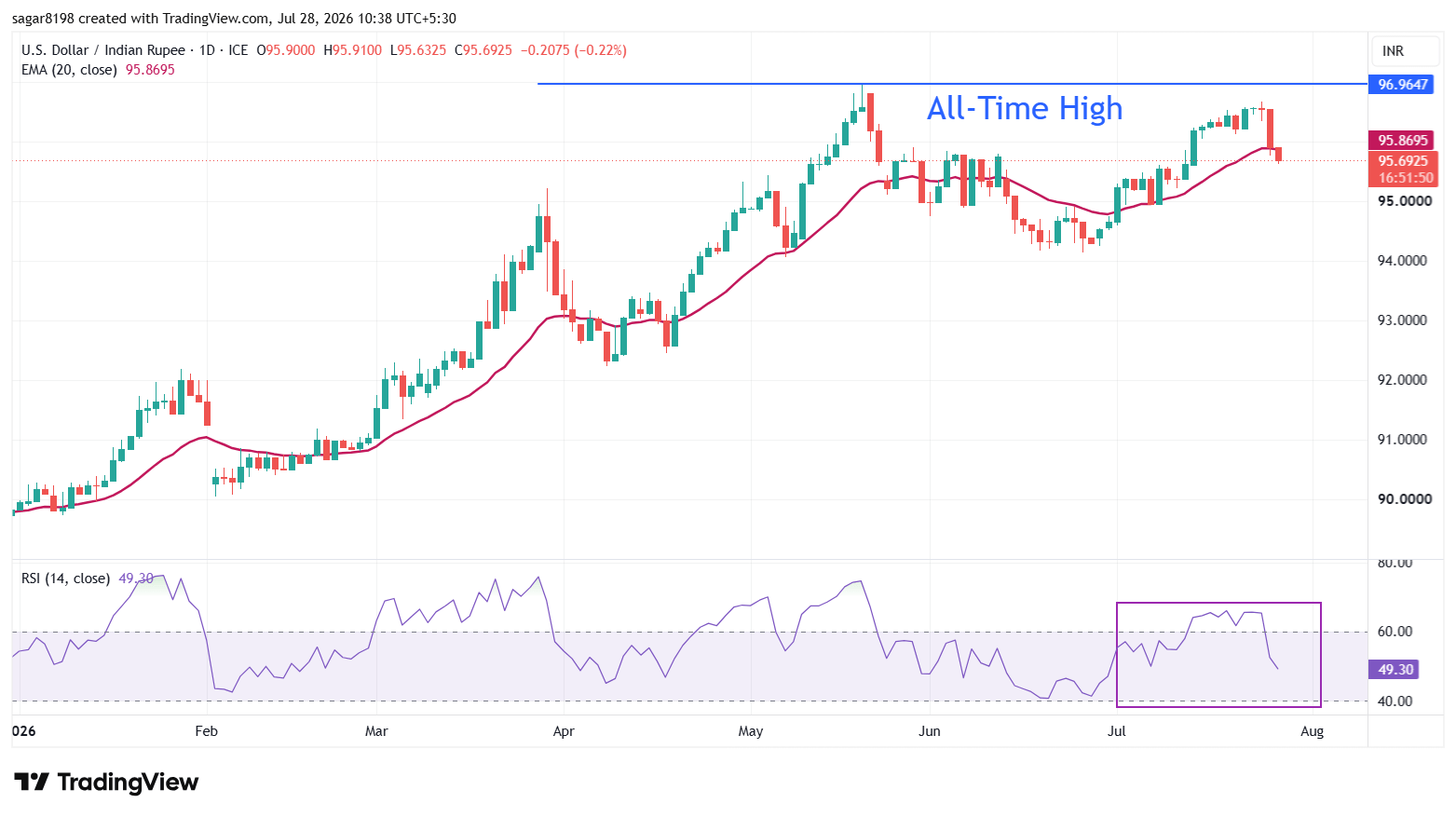
USD/INR trades lower at around 95.65, holding in a corrective phase after recent gains as it slips just under the 20-day exponential moving average (EMA), which is at 95.93. The loss of this short-term average as immediate resistance hints that upside momentum is fading, while the Relative Strength Index (RSI) at 50.6 sits near neutral territory, suggesting a consolidative rather than impulsive tone for now.
On the topside, the 20-day EMA at 95.9278 is the first barrier that bulls would need to reclaim to revive a more constructive bias and open the way for a retest of all-time highs around 97.10. Looking down, the 95.00 level will be the key support area.
Indian Rupee recovers further as US-Iran war pause hits oil prices
- The Indian Rupee gains further, capitalizing on a correction in oil prices and the US Dollar.
- US President Donald Trump pauses attacks on Iran to allow time for diplomacy.
- Investors expect the Fed to leave interest rates unchanged on Wednesday.
The Indian Rupee (INR) extends its recovery against the US Dollar (USD) at the start of the Federal Reserve’s (Fed) monetary policy week. The USD/INR pair falls further to near 96.10 as the pause in military aggression between the United States (US) and Iran has weighed heavily on oil prices and has diminished the safe-haven appeal of the US Dollar.
In the opening trade, the MCX Crude Oil contract expiring on August 19 trades 4.75% lower to near Rs. 8,200.
The appeal of currencies from economies, such as India, which rely heavily on oil imports to fulfill their energy needs, improves when oil prices fall sharply.
Meanwhile, the US Dollar Index (DXY), which gauges the Greenback’s value against six major currencies, trades 0.25% lower to near 101.25.
US holds strikes on Iran on exhaustion of target list
Two-week-long exchange of attacks between the US and Iran paused over the weekend as Washington confirmed that further military aggression would be unnecessary, confirming that the target list has been exhausted.
According to Axios, Adm Bradley Cooper, the top US military commander in the region, had told Trump the US military campaign had reached the limits of its effectiveness, The Guardian reported. Cooper added that there was little point in continuing the bombing campaign without a return to major combat operations.
In response, Iran also paused attacking US bases in its neighbouring nations, but confirmed that its position remains “attack for attack”.
Meanwhile, US ambassador to the United Nations (UN), Mike Waltz, also told Fox News on Sunday that President Donald Trump had decided to pause US attacks to allow more time for diplomacy, Reuters reports. This has renewed hopes for diplomatic efforts between both nations.
Investors await key Fed policy
This week, the major trigger for global markets will be the Federal Reserve’s (Fed) monetary policy announcement on Wednesday, in which the central bank is expected to leave interest rates unchanged in the range of 3.50%-3.75%. So far this year, the Fed has not done any monetary policy adjustments.
Investors will pay close attention to the monetary policy statement and Fed Chair Kevin Warsh’s press conference to get fresh cues regarding inflation and the economic outlook. Warsh is unlikely to deliver any remarks regarding the monetary policy guidance, as he clarified in its last press conference that “so-called forward guidance is not well-suited in the current policy juncture”.
Technical Analysis: USD/INR falls toward 20-day EMA
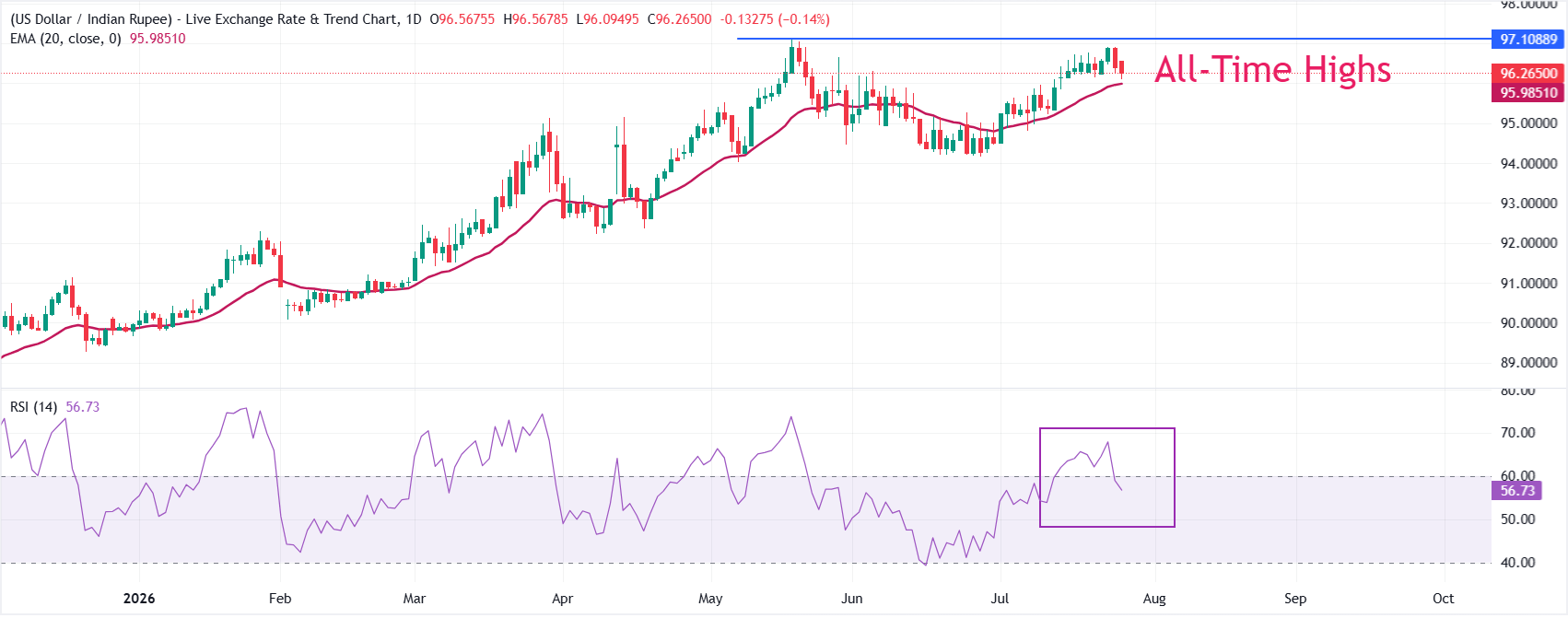
USD/INR trades lower at around 96.26 at press time. The pair remains underpinned by a constructive near-term bias, with spot holding above the 20-day Exponential Moving Average (EMA) at 95.9851.
The mildly positive 14-day Relative Strength Index around 57 suggests ongoing bullish momentum, though not yet in overbought territory, allowing room for further gains while the price action stays supported above the short-term EMA.
On the downside, immediate support is now seen at the 20-day EMA near 95.99, which protects the recent advance; a daily close below this level would hint at a deeper corrective phase toward prior price congestion. Looking up, the all-time high at around 97.10 will be the key resistance level.
Rupee Near Record Low on Oil, US Tariffs
The Indian rupee weakened to around 96.58 per dollar, hovering near record lows as a sharp surge in crude oil prices and fresh US tariff measures weighed on sentiment. Brent crude jumped more than 7% to above $100 per barrel after Yemen’s Houthis attacked two Saudi oil tankers in the Red Sea, exacerbating supply concerns as trade through the Strait of Hormuz remained severely disrupted. Sentiment was further dampened after the US imposed new tariffs of 10% to 12.5% on imports from around 60 economies under a forced-labor investigation, including a 10% duty on Indian goods, fueling concerns over global trade, India’s export outlook, and broader emerging-market assets. Investor focus also remained on the Reserve Bank of India, with traders watching for further intervention after state-run banks were reportedly seen selling dollars on the central bank’s behalf to curb volatility and prevent the rupee from breaching record lows.
Rupee Falls to 2-Month Low on Oil Surge
The Indian rupee fell to around 96.4 per dollar, reaching its lowest level since May as sentiment deteriorated after escalating tensions in the Middle East drove oil prices higher. Investor concerns over India’s import bill and inflation outlook intensified after Brent crude climbed above $90 per barrel, extending its July rally as the US carried out a ninth consecutive night of strikes on Iran following the collapse of an interim ceasefire. The rupee has lost about 1.7% this month, with traders warning that Brent crude rising above $95 per barrel could push the currency to fresh all-time lows unless the Reserve Bank of India intervenes more aggressively. Meanwhile, investors also monitored foreign portfolio flows after recent policy measures aimed at attracting dollar inflows, with overseas investors having net purchased $2.3 billion of Indian stocks and bonds so far in July, while markets awaited a decision on the inclusion of Indian government bonds in a global debt index.
Rupee Remains Under Pressure
The Indian rupee hovered around 96.2 per dollar, remaining under pressure after reaching eight-week lows as sentiment weakened on rising crude oil prices. Brent crude climbed above $85 per barrel amid escalating tensions between the US and Iran, raising concerns over potential supply disruptions through the Strait of Hormuz and increasing India’s oil import bill. The rupee has fallen about 1.7% so far this month, moving closer to its record low reached in May. Meanwhile, the positive sentiment from the Reserve Bank of India’s recent measures to attract dollar inflows has largely faded, prompting traders to resume buying dollars on dips in anticipation of further rupee weakness. Additional pressure came from more than $14 billion in overseas investment announcements by Indian companies early in the fiscal year, boosting demand for foreign currency, while foreign portfolio outflows and higher oil imports continued to weigh on the rupee and India’s foreign exchange reserves.
Rupee Falls to Over Four-Week Low
The Indian rupee weakened to 95.7 per dollar, retreating from recent gains to its lowest level in over four weeks, as renewed tensions in the Middle East sent crude oil prices sharply higher. Sentiment deteriorated amid renewed concerns over India’s trade balance after Iran expanded its attacks to Qatar and the UAE following fresh US strikes on Iran. US President Donald Trump declared that the ceasefire was over, fueling fears of further supply disruptions. Brent crude surged more than 4% to $79.28 per barrel, increasing pressure on the rupee. Investors also monitored the Reserve Bank of India’s response, with market participants expecting the central bank to continue supporting the currency through dollar sales as higher oil prices threaten to fuel inflation. Meanwhile, traders closely watched the impact of rising oil-driven inflation concerns on US Treasury yields as markets assessed the implications of the latest strikes and counter-strikes on global energy supplies.
Rupee Pauses Decline After RBI FX Intervention
The Indian rupee hovered around 95.5 per dollar, pausing losses as traders pointed to likely intervention by the Reserve Bank of India through dollar sales to temper volatility. The currency remained under pressure, however, amid renewed geopolitical tensions after fresh US military strikes on Iran and retaliatory attacks on Kuwait and Bahrain fueled concerns over oil supplies. Brent crude remained on the rise, gaining more than 8% over the previous two sessions. Broader market caution also weighed on domestic assets, sending the benchmark 10-year government bond yield up 7 basis points on Wednesday, its biggest one-day rise in over three months, while Indian equities fell 2%, their steepest drop over the same period. Meanwhile, Fed meeting minutes reinforced expectations of tighter US monetary policy, with futures implying a one-in-three chance of a rate hike this month and a two-in-three probability by September.