USD/JPY is seen consolidating as traders opt to wait for the release of the US NFP report.
Bulls await a sustained move above the $38.2% Fibo. before positioning for further gains.
Any corrective pullback is likely to find decent support near 157.25, the 23.6% Fibo. level.
The USD/JPY pair extends the range play through the Asian session on Friday, stalling this week’s solid recovery from its lowest level since May, touched in the aftermath of a joint US-Japan intervention. Spot prices currently trade near the top end of the weekly range, around mid-158.00s, as traders keenly await the crucial US Nonfarm Payrolls (NFP) report for a fresh impetus.
In the meantime, persistent geopolitical uncertainties, reviving inflation fears, and bets for at least one interest rate hike by the US Federal Reserve (Fed) act as a tailwind for the US Dollar (USD). The Japanese Yen (JPY), on the other hand, remains depressed on the back of concerns about Japan’s worsening fiscal condition. Moreover, a fall in Japan’s Household Spending for the seventh straight month weakens the case for a Bank of Japan (BoJ) rate hike in September, further weighing on the JPY and acting as a tailwind for the USD/JPY pair.
From a technical perspective, spot prices keep a capped tone near the 38.2% Fibonacci retracement level of a sharp slide from a four-decade high, touched in July. Meanwhile, the Moving Average Convergence Divergence (MACD) now prints in positive territory, hinting at improving short-term momentum on the 4-hour chart. However, the Relative Strength Index (RSI) around 50 suggests a neutral, consolidative backdrop rather than a decisive trend shift, making it prudent to wait for a move beyond the current level before placing fresh bullish bets.
A further move up beyond the 38.2% Fibo., near 158.55, is likely to confront resistance at the 50.0% retracement at 159.61 and the 61.8% level at 160.66, where further rallies could stall. On the downside, initial support appears at the 23.6% retracement at 157.26, ahead of the structural floor near 155.17. A sustained break below 157.26 is likely to open the way for a deeper correction toward that lower zone.
AUD weakens on safe-haven shift due to geopolitical tensions in the Strait of Hormuz.
China’s Trade Balance beat expectations, though moderating export and import growth presents a mixed picture.
AUD/JPY could rebound as Japanese Yen retreats despite joint Tokyo-Washington currency intervention efforts.
AUD/JPY halts its three-day winning streak, trading around 111.30 during the Asian hours on Friday. The currency cross depreciates as the Australian Dollar (AUD) loses ground, driven by a surge in global safe-haven demand. Escalating tensions in the Strait of Hormuz have rattled market stability, sparking widespread skepticism over whether this vital shipping route will reopen anytime soon.
Meanwhile, China’s latest trade figures present a mixed economic picture that could carry significant implications for Australia, given the close trading relationship between the two nations. China’s June Trade Balance in US Dollar terms came in at $112.5 billion, topping expectations of $107.0 billion though falling short of the previous $125.62 billion figure. In Chinese Yuan terms, the Trade Surplus widened to 767 billion, beating the estimated 740 billion, but trailing the prior 859.05 billion reading. July exports grew 23.9% year-over-year compared to June’s 27% rise, while imports expanded by 27.5% over the same period, moderating from the previous 36% growth rate.
RBA hike risk keeps modest upside bias in AUD
Rabobank’s FX strategists continue to see scope for further RBA tightening, arguing that “there is still risk of one more rate hike this year in November.” They note that “the market will be hoping that the RBA’s August 11 policy meeting will provide more clarity on rate hike risks,” particularly in light of shifting expectations around the policy path. Against this backdrop, Rabobank maintains “a modest upside bias in Australian Dollar out to 12 months.
Despite these pressures, the AUD/JPY cross could regain traction as the Japanese Yen (JPY) gives back some of its recent gains. Those initial gains were sparked by joint currency intervention from Tokyo and Washington, which has fueled speculation that authorities might step in again.
However, the JPY’s quick retreat highlights ongoing skepticism about whether official intervention can overcome its structural weakness, a weakness continually dragged down by wide interest rate differentials, escalating fiscal concerns, and stubbornly high energy and import costs.
Asian currency slide seen as catalyst for US Dollar intervention
Analysts at ING argue that the recent bout of weakness across key Asian currencies may have been a key trigger for official action in the US Dollar/Japanese Yen pair. They note that “large falls in the Japanese yen, Korean won and Taiwanese dollar might have been one of the reasons the US Treasury stepped in with USD/JPY intervention,” and suggest the move “could be well-timed if the Fed doesn’t hike and the Dollar falls,” potentially aligning policy dynamics with efforts to stabilise the Yen.
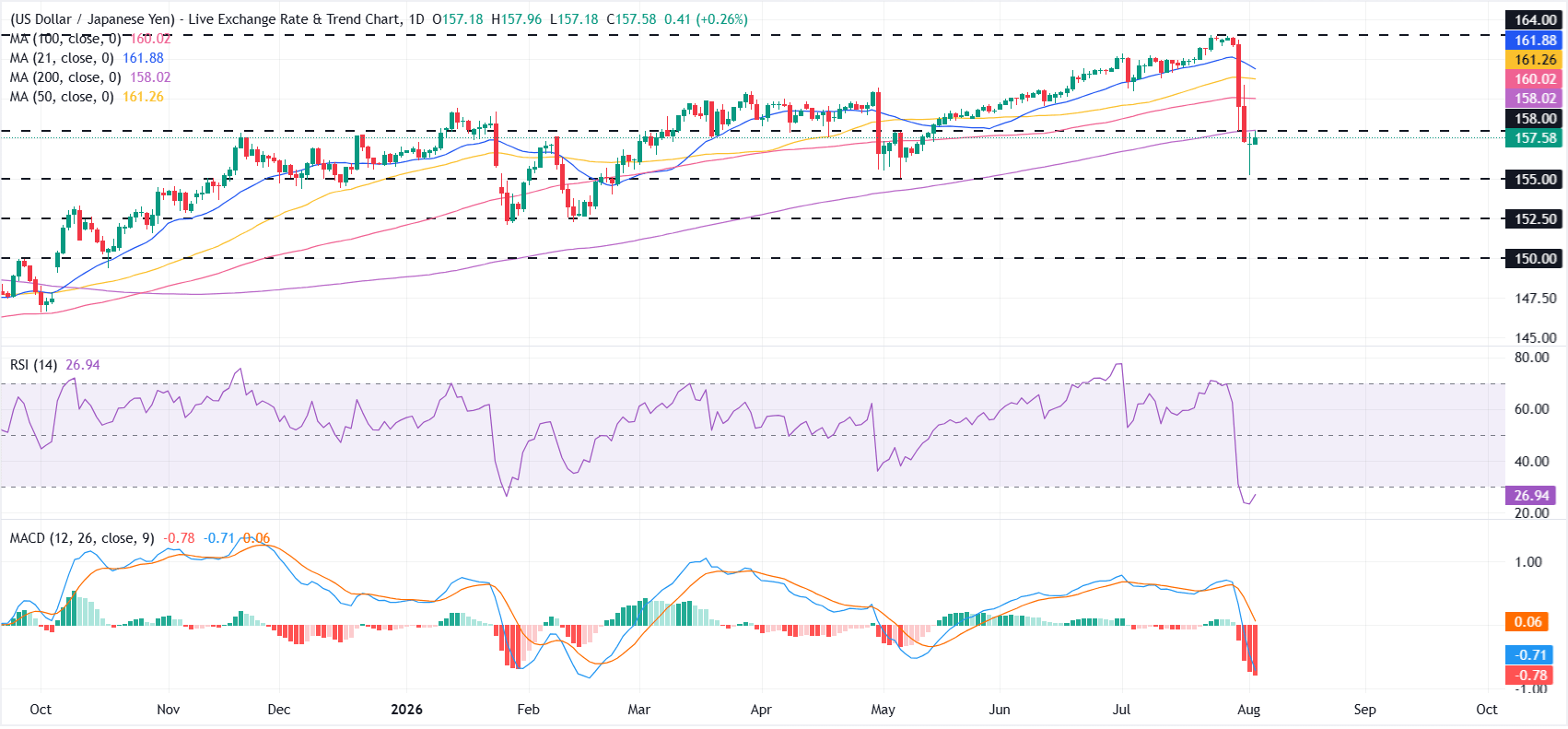
USD/JPY edges higher as the Japanese Yen gives back part of its intervention-led gains.
The pair has slipped below all major moving averages, turning the near-term bias bearish.
RSI signals oversold conditions, while the 200-day SMA at 158 offers immediate resistance.
USD/JPY trades modestly higher on Tuesday despite a softer US Dollar (USD), as the impact of recent intervention fades and the Japanese Yen (JPY) comes under pressure again. At the time of writing, the pair trades around 157.60, recovering after briefly falling toward 155 on Monday, its lowest level since May 6.
Analysts at Societe Generale argue that a lasting recovery in the Yen will hinge on the domestic growth story rather than policy theatrics, maintaining that “what will trigger a durable yen rally will be a rise in consensus forecasts of Japanese growth, rather than more, bigger intervention, coordinated or otherwise.”
They add that “more, or faster BoJ rate hikes won’t solve the problem either, unless the Japanese growth outlook makes them appear realistic,” cautioning that “if Japanese growth remains weak, higher JGB yields will increasingly be unhelpful for the yen.”
In contrast, strategists at BBH focus on the near-term impact of recent official action, noting that “the coordinated US-Japan intervention – and officials’ warning that they stand ready to act again – significantly raises the cost of fighting a stronger yen and puts a much firmer ceiling on USD/JPY.”
From a technical perspective, the intervention-driven pullback in USD/JPY has weakened the near-term bullish structure, with the pair slipping below key moving averages.
On the daily chart, the 200-day Simple Moving Average (SMA) at 158 offers immediate resistance. Further up, the 100-day SMA at 160 guards the path toward the 50-day SMA at 161.26 and the 21-day SMA at 161.89, ahead of a more distant structural hurdle at 164.
The Relative Strength Index (RSI) at 27 signals oversold conditions, while the Moving Average Convergence Divergence (MACD) remains below zero, reflecting the recent shift in momentum to the downside.
On the downside, the 155.00 psychological mark offers immediate support. A decisive break below this level could expose the 152.50 area, with the 150.00 psychological mark emerging as the next major downside target.
EUR/JPY declines to near 181.70 in Wednesday’s early European session.
The cross keeps a negative tone, with bearish RSI momentum.
The first upside barrier emerges at 184.90, the initial support level to watch is 181.15.
The EUR/JPY cross trades in negative territory around 181.70 during the early European trading hours on Wednesday. The Japanese Yen (JPY) strengthens against the Euro (EUR) as traders remain on alerts for further intervention from Japanese authorities following the coordinated intervention between the United States (US) and Japan.
Traders will closely monitor the developments surrounding US-Iran talks. Axios reported that the US, Iran, and Oman are closing in on an interim deal to reopen the Strait of Hormuz, with Washington aiming for a Wednesday announcement.
The source added that the agreement under discussion sets up a 60-day temporary arrangement between Oman and Iran in the critical waterway. Fresh optimism over the Middle East could improve risk sentiment and provide some support to the riskier asset, such as the EUR against the JPY.
Yen outlook seen hinging on growth rather than faster BoJ hikes
Societe Generale argues that the policy rate path alone is unlikely to deliver a sustained recovery in the Yen. Analysts there stress that “more, or faster BoJ rate hikes won’t solve the problem either, unless the Japanese growth outlook makes them appear realistic,” underscoring their view that a credible improvement in Japan’s growth prospects is a prerequisite for any meaningful policy tightening to support the currency.
Technical Analysis: Negative outlook of EUR/JPY remains intact
In the daily chart, EUR/JPY keeps a bearish near-term tone as spot holds below the 20-day simple moving average (SMA) from the Bollinger Bands and the 100-day SMA, which now act as a tight resistance cluster overhead. Price is sliding toward the lower Bollinger Band while the Relative Strength Index (14) at 34.77 stays close to oversold territory, hinting that downside pressure persists but may be approaching a fatigue zone.
On the topside, initial resistance is aligned at the Bollinger mid-line/20-day SMA near 184.90, followed by the 100-day SMA at 185.10. A decisive daily close above this level would be needed to ease the current downside bias, with the upper Bollinger Band up at 188.65 as a more distant barrier.
On the downside, the lower Bollinger Band around 181.15 offers the first notable support, and a clear break beneath it would expose the February 12 low of 180.81, en route to the 180.00 psychological level.
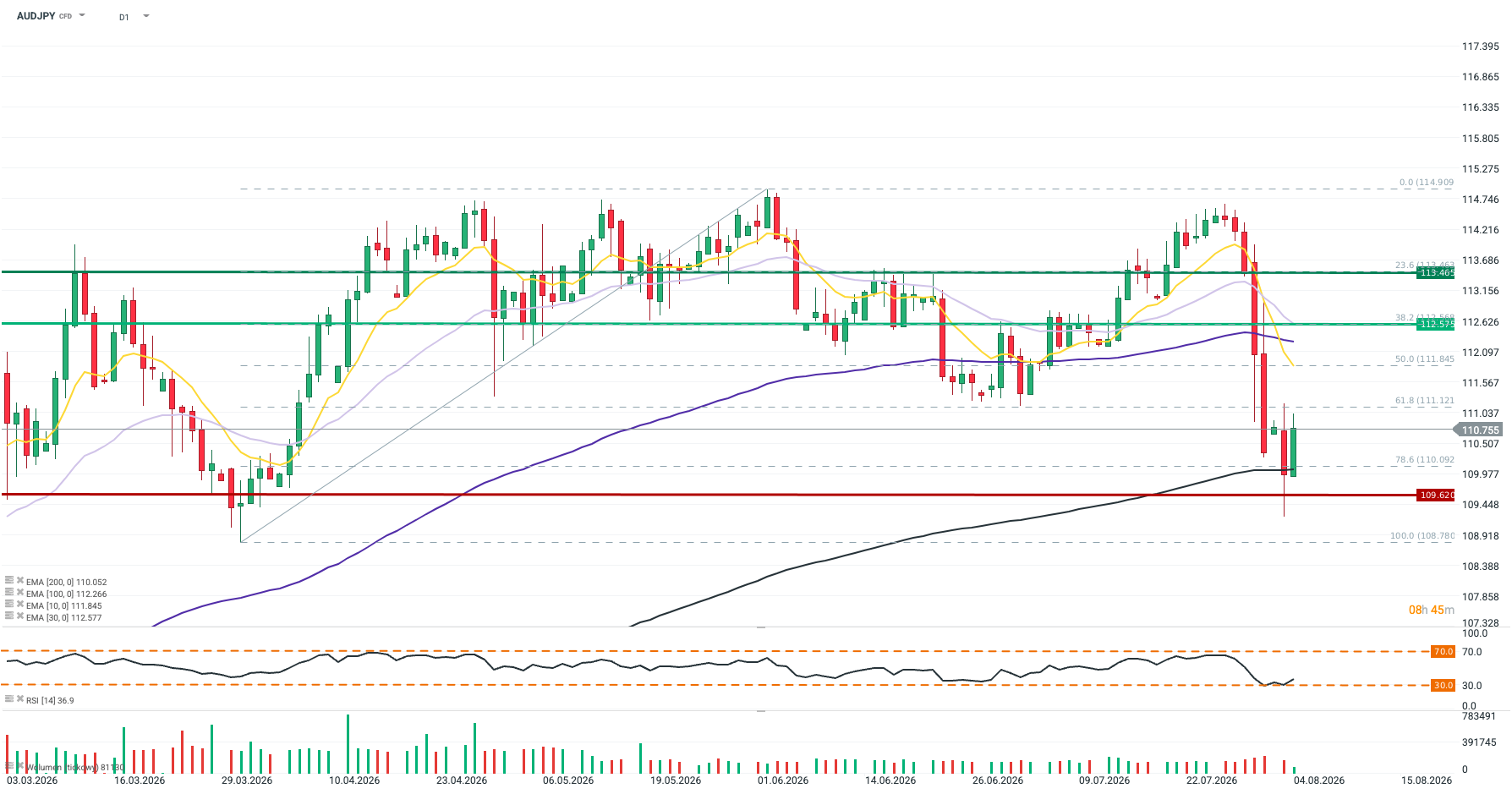
Recent currency interventions on the yen and a unified narrative from Japanese and US authorities standing behind the Japanese currency (US Treasury Secretary Bessent today: “The United States will do everything in its power to support the yen”) led to a sharp sell-off in JPY-led pairs (AUDJPY: -3.5%, USDJPY: -3.9%, EURJPY: -2.6% change over the past week). The determination communicated by Tokyo and Washington should limit speculative selling of the yen; however, a sustained recovery in the Japanese currency will likely only be possible following stabilization in the bond market and a clear hawkish turn by the Bank of Japan. With current interest rates (Australia: 4.35%, Japan: 1.00%), the recent AUDJPY sell-off enhances the appeal of the carry trade, even in light of recent, fairly dovish remarks from the RBA. A rebound off the 200-day EMA (black), combined with a global increase in risk appetite (gains in risk assets, falling oil prices, de-escalation in the Middle East), should therefore motivate at least a local upward correction in AUDJPY. This is further supported by the fact that AUDUSD itself remains in an uptrend (trading above the EMA30 and EMA100 on the daily interval), bolstered by the recent decline in US rate hike expectations.
Methodology
This recommendation was prepared based on a technical analysis of the AUDJPY chart and a fundamental analysis of the respective economies (monetary policy in Japan, Australia, and the US). The directional bias was determined using moving averages and market expectations regarding central bank policies. Take Profit and Stop Loss levels were established using Fibonacci retracements and price action:
TP1 is set at the 38.2% Fibonacci level.
TP2 is set at the 23.6% Fibonacci level.
SL is placed between the 100% and 78.6% Fibonacci levels, slightly below the EMA200.
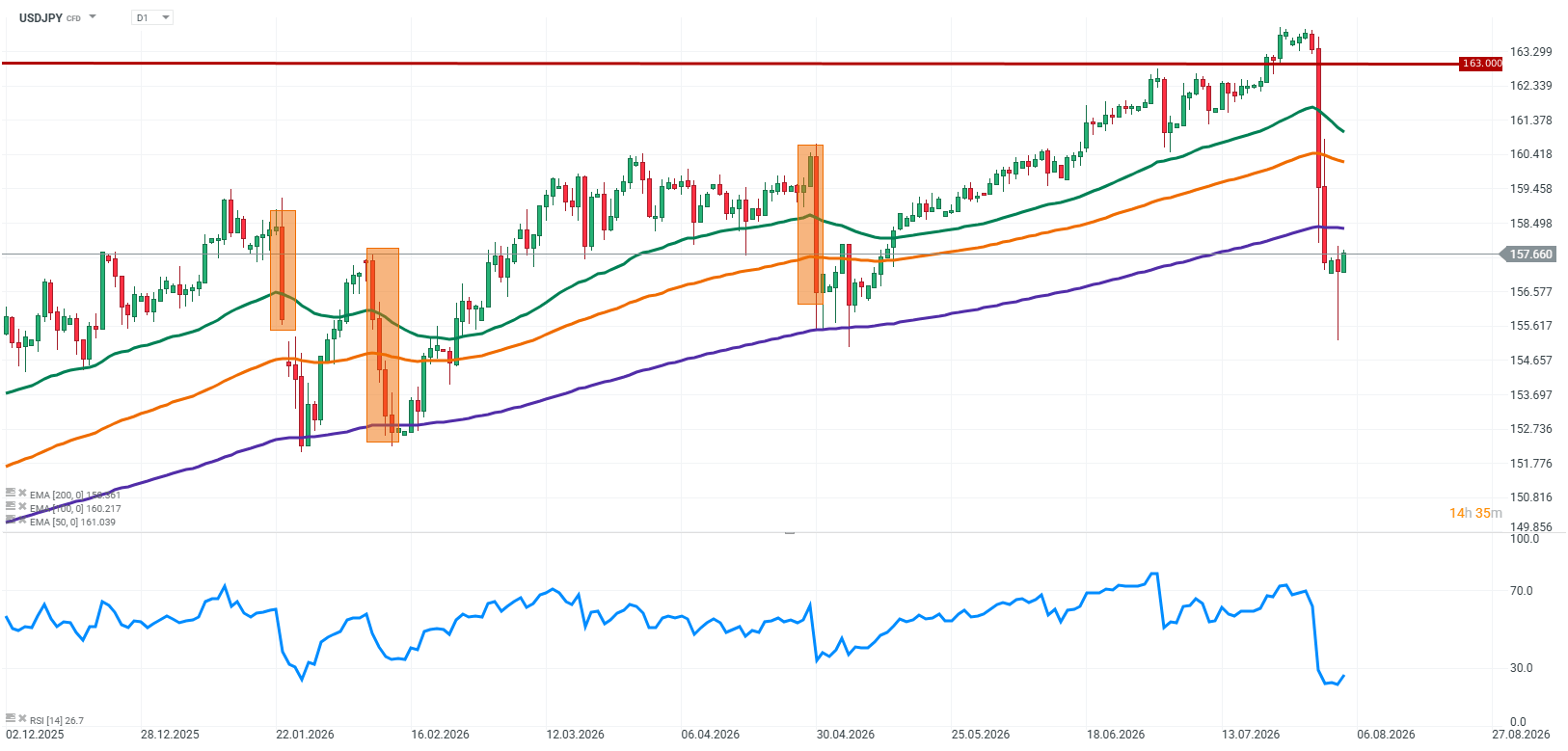
USDJPY remains one of the key topics in the foreign exchange market following the recent reaction by Japanese authorities to the sharp depreciation of the yen. The pair has once again come under selling pressure and moved toward the 158 area, falling below the 160 level, which has repeatedly been described by Japanese government officials as a level requiring particular attention. The currency market intervention delivered a short-term effect. The yen strengthened significantly, and USDJPY moved away from the psychological 160 level. However, the key question that remains is whether this move can be sustained. History shows that currency intervention can effectively limit sharp exchange-rate movements, but without a change in the fundamental factors behind a currency’s weakness, its impact is often limited in duration. In the short term, USDJPY may continue declining and move toward the 157 level. From a technical perspective, the market has received a signal that the area around 160 remains a level where Japanese authorities are prepared to respond decisively. In the longer term, however, the outlook for the yen remains challenging, as the main factor influencing the exchange rate — the interest rate differential between the United States and Japan — continues to work against the Japanese currency.
Source: xStation5
Factors Currently Shaping USDJPY
Japan’s Intervention Stopped the Move, but Did Not Solve the Yen’s Problem
The most important event of recent days was the reaction of Japanese authorities to the yen’s weakening. A move above 160 on USDJPY was considered too rapid and unfavorable, increasing pressure on households and businesses through higher import costs. The actions taken in the foreign exchange market helped limit the scale of the yen’s depreciation and pushed USDJPY below the 160 level. The market received a clear signal that Japan is willing to intervene if currency movements become excessively rapid. However, the problem is that intervention does not change the underlying fundamentals. If the interest rate gap between the United States and Japan remains wide, pressure on the yen may return. Therefore, the key question is no longer whether Japan can stop USDJPY from rising, but how long it can maintain the effects of such intervention without additional support from monetary policy.
Fed and BoJ: Interest Rate Differential Still Works Against the Yen
One of the most important factors for USDJPY remains the monetary policy stance of both central banks. At its latest meeting, the Federal Reserve kept interest rates unchanged. Markets reduced expectations for further rate hikes in the United States, but US interest rates remain at very high levels compared with Japan. On the other side, the Bank of Japan began its rate-hiking cycle this year and has clearly indicated that the current move may not be the last. Markets are pricing in the possibility of another rate increase this year, especially if inflation and wage growth remain at appropriate levels. Even if the BoJ decides on another rate hike, the scale of the interest rate gap between the US and Japan will remain significant. This factor has been the main argument behind selling the yen for many months and remains one of the biggest challenges facing the Japanese currency.
Bank of Japan Is Changing Its Stance, but the Yen Needs More Support
The start of a rate-hiking cycle by the Bank of Japan is an important shift after many years of ultra-loose monetary policy. Markets are increasingly focusing on the possibility of further policy normalization by the Japanese central bank. The problem, however, remains the pace of these changes. The BoJ continues to act cautiously because Japan’s economy is significantly more sensitive to higher financing costs than the US economy. For the yen, it will therefore be crucial not only whether the BoJ raises interest rates, but also whether markets believe the central bank is prepared to continue this process in the coming months. If expectations for the BoJ rise faster than expectations for the Fed, the yen could receive additional support. At this stage, however, the interest rate differential remains the main challenge for the Japanese currency.
Oil and the Persian Gulf Increase Risks for the Yen
Another factor affecting USDJPY is the geopolitical situation and energy prices. Tensions around the Persian Gulf and the risk of disruptions to oil supplies remain important market factors. Japan, as an economy heavily dependent on energy imports, is particularly vulnerable to rising oil prices. Higher energy costs may increase inflationary pressure in Japan, while at the same time worsening the country’s trade balance through higher import expenses. Historically, such factors have often had a negative impact on the yen. Additionally, during periods of rising geopolitical uncertainty, the US dollar often benefits as a global safe-haven currency. This means that even amid challenges facing the US economy, the dollar may remain supported against the yen.
Japan’s Fiscal Risks Are Another Challenge for the Currency
Beyond monetary policy, the market is paying increasing attention to Japan’s fiscal situation. Plans to increase public spending and possible tax cuts are raising questions about further growth in the country’s debt burden. For the currency market, the key issue is whether fiscal policy will support economic growth or increase concerns about the sustainability of public finances. If markets conclude that Japan will pursue a more expansionary fiscal policy without sufficient spending control, this could limit the potential for further yen appreciation.
USDJPY Ahead of Another Test
The current decline in USDJPY shows that the 160 level remains a threshold where Japanese authorities are prepared to intervene. In the short term, the pair may continue moving lower, particularly if markets further reduce expectations regarding Fed policy. In the longer term, however, the situation remains more complicated. The yen continues to face pressure due to the large interest rate differential between the United States and Japan, and currency intervention alone does not change the fundamental market picture. The future direction of USDJPY will depend primarily on whether the Fed begins easing monetary policy faster or whether the Bank of Japan delivers more aggressive interest rate increases. For now, the market has received a clear signal that the area around 160 is being defended by Tokyo. The remaining question is whether this will be only a short-term correction or the beginning of a more lasting change in the yen trend.
Key Takeaways
Japan’s intervention pushed USDJPY below the 160 level, but the sustainability of the move remains the biggest uncertainty.
In the short term, the pair may move toward 157, but long-term pressure on the yen remains.
The Fed continues to maintain high interest rates, and the difference between US and Japanese monetary policy remains unfavorable for the yen.
The Bank of Japan has started a rate-hiking cycle, and markets are pricing in the possibility of another move, but the interest rate gap remains significant.
Oil prices and geopolitical tensions may further affect the yen through higher energy import costs and increased risk aversion.
The future direction of USDJPY will depend mainly on whether changing expectations regarding the Fed occur faster than further monetary policy normalization by the BoJ.
AUD/JPY attracts some buyers to around 110.70 in Tuesday’s early European session.
The cross keeps a negative tone below the 100-day SMA, with bearish RSI momentum.
The initial support level is seen at 110.40; the first upside barrier is located at 112.85.
The AUD/JPY cross trades in positive territory near 110.70, snapping the six-day losing streak, during the early European trading hours on Tuesday. However, the potential upside for the cross might be limited due to the coordinated intervention between the United States (US) and Japan, which could provide some support to the Japanese Yen (JPY) against the Australian Dollar (AUD).
“The view that FX intervention cannot have a lasting impact and merely alters short-term market flows seems right in many cases. However, depending on the circumstances and broader context, intervention can exert a significant influence on the market and trigger an inflection,” said Bank of America analyst Shusuke Yamada.
Japan and US step in to stabilise Yen after historic slide
Strategists at BNY note that Japan’s finance ministry and the US Treasury have “intervened in the foreign exchange market to support the yen” after the currency weakened to its lowest level against the Dollar since 1986. Japanese Finance Minister Satsuki Katayama is cited as saying the joint action was aimed at “countering excessive volatility and disorderly movements in recent months,” underscoring that Tokyo “would not hesitate to carry out further joint intervention if needed.” BNY concludes that the authorities have made it clear they “remain ready to defend the currency” should renewed pressure on JPY emerge.
Technical Analysis:
In the daily chart, AUD/JPY extends a corrective move below the 100-day simple moving average (SMA) and the Bollinger Bands 20-day middle band, which form a dense overhead supply zone. The pair is now drifting toward the lower Bollinger band support, while the Relative Strength Index (RSI) at 34.33 hovers just above oversold territory, hinting that bearish momentum remains in control but could be nearing exhaustion.
On the downside, immediate support is located at the lower Bollinger band near 110.40, where a pause or bounce could emerge if sellers take profits. The next contention level to watch is the 110.00 psychological level, followed by the August 3 low of 109.24.
On the topside, initial resistance is seen at the 100-day SMA at 112.85, followed by the Bollinger Bands middle band at 113.00; a daily close above these clustered barriers would be needed to ease the current bearish bias and open the way toward the upper Bollinger band near 115.62.
USD/JPY rises to near 157.60 as the Japanese Yen faces profit booking.
US-Japan joint intervention strengthened the Japanese Yen.
Investors await key US JOLTS Job Openings data for June.
The Japanese Yen (JPY) trades lower against its major currency peers on Tuesday after a rare juggernaut outperformance in the last few trading days. In the Asian session, the Japanese currency is down 0.25% to near 157.60 against the US Dollar (USD).
Japanese Yen Price Today
The table below shows the percentage change of Japanese Yen (JPY) against listed major currencies today. Japanese Yen was the weakest against the Australian Dollar.
USD
EUR
GBP
JPY
CAD
AUD
NZD
CHF
USD
-0.00%
0.07%
0.27%
-0.01%
-0.25%
0.12%
-0.02%
EUR
0.00%
0.06%
0.29%
-0.02%
-0.27%
0.10%
-0.01%
GBP
-0.07%
-0.06%
0.23%
-0.07%
-0.32%
0.05%
-0.07%
JPY
-0.27%
-0.29%
-0.23%
-0.29%
-0.53%
-0.19%
-0.18%
CAD
0.00%
0.02%
0.07%
0.29%
-0.24%
0.11%
0.00%
AUD
0.25%
0.27%
0.32%
0.53%
0.24%
0.36%
0.25%
NZD
-0.12%
-0.10%
-0.05%
0.19%
-0.11%
-0.36%
-0.10%
CHF
0.02%
0.00%
0.07%
0.18%
-0.00%
-0.25%
0.10%
The heat map shows percentage changes of major currencies against each other. The base currency is picked from the left column, while the quote currency is picked from the top row. For example, if you pick the Japanese Yen from the left column and move along the horizontal line to the US Dollar, the percentage change displayed in the box will represent JPY (base)/USD (quote).
The Asia-Pacific currency outperformed due to rare joint intervention by the United States (US) and Japan to support the Yen.
Japan and US step in as Yen hits weakest level since 1986
BNY notes that Japan’s finance ministry and the US Treasury have moved to shore up the Yen, jointly intervening in the foreign exchange market after the currency fell to its lowest level against the Dollar since 1986. Japanese Finance Minister Satsuki Katayama said the coordinated action was aimed at countering “excessive volatility and disorderly movements in recent months.” She underscored that Tokyo “would not hesitate to carry out further joint intervention if needed,” signaling that the authorities remain ready to defend the currency should renewed pressure emerge.
Meanwhile, the US Dollar (USD) holds onto its Monday’s recovery move, with investors awaiting key US economic data, notably the Nonfarm Payrolls (NFP), releasing this week. As of writing, the US Dollar Index (DXY), which gauges the Greenback’s value against six major currencies, trades firmly near 100.00.
In Tuesday’s session, investors will focus on the JOLTS Job Openings data for June, which will be published at 14:00 GMT. The US economy is expected to have posted 7.45 million fresh jobs, slightly lower than 7.594 million in May.
USD/JPY technical outlook
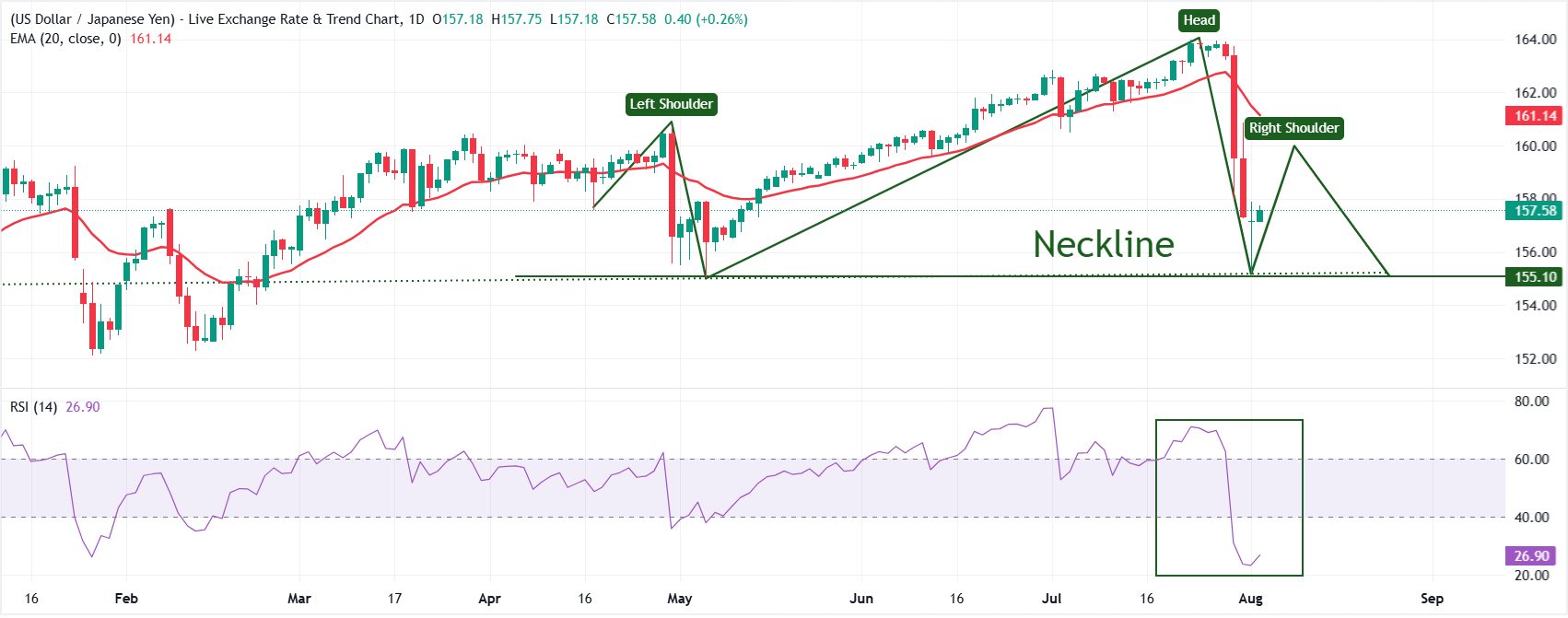
USD/JPY trades at around 157.58 at press time, retaining a bearish near-term bias as spot holds well below the 20-day exponential moving average (EMA) at 161.14. The chart structure of the pair reflects a Head and Shoulders pattern in the making, whose right shoulder is yet to be formed, likely near 160.00, suggesting a respite is highly likely after a juggernaut fall.
The pair has retreated from recent highs, and the Relative Strength Index (RSI) at 26.90 sits in oversold territory, which hints that downside momentum is stretched but does not yet show a clear reversal signal.
Going forward, a “Sell on Rise” strategy appears optimal in these conditions, and the round level of 160.00 would be a key barrier. After that, the pair might retest the neckline at around 155.10.
On the contrary, the pair would regain a bullish bias if it manages to extend the recovery above the July 16 low near 162.00. The pair would aim to revisit the multi-decade high at around 164.00 if it manages to break above 162.00.
To provide the best experiences, we use technologies like cookies to store and/or access device information. Consenting to these technologies will allow us to process data such as browsing behavior or unique IDs on this site. Not consenting or withdrawing consent, may adversely affect certain features and functions.
Functional
Always active
The technical storage or access is strictly necessary for the legitimate purpose of enabling the use of a specific service explicitly requested by the subscriber or user, or for the sole purpose of carrying out the transmission of a communication over an electronic communications network.
Preferences
The technical storage or access is necessary for the legitimate purpose of storing preferences that are not requested by the subscriber or user.
Statistics
The technical storage or access that is used exclusively for statistical purposes.The technical storage or access that is used exclusively for anonymous statistical purposes. Without a subpoena, voluntary compliance on the part of your Internet Service Provider, or additional records from a third party, information stored or retrieved for this purpose alone cannot usually be used to identify you.
Marketing
The technical storage or access is required to create user profiles to send advertising, or to track the user on a website or across several websites for similar marketing purposes.