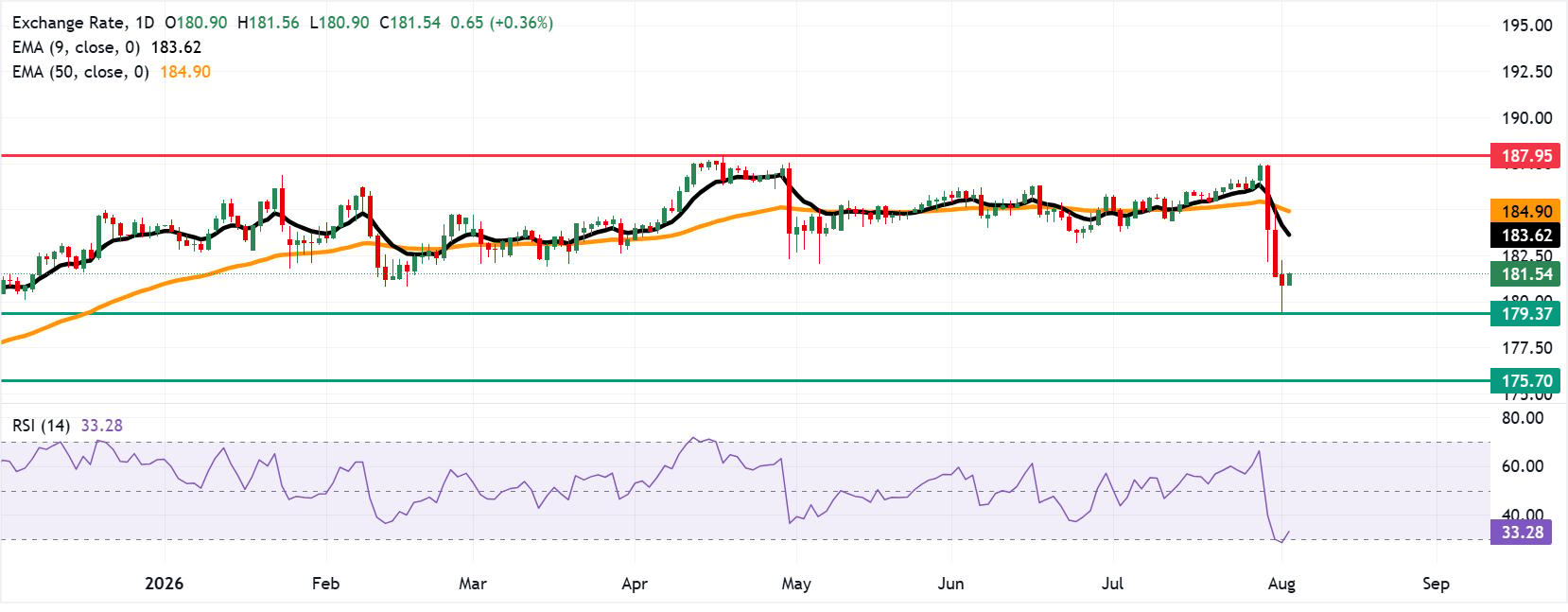
EUR/JPY may fall toward the immediate support at the eight-month low of 179.37.
The 14-day Relative Strength Index at 32.97 signals dominant downside momentum.
The initial resistance lies at the nine-day EMA at 183.62.
EUR/JPY gains ground after three days of losses, trading around 181.50 during the Asian hours on Tuesday. The currency cross is maintaining a bearish near-term tone as it holds beneath both the nine-day and 50-day Exponential Moving Averages (EMAs).
The EUR/JPY cross is retreating away from recent highs, while the 14-day Relative Strength Index (RSI) at 32.97 hovers just above oversold territory, hinting that downside momentum is still dominant but nearing stretched conditions.
The EUR/JPY cross may retest the initial support at the eight-month low of 179.37, reached on August 3. Further support lies at the nine-month low of 175.70.
On the upside, the EUR/JPY cross could rise toward the nine-day EMA at 183.62, followed by the 50-day EMA at 184.90. Further advances above these moving averages would cause a bullish emergence and support the currency cross to explore the region around the all-time high of 187.95, which was recorded on April 17.
Yen positioning seen shifting after Japan-US intervention
Strategists at Rabobank highlight that “JPY net shorts had climbed to their highest levels since 2024 last week,” just before the “concerted intervention from the MoF and the US Treasury to stem the weakness in the JPY.” The bank argues that this official action “suggests that positioning is likely to be sharply changed in the next data release,” but cautions that “it is too early to assess whether Japan’s fundamentals have strengthened sufficiently to allow the JPY to hold better levels vs. the USD in the spot market over the medium-term.”
(The story was corrected on August 4 at 03:45 GMT to say in the title that EUR/JPY rebounds from eight-month lows and not highs.)
After reaching its highest level since 1986 (163.99), the USDJPY pair recorded a very dynamic decline. The movement was driven by the first coordinated intervention by the US and Japan since 2011. At that time, the yen was weakened following a massive earthquake. US Treasury Secretary Scott Bessent and Japan’s Minister of Finance Satsuki Katayama emphasised that both sides are prepared to take further action to stabilise the exchange rate.
Historic intervention
According to data provided by the Bank of Japan, the scale of the Japanese intervention may have reached as much as 59 billion dollars, which would be unprecedented given the scale of a one-day intervention. Although we cannot estimate the scale of the US action using official data, many indications suggest it reached 5-10 billion dollars. This is suggested, at least, by a note left by Scott Bessent during a meeting in Maryland.
Source: Reuters The US intervention was confirmed over the weekend by President Trump: “Japan has been very good to us, except, of course, for the attack on Pearl Harbor. (…) They have a weakening yen and they needed a little help. And we are always ready to help Japan.” Today, an official letter confirming the intervention was published by Minister Katayama.
Is the Mar-a-Lago accord returning?
Due to US cooperation in the recent intervention aimed at strengthening the yen, the issue of broader White House policy is returning to the fore. A return to actions aimed at weakening the US currency, which would support domestic exports, seems possible. At the beginning of 2025, such actions were termed the “Mar-a-Lago Accord,” a modern attempt to repeat the premises of the 1985 Plaza Accord.
What is behind the earlier weakening of the yen?
Key to this was the return of the carry trade, i.e., trading on interest rate differentials.
How does this work?
This strategy is based on borrowing a currency (in this case, the yen) at near-zero interest rates and immediately exchanging it for another (e.g., the dollar) to make investments in a market offering higher returns. Although the Bank of Japan has moved away from its ultra-loose monetary policy and implemented five interest rate hikes in recent months, bringing the reference interest rate to its highest level in over 20 years (1%), it still remains far below levels seen in the United States (3.75%) and many other developed economies, such as Australia (4.35%), Norway (4.25%), the UK (3.75%), or the eurozone (2.4% – deposit rate).
BoJ holds rates
In line with market expectations, the Bank of Japan kept interest rates unchanged overnight from Thursday to Friday. The main interest rate remains at 1%. The decision was made by a vote of 8 to 1. One of the hawks, Hajime Takata, voted in favour of a hike. Due to government initiatives aimed at supporting households regarding energy prices, the BoJ revised down its inflation forecast for the 2026 fiscal year, lowering it from 2.8% to 2.5%. At the same time, the inflation forecast for 2027 was raised from 2.3% to 2.4%. The meeting was treated as a pause to assess the impact of recent tightening. Naoki Tamura, a board member, suggested the possibility of raising rates at intervals of a few months by 25 basis points until reaching a level of approx. 2%. This is largely consistent with market valuations. The market-implied probability of a hike in September can be compared to a coin toss. An upward move before the end of the year is fully priced in. It is possible that the BoJ will raise rates twice in the mentioned period.
What is the inflation situation?
The quarterly report published in July showed that households estimate prices will grow at a rate of 10.8% over the next five years. The survey has never shown such high values (though it should be noted that it has only been conducted for 20 years). Although this figure is inflated by the survey methodology – an average is presented, which is contaminated by irrationally high expectations of part of the society – the anxiety regarding rising price pressure cannot be underestimated. The median (5%) is also growing very dynamically, which may be a more reliable indicator in this regard. Inflation grew in the last four months by 0.4%, 0.1%, 0.4%, and 0.3% respectively on a monthly basis – when annualised, this data suggests price growth in the region of 4-5%. After excluding the most volatile energy and food prices, the situation looks better, but much still points to a significant rise in the indicator from current levels (1.6%). Significant factors may include, among others, relatively dynamic wage growth (3.2% in May).
Dependence on energy imports
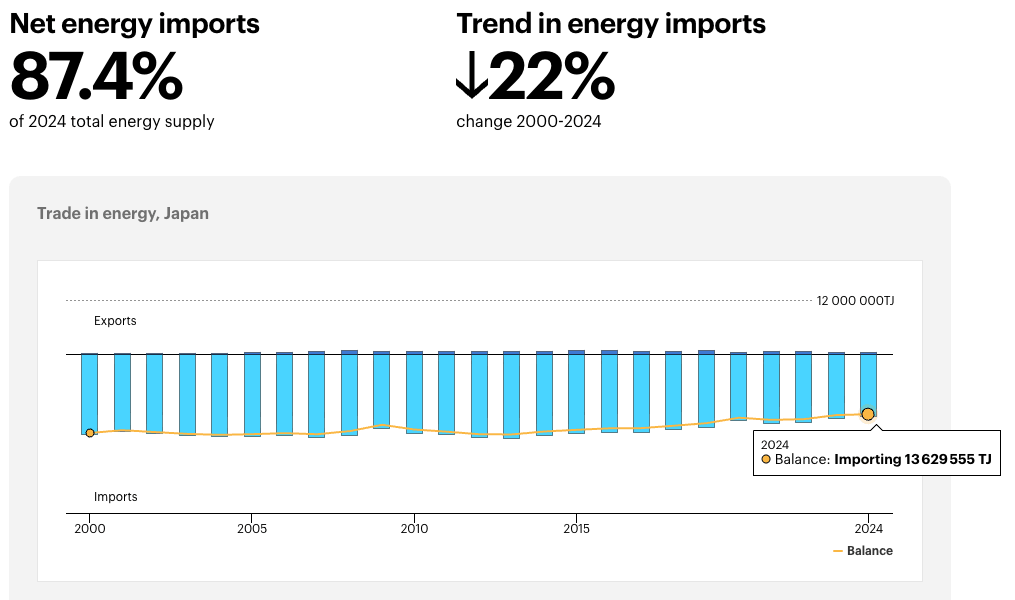
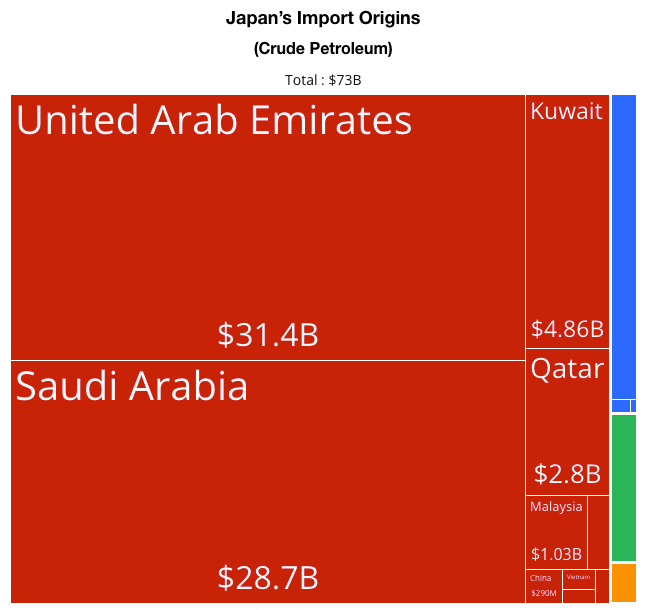
A weaker yen is not just a matter of carry trade. The outbreak of war in the Middle East plays a significantly important role, which brought oil and LNG prices to their highest levels since 2022, when Russia launched a full-scale attack on Ukraine. Nearly 90% of Japan’s energy demand comes from imports, and under normal conditions, its main suppliers are Middle Eastern countries.
Figure 1: Japan’s Energy Sector Trade Balance (1998 – 2026)
Source: IEA, 03.08.2026 The prolonged lack of de-escalation in the conflict between the United States and Iran may translate not only into a significant increase in inflationary pressure but also into problems maintaining the continuity of key energy resource supplies. Figure 2: Structure of Japan’s Crude Oil Imports (2024)
Source: OEC, 03.08.2026
Technical analysis
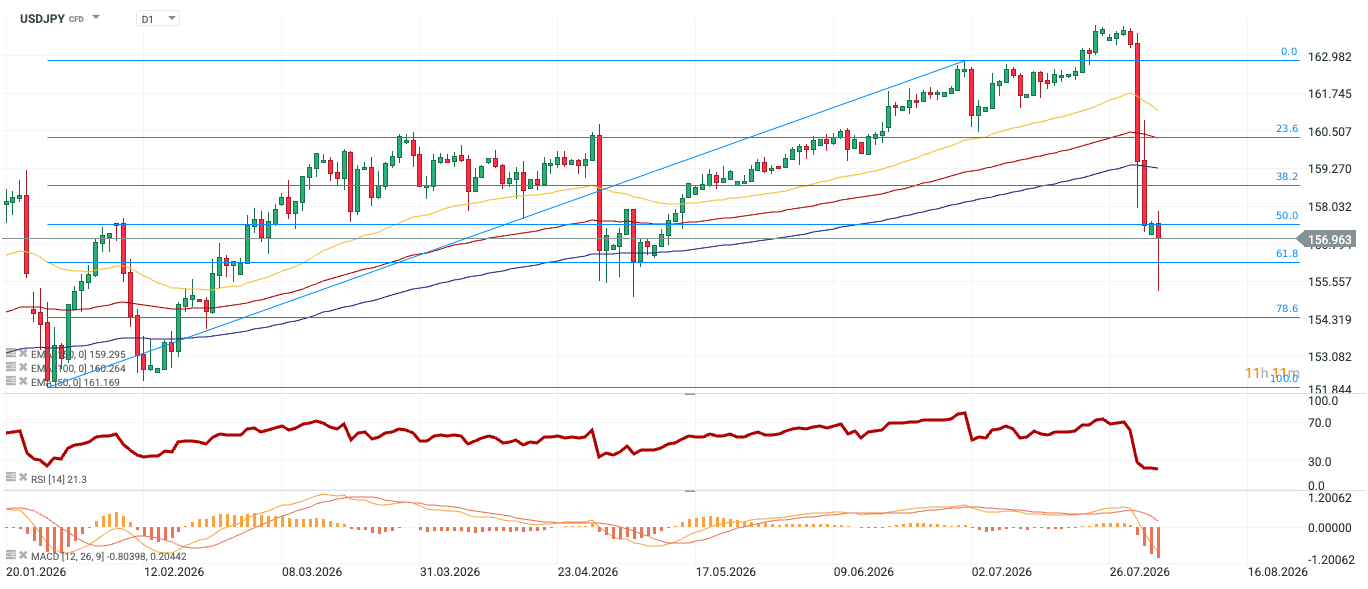
Figure 3: USDJPY [D1] (20.01.2026 – 03.08.2026)
Source: xStation, 03.08.2026 After reaching a local peak near the 164 level, the market experienced a sharp collapse. The price broke through key structural supports with momentum and is currently in the 157 region. It is worth noting, however, that a long lower wick formed on one of the recent candles – this signifies the first serious attempt at defence and a reaction from demand. The price drastically broke down through the band of moving averages (EMA 50, EMA 100, and EMA 200). For a long time, these averages (blue, red, and yellow lines) served as dynamic supports in the uptrend. Currently, this setup has been negated. The closest of them (blue, around 159.3) now constitutes the first very important dynamic resistance in the case of a possible rebound.
The long lower wick of the bearish candle tested the 78.6 Fibo retracement. Currently, the price has rebounded and is fighting to hold above the 61.8 retracement. The RSI indicator is at the 21.3 level. This is an extreme oversold zone (below 30). Although in strong downtrends, the RSI can stay in this zone for a long time, such a low value is a strong warning signal of a possible upward correction or at least a transition into consolidation to “cool down” the indicator. MACD confirms a strong downtrend. The lines have crossed downwards and are moving away from the zero level, and the histogram is growing in the negative zone. There are no divergences here at this moment.
EUR/JPY may retest initial support at its eight-month low of 179.37.
With the 14-day Relative Strength Index at 27.71, the decline’s pace may soon moderate.
The currency cross could rise toward its nine-day EMA at 184.07.
EUR/JPY extends its gains for the third successive day, trading around 179.40 during the Asian hours on Monday. The currency cross is extending a bearish near-term tone as price holds beneath both the nine-period and 50-period Exponential Moving Averages (EMAs).
The short-term EMA remains below the longer 50-period EMA, reinforcing downside pressure, while the 14-day Relative Strength Index (RSI) indicator at 27.71 slips into oversold territory, hinting that while sellers are in control, the pace of the decline could soon moderate.
The EUR/JPY cross may retest the initial support at the eight-month low of 179.37, reached on August 3. Further support lies at the nine-month low of 175.70.
On the upside, the EUR/JPY cross rises toward the nine-day EMA at 184.07, followed by 185.02. A break above these moving averages would cause a bullish shift and support the currency cross to explore the region around the all-time high of 187.95, which was recorded on April 17.
USD/JPY falls to around 156.45 in Monday’s early European session.
Japan and the US confirm a joint JPY-buying intervention, signal more action.
Trump said Iran talks would resume Monday after calling off planned strikes.
The USD/JPY pair tumbles to near 156.45 during the early European trading hours on Monday. The Japanese Yen (JPY) climbs amid speculation that Japanese authorities may have intervened to prop up the currency again after coordinated action between the US and Japan last week.
Japan’s Finance Minister Satsuki Katayama said on Monday that Japan and the United States (US) conducted coordinated Yen-buying intervention and will not hesitate to take further action, per Reuters. Katayama confirmed a rare bilateral action to halt the JPY’s slide to fresh 40-year lows.
Meanwhile, US Treasury Secretary Scott Bessent said that Washington wouldn’t hesitate to step into the market again. US President Donald Trump said on Sunday the US was helping Japan prop up the JPY as a sign of friendship and to help the world economy.
“It seems likely that authorities would intervene further in the coming days if the yen begins to unwind the recent move, as was the case in May of this year,” Goldman Sachs Group Inc. strategists including Kamakshya Trivedi wrote in a note. “We continue to think intervention is an effective tool for authorities to buy some time before fundamental factors turn more positive.”
Uncertainty in the Middle East remains high despite hopes of a breakthrough between the US and Iran. Bloomberg reported on Monday that Trump said that a new round of Iran talks would begin Monday afternoon after he cancelled a planned attack on Iran partially in response to pleas from US allies in the Middle East, including Saudi Arabia.
However, Iranian officials said that Trump’s claim that Tehran had requested a pause “was nothing but a new lie.” Any signs of renewed escalation in the Middle East could boost the Greenback against the JPY in the near term.
Yen seen as undervalued as Japan authorities urged to back firmer currency stance
Strategists at BNY Mellon note that official rhetoric is turning more supportive of the Yen, pointing out that U.S. Treasury Secretary Scott Bessent said on Thursday that the Japanese Yen “looks very undervalued and should strengthen further,” while also stressing that “excessive volatility in the currency isn’t healthy.” In their view, “reported intervention and a firmer BoJ message could change that quickly.” BNY Mellon argues that stronger intervention would demonstrate that the authorities are prepared to resist further depreciation, while clearer policy guidance would “reduce the credibility discount embedded in JPY assets.”
Japan’s Finance Minister Satsuki Katayama said on Monday that she has no comment on whether there was foreign exchange (FX) intervention today, Reuters reported.
Earlier Monday, Katayama stated that Japanese authorities conducted coordinated Yen-buying intervention with the United States (US) on Friday, adding that officials will not hesitate to carry out more FX intervention with Washington.
Meanwhile, US Treasury Secretary Scott Bessent stated that Friday’s coordinated FX moves curbed disorderly Japanese Yen (JPY) swings. Bessent said that the Treasury will stay vigilant and maintain close communication with counterparts at the Ministry of Finance (MoF) and the Bank of Japan (BoJ).
Key quotes from Japan’s Katayama
Conducted coordinated yen-buying intervention with U.S. on Friday.
Won’t hesitate to carry out more forex intervention with U.S.
Intervention aimed at tackling recent excessive, disorderly yen moves.
Japan plans to use Federal Reserve’s foreign and international repo facility in future.
Japan remains vigilant and in close contact with U.S. Treasury counterparts.
No comment on forex intervention except Friday.
Market reaction
The Japanese Yen (JPY) attracts some buyers following the headlines. At the time of writing, the USD/JPY is down 0.62% on the day at 156.35.
The Japanese yen strengthened toward 155 per dollar on Monday, bringing its gains to about 5% over three sessions, after the Finance Ministry confirmed it carried out coordinated yen-buying operations with the US Treasury last week following the currency’s slide to 40-year lows. Japanese authorities also warned they stand ready to conduct additional coordinated interventions if needed, adding that they remain in close contact with their US counterparts. US Treasury Secretary Scott Bessent also confirmed the joint action to counter disorderly moves in the yen, while President Donald Trump previously said the US joined last week’s coordinated intervention as a show of support for Japan and to help safeguard global economic stability. The yen had fallen to four-decade lows last month amid pressure from elevated energy costs, mounting fiscal concerns, and persistently wide interest rate differentials.
The Euro surges further against the Japanese Yen to near 185.20 after the BoJ leaves interest rates unchanged at 1%.
The BoJ reiterates the hawkish stance on interest rates while warning of upside inflation risks.
Investors await the Eurozone flash HICP data for July.
The Euro (EUR) extends the intraday rally to near 185.20 against the Japanese Yen (JPY) after the Bank of Japan’ (BoJ) monetary policy decision during the Asian trading session on Friday. The BoJ has kept interest rates steady at 1%, as expected, with an 8-1 majority.
BoJ member Hajime Takata dissented from the vote to hold and favored a 25 basis points (bps) interest rate hike to push rates to 1.25%.
The Japanese central bank has warned that medium-to-long-term inflation expectations are set to climb and has reiterated that the monetary policy path will remain on the upside. “Will keep raising interest rates in response to economic, price trends and financial conditions,” BoJ said.
The BoJ was already anticipated to do so as it is unlikely to deliver back-to-back rate hikes to build pressure on the economy. In the June meeting, the Japanese central bank raised borrowing rates by 25 basis points (bps) to 1%, the highest level not seen since 1995.
On the Eurozone front, investors await the preliminary Harmonized Index of Consumer Prices (HICP) data for July, which will be published at 09:00 GMT. The inflation data from Germany and Spain showed on Monday that inflationary pressures grew at a faster-than-expected pace.
According to TD Securities, Eurozone inflation is likely to firm only modestly in the latest print, with the bank expecting “euro area HICP to pick up only slightly to 2.9% y/y (mkt: 2.9%; prior: 2.8%), as the recent rebound in energy is largely offset by softer food and core goods prices.” The analysts note that “airfares may provide some upside given higher jet fuel costs and the start of the summer holiday season,” but they judge that “broader services HICP is likely to remain contained, with limited evidence so far of a wider pass-through of the energy shock.” In this context, TD Securities concludes that “we see the core inflation number remaining steady at 2.4% y/y (mkt: 2.4%, prior: 2.4%).”
Signs of acceleration in inflationary pressures in the Eurozone would prompt expectations of more interest rate hikes by the European Central Bank (ECB) in the near term.
AUD/JPY attracts follow-through buyers and recovers further from its lowest level since April.
The wide rate gap between Japan and other economies undermines the JPY and lends support.
The momentum seems unaffected by China’s weaker PMIs and the BoJ’s on-hold rate decision.
The AUD/JPY cross builds on the previous day’s goodish rebound from sub-111.00 levels, or the lowest since April 7, and gains strong positive traction during the Asian session on Friday. Spot prices stick to intraday gains near the 113.00 mark after the Bank of Japan (BoJ) announced its decision and, for now, seem to have snapped a three-day losing streak.
As was widely expected, the BoJ left the short-term interest rate unadjusted at 1.00% following the conclusion of the July policy review meeting. Moreover, the central bank revised its real GDP forecast for fiscal 2026 to +0.6% vs +0.5% prior, while trimming the FY2026 core CPI estimates to +2.5% from +2.8% in April. The BoJ flagged the Middle East conflict as something it must watch closely for economic and price spillovers, which continues to undermine the Japanese Yen (JPY).
Meanwhile, borrowing costs in Japan remain significantly lower compared to other major economies, including Australia. The wide interest rate differential, in turn, keeps the so-called JPY carry trade active, which is seen as another factor lending some support to the AUD/JPY cross. The intraday move up seems unaffected by China’s disappointing official PMIs, with bulls looking past a suspected official intervention by Japan on Thursday to prop up the domestic currency.
Nevertheless, spot prices remains on track to register losses for the first time in five weeks, though the fundamental backdrop backs the case for a further intraday appreciating move. The market focus now shifts to the Reserve Bank of Australia (RBA) policy meeting on August 11. Heading into the key central bank event risk, diminishing odds for an immediate interest rate hike by the RBA might hold back bullish traders from placing fresh bets on the AUD/JPY cross.
Analysts at Deutsche Bank highlight that the latest inflation print has taken some of the heat out of the case for further policy tightening by the RBA. They note that annual core inflation “edged up from +3.5% to +3.6%, but remained below the consensus estimate of +3.7%, reducing the urgency for additional interest rate hikes after the RBA already raised rates three times this year.” In their view, the combination of only a marginal uptick in core prices and a miss versus expectations reinforces the sense that the central bank can afford to pause after an already aggressive tightening cycle.
To provide the best experiences, we use technologies like cookies to store and/or access device information. Consenting to these technologies will allow us to process data such as browsing behavior or unique IDs on this site. Not consenting or withdrawing consent, may adversely affect certain features and functions.
Functional
Always active
The technical storage or access is strictly necessary for the legitimate purpose of enabling the use of a specific service explicitly requested by the subscriber or user, or for the sole purpose of carrying out the transmission of a communication over an electronic communications network.
Preferences
The technical storage or access is necessary for the legitimate purpose of storing preferences that are not requested by the subscriber or user.
Statistics
The technical storage or access that is used exclusively for statistical purposes.The technical storage or access that is used exclusively for anonymous statistical purposes. Without a subpoena, voluntary compliance on the part of your Internet Service Provider, or additional records from a third party, information stored or retrieved for this purpose alone cannot usually be used to identify you.
Marketing
The technical storage or access is required to create user profiles to send advertising, or to track the user on a website or across several websites for similar marketing purposes.