EUR/JPY may rise toward the ascending triangle’s upper boundary near 186.10.
The 14-day Relative Strength Index is around 53 and signals steady momentum.
The initial support lies at the nine-day EMA at 185.46.
EUR/JPY edges higher after three days of losses, trading around 185.50 during the Asian hours on Tuesday. The currency cross is holding above both the nine-day and 50-day Exponential Moving Averages (EMAs), which reinforces a mildly bullish near-term bias.
The EUR/JPY cross is pressing into the upper end of its recent range while the 14-day Relative Strength Index (RSI) around 53 suggests constructive but not overstretched momentum. The daily chart technical analysis shows the currency cross is remaining within the ascending triangle, signalling aggressive buying pressure.
The EUR/JPY cross may find the initial resistance at the triangle’s upper boundary around 186.10. A decisive break above the triangle could trigger a powerful bullish continuation, which could expose the all-time high of 187.95, which was recorded on April 17.
On the downside, immediate support sits at the nine-day EMA of 185.46, with additional backing at the 50-day EMA of 185.12 and the lower edge of the ascending triangle near 185.00. A breakdown below the triangle pattern would undermine the bullish setup, exposing the EUR/JPY cross to deeper downside toward the March 16 five-month low of 181.87 and the seven-month low of 180.81.
EUR/JPY: Daily Chart
Euro Price Today
The table below shows the percentage change of Euro (EUR) against listed major currencies today. Euro was the strongest against the Japanese Yen.
USD
EUR
GBP
JPY
CAD
AUD
NZD
CHF
USD
-0.04%
-0.08%
0.00%
-0.01%
-0.16%
-0.41%
0.00%
EUR
0.04%
-0.04%
0.06%
0.03%
-0.10%
-0.37%
0.04%
GBP
0.08%
0.04%
0.11%
0.08%
-0.05%
-0.33%
0.09%
JPY
0.00%
-0.06%
-0.11%
-0.01%
-0.15%
-0.43%
0.00%
CAD
0.00%
-0.03%
-0.08%
0.01%
-0.14%
-0.40%
0.01%
AUD
0.16%
0.10%
0.05%
0.15%
0.14%
-0.27%
0.14%
NZD
0.41%
0.37%
0.33%
0.43%
0.40%
0.27%
0.41%
CHF
-0.01%
-0.04%
-0.09%
-0.00%
-0.01%
-0.14%
-0.41%
The heat map shows percentage changes of major currencies against each other. The base currency is picked from the left column, while the quote currency is picked from the top row. For example, if you pick the Euro from the left column and move along the horizontal line to the US Dollar, the percentage change displayed in the box will represent EUR (base)/USD (quote).
The Japanese Yen trades calmly around 162.50 against the US Dollar amid uncertainty over the future of the Middle East.
US President Trump will either accept a 10-day ceasefire or call for a joint full-scale military campaign against Iran.
Investors await the Japan National CPI data for June.
The Japanese Yen (JPY) trades flat against the US Dollar (USD) at around 162.50 during the Asian trading session on Tuesday, closer to its multi-decade high of 162.84. The USD/JPY pair will likely remain sideways as investors seek fresh cues regarding whether the United States (US) and Iran will announce a ceasefire or will continue exchanging attacks.
In the Asian trade, the US Dollar Index (DXY), which gauges the Greenback’s value against six major currencies, trades flat around 101.00.
According to a report from Axios, US President Donald Trump will either accept the 10-day ceasefire with Iran and resume negotiations towards an interim deal or call for a joint full-scale military campaign with Israel against Iran.
On Monday, a senior Iranian official confirmed receiving a proposal for a 10-day ceasefire from mediators to resume talks on an interim deal.
On the domestic front, investors await Japan’s National Consumer Price Index (CPI) data for June, which will be released on Friday. Investors will pay close attention to the inflation data to get cues regarding the Bank of Japan’s (BoJ) monetary policy outlook. The National CPI ex. Fresh Food is expected to arrive at 1.6% Year-on-Year (YoY), higher than 1.4% in May.
Meanwhile, the next key trigger for the US Dollar will be the preliminary S&P Global PMI data for July, which will be released on Thursday.
AUD/JPY gains traction to near 113.85 in Tuesday’s early European session.
The cross maintains a constructive tone above the 100-day SMA, with bullish RSI momentum.
The immediate resistance level emerges at 114.10; the first downside target to watch is 113.10.
The AUD/JPY cross trades in positive territory around 113.85 during the early European session on Tuesday. The Australian Dollar (AUD) strengthens against the Japanese Yen (JPY) due to the interest rate differential between the Reserve Bank of Australia (RBA) and the Bank of Japan (BoJ). However, fears of possible intervention from Japanese authorities might cap the upside for the cross.
After delivering three consecutive 25 basis points (bps) hikes earlier this year, the Reserve Bank of Australia (RBA) decided to hold the Official Cash Rate (OCR) steady at 4.35% at its June policy meeting.
Economists warned that rising oil and fuel prices could cement a fourth interest rate rise this year if US President Donald Trump’s renewed conflict with Iran is not resolved within a week.
Traders have raised their bets on an RBA rate hike since airstrikes resumed last week, now pricing in nearly a 23% odds of a hike in August and more than a 50% chance by December, according to the Guardian.
Technical Analysis:
In the daily chart, AUD/JPY holds a bullish near-term bias as it remains above the 100-day simple moving average (SMA) and the Bollinger Bands’ 20-day middle band, keeping the broader uptrend intact. Price is advancing toward the Bollinger upper band, while the Relative Strength Index (14) around 60 suggests firm but not overstretched upside momentum.
On the topside, immediate resistance aligns with the Bollinger Bands’ upper band at 114.10. The next hurdle is located at the May 13 high of 114.74, en route to the 115.00 psychological level.
On the downside, initial support is seen at the July 20 low of 113.10. The next contention level to watch is the 100-day SMA at 112.75, followed by the Bollinger middle band at 112.55, with a deeper cushion coming in at the lower band near 111.05 should a corrective pullback develop.
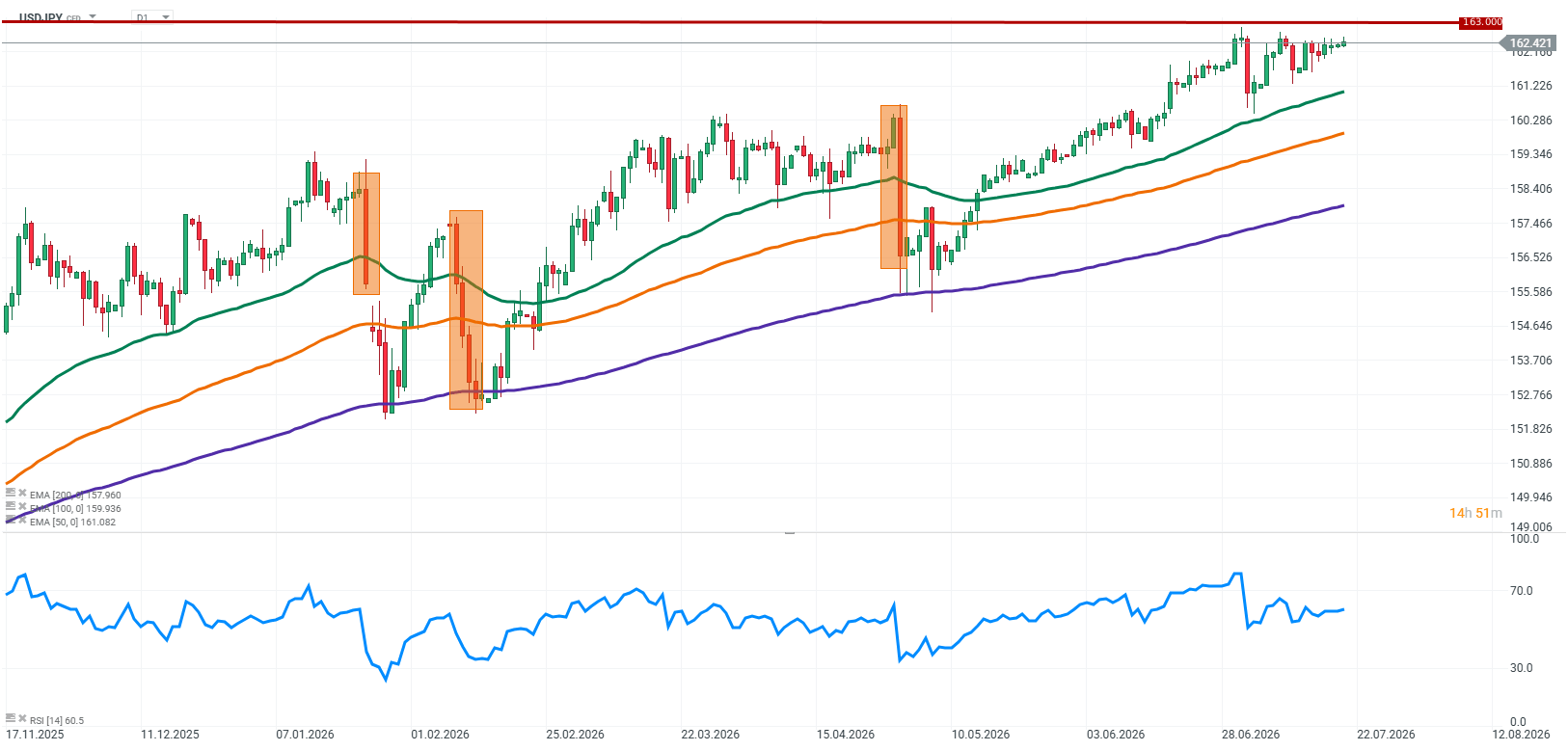
The USDJPY market currently resembles another round of a fight between two heavyweight contenders. On one side stands the dollar, supported by high US asset yields and the ongoing advantage in interest rates. On the other side stands the yen, which despite the Bank of Japan beginning the process of monetary policy normalization, remains under pressure. Japan has taken the first step away from its ultra-loose monetary policy, but the gap between interest rate levels in the United States and Japan remains extremely wide. This difference continues to be the main argument supporting the dollar. At the same time, USDJPY is trading at levels that are attracting increased attention from speculators and Japanese authorities.
Today’s holiday in Japan means lower market liquidity, and such conditions often increase the risk of sharp price movements. Tokyo has been signaling for months that it will not tolerate excessive yen volatility, meaning markets must continue to account for the possibility of direct intervention. USDJPY currently resembles a fight in which the dollar continues to score points thanks to its fundamental advantage, but every additional move higher increases the risk of a response from Japan.
Source: xStation5
The key factors currently shaping USDJPY1. Japan and the risk of currency intervention
The most important psychological factor for the USDJPY market remains the possibility of direct action from Japanese authorities. Japan’s Ministry of Finance has been monitoring developments in the currency market for months and has repeatedly emphasized that excessive yen volatility may require action. The issue is not only the absolute level of USDJPY, but above all the speed of the move. History shows that Japan has typically reacted when yen weakness became too rapid and started affecting expectations among businesses and households. Tokyo understands that an excessively weak currency increases the cost of imported energy and raw materials, making the fight against inflation more difficult. Today’s holiday in Japan adds another layer of attention to the market. With liquidity reduced, even smaller capital flows can generate larger moves in exchange rates. For authorities, such conditions could create a situation where a potential intervention would have a stronger psychological impact. At the same time, Japan needs to remain patient. Using foreign currency reserves too quickly could produce only a short-term effect if fundamentals continue to favor the dollar. Tokyo needs the right moment, when the market is most vulnerable to a change in direction.
2. Interest rate differentials remain the main argument supporting the dollar
The most important fundamental factor for USDJPY remains the difference between monetary policy in the United States and Japan. The Bank of Japan has started raising interest rates, but the path toward a more restrictive policy will likely remain very gradual. The Federal Reserve, meanwhile, continues to maintain rates at elevated levels, while investors continue to assess when and how quickly the Fed may begin a rate-cutting cycle. For the currency market, the key factors are not only current interest rate levels but also bond yields and expectations regarding future monetary policy. If the Fed maintains a cautious approach and continues limiting expectations for rapid policy easing, the dollar may remain supported. Even with lower inflation in the United States, dollar strength can persist as long as real interest rates remain attractive for investors. Japan faces a different challenge. The Bank of Japan must balance the need to normalize monetary policy with the risk of weakening economic growth. Moving too quickly with rate increases could hurt the economy, which is why the tightening process remains cautious.
3. Middle East tensions and oil prices increase pressure on the yen
Another factor influencing USDJPY remains the geopolitical situation in the Middle East. The intensifying conflict in the Persian Gulf has increased the importance of the oil market and the risk of disruptions to energy supplies. Rising oil prices can affect currencies through several channels. The first channel is inflation. Higher energy costs make further declines in price pressures more difficult and may limit the room available for central banks to ease monetary policy. The second channel is related to security. During periods of heightened uncertainty, investors often move capital toward the dollar as the world’s primary reserve currency. This provides additional support for the US currency during periods of increased risk. The situation is particularly challenging for Japan, as the country remains a major energy importer. Higher oil prices can worsen the trade balance and increase costs throughout the economy. As a result, geopolitical developments may currently work against the yen, despite the fact that the Japanese currency has historically benefited during periods of elevated risk aversion.
USDJPY: The Dollar Still Leads, but Japan Remains in the Fight
The current situation in USDJPY is the result of several overlapping factors that are pushing the market in different directions. The dollar continues to benefit from the interest rate advantage and high US Treasury yields. Despite softer inflation data, the Federal Reserve remains cautious about starting a rapid easing cycle, which limits pressure on the US currency. Japan, meanwhile, remains in a difficult position. The Bank of Japan has started changing the direction of monetary policy, but the pace of normalization remains slow. At the same time, every additional decline in the yen increases pressure on the Ministry of Finance, which must consider the economic costs of an excessively weak currency. From a technical perspective, the pair remains in an uptrend and continues to trade within an ascending channel. The RSI indicator remains in positive territory but has not yet reached extreme overbought levels, suggesting that buying pressure remains present. The key question for the market is whether the dollar’s fundamental advantage will be strong enough to overcome the growing risk of Japanese intervention.
Key Takeaways
USDJPY remains one of the most important currency pairs due to the combination of strong fundamentals and the possibility of political action from Japan.
The interest rate differential between the US and Japan remains the main argument supporting the dollar.
The Bank of Japan has started the process of monetary policy normalization, but the pace of change remains significantly slower than in the United States.
Today’s holiday in Japan increases market attention toward the possibility of intervention during a period of reduced liquidity.
Middle East tensions and rising oil prices may add further pressure on the yen through the energy channel while increasing demand for the dollar as a safe-haven currency.
Technically, USDJPY remains in an uptrend, but levels near historical highs increase the risk of a sharp market reaction.
USDJPY is currently at a very interesting point. The dollar continues to score points thanks to its fundamental advantage, but every additional move higher increases the importance of Japan as a contender capable of changing the course of the entire fight at the right moment.
USD/JPY struggles to gain any meaningful traction amid mixed fundamental cues.
Intervention risks hold back the JPY bears from placing fresh bets and cap spot prices.
The wide US-Japan rate gap and rising US-Iran tensions act as a tailwind for the pair.
The USD/JPY pair seesaws between tepid gains/minor losses during the Asian session on Monday and currently trades just below mid-162.00s amid relatively thin liquidity on the back of a holiday in Japan. Nevertheless, spot prices remain close to a four-decade high, touched earlier this July, though bulls seem hesitant amid speculations that Japanese authorities will step in to prop up the Japanese Yen (JPY).
Japan’s Finance Minister Satsuki Katayama said on Friday that the government will take decisive action at any time if it becomes necessary. Despite the warning of possible intervention in the currency market, the JPY continues with its struggle to attract any meaningful buyers amid the wide rate differential between Japan and other major economies, which keeps the so-called carry trade active. Apart from this, economic risks stemming from the Middle East crisis continue to undermine the JPY, which, along with a modest US Dollar (USD) strength, acts as a tailwind for the USD/JPY pair.
Given that Japan relies on the Middle East for over 90% of its crude oil, investors are increasingly worried that the economy will remain under strain due to escalating US-Iran tensions and supply disruptions in the Strait of Hormuz. In fact, the US military said that it carried out a ninth straight night of strikes against Iran aimed at degrading its capabilities used to attack commercial vessels and civilian mariners transiting the strategic waterway. Moreover, US allies in the region reported a new wave of attacks on Sunday, prompting traders to continue to price in the geopolitical risk premium.
Meanwhile, US-Iran hostilities benefit the safe-haven USD amid concerns that rising crude oil prices would revive inflationary pressures and force the US Federal Reserve (Fed) to adopt a more hawkish stance. According to the CME Group’s FedWatch Tool, traders are still pricing in the possibility of at least one interest rate hike by the Fed in 2026. This, in turn, favors the USD bulls and backs the case for a further near-term appreciating move for the USD/JPY pair. Hence, any corrective pullback could be seen as a buying opportunity and is more likely to be limited.
EUR/JPY may find immediate resistance at the ascending triangle top near 186.10.
The 14-day Relative Strength Index of 55.33 signals healthy bullish momentum that is not yet overextended.
The initial support lies at the nine-day EMA at 185.50.
EUR/JPY remains subdued for the third consecutive day, trading around 185.80 during the Asian hours on Monday. The currency cross is holding a constructive bullish bias as it stays above both the nine-day and 50-day Exponential Moving Averages (EMAs), now aligned as nearby dynamic support.
The 14-day Relative Strength Index (RSI) at 55.33 leans to the upside without signalling overbought conditions, suggesting bullish momentum is present but not yet overstretched while price consolidates just under the recent highs.
The daily chart technical analysis shows the EUR/JPY cross is remaining within the ascending triangle, at the top near 186.10. This flat ceiling, combined with shallower dips, signals aggressive buying pressure. A decisive break above the triangle could trigger a powerful bullish continuation, which could expose the all-time high of 187.95, which was recorded on April 17.
On the downside, primary support lies at the nine-day EMA at 185.50, followed by the 50-day EMA at 185.12 and the ascending triangle’s lower boundary around 185.00. A break below the triangle would weaken the bullish bias and put downward pressure on the EUR/JPY cross to navigate the region around the five-month low of 181.87, recorded on March 16, and the seven-month low of 180.81.
EUR/JPY: Daily Chart
Euro Price Today
The table below shows the percentage change of Euro (EUR) against listed major currencies today. Euro was the weakest against the New Zealand Dollar.
USD
EUR
GBP
JPY
CAD
AUD
NZD
CHF
USD
-0.01%
-0.07%
-0.02%
-0.09%
-0.15%
-0.24%
0.02%
EUR
0.01%
-0.02%
0.00%
-0.08%
-0.13%
-0.25%
0.03%
GBP
0.07%
0.02%
0.02%
-0.06%
-0.11%
-0.21%
0.04%
JPY
0.02%
0.00%
-0.02%
-0.06%
-0.13%
-0.19%
0.03%
CAD
0.09%
0.08%
0.06%
0.06%
-0.06%
-0.12%
0.09%
AUD
0.15%
0.13%
0.11%
0.13%
0.06%
-0.08%
0.18%
NZD
0.24%
0.25%
0.21%
0.19%
0.12%
0.08%
0.22%
CHF
-0.02%
-0.03%
-0.04%
-0.03%
-0.09%
-0.18%
-0.22%
The heat map shows percentage changes of major currencies against each other. The base currency is picked from the left column, while the quote currency is picked from the top row. For example, if you pick the Euro from the left column and move along the horizontal line to the US Dollar, the percentage change displayed in the box will represent EUR (base)/USD (quote).
USD/JPY trades with mild gains around 162.40 in Friday’s Asian session.
The US is carrying out major strikes on Iran for the sixth consecutive day, lifting the US Dollar.
Japan’s Katayama said authorities are ready to act on currency moves whenever necessary.
The USD/JPY pair posts modest gains near 162.40 during the Asian trading hours on Friday. The US Dollar (USD) strengthens against the Japanese Yen (JPY) as the United States (US) launches a new wave of strikes against Iran for a sixth night in a row. Traders will keep an eye on the preliminary reading of the Michigan Consumer Sentiment Index for July later on Friday.
The US Central Command (CENTCOM) said on Thursday that it launched a new wave of strikes against Iran for a sixth night in a row, per the BBC. The US military said that the attacks were intended to “further degrade Iranian military capabilities” before saying it had boarded a vessel as part of its blockade of the Strait of Hormuz.
Iran’s state media reported US missiles struck close to the island of Qeshm, near the strait, as well as in Bandar Abbas and Bushehr, the site of a nuclear power plant. Earlier this week, US President Donald Trump threatened to strike Iran’s bridges and power plants if the country did not return to talks. Renewed Hormuz hostilities could boost the Greenback against the JPY in the near term.
Kyodo News Agency reported on Friday that the Japanese government will state in its economic blueprint that decisions on specific monetary policy tools should be left to the Bank of Japan (BoJ). A final version of the blueprint will also state that the government will reach a decision “by early August” on whether and by how much Japan will cut 8% consumption tax levied on food.
Traders remain on alert for possible intervention from Japanese officials. Japan’s Finance Minister Satsuki Katayama said on Friday that the authorities are ready to act on currency moves whenever necessary.
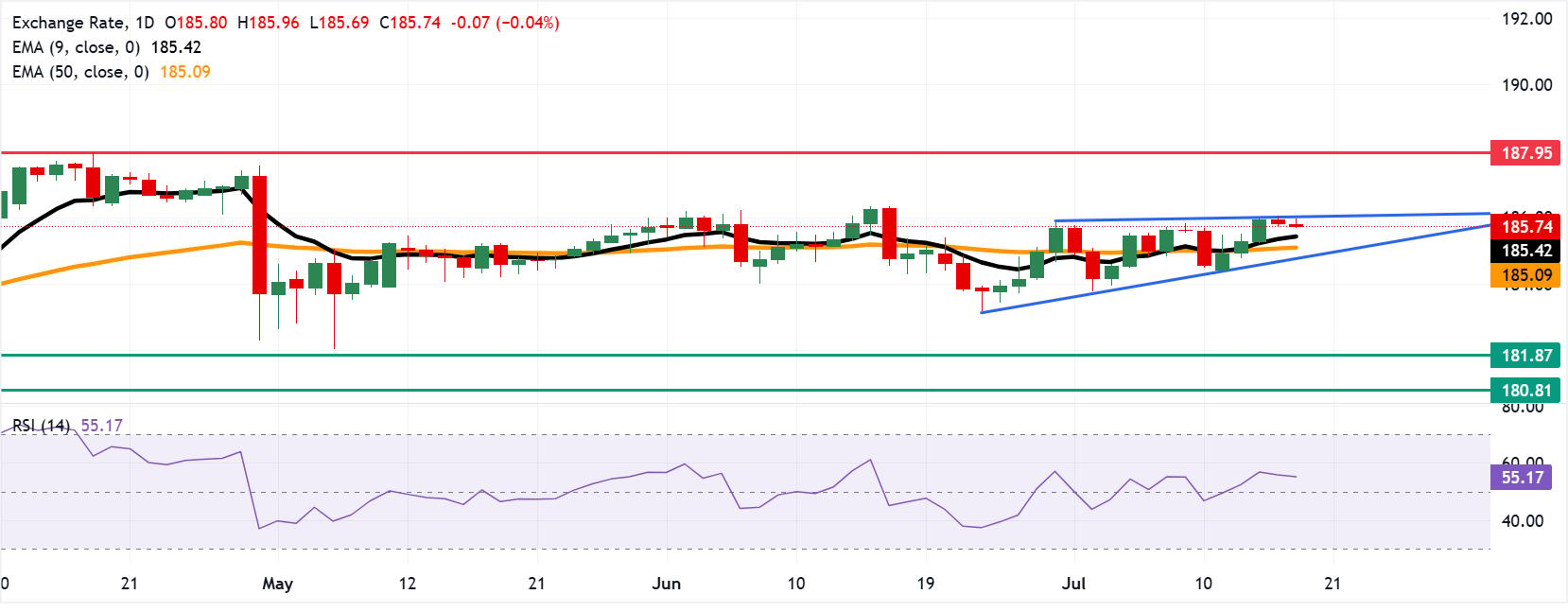
EUR/JPY may find immediate resistance at the ascending triangle top near 186.00.
The 14-day Relative Strength Index is at 55.17, indicating steady, sustainable bullish momentum.
The currency cross could find the initial support at the nine-day EMA at 185.42.
EUR/JPY extends its losses for the second consecutive day, trading around 185.70 during the Asian hours on Friday. The currency cross is holding above both the nine-period and 50-period Exponential Moving Averages (EMAs), which reinforces a constructive near-term bias. The 14-day Relative Strength Index (RSI) sits at 55.17, neutral-to-positive territory, suggesting steady bullish momentum rather than an overstretched rally.
The daily chart technical analysis shows the EUR/JPY cross is pressing against ascending triangle resistance near 186.00. This flat ceiling, combined with shallower dips, signals aggressive buying pressure. Because bulls are consistently absorbing the supply at this level, momentum is heavily building for an imminent upside breakout. A decisive daily close above this upper boundary typically triggers a powerful bullish continuation, which could expose the all-time high of 187.95, which was recorded on April 17.
On the downside, primary support lies at the nine-day EMA at 185.42, followed by the 50-day EMA at 185.09. Further declines would put downward pressure on the EUR/JPY cross to test the ascending triangle’s lower boundary around 184.80. A break below the triangle would expose the four-month low of 181.87, recorded on March 16, and the six-month low of 180.81.
EUR/JPY: Daily Chart
Euro Price Today
The table below shows the percentage change of Euro (EUR) against listed major currencies today. Euro was the weakest against the Canadian Dollar.
USD
EUR
GBP
JPY
CAD
AUD
NZD
CHF
USD
0.02%
0.06%
0.00%
-0.04%
0.12%
0.04%
0.00%
EUR
-0.02%
0.06%
-0.04%
-0.09%
0.13%
0.03%
-0.02%
GBP
-0.06%
-0.06%
-0.09%
-0.14%
0.06%
-0.02%
-0.08%
JPY
0.00%
0.04%
0.09%
-0.03%
0.15%
0.04%
0.01%
CAD
0.04%
0.09%
0.14%
0.03%
0.19%
0.09%
0.05%
AUD
-0.12%
-0.13%
-0.06%
-0.15%
-0.19%
-0.11%
-0.14%
NZD
-0.04%
-0.03%
0.02%
-0.04%
-0.09%
0.11%
-0.04%
CHF
-0.00%
0.02%
0.08%
-0.01%
-0.05%
0.14%
0.04%
The heat map shows percentage changes of major currencies against each other. The base currency is picked from the left column, while the quote currency is picked from the top row. For example, if you pick the Euro from the left column and move along the horizontal line to the US Dollar, the percentage change displayed in the box will represent EUR (base)/USD (quote).
To provide the best experiences, we use technologies like cookies to store and/or access device information. Consenting to these technologies will allow us to process data such as browsing behavior or unique IDs on this site. Not consenting or withdrawing consent, may adversely affect certain features and functions.
Functional
Always active
The technical storage or access is strictly necessary for the legitimate purpose of enabling the use of a specific service explicitly requested by the subscriber or user, or for the sole purpose of carrying out the transmission of a communication over an electronic communications network.
Preferences
The technical storage or access is necessary for the legitimate purpose of storing preferences that are not requested by the subscriber or user.
Statistics
The technical storage or access that is used exclusively for statistical purposes.The technical storage or access that is used exclusively for anonymous statistical purposes. Without a subpoena, voluntary compliance on the part of your Internet Service Provider, or additional records from a third party, information stored or retrieved for this purpose alone cannot usually be used to identify you.
Marketing
The technical storage or access is required to create user profiles to send advertising, or to track the user on a website or across several websites for similar marketing purposes.