

Currency Hedger No Comments

GBP/JPY slips as UK political risk pressures Pound, Yen weakness limits losses

  • GBP/JPY trims intraday gains as the British Pound softens on UK political uncertainty.
  • Markets await the BoE and BoJ monetary policy decisions due this week.
  • Technicals remain bullish above key SMAs, though momentum shows signs of cooling.

GBP/JPY gives back part of its earlier gains on Monday as theย British Poundย (GBP) comes under pressure following reports thatย UK Prime Minister Keir Starmer will face a parliamentary voteย on a possible probe into whether he misled lawmakers over the appointment of Peter Mandelson as ambassador to the United States.

However, the downside remains limited as the Japanese Yen (JPY) continues to underperform most of its major peers, with elevated Oil prices weighing on the currency given Japanโ€™s heavy reliance on imported energy.

At the time of writing, GBP/JPY is trading around 215.67, easing slightly after hitting 216.06, its highest level since January 2008, while the wide interest rate differential between the Bank of England (BoE) and the Bank of Japan (BoJ) keeps the broader bias tilted to the upside.

Attention now turns to upcoming monetary policy meetings dueย this week, with both theย BoEย and theย BoJย widely expected to holdย ratesย steady as policymakers assess the impact of rising Oil prices on inflation and economic growth.

The BoJโ€™s slow pace of policy normalization is likely to keep the Yen on the defensive, although lingering intervention risks could limit further weakness amid repeated warnings from Japanese officials, with USD/JPY hovering close to the 160 mark.

In the daily chart, GBP/JPY keeps a bullish near-term bias as it holds well above both the 21-day simple moving average (SMA) at 213.60 and the 50-day SMA at 212.24. The positive but moderating Relative Strength Index (RSI) around 65 and a still-positive Moving Average Convergence Divergence (MACD) histogram hint that upside momentum persists, though the pace of the advance is losing some steam as the cross consolidates near recent highs.

On the downside, initial support is seen at the 21-day SMA at 213.60, with a deeper pullback likely finding additional demand near the 50-day SMA at 212.24. As long as GBP/JPY holds above these moving averages, the broader bullish structure remains intact, and any dips toward this support band may be treated as corrective rather than signaling a sustained reversal.

(The technical analysis of this story was written with the help of an AI tool.)

Japanese Yen Price Today

The table below shows the percentage change of Japanese Yen (JPY) against listed major currencies today. Japanese Yen was the strongest against the Swiss Franc.

USDEURGBPJPYCADAUDNZDCHF
USD-0.14%-0.08%-0.06%-0.43%-0.49%-0.51%-0.03%
EUR0.14%0.08%0.09%-0.28%-0.32%-0.35%0.13%
GBP0.08%-0.08%0.00%-0.38%-0.43%-0.45%0.05%
JPY0.06%-0.09%0.00%-0.35%-0.42%-0.46%0.09%
CAD0.43%0.28%0.38%0.35%-0.06%-0.10%0.41%
AUD0.49%0.32%0.43%0.42%0.06%-0.01%0.47%
NZD0.51%0.35%0.45%0.46%0.10%0.01%0.49%
CHF0.03%-0.13%-0.05%-0.09%-0.41%-0.47%-0.49%

The heat map shows percentage changes of major currencies against each other. The base currency is picked from the left column, while the quote currency is picked from the top row. For example, if you pick the Japanese Yen from the left column and move along the horizontal line to the US Dollar, the percentage change displayed in the box will represent JPY (base)/USD (quote).

Currency Hedger No Comments

USD/JPY: Convergence delayed but capped by intervention โ€“ HSBC

HSBC strategists highlight that the Japanese Yen (JPY) has been the weakest G10 currency month-to-date, with USD/JPY trading in an unusually narrow range despite Japanโ€™s large net energy import status and Gulf exposure. They argue a cautious Bank of Japan (BoJ) and domestic fiscal issues may delay USD/JPYโ€™s move lower, although intervention risks and portfolio inflows should cap upside. HSBCโ€™s base case still sees USD/JPY declining by year-end.

BoJ caution and fiscal strains vs caps

“Bearish sentiment towards JPY is consistent with Japanโ€™s macro exposure. Japan is the largest net energy importer among advanced economies (scaled by GDP) and has deep economic ties with the Gulf region.”

“Despite these headwinds, USD-JPY has traded in an unusually narrow range recently. A cautious Bank of Japan (BoJ) and domestic fiscal challenges may delay USD/JPYโ€™s convergence lower towards levels implied by rate differentials.”

“Key fiscal watchpoints include the possibility that funding for fuel subsidies may run out in mid/late May and that a supplementary budget may be proposed.”

“Offsetting factors include net portfolio inflows (foreign buying of Japaneseย equitiesย and bonds month-to-date in April, alongside Japanese selling of foreign bonds) and firm verbal intervention from the Ministry of Finance, may help cap USD/JPY.”

“Our base case remains for USD/JPY to decline by year-end. Near-term upside risks include a more dovishย BoJ, a more hawkishย Federal Reserveย (Fed), escalation in the Middle East conflict and renewed oil-price highs, and further fiscal slippage in Japan.”

Currency Hedger No Comments

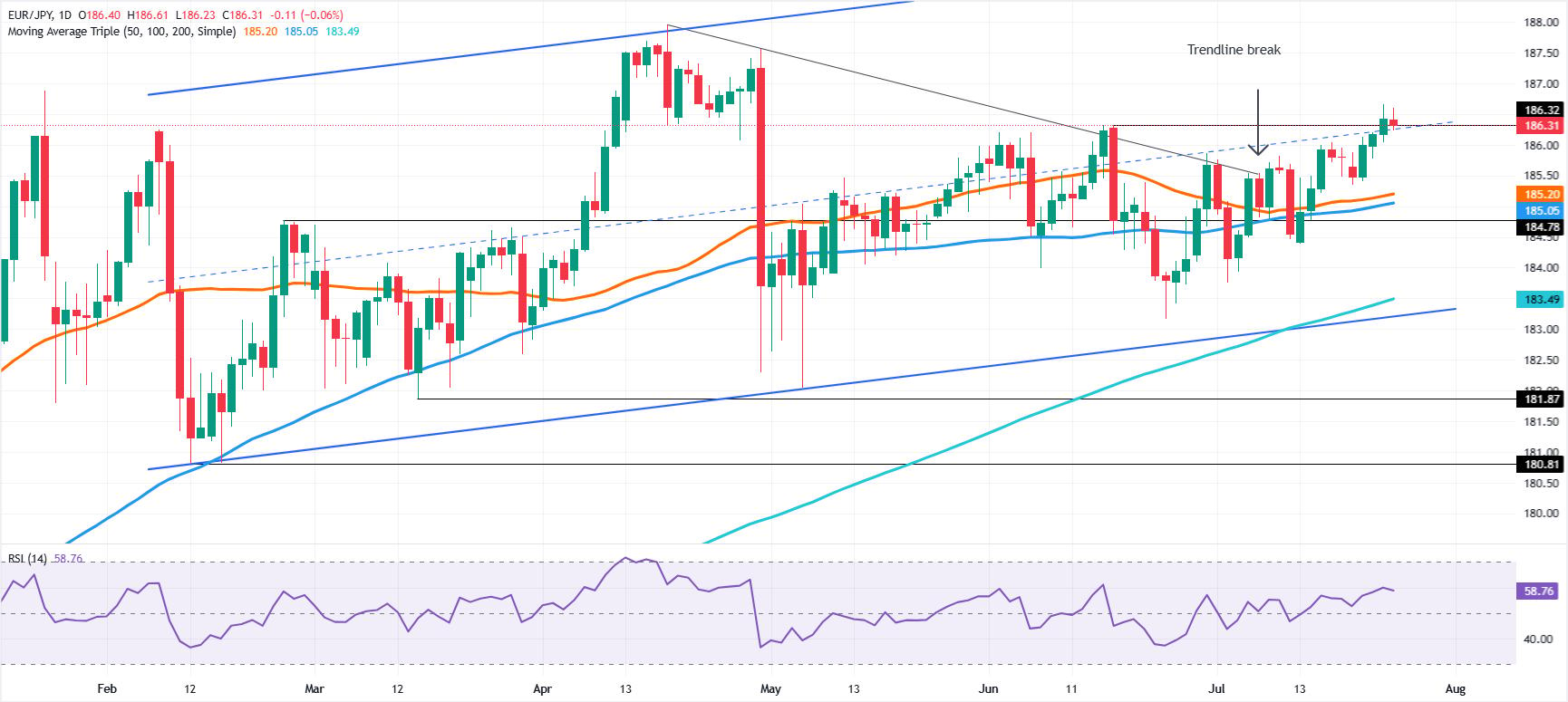
EUR/JPY Tests nine-day EMA support near 186.50

  • EUR/JPY may explore the region around the all-time high of 187.95.
  • The 14-day Relative Strength Index near 60 signals positive momentum without extreme conditions.
  • The immediate support lies at the nine-day EMA of 186.75.

EUR/JPY inches lower after registering modest gains in the previous day, trading around 186.70 during Asian hours on Monday. The technical analysis of the daily chart indicates the currency cross is positioned within the ascending channel, signaling an ongoing bullish bias.

The EUR/JPY cross holds a bullish near-term bias as it consolidates above both the nine-day and 50-day Exponential Moving Averages (EMAs), respectively. The currency cross is hovering just under the recent highs, with the 14-day Relative Strength Index (RSI) around 60, suggesting positive but not extreme momentum that keeps the door open for another push higher while dips remain contained.

The EUR/JPY cross may advance toward the all-time high of 187.95, which was recorded on April 17. Further advances above this level would support the currency cross to explore the region around the upper boundary of the channel, around 189.70.

On the downside, the immediate support lies at the nine-day EMA of 186.75, aligned with the lower boundary of the ascending channel around 186.60. A sustained break below the channel would put downward pressure on the EUR/JPY cross to test the 50-day EMA at 184.94.

EUR/JPY: Daily Chart

Euro Price Today

The table below shows the percentage change of Euro (EUR) against listed major currencies today. Euro was the strongest against the US Dollar.

USDEURGBPJPYCADAUDNZDCHF
USD-0.06%-0.07%-0.10%-0.03%-0.30%-0.17%-0.02%
EUR0.06%0.02%-0.04%0.03%-0.22%-0.09%0.04%
GBP0.07%-0.02%-0.04%0.02%-0.22%-0.09%0.04%
JPY0.10%0.04%0.04%0.08%-0.20%-0.09%0.11%
CAD0.03%-0.03%-0.02%-0.08%-0.27%-0.16%0.01%
AUD0.30%0.22%0.22%0.20%0.27%0.14%0.28%
NZD0.17%0.09%0.09%0.09%0.16%-0.14%0.15%
CHF0.02%-0.04%-0.04%-0.11%-0.01%-0.28%-0.15%

The heat map shows percentage changes of major currencies against each other. The base currency is picked from the left column, while the quote currency is picked from the top row. For example, if you pick the Euro from the left column and move along the horizontal line to the US Dollar, the percentage change displayed in the box will represent EUR (base)/USD (quote).

Currency Hedger No Comments

The Japanese Yen holds steady as BoJ and Fed rate decisions in focus

  • USD/JPY flat lines around 159.50 in Mondayโ€™s early Asian session.ย 
  • Markets expect the BoJ to leave interest rates unchanged on Tuesday.ย 
  • The FOMC is anticipated to maintain the federal funds rate betweenย 3.50% and 3.75%ย at its April meeting on Wednesday.

The USD/JPY pair trades on a flat note near 159.50 during the early Asian session on Monday. Traders prefer to wait on the sidelines ahead of the key interest rate decisions from both the Bank of Japan (BoJ) and the USย Federal Reserveย (Fed).

Markets anticipate the Japanese central bank keeping interest rates steady at 0.75% on Tuesday. While a “hawkish hold” is possible, officials are balancing rising energy-driven inflation against economic uncertainty caused by ongoing conflicts in the Middle East.

Meanwhile, intervention fears could provide some support to the JPY and act as a headwind for the pair. Japanese authorities, including Finance Minister Satsuki Katayama, highlighted a “high sense of urgency” regarding speculative and weak-JPY moves driven by Middle East tensions. 

The Federal Open Market Committee (FOMC) is expected to maintain the benchmark federal funds rate in the 3.50% to 3.75% range, marking the third consecutive meeting without a change. This meeting may be the final one for Jerome Powell, whose successor, Kevin Warsh, is nearing confirmation.

Traders will take more cues from the press conference on how policymakers are interpreting the impact of higher energy costs and whether this alters their longer-termย outlookย on interestย rates. Any hawkish remarks from the Federal Reserve (Fed) policymakers could lift the Greenback against the Japanese Yen (JPY).ย 

Currency Hedger No Comments

Currency Talk – AUDCAD, NZDUSD, USDJPY

Key takeaways

  • What is the technical outlook for AUDCAD, NZDUSD, and USDJPY?

This analysis from the Overbalance series aims to identify three financial instruments, analyzed primarily on the daily/four-hour (D1/H4) timeframe. The analysis uses only the Overbalance methodology, which helps determine where a trend may continue or where a reversal might occur. Todayโ€™s analysis covers three instruments, evaluated solely in terms of 1:1 correction structures.

AUDCAD

Since late March, AUDCAD has been trending upward. The key level remains the support at 0.9755, which stems from the lower boundary of the local 1:1 pattern, as well as from previous local peaks. According to the Overbalance methodology, as long as the price remains above this level, the uptrend remains in effect. However, it is worth noting the lack of a clear demand reactionโ€”further tests of this support level could weaken it, increasing the risk of a breakout to the downside. Therefore, the 0.9755 level is critical in the short term for the direction of the market.

AUDCAD – H4 timeframe. Source: xStation

NZDUSD

Since early April, the NZDUSD pair has been trending upward, but the market is currently testing key support at the 0.5840 level. Holding this level could trigger another upward move. Conversely, a break below this level and a return below 0.5828 could pave the way for a resumption of the downward trend. The current levels are therefore crucial for determining the short-term direction.

NZDUSD – H4 chart. Source: xStation

USDJPY

USDJPY has been trending upward for quite some time, but in April we saw a consolidation phase and two tests of support at the 158.10 level. This level was successfully defended, which supports the current uptrend. A break above the March 29 high would confirm the continuation of the uptrend. However, as long as support at 158.10 holds, the base case scenario is for further gains. A break below this level, however, could lead to a larger correction toward 155.11.

USDJPY – H4 chart. Source: xStation

Currency Hedger No Comments

JPY hangs near two-week low vs USD as Japanโ€™s National CPI fails to impress bulls

  • USD/JPY trades with a positive bias for the fifth straight day and flirts with a nearly two-week top.
  • Economic concerns due to the Hormuz standoff and delayed BoJ rate hike bets undermine the JPY.
  • Less dovish Fed expectations support the USD and the pair, though intervention fears cap the upside.

The USD/JPY pair sticks to its positive bias for the fifth straight day and trades around the 159.80 area, or a nearly two-week top during the Asian session on Friday. Spot prices remain on track to register strong weekly gains, though the mixed fundamental backdrop makes it prudent to wait for a breakout through over a one-month-old range before positioning for a firm near-term direction.

The Japanese Yen (JPY) continues with its relative underperformance amid economic concerns stemming from intensifying tensions in the Middle East, which, along with a bullish US Dollar (USD), acts as a tailwind for the USD/JPY pair. Investors remain skeptical about a durable agreement between the US and Iran amid the lack of progress in peace talks due to the American blockade of Iranian ports. Iran has set the complete removal of the US naval blockade as a strict precondition for resuming negotiations.

Meanwhile, Iran attacked three ships in the Strait of Hormuz on Wednesday and seized two of them. This adds to worries that Japan’s economy will come under substantial strains due to continued disruptions to energy supplies through the strategic waterway. Adding to this, expectations that the Bank of Japan (BoJ) will hold interestย ratesย steady at its upcoming April meeting, bolstered by the latest inflation figures, turn out to be another factor undermining the JPY and supporting the USD/JPY pair.

A government report showed that Japan’s headline Consumer Price Index (CPI) recovered from its lowest level in nearly four years and rose to the 1.5% YoY rate in March. Moreover, the core gauge, which excludes volatile fresh food costs, climbed 1.8% from 1.6% in February, though it remained below the BoJ’s 2% annual target. That said, the Core CPI that excludes both fresh food and fuel costs rose 2.4%, suggesting that price pressures remain sticky and backing the case for an imminentย BoJย rate hike.

The data, however, does little to provide any respite to the JPY bulls. The US Dollar (USD), on the other hand, preserves its gains registered over the past three days amid persistent geopolitical uncertainties and fading dovish USย Federal Reserveย (Fed) bets. This further contributes to a positive tone surrounding the USD/JPY pair. However, speculations that Japanese authorities will step in to stem further weakness in the domestic currency help limit deeper JPY losses and cap gains for the currency pair.

Currency Hedger No Comments

EUR/JPY – Holds above 186.50 to test nine-day EMA barrier

  • EUR/JPY may rise toward the all-time high of 187.95.
  • The 14-day Relative Strength Index near 58 indicates positive momentum without overbought conditions.
  • The primary support lies at the 50-day EMA at 184.86.

EUR/JPY inches higher after three days of gains, trading around 186.60 during Asian hours on Friday. The technical analysis of the daily chart indicates the currency cross is positioned slightly below the ascending channel, signaling potential for a bearish reversal.

However, the EUR/JPY cross holds a constructive bullish bias as it remains above the 50-day Exponential Moving Average (EMA) while facing immediate friction at the nine-day EMA.

Additionally, the 14-day Relative Strength Index sits around 58, comfortably above the midline yet below overbought territory, which suggests positive but not overstretched momentum that could favor further upside as long as the EUR/JPY cross holds over the underlying average.

The EUR/JPY cross is testing the immediate barrier at the nine-day EMA of 186.69. A rebound back to the ascending channel would reinforce the bullish bias and support the EUR/JPY cross to test the all-time high of 187.95, which was recorded on April 17. Further advances above this level would support the currency cross to explore the region around the upper boundary of the channel, around 189.40.

On the downside, further declines would put downward pressure on the EUR/JPY cross to navigate the region around the 50-day EMA at 184.86.

EUR/JPY: Daily Chart

Euro Price Today

The table below shows the percentage change of Euro (EUR) against listed major currencies today. Euro was the strongest against the New Zealand Dollar.

USDEURGBPJPYCADAUDNZDCHF
USD0.09%0.10%0.05%0.10%0.17%0.21%0.12%
EUR-0.09%0.00%0.00%0.00%0.08%0.12%0.04%
GBP-0.10%-0.01%-2.13%0.02%0.08%0.12%0.02%
JPY-0.05%0.00%2.13%0.03%0.10%0.14%0.03%
CAD-0.10%0.00%-0.02%-0.03%0.06%0.10%0.02%
AUD-0.17%-0.08%-0.08%-0.10%-0.06%0.04%-0.07%
NZD-0.21%-0.12%-0.12%-0.14%-0.10%-0.04%-0.09%
CHF-0.12%-0.04%-0.02%-0.03%-0.02%0.07%0.09%

The heat map shows percentage changes of major currencies against each other. The base currency is picked from the left column, while the quote currency is picked from the top row. For example, if you pick the Euro from the left column and move along the horizontal line to the US Dollar, the percentage change displayed in the box will represent EUR (base)/USD (quote).

Currency Hedger No Comments

Chart of the Day – USD/JPY Under The Shadow of Hormuz and the BOJ?

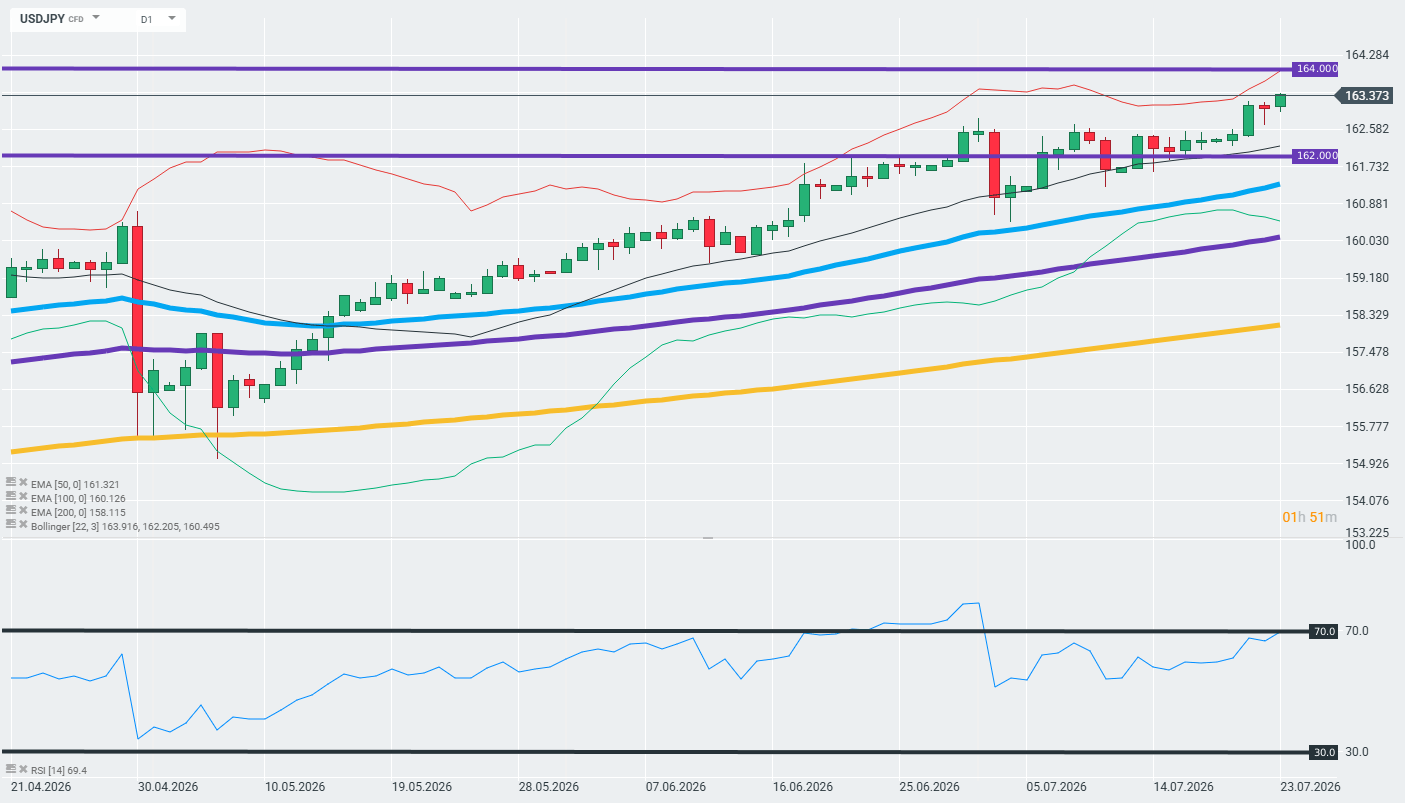
The USDJPY pair continues to trade in a heightened uncertainty environment, where geopolitical factors, macroeconomic data, and growing expectations regarding Bank of Japan policy are all influencing price action at the same time. The market is moving around key technical levels, with particular attention focused on the 160 area, which has been consistently defended and is widely viewed as a significant psychological barrier as well as a potential intervention zone for Japanese authorities. This raises an increasingly important question: whether this level will eventually be broken, and if so, under what conditions and timing. The current dynamics are driven both by global geopolitical tensions and by an intensifying debate over the possible normalization of monetary policy in Japan.

Source: xStation5

What drives USDJPY pricing? Geopolitics and the Strait of Hormuz as a source of global risk aversion

One of the key drivers of market sentiment remains geopolitical tensions in regions critical for global energy transport, such as the Strait of Hormuz. The market reacts very sensitively to any risk of disruptions in oil and gas flows, which leads to higher energy prices and increased volatility. Japan is heavily dependent on energy imports, largely sourced from the Persian Gulf region. As a result, rising oil and gas prices deteriorate Japanโ€™s trade balance and increase imported inflation pressures. Therefore, prolonged tensions in the Hormuz region do not necessarily support the yen. Instead, they tend to weaken it. In this context, geopolitics does not provide a clear directional signal for USDJPY, but rather reinforces upside pressure on the pair while increasing overall volatility.

Japanese macro data and PMI signals

Recently, Japanese PMI data has attracted more attention, showing a gradual improvement in economic activity. While this is not yet a strong upward trend, signs of stabilization in both manufacturing and services increase the likelihood that the Bank of Japan will have more room to continue normalizing monetary policy. For the FX market, this is important because the yen has remained under pressure for years due to ultra-loose monetary conditions. Even small shifts in this area can have a meaningful impact on global capital flows.

Inflation (CPI) as a key BOJ catalyst

One of the most important short-term drivers remains Japanese CPI data, which plays a central role in shaping expectations regarding future Bank of Japan actions. If inflation remains above the 2% target, markets increasingly price in the possibility of further rate hikes or at least a more hawkish communication stance from the central bank. In such a scenario, upward pressure on the yen increases. Conversely, weaker inflation data reinforces expectations that ultra-loose policy will be maintained for longer, which supports further yen weakness against the dollar.

Bank of Japan policy and interest rate differentials

A key medium- and long-term factor remains Bank of Japan policy, which is gradually moving away from its long-standing regime of ultra-low interest rates and yield curve control. Even though this process is slow, its direction is highly significant for markets. USDJPY is particularly sensitive to the interest rate differential between the US and Japan, which has been a major driver of yen weakness through carry trade strategies for years. Any narrowing of this spread could trigger significant capital flows and lead to shifts in the medium-term trend.

The 160 level and intervention risk

The 160 level on USDJPY remains a key reference point, both technically and politically. Historically, levels around this area have been repeatedly highlighted as zones of heightened vigilance by Japanese authorities regarding excessive FX volatility. As a result, markets are increasingly pricing in the risk of intervention by the Japanese Ministry of Finance, which may take the form of either verbal warnings or direct FX market operations. Such interventions typically result in sharp but often short-lived strengthening of the yen.

Key Takeways

  • USDJPY remains in a high-volatility environment where direction is driven simultaneously by macroeconomic data, geopolitical developments, and central bank policy.
  • Geopolitical tensions, including the situation in the Strait of Hormuz, increase global risk aversion.
  • Japanese macro data, particularly PMIs, indicate gradual economic improvement and support the case for further BOJ normalization.
  • Inflation (CPI) remains a key short-term catalyst for BOJ expectations and the yenโ€™s direction.
  • BOJ policy is becoming an increasingly important source of volatility, with even small communication shifts capable of moving the market.
  • The USโ€“Japan interest rate differential remains the core structural driver of USD/JPY, and its potential narrowing could reshape medium-term dynamics.
  • The 160 level represents a major psychological and political barrier, increasing the risk of intervention or verbal action by Japanese authorities.
  • The market remains in a phase dominated by expectations and narratives, which supports sharp but often short-lived price moves.