

GBP/USD Price – Holds gains near 1.3200 despite persistent bearish bias

March 31, 2026
  • GBP/USD may retest support near 1.3150 at the lower boundary of the descending channel.
  • The 14-day Relative Strength Index near 38 signals fading downside momentum, but insufficient buying pressure.
  • The pair may climb toward resistance at the nine-day EMA of 1.3291.

GBP/USD halts its five-day losing streak, trading around 1.3200 during the Asian hours on Tuesday. The technical analysis of the daily chart indicates an ongoing bearish bias, as the pair moves downwards within the descending channel pattern.

The near-term bias stays mildly bearish as the GBP/USD pair holds below both the nine-day and 50-day Exponential Moving Averages (EMAs), which cap price action and frame a descending short-term profile.

Additionally, the latest 14-day Relative Strength Index (RSI) hovers near 38 after recovering from oversold territory, indicating fading downside momentum but not yet enough buying pressure to challenge the dominant corrective phase from recent highs.

The GBP/USD pair may retest the immediate support at the descending channel’s lower boundary around 1.3150. A break below the channel would expose the 1.3010, the lowest since April 2025, which was recorded in November 2025.

On the upside, the GBP/USD pair may rise toward the primary barrier at the nine-day EMA of 1.3291. Further advances would lead the GBP/USD pair to test the 50-day EMA at 1.3412, followed by the upper descending channel boundary around 1.3460. A break above this confluence resistance would trigger a bullish bias, paving the way for the pair to test 1.3869, its highest level since September 2021, reached on January 27.

GBP/USD: Daily Chart

(The technical analysis of this story was written with the help of an AI tool.)

Pound Sterling Price Today

The table below shows the percentage change of British Pound (GBP) against listed major currencies today. British Pound was the strongest against the New Zealand Dollar.

USDEURGBPJPYCADAUDNZDCHF
USD-0.03%-0.08%-0.05%0.05%0.12%0.20%-0.10%
EUR0.03%-0.04%0.02%0.13%0.18%0.26%-0.03%
GBP0.08%0.04%0.06%0.18%0.23%0.30%0.01%
JPY0.05%-0.02%-0.06%0.11%0.16%0.24%-0.04%
CAD-0.05%-0.13%-0.18%-0.11%0.06%0.14%-0.15%
AUD-0.12%-0.18%-0.23%-0.16%-0.06%0.09%-0.21%
NZD-0.20%-0.26%-0.30%-0.24%-0.14%-0.09%-0.30%
CHF0.10%0.03%-0.01%0.04%0.15%0.21%0.30%

The heat map shows percentage changes of major currencies against each other. The base currency is picked from the left column, while the quote currency is picked from the top row. For example, if you pick the British Pound from the left column and move along the horizontal line to the US Dollar, the percentage change displayed in the box will represent GBP (base)/USD (quote).


EUR/USD snaps five-day losing streak as Trump mulls ending Iran war

March 31, 2026

EUR/USD finds support near 1.1450 after snapping a five-day losing streak.

US President Trump is willing to end the war with Iran, WSJ reported.

Investors await flash Eurozone HICP data for March.

The EUR/USD pair attracts bids after a five-day losing streak and edges higher to near 1.1475 during the Asian trading session on Tuesday. The major currency pair ticks up as the US Dollar (USD) edges down amid hopes of an end to the month-long war in the Middle East.

As of writing, the US Dollar Index (DXY), which tracks the Greenback’s value against six major currencies, trades slightly lower to near 100.40.

The expectations of peace in the Middle East war, which involves the United States (US), Israel, and Iran, have accelerated as President Trump has stated that he is willing to end the war, the Wall Street Journal (WSJ) reported. The report also shows that Trump is ready for peace despite the Strait of Hormuz remaining largely closed, as he doesn’t intend a forceful reopening to avoid stretching the military mission beyond his timeline of four to six weeks.

The continuous closure of the Hormuz, through which almost 20% of global energy is supplied, would limit the upside in the oil price, a scenario that will keep global inflation projections elevated. This could be the reason behind a slight downtick in the US Dollar, which should have faced intense selling pressure on peace hopes, as it rallied in the past few weeks due to hopes that de-anchored inflation expectations would discourage the Federal Reserve (Fed) from loosening the monetary policy in the near term.

Meanwhile, higher oil prices are expected to remain a key drag on the Euro (EUR), given that the Eurozone is an energy importer.

On the macro front, investors await the flash Eurozone Harmonized Index of Consumer Prices (HICP) data for March, which will be published at 09:00 GMT. The headline HICP is expected to have grown at a robust pace of 2.7% Year-on-Year (YoY) against the previous reading of 1.9%.

USD/JPY retreats from intervention red line as Japan warns on Yen weakness

March 30, 2026
  • USD/JPY retreats after briefly surpassing 160.00, a level widely seen as a red line for Japanese authorities
  • Japanese officials step up warnings over JPY weakness and do not rule out decisive action.
  • Middle East geopolitical tensions and Powell’s cautious tone help limit the US Dollar’s downside.

USD/JPY retreats on Monday and trades around 159.60 at the time of writing, down 0.44% on the day, after reaching a nearly 20-month high above 160.00 earlier in the day. The move lower follows renewed warnings from Japanese authorities about potential intervention in the foreign exchange market.

The main catalyst behind the Japanese Yen’s (JPY) rebound came from comments by Japan’s top currency diplomat, Atsushi Mimura, who pointed to increasing speculative activity in currency markets. He warned that Tokyo could take “decisive steps” if these trends persist, reviving concerns about direct intervention to support the Japanese currency.

These remarks come as some policymakers also raise the possibility of a rate hike by the Bank of Japan (BoJ) to curb the inflationary effects of JPY weakness and rising energy prices. According to analysts at MUFG, recent signals suggest that Japanese authorities could respond through both monetary tightening and foreign exchange intervention if pressure on the currency continues.

However, the downside in the US Dollar (USD) remains limited as risk aversion persists amid escalating geopolitical tensions in the Middle East. The involvement of Iran-backed Houthi militias and threats to disrupt key maritime routes for Oil transport have increased market uncertainty and helped sustain demand for safe-haven assets.

In this context, US President Donald Trump said that Washington is holding discussions with what he described as a “new regime” in Iran in an effort to end military operations. At the same time, he warned that the United States (US) could target Iranian energy infrastructure if no agreement is reached quickly or if the Strait of Hormuz remains closed to commercial traffic.

On the monetary policy front, Federal Reserve (Fed) Chair Jerome Powell said earlier that the current policy stance is in a “good place” and that the Fed will wait for more data before adjusting interest rates. The Fed chair also stressed that supply shocks, particularly those linked to energy prices and geopolitical tensions, must be monitored to prevent inflation expectations from becoming unanchored.

Investors will also keep a close eye on upcoming Japanese data releases, including the Tokyo Consumer Price Index (CPI), Industrial Production and Retail Sales figures, which could offer further clues about the country’s economic outlook and the future policy path of the Bank of Japan.

US Dollar Price Today

The table below shows the percentage change of US Dollar (USD) against listed major currencies today. US Dollar was the strongest against the New Zealand Dollar.

USDEURGBPJPYCADAUDNZDCHF
USD0.57%0.65%-0.43%0.22%0.43%0.67%0.21%
EUR-0.57%0.07%-0.95%-0.34%-0.10%0.13%-0.37%
GBP-0.65%-0.07%-1.05%-0.39%-0.18%0.07%-0.43%
JPY0.43%0.95%1.05%0.66%0.87%1.12%0.63%
CAD-0.22%0.34%0.39%-0.66%0.20%0.41%-0.05%
AUD-0.43%0.10%0.18%-0.87%-0.20%0.26%-0.23%
NZD-0.67%-0.13%-0.07%-1.12%-0.41%-0.26%-0.50%
CHF-0.21%0.37%0.43%-0.63%0.05%0.23%0.50%

The heat map shows percentage changes of major currencies against each other. The base currency is picked from the left column, while the quote currency is picked from the top row. For example, if you pick the US Dollar from the left column and move along the horizontal line to the Japanese Yen, the percentage change displayed in the box will represent USD (base)/JPY (quote).

GBP/USD dives to four-month lows as Middle East tensions lift the US Dollar

March 30, 2026
  • GBP/USD is weighed by Middle East tensions, with higher oil prices boosting haven demand.
  • Powell acknowledges policy tension as traders trim aggressive Fed tightening bets.
  • Weak UK data and energy vulnerability keep pressure on Sterling.

The British Pound (GBP) collapses on Monday as Middle East escalations push the US Dollar (USD) higher, while Oil prices extend their gains for the fourth consecutive trading day. At the time of writing, the GBP/USD trades at 1.3184, down by more than 0.50%, hitting a four-month low.

Sterling sinks as oil rises, Fed bets ease, UK outlook dims ahead

Market mood has improved slightly as US President Donald Trump said that the current Iranian regime seems “reasonable.” However, he added that if Iran’s new regime doesn’t open the Strait of Hormuz, the conflict could escalate after the arrival of 3,500 troops to the Middle East.

In the meantime, fears that the Iran war could weigh on the economy pushed traders to trim hawkish bets and increase the chances for a rate cut by the Federal Reserve (Fed) by the end of 2026.

Recently, Fed Chair Jerome Powell crossed the wires, acknowledging that there’s tension between the dual mandate’s goals. He said that the central bank is committed to getting inflation back to 2% on a “sustained basis,” adding that tariff-related inflation likely added 0.5% to 1% to inflation, but it’s likely a one-time effect.

Powell said that monetary policy is in a good place, that events in the Middle East affect gas prices, and added that long-term inflation expectations remain in check. Furthermore, commented that officials may need to respond to the impact of the conflict and that, if prices begin to shift inflation expectations, they would be ready to act.

In the UK, some economists see vulnerabilities due to Britain’s dependence on imported natural gas. Along with stubbornly high inflation above the Bank of England’s target, it paints a gloomy economic outlook, as downside risks for the economy rise.

Last week’s economic data revealed that British business activity hit a six-month low, manufacturers’ input costs rose at their fastest rate since 1992, and retail sales declined. Meanwhile, traders’ eyes are on the release of economic growth data, as they expect the UK’s Q4 2025 GDP to remain steady at 1%.

In the US, investors’ focus will be on the Consumer Confidence index and the Job Openings and Labour Turnover Survey (JOLTS) for February, as well as speeches by Fed officials.

GBP/USD Price Forecast: Technical outlook 

Chart Analysis GBP/USD

In the daily chart, GBP/USD trades at 1.3188. The near-term bias is bearish as spot holds well below the clustered simple moving averages around 1.3500, confirming a downside break from the prior range. Price has slipped through the rising support trend line drawn from 1.3035, turning the broader structure from supported to pressured. The downward-sloping resistance trend line from 1.3869 continues to cap bounces, while the rising Fed Sentiment Index highlights a supportive backdrop for the dollar that aligns with the current selling pressure in cable.

Immediate resistance appears near 1.3330, where recent swing highs converge with the descending trend line, followed by 1.3410 and 1.3435 as the next upside hurdles if a corrective rebound develops. On the downside, the latest low at 1.3188 is the first level to watch, with further weakness opening the way toward the psychological 1.3100 area and then 1.3035, where the prior trend-line origin sits as deeper support. As long as price remains beneath 1.3330 and the moving average cluster around 1.3500, rallies are likely to be sold rather than sustained.

(The technical analysis of this story was written with the help of an AI tool.)

Pound Sterling Price Today

The table below shows the percentage change of British Pound (GBP) against listed major currencies today. British Pound was the strongest against the New Zealand Dollar.

USDEURGBPJPYCADAUDNZDCHF
USD0.49%0.55%-0.53%0.21%0.29%0.62%0.13%
EUR-0.49%0.04%-1.00%-0.28%-0.12%0.13%-0.36%
GBP-0.55%-0.04%-1.07%-0.33%-0.21%0.09%-0.41%
JPY0.53%1.00%1.07%0.75%0.85%1.15%0.66%
CAD-0.21%0.28%0.33%-0.75%0.09%0.35%-0.09%
AUD-0.29%0.12%0.21%-0.85%-0.09%0.30%-0.18%
NZD-0.62%-0.13%-0.09%-1.15%-0.35%-0.30%-0.50%
CHF-0.13%0.36%0.41%-0.66%0.09%0.18%0.50%

The heat map shows percentage changes of major currencies against each other. The base currency is picked from the left column, while the quote currency is picked from the top row. For example, if you pick the British Pound from the left column and move along the horizontal line to the US Dollar, the percentage change displayed in the box will represent GBP (base)/USD (quote).

Trade of The Day – AUD/NZD

March 30, 2026

Facts

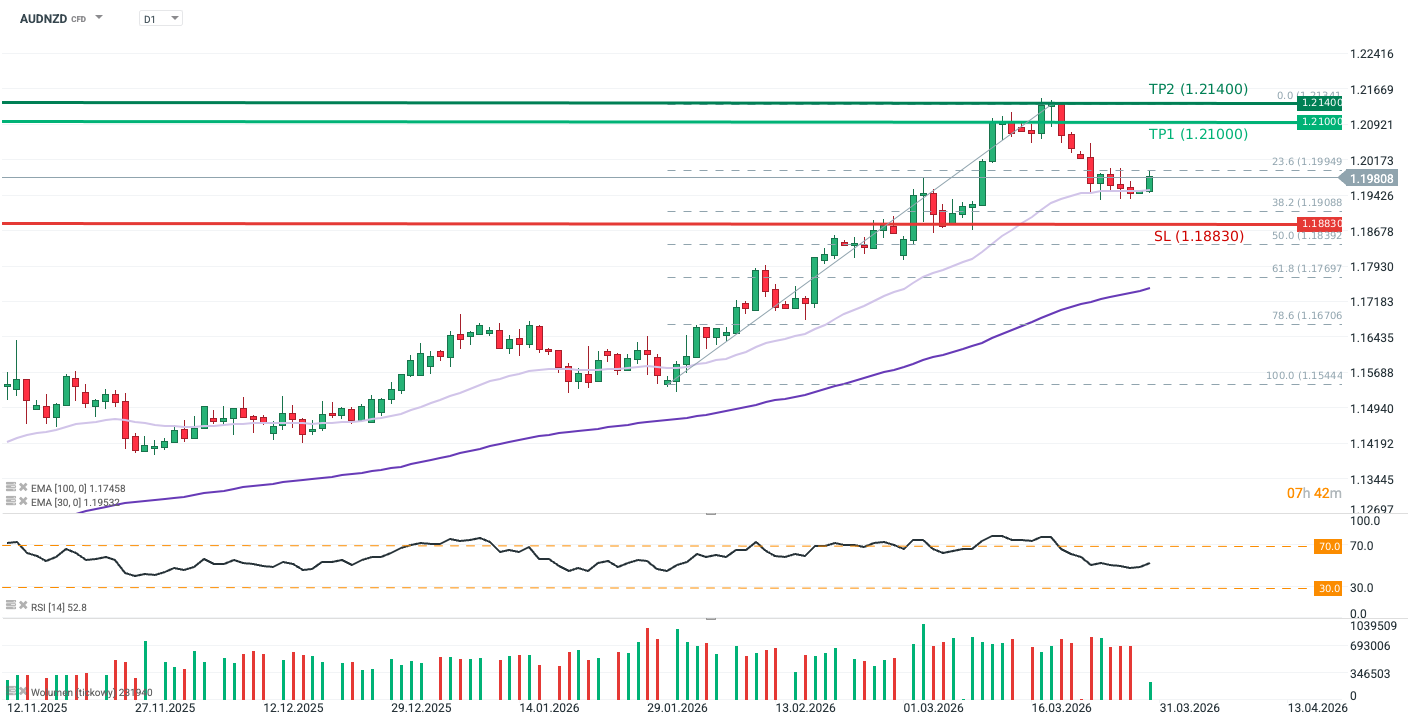
  • AUDNZD rebounded from the 30-day exponential moving average (EMA30; light purple) during today’s session.
  • The swap market (OIS curve) currently prices an approximately 60% probability of an interest rate hike in Australia for May, compared to approximately 8% in New Zealand.
  • The RSI stands at approximately 52, remaining well below the overbought threshold (i.e., below 70).

Recommendation

  • Long Position (BUY) at market price
  • Target Prices (Take Profit): 1.21000 (TP1), 1.21400 (TP2)
  • Stop Loss (SL): 1.18830

Source: xStation5

Opinion

AUDNZD recently underwent a correction triggered by a global decline in risk appetite and concerns regarding an economic slowdown in China. As China is highly dependent on Iranian oil, its trade ties with the Australian mining industry significantly influence the Australian dollar’s valuation. However, the downward move stalled at the EMA30; after several days of sideways trading, the pair rebounded, signaling a likely continuation of the broader uptrend.

While global inflation concerns driven by energy prices remain prevalent, the Reserve Bank of Australia (RBA) continues to position itself as the most hawkish central bank among G10 nations, with rates currently at 4.10%. This creates a favorable carry trade opportunity against the significantly more dovish Reserve Bank of New Zealand (RBNZ), where rates stand at 2.25%.

The 10-year bond yield spread between the two economies has remained stable since early March (at approximately 30 bps). Therefore, in the short term, Australia’s active hiking cycle should continue to support the AUDNZD trend. A primary risk factor would be a decisive pivot from the RBNZ; according to the OIS curve, markets expect the RBNZ to resume hikes in the autumn, potentially ending the year with rates at 3%.

Methodology

This recommendation was prepared based on a technical analysis of the AUDNZD chart and a fundamental analysis of both economies (focusing on Australian and New Zealand monetary policy). The directional bias was determined using moving averages, price action, and market expectations regarding central bank responses to the ongoing conflict in Iran. Take Profit and Stop Loss levels were set using Price Action methodology (TP1 at the nearest resistance, TP2 at the recent peak, and SL at the nearest swing low).

AUD/USD weakens on Middle East tensions as markets await RBA minutes

March 30, 2026
  • AUD/USD weakens as rising geopolitical tensions in the Middle East weigh on investor sentiment.
  • Threats to key Oil shipping routes and the involvement of the Houthis increase fears of a broader escalation.
  • Markets continue to assess the outlook for Australian interest rates ahead of the RBA’s minutes release.

AUD/USD trades around 0.6860 on Monday at the time of writing, down 0.21% on the day, as investors adopt a cautious stance amid escalating geopolitical tensions in the Middle East.

Market sentiment remains fragile after Iran-backed Houthi forces in Yemen joined the conflict between Israel and Iran. Over the weekend, the militants launched missiles toward Israel and threatened to close the Bab el-Mandeb Strait, a strategic shipping route for Middle Eastern Oil supplies. This new source of uncertainty has increased fears of a broader regional escalation and added volatility to financial markets.

In this environment of risk aversion, growth-sensitive currencies such as the Australian Dollar (AUD) tend to come under pressure, while investors shift toward assets perceived as safer. The conflict is also complicating the outlook for energy markets, with some analysts warning that Oil prices could rise further if maritime routes are disrupted.

On the political front, US President Donald Trump said on Monday that Washington is holding “serious discussions” with what he described as a new regime in Iran in an effort to end military operations. However, he also warned that the US could launch massive strikes against Iranian energy infrastructure if a deal is not reached quickly or if the Strait of Hormuz remains closed to commercial traffic.

Markets have reacted cautiously to these remarks. Iranian officials have expressed skepticism about the negotiations, accusing Washington of speaking about diplomacy while preparing the ground for a possible military invasion.

On the Australian side, investors are focusing on the upcoming release of the minutes from the latest Reserve Bank of Australia (RBA) meeting, scheduled for Tuesday. The central bank raised its key interest rate by 25 basis points at that meeting, bringing the cash rate to 4.1%. Traders will look for clues in the minutes about the policy outlook in the coming months.

According to the ASX’s RBA Rate Tracker, markets currently price in about a 69% chance of another rate hike at the May 5 meeting. Confirmation of this outlook could provide support to the Aussie, although geopolitical risks and shifts in global risk appetite remain key drivers for AUD/USD in the near term.

Australian Dollar Price Today

The table below shows the percentage change of Australian Dollar (AUD) against listed major currencies today. Australian Dollar was the strongest against the New Zealand Dollar.

USDEURGBPJPYCADAUDNZDCHF
USD0.20%0.24%-0.59%0.20%0.19%0.46%0.09%
EUR-0.20%0.03%-0.77%0.00%0.04%0.26%-0.12%
GBP-0.24%-0.03%-0.82%-0.02%-0.01%0.23%-0.15%
JPY0.59%0.77%0.82%0.79%0.78%1.03%0.66%
CAD-0.20%-0.00%0.02%-0.79%-0.01%0.19%-0.13%
AUD-0.19%-0.04%0.01%-0.78%0.01%0.24%-0.11%
NZD-0.46%-0.26%-0.23%-1.03%-0.19%-0.24%-0.38%
CHF-0.09%0.12%0.15%-0.66%0.13%0.11%0.38%

The heat map shows percentage changes of major currencies against each other. The base currency is picked from the left column, while the quote currency is picked from the top row. For example, if you pick the Australian Dollar from the left column and move along the horizontal line to the US Dollar, the percentage change displayed in the box will represent AUD (base)/USD (quote).

Currency Talk – EUR/NZD, EUR/CAD, AUD/USD

March 30, 2026

The Overbalance analysis aims to identify three financial instruments, analyzed primarily on the daily/four-hour (D1/H4) timeframe. The analysis uses only the Overbalance methodology, which helps determine where a trend may continue or where it may reverse.
Today’s analysis covers three instruments, evaluated solely in terms of 1:1 correction structures.

EURNZD
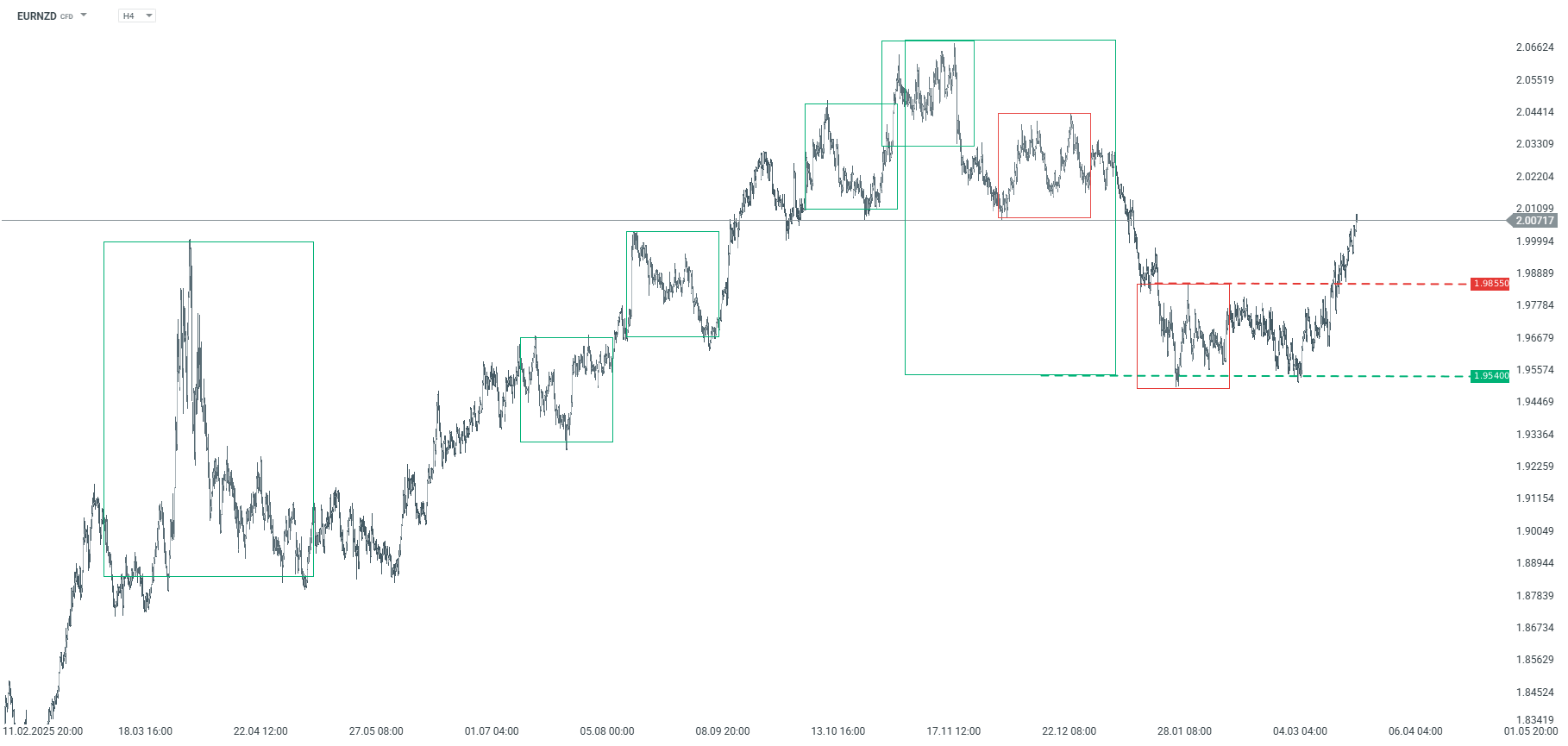
Last week, the EURNZD broke through key resistance at 1.9855, which corresponded to the upper boundary of the 1:1 geometric pattern. According to the Overbalance methodology, this breakout suggests potential for a move toward last November’s highs, around 2.0680. An additional argument in favor of the bullish scenario is the earlier double bounce off support at 1.9540. In the event of a correction, the 1.9855 level should act as short-term support.

EURNZD – H4 timeframe. Source: xStation

EURCAD
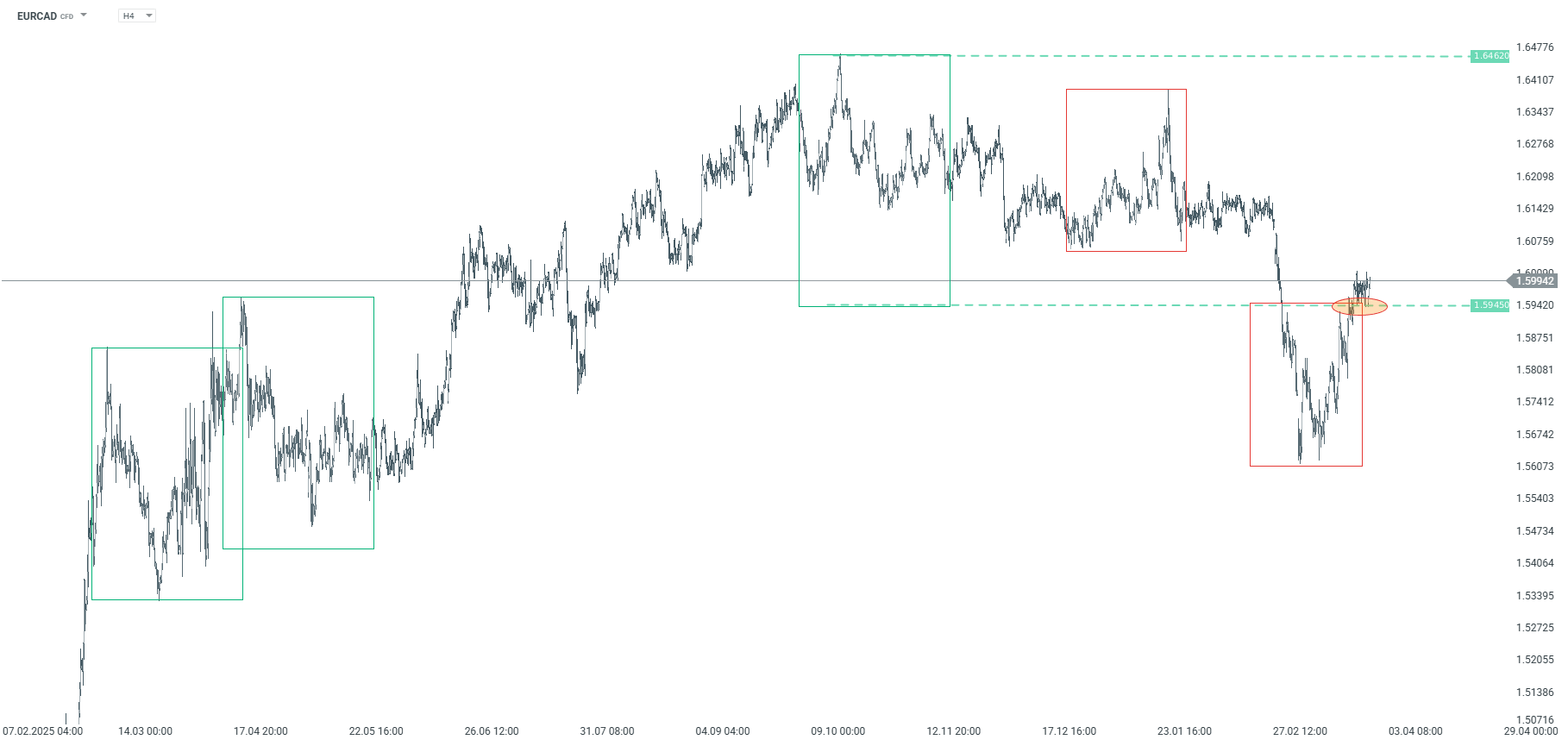
The EURCAD pair is attempting to resume its upward trend. The price has broken above the upper boundary of the 1:1 bearish pattern at the 1.5945 level and has also broken above the polarity of the previous bullish pattern, which falls exactly at the same point. According to the Overbalance methodology, as long as the price remains above the 1.5945 level, the bullish scenario remains in effect.

EURCAD – H4 timeframe. Source: xStation

AUDUSD
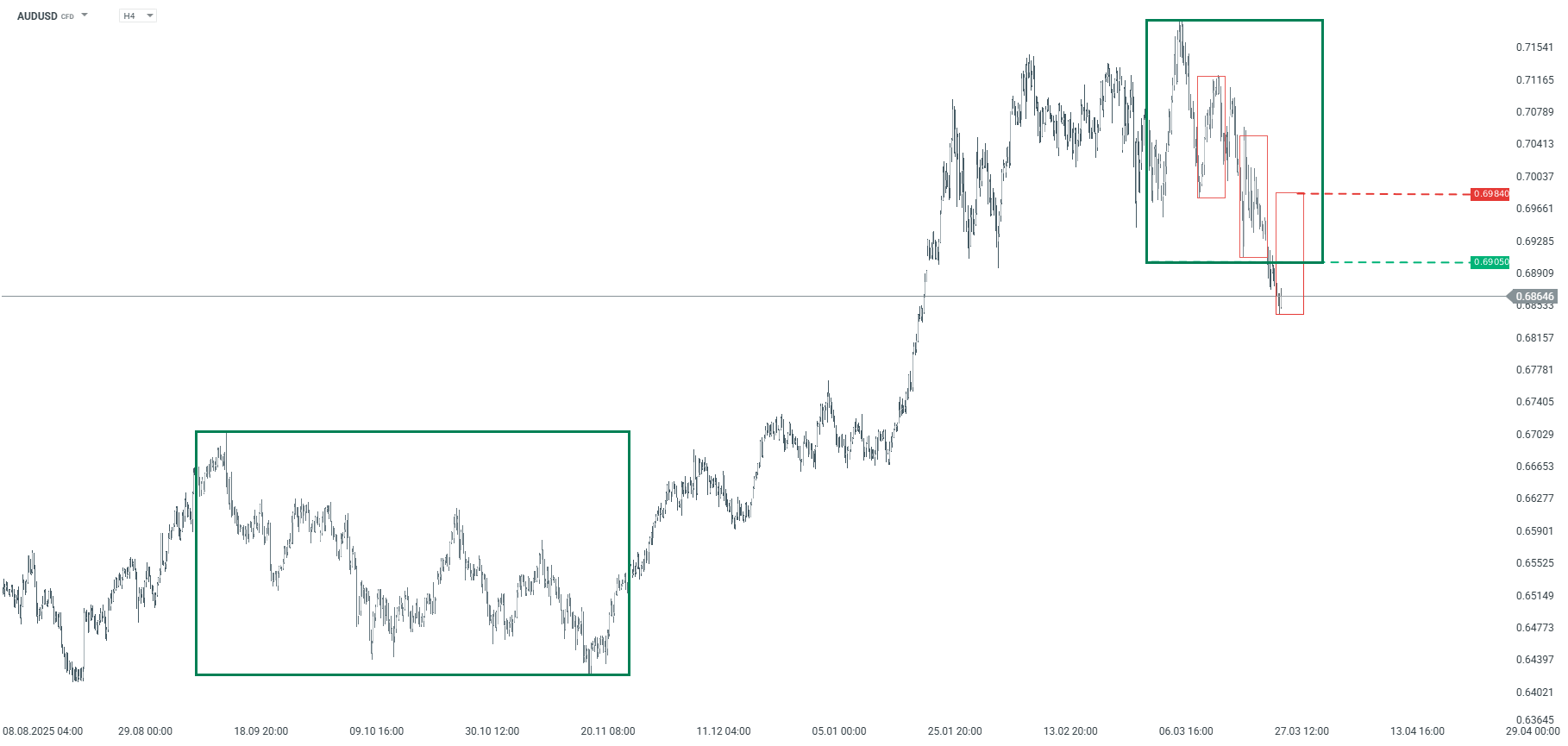
The AUDUSD price has broken below the key support level at 0.6905, which corresponded to the lower boundary of a broad 1:1 pattern. A break below this level could support a scenario involving a deeper correction or even a trend reversal. Currently, the 0.6905 level acts as key resistance. To signal a return to an uptrend, the price would need to additionally break above the 0.6984 level, where the upper boundary of the local 1:1 downtrend pattern is located.

AUDUSD – H4 chart. Source: xStation

The material on this page does not constitute financial advice and does not take into account your level of understanding, investment objectives, financial situation or any other specific needs. All information provided, including opinions, market research, mathematical results and technical analyzes published on the Website or transmitted To you by other means, it is provided for information purposes only and should in no way be construed as an offer or solicitation for a transaction in any financial instrument, nor should the information provided be construed as advice of a legal or financial nature on which any investment decisions you make should be based exclusively To your level of understanding, investment objectives, financial situation, or other specific needs, any decision to act on the information published on the Website or sent to you by other means is entirely at your own risk if you In doubt or unsure about your understanding of a particular product, instrument, service or transaction, you should seek professional or legal advice before trading. Investing in CFDs carries a high level of risk, as they are leveraged products and have small movements Often the market can result in much larger movements in the value of your investment, and this can work against you or in your favor. Please ensure you fully understand the risks involved, taking into account investments objectives and level of experience, before trading and, if necessary, seek independent advice.

Euro Heads for Over 2% Monthly Loss as Middle East Risks Weigh

March 30, 2026

The euro held steady at $1.15 by the end of March, poised for a monthly decline of over 2% against the US dollar. Traders offloaded riskier assets as concerns mounted over the economic fallout from the escalating Middle East conflict, with reports suggesting thousands of US troops were preparing for a potential ground operation, despite Washington’s insistence that diplomatic talks with Iran were progressing. Investors also turned their attention to a wave of key economic data due this week, including March inflation flash estimates from Europe’s major economies. Market sentiment has shifted sharply on ECB policy, with traders now pricing in at least two interest rate hikes this year and a growing possibility of a third, abandoning earlier expectations of a 40% chance of a rate cut in 2026.